
- The goal is to collect three complete property sets before your opponents — the first player to do so wins immediately.
- Each turn you draw two cards and may play up to three; hand management and knowing when to hold back are just as important as aggressive plays.
- Action cards like Deal Breaker and Just Say No can swing the game dramatically — track what’s been played and save your defences for high-stakes moments.
- Pay debts using your bank or property area only — cards held in hand cannot be used for payment.
- Monopoly Deal plays in 15–20 minutes, making it ideal for multiple rounds in a single session.
The Monopoly card game — officially called Monopoly Deal — strips the classic board game down to its most exciting elements and deals them out in a fast-moving, endlessly strategic card format. Whether you’re new to the table or looking to sharpen your edge against friends and whānau, this guide covers everything: setup, rules, hand management, advanced tactics, and the most common mistakes to avoid. Let’s get into it.
What Is the Monopoly Card Game?
Monopoly Deal was published by Hasbro and has become one of the most popular card games in New Zealand homes. Where the original board game can stretch on for hours, a full game of Monopoly Deal typically wraps up in 15–20 minutes — a massive draw for families and game-night regulars alike. The pace is sharper, the decisions are crunchier, and the scope for tactical play is surprisingly deep.
At its heart, Monopoly Deal is a property-collection race. You’re trying to assemble three complete property sets before anyone else does, using a deck that contains property cards, money cards, rent cards, and action cards. Every card in the deck has a monetary value printed on it, meaning even a card you don’t want to play can be banked as currency — a design choice that keeps every draw relevant.
If you enjoy fast-paced card games that reward planning, you’ll also want to check out our guides to Gin Rummy rules and UNO — both sit nicely in the same evening-entertainment bracket.
What’s in the Deck? Card Types Explained
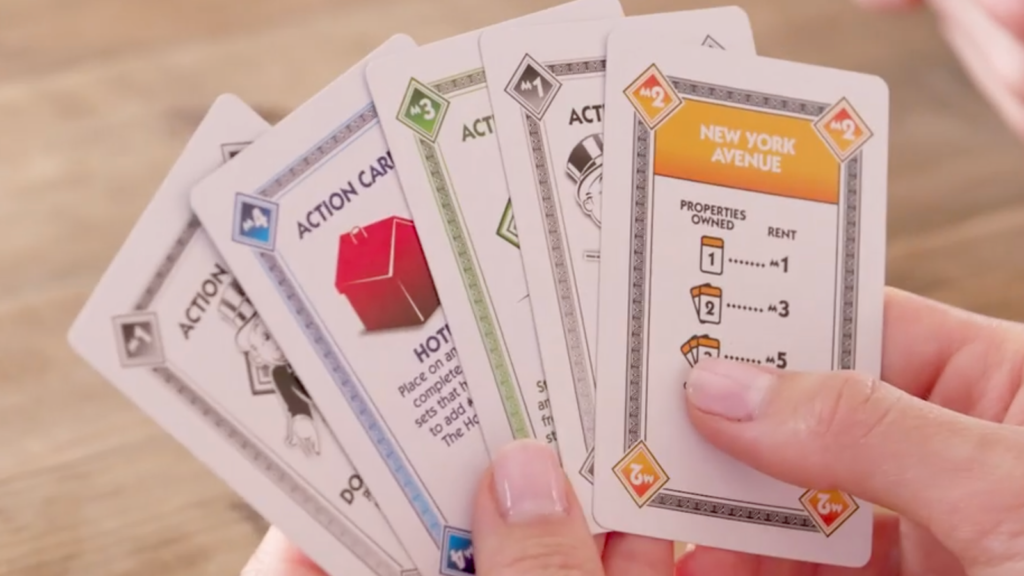
Before you play your first hand, it pays to understand what each card type does. The standard Monopoly Deal deck contains 110 cards, broken into four categories:
- Property cards: The core of the game. Each card belongs to a colour-coded set (brown, light blue, pink, orange, red, yellow, green, dark blue, and two railway/utility sets). Completing a full set means holding the correct number of cards in that colour.
- Money cards: Valued from $1M to $10M (in Monopoly millions). Played face-up into your bank to pay rent, fees, or card costs.
- Rent cards: Allow you to charge opponents rent based on the property sets you’ve built. Some rent cards target all players simultaneously; others target a single opponent.
- Action cards: The wild cards of the game. Include powerful moves like Deal Breaker (steal a complete set), Sly Deal (steal a single property), Debt Collector (charge one opponent $5M), It’s My Birthday (collect $2M from every player), and Just Say No (cancel any action played against you).
Wild property cards can be placed in any compatible colour group and can be moved between groups at the start of your turn — giving you flexible options as the game evolves.
How to Set Up Monopoly Deal
Setup is quick and straightforward:
- Shuffle the full 110-card deck thoroughly.
- Deal five cards face-down to each player. Players may look at their own hand immediately.
- Place the remaining deck face-down in the centre of the play area as the draw pile.
- Leave space beside the draw pile for a discard pile.
- Each player has two play areas in front of them: their bank (money cards played face-up) and their property collection (property cards arranged by colour group).
- Decide who goes first — youngest player, most recent winner, or a simple coin flip all work fine.
The game accommodates two to five players, though many fans feel the sweet spot is three or four — enough opponents to keep the action lively without the game becoming chaotic.
How to Play: Turn-by-Turn Rules
Play proceeds clockwise. On your turn, follow these steps in order:
- Draw two cards from the top of the deck and add them to your hand. If the deck runs out, reshuffle the discard pile to form a new draw pile. (Exception: if your hand is completely empty at the start of your turn, draw five cards instead of two.)
- Play up to three cards. You can play any combination of property cards, money cards, rent cards, and action cards — but no more than three in a single turn. You are never forced to play any cards; holding them is a valid strategy.
- Discard down to seven cards if your hand exceeds seven at the end of your turn. Place excess cards face-up on the discard pile.
Playing cards
- Property cards are placed face-up in your property area, arranged by colour group.
- Money cards are placed face-up in your bank.
- Action and rent cards are resolved immediately and then placed on the discard pile.
Paying debts
When you owe money — from rent, Debt Collector, It’s My Birthday, or similar — you must pay using cards from your bank first. If your bank doesn’t cover the full amount, you may pay with property cards valued at face value. You cannot pay with cards held in your hand. If you cannot pay the full amount, you simply give everything you have; the creditor cannot demand more.
Monopoly Deal is considered part of the broader tradition of trick-and-collection card games. For a deep dive into New Zealand’s card-playing heritage, the Te Ara entry on card, board games, and puzzles covers the fascinating history of these games in Kiwi culture — well worth a read as a companion to this game guide.
Winning the Game
The first player to lay down three complete property sets wins immediately — even if it’s in the middle of an opponent’s turn. You must announce your win clearly; the game does not continue once a valid winning position is on the table.
A complete set means holding the exact number of property cards required for that colour group:
- Brown and dark blue: 2 cards each
- Light blue, pink, orange, red, yellow, green: 3 cards each
- Railroads (black): 4 cards
- Utilities (grey): 2 cards
Crucially, a property set that has a House or Hotel card attached to it earns significantly higher rent — so building upwards is a legitimate path to victory, not just a cosmetic upgrade.
Monopoly Deal vs Similar Card Games
| Game | Players | Avg. Play Time | Complexity | Key Mechanic |
|---|---|---|---|---|
| Monopoly Deal | 2–5 | 15–20 min | Low–Medium | Property set collection |
| UNO | 2–10 | 20–30 min | Low | Card matching & hand depletion |
| Gin Rummy | 2–4 | 20–40 min | Medium | Meld building & knock |
| Solitaire | 1 | 10–20 min | Low | Sequential card arrangement |
| Blackjack | 2–7 | 5–15 min/round | Low–Medium | Hand value vs dealer |
Fancy exploring some of those alternatives? We’ve got full guides to Solitaire, Blackjack, and Gin Rummy right here on the site.
Hand Management and Banking Strategy
How you manage your hand and bank is often more decisive than the cards you’re dealt. Here are the key principles:
Bank smart, not just safe
Every card in Monopoly Deal carries a face monetary value — including rent and action cards. If you have no immediate use for a card, banking it is perfectly valid. However, be aware that a large, visible bank makes you a juicy target for Debt Collector and It’s My Birthday cards. Keeping your bank moderate — enough to cover typical rent demands — is generally wiser than hoarding cash.
Hold defensive cards wisely
Just Say No cards are among the most powerful in the deck. There are only three in the full 110-card deck, so if you’re holding one, think carefully before spending it. Save it for genuinely game-changing threats like a Deal Breaker targeting your complete set, rather than a modest rent charge you could absorb from your bank.
Don’t over-commit early
Playing all three of your allotted cards every turn can feel productive, but it can leave your hand thin and defenceless. Sometimes playing one or two cards and banking the rest gives you the flexibility to respond to whatever your opponents throw at you next round.
Advanced Strategy Tips
Once you’ve got the basics down, these tactics will separate you from casual players:
- Diversify your property targets early. Going all-in on a single colour set makes you predictable and easy to disrupt. Spreading your initial builds across two or three colour groups forces opponents to cover more ground when deciding whom to attack.
- Track action cards. Pay attention to what’s been played and discarded. If you’ve seen both Sly Deal cards go to the discard pile, you can build your sets with a little more confidence.
- The low-bank bluff. Keeping very little money visible in your bank can discourage opponents from playing high-rent or Debt Collector cards against you — they know you’ll have to pay with properties, which may not be worth the disruption to their own strategy. This is only effective situationally; don’t let your bank run so low that you genuinely can’t cover small payments.
- Target the leader. If one player is one set away from winning, everyone at the table has an incentive to slow them down. Don’t be shy about coordinating informal pressure — use your action cards on the player closest to victory, not the player who annoyed you last turn.
- Wild cards are mobility, not commitment. Remember that wild property cards can be reassigned at the start of your turn. Build flexibility into your property layout so you can pivot if an opponent steals from one of your groups.
If you enjoy the strategic depth here, the kind of decision-making involved shares DNA with games like poker. Our piece on mistakes every poker beginner needs to avoid has transferable lessons about patience, reading opponents, and knowing when to hold back.
Common Mistakes to Avoid
Even experienced players slip up on these:
- Forgetting to draw five when your hand is empty. It’s easy to miss — the default rule is draw two, but an empty hand at the start of your turn earns you five cards.
- Paying rent from your hand. You can only pay debts using cards already in your bank or your property area. Cards in hand are off-limits for payment purposes.
- Playing a Just Say No on a Just Say No. Yes, this is legal — you can counter a counter — but burning two defensive cards in one exchange is rarely worth it unless the original action would cost you the game.
- Ignoring the hand limit. Finishing your turn with more than seven cards means discarding the excess. Many new players forget this until they’re sitting on a fortress hand, which isn’t actually allowed.
- Completing a set then leaving it unprotected. A complete set can still be targeted by Deal Breaker right up until you win. Don’t relax once you hit two complete sets — keep your defences active.
Frequently Asked Questions
How many cards do you start with in Monopoly Deal?
Each player is dealt five cards at the start of the game. On each subsequent turn, players draw two cards from the draw pile at the beginning of their turn — or five cards if their hand is completely empty at that point.
Can you use a Just Say No card against another Just Say No?
Yes, absolutely. If an opponent plays a Just Say No to cancel your action, you can play your own Just Say No to cancel theirs — effectively reinstating your original action. This chain can continue as long as players have Just Say No cards to play, though with only three in the deck it rarely goes more than two rounds.
What happens if you can’t pay the full rent amount?
If you don’t have enough in your bank or property area to cover the full amount owed, you simply pay everything you have. The creditor receives whatever you can give — they cannot demand more, and you are not eliminated from the game. You continue playing from whatever position you’re left in.
Can wild property cards be stolen?
Yes. Wild cards placed in your property area can be stolen by Sly Deal or Deal Breaker cards just like any other property card. The only protection is a Just Say No card. Wild cards held in your hand, however, cannot be targeted — only cards already on the table are vulnerable.
How long does a game of Monopoly Deal usually take?
Most games wrap up in 15 to 20 minutes, which is a big part of its appeal. With experienced players who know the cards well, games can occasionally finish faster. It’s quick enough to play several rounds back-to-back in a single evening, making it a brilliant choice for game nights of any size.
