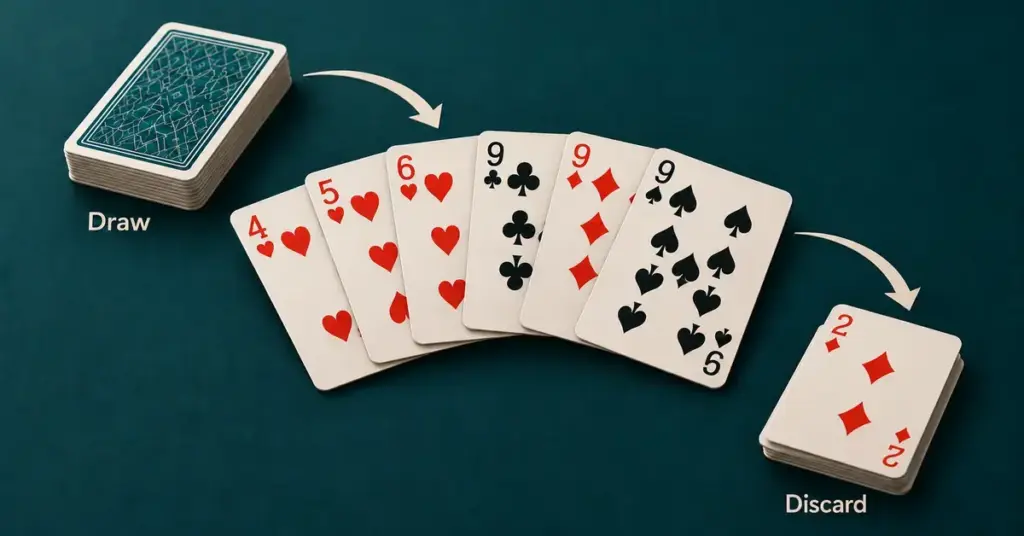
Rummy is not a single game but one of the world’s largest families of card games, united by one simple idea: draw a card, improve your hand, then discard a card you no longer need. From a quiet two-player match at the kitchen table to large social gatherings, rummy games are among the most played in New Zealand because they are easy to learn in minutes yet reward memory, observation and calculated risk. This guide explains what the rummy family has in common, how the core rules work, and how the best-known variants differ, so you can pick the version that suits your table.
Key Points
- What it is: a large family of draw-and-discard card games, not one fixed game.
- Goal: arrange your whole hand into melds — sets and runs — before your opponents.
- Deck: a standard 52-card deck for most versions (two decks for Canasta and Indian Rummy).
- Typical deal: 10 cards for two players, 7 for three or four, 6 for five or six.
- Scoring: unmatched "deadwood" counts against you — aces 1, number cards face value, face cards 10.
- Best known variants: Gin Rummy, Rummy 500, Canasta and Indian Rummy.
What rummy is and where it comes from
Every rummy game shares the same engine. You hold a hand of cards and try to arrange them into valid combinations — called melds — by drawing and discarding one card each turn. The first player to turn their whole hand into melds wins the deal, and the cards left stranded in the other players’ hands are counted against them as penalty points.
The family is old and its exact origins are debated. Games historian David Parlett traces modern rummy back to a Mexican game called Conquian, first recorded in the mid-19th century, which in turn may share roots with the draw-and-discard card games of China. The name itself is usually linked to the old British slang word "rum", meaning odd or peculiar. Whatever the true history, the format proved so flexible that dozens of variants emerged through the 20th century, including Gin Rummy, 500 Rum, Canasta and the 13-card game popular in India.
The core rules every rummy game shares
If you understand one rummy game, you are most of the way to understanding them all. The differences between variants are mostly about how many cards you hold, when you lay your melds down, and how the points are counted. The underlying turn — draw, meld, discard — stays the same. For a full step-by-step walkthrough of a standard game, see our detailed guide on how to play rummy.
The deal and the two piles
Basic rummy uses a standard 52-card deck. The number of cards dealt depends on how many people are playing:
- 2 players: 10 cards each
- 3 or 4 players: 7 cards each
- 5 or 6 players: 6 cards each
The remaining cards are placed face down to form the stock (the draw pile). The top card is turned face up next to it to start the discard pile. On your turn you take one card — either the unknown top card of the stock or the visible top card of the discard pile — and you always end your turn by placing one card onto the discard pile. Drawing from the discard pile tells your opponents something about what you are collecting, while drawing from the stock keeps your plan hidden but leaves it to chance.
Sets, runs and valid melds
There are only two kinds of meld in almost every rummy game, and learning to spot them quickly is the heart of the game:
- Set (also called a group or book): three or four cards of the same rank, such as three Sevens or four Queens. The suits do not matter.
- Run (also called a sequence): three or more consecutive cards of the same suit, such as the 4, 5 and 6 of hearts.
In standard rummy the ace is low, so a valid ace run is A-2-3. The ace cannot usually "wrap around", which means a sequence like K-A-2 is not allowed. Some house rules let the ace count high (Q-K-A) instead — it is worth agreeing which before the first deal. In many variants you may also lay off cards, meaning you add a matching card from your hand to a meld already on the table, which is a quick way to shed cards late in a round.
Going out, deadwood and scoring
You "go out" when you can arrange your entire hand into melds and discard your last card. The round then ends and the other players tally the cards still trapped in their hands. These unmatched cards are known as deadwood, and in the standard game they are valued like this:
- Aces: 1 point
- Number cards: their face value (a Seven is worth 7)
- Face cards (Jack, Queen, King): 10 points each
The winner of the deal scores the total deadwood collected from everyone else. Play continues over several deals until a player reaches an agreed target — often 100 points, or a set number of rounds. Because high cards cost the most if you are caught holding them, experienced players tend to discard unmatched Kings, Queens and Jacks early, provided they are not handing an opponent the exact card needed to finish a meld.
The main rummy variants
The table below compares the most common members of the rummy family. Each variant keeps the draw-and-discard core but changes the hand size, the scoring or the equipment, which is what gives each one its own character.
Rummy Variants Compared
| Variant | Players | Cards dealt | What makes it different |
|---|---|---|---|
| Basic Rummy | 2–6 | 10 / 7 / 6 | The standard game; lay melds down as you form them. |
| Gin Rummy | 2 | 10 each | Hidden hand; end the round by knocking at 10 or fewer deadwood points. |
| Rummy 500 | 2–8 | 7 each | Score the value of melded cards; play to 500 points. |
| Indian Rummy | 2–6 | 13 each | Two decks and jokers; at least one pure run is required. |
| Canasta | 2–6 | 11–15 | Two decks; build seven-card melds called canastas with wild cards. |
| 5 Crowns | 2–7 | varies by round | Special five-suit deck with a changing wild card each round. |
Gin Rummy
Gin Rummy is the famous two-player version, with each player dealt 10 cards. Unlike basic rummy, you keep your melds hidden in your hand rather than laying them on the table. Instead of melding as you go, you end the round by "knocking" — which you may do once your deadwood total is 10 points or less — or by going "Gin" with zero deadwood for a bonus. If the player who knocks turns out to have more deadwood than their opponent, the opponent "undercuts" them and takes the bonus instead. Bonus values vary by table: a gin or an undercut is commonly worth 25 points, though some groups use 20 or 10, so confirm the scale first. For the full picture, read our guide to Gin Rummy strategy.
Rummy 500 (500 Rum)
Rummy 500 is a popular multi-player cousin, usually dealt 7 cards each. Its signature twist is that you score the point value of the cards you have melded, rather than simply racing to empty your hand, and you may sometimes take several cards at once from the discard pile. As the name suggests, the game runs until someone reaches 500 points. This scoring style makes holding and building bigger melds worthwhile, changing the risk calculation compared with basic rummy.
Other games in the rummy family
Several other popular games follow the same principles with their own equipment and goals:
- Indian Rummy is a 13-card game played with two decks and jokers, where forming at least one pure (joker-free) run is compulsory.
- Canasta uses two decks and builds large seven-card melds called canastas, with jokers and twos acting as wild cards.
- 5 Crowns is a commercial rummy-style game played with a special five-suit deck and a changing wild card each round.
Simple strategy and common mistakes
Rummy blends luck and skill. You cannot control the cards you draw, but good habits steadily tip the odds in your favour over many deals.
Habits that help you win
- Clear high cards early if they are not close to forming a meld, so you are not caught with heavy deadwood.
- Watch the discard pile. Noticing which cards your opponents pick up reveals what they are building, and lets you avoid feeding them.
- Keep flexible cards. A card that could join either a set or a run gives you more ways to complete a meld.
- Track what is gone. If the cards you need have already been discarded, change plans early rather than waiting in hope.
Common beginner mistakes
- Holding on to high scoring cards "just in case" for too long.
- Discarding a card an opponent has clearly been collecting.
- Drawing from the discard pile when it gives away your whole strategy for little gain.
- Forgetting to agree the ace value and target score before play begins, which causes disputes later.
Who rummy suits and how to get started
One of the reasons rummy has lasted for well over a century is how easily it scales to the group in front of it. A two-player game is quick, tense and strategic, which is why Gin Rummy became a classic for couples and travellers. Larger versions like Rummy 500 and Canasta work well for family gatherings, while the 13-card Indian Rummy is a social staple for bigger groups. Because the core turn is so simple, children and newcomers can usually join a basic game within a single round, yet the memory and probability elements keep it interesting for experienced players.
Getting started needs very little: a standard 52-card deck, a flat surface and at least one other player. Before dealing, agree three things as a table — which variant you are playing, whether the ace is low or high, and the target score that ends the match. Settling these up front avoids the most common arguments and lets everyone focus on the play. Once you are comfortable with the basics covered here, the dedicated guides on individual variants will take you deeper into their particular scoring and tactics.
Rummy also travels well to screens. Most variants are available as free apps and browser games against the computer or other people online, which is a low-pressure way to practise reading the discard pile and recognising melds quickly before you sit down at a physical table. Treat these as practice and entertainment; the skills you build — tracking cards and weighing the odds of a draw — carry straight back to the kitchen-table game.
Sources
Frequently Asked Questions
How many cards do you deal in rummy?
In basic rummy with a single 52-card deck, deal 10 cards each for two players, 7 cards each for three or four players, and 6 cards each for five or six players. Variants differ: Gin Rummy always deals 10, Rummy 500 usually deals 7, and Indian Rummy deals 13.
What is the difference between a set and a run?
A set is three or four cards of the same rank in any suits, such as three Nines. A run is three or more consecutive cards of the same suit, such as the 5, 6 and 7 of clubs. Both count as valid melds.
What counts as deadwood in rummy?
Deadwood is any card left in your hand that is not part of a valid set or run when the round ends. It is counted against you: aces score 1, number cards their face value, and face cards 10 points each.
Is rummy a game of luck or skill?
It is both. The cards you are dealt and draw are down to luck, but deciding what to keep, what to discard and when to end the round rewards memory and judgement, which is why skilled players win more often over many deals.
What is the main difference between rummy and Gin Rummy?
In basic rummy you lay your melds on the table as you form them, while in Gin Rummy you keep your hand concealed and end the round in one move by knocking or going Gin. Gin Rummy is also strictly a two-player game.