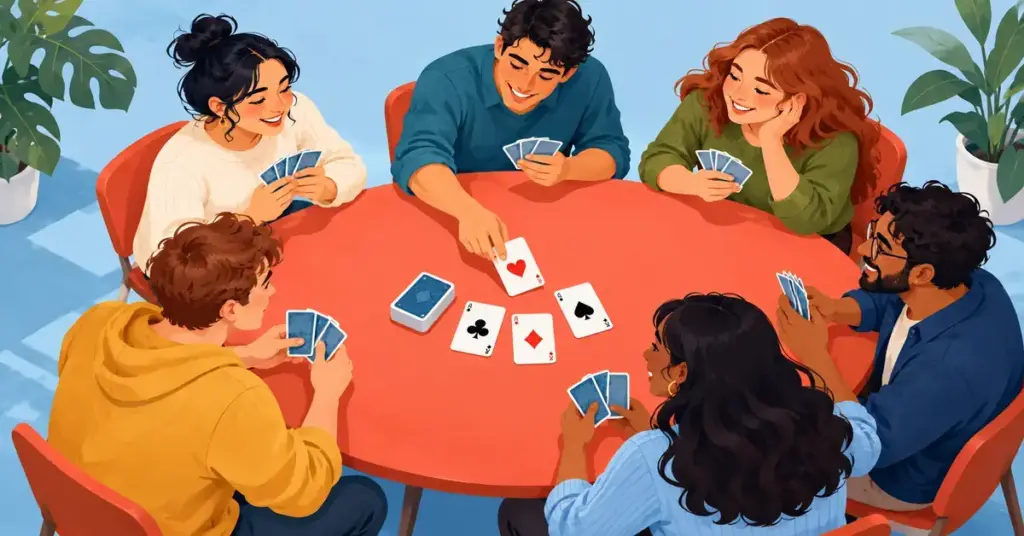
A good card game can turn any gathering — a birthday, a family get-together or a casual Friday night with friends — into something everyone remembers. The trick is choosing a game that actually suits the number of people at the table. This guide groups the most reliable card games for groups by style and player count, with verified player numbers, playing times and age guidance, plus notes on where to buy them in New Zealand. The aim is simple: help you walk into any get-together already knowing what to deal.
Key Points
- Choose group card games that scale well, teach in under five minutes and keep every player involved rather than knocking people out early.
- Base-game player counts matter: Exploding Kittens is 2–5 (the Party Pack edition reaches 10), while Dobble, Sushi Go! Party and Taco Cat Goat Cheese Pizza each play 2–8.
- A standard 52-card deck covers Hearts, Spades, Poker, Snap and Ring of Fire — the best-value option for any household.
- Match the game to your group: party, competitive, cooperative, family or quick, and rotate styles across the night to keep things fresh.
- NZ retailers including Mighty Ape, The Warehouse, Paper Plus and Toyworld stock group card games, with Trade Me useful for second-hand and out-of-print copies.
What makes a card game work for a group
Not every card game scales well. A game that shines with four players can stall badly at ten. Before you shuffle anything, it helps to understand what separates a game that keeps a crowd involved from one that leaves half the table waiting.
Qualities to look for
- Scalable player count: The most group-friendly games support six or more players, or combine two copies to go higher, without slowing to a crawl.
- Short rules explanation: Games that can be taught in under five minutes keep energy high. Nobody wants a rulebook read aloud at 9 pm.
- Fast or simultaneous turns: Long gaps between turns kill momentum. Games where everyone acts at once, or where turns are quick, hold attention.
- Low downtime for eliminated players: Games that knock people out early leave them watching from the couch; round-based scoring keeps everyone in.
- Replayability: A single box or deck that plays differently each night offers far more use than a one-trick game.
It also pays to match the game to your crowd. A room of competitive strategy fans wants something different from a group of relaxed first-timers. Getting the complexity and tone right for the people present is half the work.
Party card games for six or more players
Party card games rely on interaction, quick turns and the flexibility to absorb whoever arrives late. These titles are built for noise and numbers.
Popular party picks
- Exploding Kittens: A fast, elimination-style game. The base game is designed for 2–5 players and runs about 15 minutes; the separate Party Pack edition extends the same game to larger tables of up to 10. Easy to teach and widely available in NZ. See our full Exploding Kittens rules and strategy guide for setup and card effects.
- What Do You Meme?: Players pair a photo card with caption cards and a rotating judge picks a winner each round, so the player count is flexible and nobody is eliminated.
- Taco Cat Goat Cheese Pizza: A reflex and pattern-spotting game for 2–8 players that most people pick up in under a minute. Rounds last roughly 10 minutes. Read the full Taco Cat Goat Cheese Pizza guide for the exact sequence and slap rules.
- Unstable Unicorns: A tactical card game for 2–8 players, rated 14+, where you build a stable of unicorns while disrupting your opponents. Games run 30–45 minutes, so it suits a settled adult or teen table more than a quick warm-up.
The common thread for party games is accessibility. Keep the explanation short, make sure there is enough interaction to spark conversation, and lean on games where the fun comes from the people as much as the cards.
Competitive group card games
Sometimes a group wants a clear winner. Competitive card games reward strategy, memory and a well-timed bluff.
Strong competitive options
- Poker: The best-known competitive card game. Texas Hold’em in particular works well at a larger home table once you have enough chips. Brush up on hand rankings and betting rounds in our beginner’s poker guide and the detailed Texas Hold’em rules before game night.
- Spades: A partnership trick-taking game that rewards communication and planning, usually played by four in two teams. Our Spades rules guide covers bidding, the nil bid and scoring.
- Cabo: A memory and card-swapping game where the lowest total score wins. It is a smaller-table game — most editions play 2–4 players (some newer printings up to 5) in about 30–45 minutes — so it suits a focused group rather than a large crowd.
For competitive play, agree the house rules before you start. Settle the stakes (bragging rights are fine), the number of rounds and the scoring system up front. A little structure keeps the edge friendly rather than fractious.
Team and cooperative group card games
Team and cooperative games add a social layer: you are invested in your partners’ decisions as much as your own, and shared wins land harder than solo ones.
Games worth trying
- Hearts: A classic four-player trick-avoidance game with well-known partnership variants. Our Hearts rules guide covers scoring and ‘shooting the moon’.
- Codenames (card and board editions): Splits the group into two teams; clue-givers try to lead their team to the right cards using one-word hints. It handles larger numbers because spectators can still guess. See the Codenames rules guide for setup.
- The Mind: A cooperative game for 2–4 players in which the group plays numbered cards in ascending order without speaking. It is small-count and tense rather than a big-party game, but excellent for a quiet, focused table.
Team games work especially well with mixed skill levels, because stronger players can guide newcomers naturally. They also create collective moments — the whole table reacting at once when a risky play comes off.
Card games for adult gatherings
Adult group games — including drinking games — are a staple of social nights. They work best when everyone agrees in advance on how they want to play.
Adult group favourites
- Ring of Fire (Kings): Played with a standard deck, each card drawn triggers a rule. It scales to large groups and needs no special purchase.
- Higher or Lower: A simple guessing game that moves fast and fills a room with groans and cheers.
- Never Have I Ever (card edition): The boxed version supplies prompts so nobody has to invent statements on the spot.
If you would rather play remotely or want printable versions, our guide to drinking games online covers options for a digital night. Whatever you play, keep it responsible: drink within your limits, never pressure anyone, make non-alcoholic options available, and make sure everyone has a safe way home. These games are optional entertainment, not a challenge.
Family-friendly group card games
The best family games bridge generations — engaging for teenagers without overwhelming younger children.
Family picks by age
- Uno (ages 7+): The go-to for accessible family play — simple for children, competitive enough for adults. See the UNO rules and house-rule guide for scoring and the much-debated stacking rules.
- Skip-Bo (ages 7+): A sequencing game that quietly reinforces number order while staying genuinely competitive. Full rules are in our Skip-Bo guide.
- Sushi Go! Party (ages 8+): A card-drafting game for 2–8 players with friendly artwork; a game takes about 20 minutes and scales smoothly across the range.
- Rummikub (card version, ages 8+): A run-and-group matching game that grandparents and grandchildren can enjoy on roughly equal terms.
For family gatherings, prioritise colourful visuals, minimal reading for young players and short rounds that survive a snack break. Keeping a couple of backup games nearby helps — children’s appetite for ‘one more round’ is hard to predict. For more options by age, see our kids’ card games guide.
Quick group card games under 20 minutes
When time or patience is short, speed matters. These fill a gap or warm up a longer night.
Fast games that respect the clock
- Snap: Pure reflex, maximum noise and zero setup. Our Snap rules cover the standard and ‘speed’ variants.
- Slapjack: A fast cousin of Snap built around racing to slap the jacks. See the Slapjack guide for the full rules.
- Skull: A bluffing game for 3–6 players that creates heavy tension from a handful of cards in about 15–45 minutes.
- Dobble (Spot It!): A visual matching game for 2–8 players, ages 6+, that runs around 15 minutes and includes several mini-games in one tin.
Quick games double as icebreakers at the start of an evening, loosening the table up before you move to something heavier. It is worth keeping two or three in your collection for exactly that purpose.
Group games you can play with a standard deck
You do not need a specialist box to run a great game night. A single 52-card deck covers a surprising amount of ground, which makes it the best-value option for most households.
- Hearts and Spades: Trick-taking classics for four, with partnership variants for teams.
- Poker: From casual five-card draw to Texas Hold’em, a deck and some tokens are enough to start.
- Ring of Fire: A full party game built entirely around the standard deck.
- Snap, Slapjack and Higher or Lower: Instant, rules-light games anyone can join.
If you are regularly four at the table, our guide to 4-player card games lists more standard-deck options worth learning.
Strategy and etiquette tips for group game nights
A few habits improve almost any group session, whatever you play:
- Read the room: Match the game to the energy — something loud after dinner, something slower for a quiet evening.
- State house rules first: Write them down if needed. House rules only cause arguments when they are assumed rather than agreed.
- Rotate who chooses: Letting a different person pick each round gives everyone a stake in the night.
- Use team variants: Standard games such as Hearts and Spades have team versions that change the dynamic for larger groups.
- Keep backups ready: Not every game suits every group; two or three options prevent an awkward dead end.
Where to buy group card games in New Zealand
New Zealand has a solid range of retailers for card games, in store and online.
General retailers
- Mighty Ape: A large NZ-based online retailer with a wide catalogue and nationwide shipping.
- The Warehouse: Reliable for staples such as Uno, Skip-Bo and Exploding Kittens at everyday prices.
- Paper Plus and Toyworld: Good for family titles and often carry new releases ahead of other general stores.
Specialty and second-hand
- Specialty tabletop stores: Shops in the main centres (Auckland, Wellington and Christchurch) carry deeper catalogues and staff who can recommend titles. Stock and opening hours change, so check a store’s current website or listing before visiting.
- Trade Me: Useful for second-hand copies and out-of-print editions. See our guide to buying and selling on Trade Me for tips on checking listings.
Buying from NZ-based retailers generally means faster delivery and easier returns than importing.
Quick comparison of popular group card games
The table below collects verified player counts, playing times and recommended ages so you can match a game to your group at a glance. Figures are for the base game unless noted.
Game Comparison
| Game | Players (base game) | Play time | Age | Best for |
|---|---|---|---|---|
| Exploding Kittens | 2–5 (Party Pack up to 10) | ~15 min | 7+ | Fast party rounds |
| Taco Cat Goat Cheese Pizza | 2–8 | ~10 min | 8+ | Reflex / icebreaker |
| Dobble (Spot It!) | 2–8 | ~15 min | 6+ | Quick family play |
| Sushi Go! Party | 2–8 | ~20 min | 8+ | Families & mixed groups |
| Unstable Unicorns | 2–8 | 30–45 min | 14+ | Adult / teen tables |
| Skull | 3–6 | 15–45 min | 10+ | Bluffing & tension |
| Poker (Texas Hold’em) | 2–10 | 60+ min | Adults | Competitive play |
| Cabo | 2–4 (some editions 5) | 30–45 min | 8+ | Smaller focused groups |
| The Mind | 2–4 | ~20 min | 8+ | Cooperative play |
| Ring of Fire | 4+ (standard deck) | 30–60 min | 18+ | Large adult parties |
Sources
Frequently Asked Questions (FAQ)
What is a good card game for a large group of eight or more?
For eight or more, look for games with fast or simultaneous turns so nobody sits idle. Dobble (Spot It!) and Sushi Go! Party both handle up to eight. For bigger crowds, Ring of Fire with a standard deck scales as far as the table allows, and the Exploding Kittens Party Pack edition is designed for up to ten. You can also combine two copies of some card games to raise the limit.
Which card games suit mixed ages at a family gathering?
Uno is the usual answer: accessible from about age seven and still competitive enough to hold adult attention. Sushi Go! Party (ages 8+) pairs simple card-drafting with friendly artwork, and Skip-Bo (ages 7+) teaches number order while staying genuinely tense. All three scale across a range of players and keep rounds short.
Are there good group games that use only a standard 52-card deck?
Yes. A single deck covers Poker, Spades, Hearts, Snap, Slapjack, Higher or Lower and Ring of Fire, among others. Learning a handful of these is the best-value way to be ready for any group, since one inexpensive deck supports dozens of different games.
How do I choose between competitive and cooperative group games?
Think about your group’s mood. Competitive games such as Poker or Spades suit tables that enjoy friendly rivalry and a clear winner. Cooperative games such as The Mind work when you want everyone included and the night to end on a shared high. Many groups simply rotate between the two across an evening.
Where can I find the rules for classic group card games?
Card-games.nz has detailed, beginner-friendly rules pages covering everything from Spades and Hearts to Poker and Uno. Most include variations, scoring and tips for teaching new players — handy to have on your phone when someone asks how bidding works just before the game starts.