

Monopoly Deal is a card game based on the traditional Monopoly game, designed to be quicker and more strategic. It focuses on using strategy and making quick decisions, with each turn offering new opportunities.
Understanding the Monopoly card game
The goal of the Monopoly card game is to collect three full property sets before your opponents. Players use cards to build properties, charge rent, and disrupt opponents’ progress. The game focuses on strategy and quick decision-making, requiring players to adapt their tactics based on the cards they hold and the actions of others.
Unlike the original board game, Monopoly Deal is all about short-term strategy and fast thinking, making each turn an opportunity to gain an advantage.
Setting up the Monopoly card game
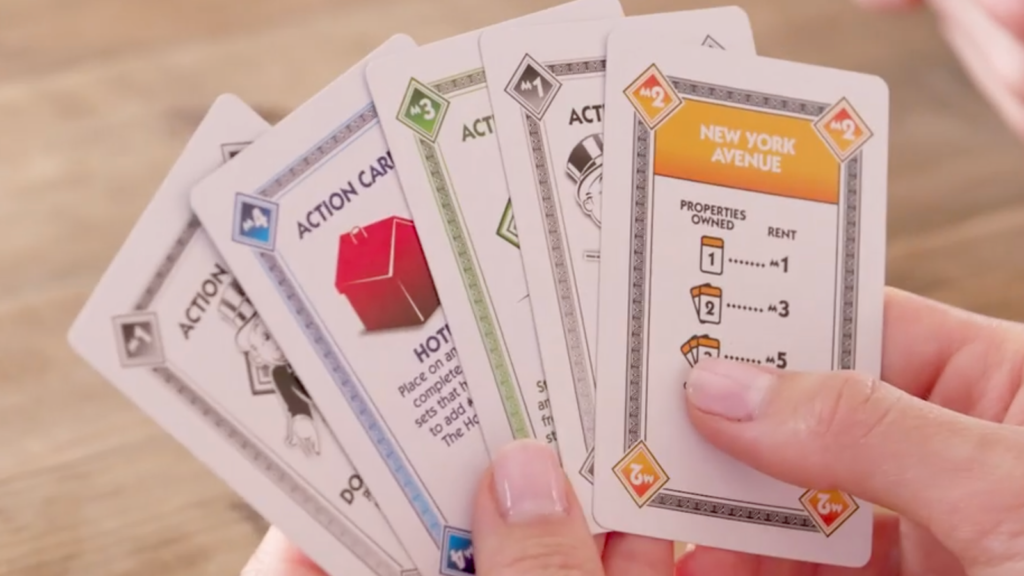
To set up the Monopoly card game, each player is dealt five cards from the shuffled deck. Players will take turns drawing cards from the deck, using them to either play or take actions to build their property sets. A game can be played by two to five players, making it versatile for different group sizes. The deck consists of property cards, action cards, rent cards, and money cards, each serving a unique purpose.
Property cards are used to build sets, rent cards charge opponents for property use, and money cards are used to pay for rent or actions. Action cards allow players to perform special moves, such as stealing properties or forcing opponents to pay.
The dealer may explain the basic rules before starting, ensuring all players are familiar with the gameplay and objectives. This initial understanding helps keep the game smooth and enjoyable for everyone involved.
Gameplay and turns
In Monopoly Deal, players take turns in a clockwise direction, with each turn providing an opportunity to draw and play cards strategically. At the start of their turn, players draw two cards from the deck, adding to their hand. They can then play up to three cards from their hand in the Monopoly card game, making decisions based on the cards they have available. Actions include adding property cards to their collection, charging rent to other players, or using action cards that can either help them advance or disrupt their opponents’ progress.
Rent is charged according to the properties a player holds, with higher-value property sets yielding larger rent charges. Rent cards can be played to collect money from other players, depending on the properties in the player’s collection. Money cards are used to pay rent or to cover costs from action cards, such as paying a fee or defending against attacks. Action cards can range from stealing properties to forcing opponents to discard cards, adding an element of surprise and strategy to the game.
The turn order is straightforward, allowing players to focus on managing their hand and planning ahead. As players strategise, they must decide whether to build their property sets, charge rent, or hold onto cards for defensive purposes. The simplicity of the turn structure makes the Monopoly card game quick to learn, while the variety of cards ensures that each turn is an opportunity to outmanoeuvre your opponents.
Managing your hand and bank
Your hand is essential for success in Monopoly Deal, as it holds the cards you use to perform actions, build your property sets, and defend your assets. Managing your hand effectively is crucial. You can store cards as money in your “bank” to pay for rent or card costs. Players can choose whether to hold on to cards for future use or use them immediately to progress their position. However, be cautious not to use all your cards too quickly, as you’ll need them to defend against attacks or increase your property value.
Winning the game
The objective of Monopoly Deal is to collect three complete property sets, each consisting of at least three properties in different colours. You must also complete these sets before your opponents do to win. The game ends once one player has successfully assembled their three property sets. This player is declared the winner, having outlasted their rivals through strategic plays and calculated decisions.
Keep in mind that some properties come with higher values or special actions, such as the ability to charge higher rent or protect assets, which can help speed up or delay progress toward this goal. Players must also be mindful of action cards that could alter the course of the game, such as forcing others to give up properties or disrupting property sets. Success requires balancing the speed of building your sets with the need to defend against others’ strategies.
Advanced strategies
Mastering Monopoly Deal requires more than just luck; it demands careful strategy. One advanced strategy involves managing your property sets. Instead of focusing on one colour, consider diversifying your property collection. This allows you to protect your assets by having properties spread across different colours. Another strategy involves keeping track of action cards in other players’ hands. By doing this, you can predict when an opponent might target you with an action card and adjust your defences accordingly. Understanding the timing of when to charge rent or when to hold onto cards for defence is crucial.
Advanced Strategy: The “2026 Pro Meta”
While many view Monopoly Deal as a game of luck, high-level players in the New Zealand competitive circuit use specific mathematical “meta-plays” to control the pace of the game.
The “Empty Bank” Trap
One of the most effective advanced strategies is intentionally keeping your bank low. By having only a small amount of cash visible, you discourage opponents from playing high-rent cards against you, as they know you will be forced to pay with properties they might not want or cannot legally take (e.g., if it breaks their own sets). Conversely, “over-banking” makes you a target for Debt Collector and It’s My Birthday cards.
The “Sly Deal” Holding Pattern
Professional players rarely play a Sly Deal or Forced Deal early in the game. These cards are best used as “finishers” to take the final card of an opponent’s set exactly when you have the other pieces ready in your hand to play immediately. This prevents the opponent from having a turn to “steal back” their property.
Managing the “Just Say No” Economy
In a standard 110-card deck, there are only three Just Say No cards. Tracking these is vital. If you know two have been discarded, your Deal Breaker becomes nearly unstoppable. 2026 strategy suggests holding a Just Say No specifically to protect a full set from a Deal Breaker, rather than wasting it on minor rent charges.
Monopoly Deal vs. Monopoly Bid vs. Monopoly Knockout
The Monopoly “Card Game” family has expanded significantly. In 2026, New Zealanders often choose between these three distinct versions depending on the group’s dynamic.
| Game Version | Mechanics | Best For | Average Play Time |
| Monopoly Deal | Set collection & “Take-that” actions. | Strategy lovers & quick sessions. | 15 Minutes |
| Monopoly Bid | Blind auctions and card bidding. | Groups who enjoy bluffing and risk. | 20 Minutes |
| Monopoly Knockout | Dexterity-based sliding/aiming cards. | Active family nights and younger kids. | 10 Minutes |
2026 NZ Retail & Price Guide
Monopoly Deal remains one of the most affordable “filler” games in the country. Prices have remained stable into 2026 across major Kiwi retailers.
The Warehouse: Frequently the cheapest at $4.00 – $6.00 NZD.
Toyworld: Standard retail price sits at $5.99 NZD.
Woolworths/Countdown: Often found in the “Toys/Games” aisle for $6.00 NZD.
Mighty Ape: Usually priced around $7.00 NZD but offers themed versions like Monopoly Deal: Harry Potter for $9.00 – $12.00 NZD.
Custom “Hard Mode” Variations for Kiwi Groups
If your social circle finds the base game too easy, these 2026 “Hard Mode” variants are popular in New Zealand gaming clubs:
The 5-Set Marathon: Change the winning condition from 3 sets to 5 sets. This significantly increases the value of banking and long-term property management.
Taxation Turn: Every time a player plays a Pass Go card, they must also pay $1M into a central “Pot.” The next person to play a Debt Collector takes the entire pot.
No Hand-Flip: Once a wild card is placed in a set on the table, it cannot be flipped to the other color until your next turn, making your sets more vulnerable for one full round.
FAQs
What happens when the Monopoly Deal draw pile runs out of cards?
When the draw pile runs out of cards, the Monopoly card game continues with players only drawing from the face-up discard pile. Players can still take actions and play cards as usual. Once all cards are exhausted, no further actions can be taken, and the game may end if a player has completed their property sets.
Can I ever put cards back in my hand?
No, once cards are played in Monopoly Deal, they cannot be returned to your hand. Any cards used for properties, actions, or money are placed in front of you or the bank and remain there for the remainder of the Monopoly card game.
How many people can you play Monopoly Deal with?
Monopoly Deal is designed for 2 to 5 players. The more players involved, the more dynamic and challenging the game becomes. It can also be played with larger groups if multiple decks are available, but the standard deck is intended for up to 5 players.
Can I play Monopoly Deal online in NZ?
Yes, a digital version is available via the Microsoft Store for PC. There are also community-made versions on Tabletop Simulator that allow for remote play with friends across New Zealand.
Does a Hotel replace a House?
In the official 2026 rules, a Hotel is added on top of a House. You must have a House on a full set before you can add a Hotel. Both contribute to the total rent value.
What happens if I have 8 cards at the end of my turn?
You must discard down to 7 cards. These discarded cards go to the bottom of the draw pile (or the discard pile, depending on your specific house rules).
Can I use a “Just Say No” against a “Just Say No”?
Yes. This is known as a “Counter-No.” If Player A plays an action, Player B plays Just Say No, and Player A plays their own Just Say No, the original action proceeds.
Can a property card ever be put into the Bank?
No. Only Money cards and Action cards (using their corner value) can be placed in the Bank. Property cards must stay in your property collection area.
What is the “Mercy Rule” in Monopoly Deal?
While not an official rule, many NZ families play that if a player has zero properties and zero money in their bank, they are “immune” from rent until they draw their next cards.
Can I rearrange my sets during someone else’s turn?
No. You may only reorganize your property sets (moving wild cards, etc.) during your own turn.
How many “Deal Breaker” cards are in the deck?
There are only 2 Deal Breaker cards in a standard 110-card deck, making them the most powerful and rare action cards in the game.
Can I pay rent with a full set?
Yes, but the receiving player must take the entire set. They cannot “break” the set once they receive it until it is their turn.
If I draw 5 cards (starting with 0), can I still play 3?
Yes. Drawing the 5 cards is part of the “Draw” phase. You then proceed to your “Play” phase where you can lay down up to 3 cards.