Pitch is a fast, bluff-and-bargain trick-taking card game that grew out of the old English game All Fours (also called Seven-Up). Players bid for the right to choose the trump suit, then fight over just four scoring points every hand — High, Low, Jack and Game. It is easy to learn in one sitting but rewards sharp card-counting, which is why it has stayed a kitchen-table favourite in the United States for well over a century. This guide walks through everything a beginner needs: the deal, the bidding, how a hand is played, and exactly how the points are scored.
Quick Facts
- Also known as: Auction Pitch, Setback
- Family: All Fours (Seven-Up)
- Players: 2–7 (best with 4)
- Deck: Standard 52 cards, no jokers; Ace high
- Deal: 6 cards each, three at a time
- Trump: Set by the first card the bidder leads
- Points per hand: 4 — High, Low, Jack, Game
- Game to: 7 points (often 11 or 21 in variants)
- Skill level: Easy to learn
A short history of Pitch
Pitch belongs to the All Fours family of card games, first described in Charles Cotton’s The Compleat Gamester of 1674 and associated with 17th-century England. All Fours crossed the Atlantic and became hugely popular in the United States, where the bidding version known as Auction Pitch (or Setback) took shape in the middle of the 19th century.
The name comes from the act of “pitching” — the first card led by the winning bidder sets the trump suit, rather than trump being turned up from the stock as in older games. Offshoots such as Pedro, Cinch and the various ten-point games all trace back to this same root. If you enjoy games where bidding decides who controls trump, it sits alongside relatives like Whist and other classic traditional card games.
What you need to play
- Players: 2 to 7, though four players is the classic number. Four can play as individuals or in two fixed partnerships.
- Deck: A standard 52-card deck. The basic game uses no jokers. Cards rank from Ace (high) down to 2.
- Scorepad: Pencil and paper (or an app), because scores can go negative and need tracking across several hands.
- Difficulty: Beginner-friendly — the rules fit on a single page, and most of the skill is in bidding and remembering which trumps have gone.
Setting up: the deal
Choose a dealer (high cut, or any agreed method). The dealer gives out cards three at a time, clockwise, starting with the player on their left, until everyone holds six cards. The remaining cards are set aside and are not used during the hand. After each hand the deal passes one seat to the left.
Bidding for the pitch
Before any card is played, there is one round of bidding to win the “pitch” — the right to lead first and name trump. Starting with the player to the dealer’s left, each player in turn either makes a bid or passes.
- The lowest bid is usually two (some house rules allow a bid of one).
- Each new bid must be higher than the one before it.
- The dealer has a privilege: they may take the contract by matching the highest bid rather than having to beat it.
- A bid of four is called “smudging” — the maximum possible, since only four points are available. A smudge bid cannot be overcalled.
Your bid is a promise: you are committing to win at least that many of the four points this hand. The winning bidder is called the pitcher.
Playing the hand
The pitcher leads any card they like, and the suit of that first card becomes trump for the whole hand. Play then continues clockwise, one card per player, forming a trick.
- If a trump is led, every player must follow with a trump if they hold one.
- If any other suit is led, a player may either follow suit or play a trump (their choice) — a key feature that lets players “trump in” to grab points.
- If you cannot follow suit, you may play any card.
The highest trump in a trick wins it; if no trump was played, the highest card of the suit led wins. The winner of a trick leads the next one. With six cards each, a hand is six tricks long.
The four points and how to score them
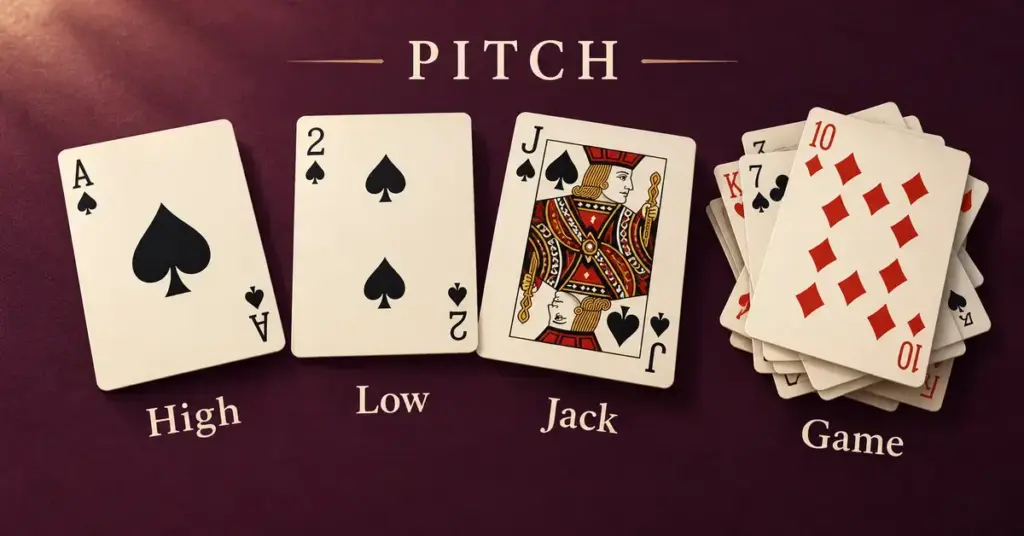
No matter how many players are in, only four points are available each hand. They are counted in a fixed order — High, Low, Jack, Game — which also breaks ties when two players reach the target in the same deal.
The Four Points
- High — 1 point for the highest trump in play, to whoever holds it.
- Low — 1 point for the lowest trump in play; in the basic game it goes to its original holder.
- Jack — 1 point for the Jack of trumps, to the player who captures it in a trick. If the Jack of trumps was not dealt, this point is not scored.
- Game — 1 point for capturing the most card-point pips (Ten 10, Ace 4, King 3, Queen 2, Jack 1).
The Game point goes to whoever captured the most card-point “pips” in their won tricks. Count only these cards:
| Card | Pip value for Game |
|---|---|
| Ten | 10 |
| Ace | 4 |
| King | 3 |
| Queen | 2 |
| Jack | 1 |
| 9 down to 2 | 0 |
If two sides tie on pips, the Game point is simply not awarded that hand.
Reaching the target: winning the game
After all six tricks, each player totals the points they won. The key rule is the bid:
- Players who were not the pitcher always keep every point they won.
- The pitcher scores their points only if they made the bid (won at least as many points as they promised).
- If the pitcher falls short, they are “set back” — the bid amount is subtracted from their score. A negative score is called being “in the hole,” often marked with a circle around the number.
The first player to reach a plus score of 7 points wins (many groups play to 11 or 21 instead — agree before you start). If the pitcher and another player both hit the target in the same hand, the pitcher wins. Between two non-pitchers, the points are awarded in order — High, Low, Jack, Game — and whoever’s winning point comes first takes the game.
A player who smudges (bids four and wins all four points) wins the game instantly — unless they were already in the hole, in which case they simply score the four points.
Popular variations of Pitch
Pitch is one of the most variant-rich card games around. Common versions include:
- Auction Pitch / Setback: the standard four-point bidding game described above.
- Partnership Pitch: four players in two teams, usually played to 21, with “shooting the moon” as a separate higher bid.
- Ten-point Pitch: adds extra scoring cards (such as the off-jack and the trump Three and Ten) to spread more points across each hand.
- Pedro and Cinch: higher-scoring descendants built on the same bidding-and-trump core.
Because rules differ by region, it is worth agreeing on one version before dealing — especially how the Low point is awarded (to the original holder of the lowest trump, or to whoever wins it in a trick).
Common mistakes to avoid
- Over-bidding. Promising more points than your hand can realistically take is the quickest way into the hole. Count your likely trumps first.
- Forgetting the Ten is the big pip card. The Ten is worth 10 toward Game, far more than the Ace — so capturing tens matters more than it looks.
- Wasting high trumps early. Hold the top trump to guarantee the High point and to pull out opponents’ trumps when it helps.
- Not agreeing the variant. Decide the target score and the Low-point rule up front to avoid mid-game disputes.
How Pitch compares to other trick-taking games
If you like Pitch, several related games use the same “bid, pick trump, win tricks” idea at different levels of complexity:
| Game | Players | Bidding | Good next step if you like… |
|---|---|---|---|
| Euchre | 4 (partners) | Yes, for trump | fast partnership play |
| Spades | 4 (partners) | Bid tricks; spades always trump | bidding exact tricks |
| 500 | 3–5 | Yes, naming trump and target | deeper bidding strategy |
| Bridge | 4 (partners) | Detailed auction | the most strategic step up |
Reference Sources
Frequently Asked Questions (FAQ)
How many players do you need for Pitch?
Pitch works with 2 to 7 players, but four is the classic and most balanced number. With four you can play as individuals or in two fixed partnerships.
What does “smudging” mean in Pitch?
Smudging is bidding four — the maximum, because only four points (High, Low, Jack, Game) exist in a hand. A smudge bid cannot be overcalled, and winning all four points after a smudge normally wins the whole game outright.
How is the trump suit decided?
There is no card turned up from the deck. The winning bidder (the pitcher) leads the first card, and the suit of that card becomes trump for the entire hand. This “pitching” is what gives the game its name.
What score do you need to win?
In standard Pitch the first player to reach a plus score of 7 points wins. Many groups instead play to 11 or 21, so agree on the target before the first deal.
What is the difference between Pitch and All Fours?
They share the same four scoring points, but in All Fours trump is set by a card turned up from the stock, while in Pitch the bidder chooses trump by leading it. Pitch also adds the bidding round that All Fours does not have.