Sequence is a strategy game that blends an ordinary deck of playing cards with a game board, asking two to twelve players to turn matching cards into rows of five chips. It has been a fixture on New Zealand coffee tables, in classrooms and at holiday baches for decades, largely because it can be learned in a single round yet still rewards planning several moves ahead. This guide walks through the official rules, the special role of the Jacks, team play, buying options across Aotearoa and the game’s unusual origin story — with every figure and date checked against the publisher’s information and the standard rulebook rather than memory.
Quick Facts
| Game | Sequence (originally “Sequence Five”) |
| Designer | Douglas Reuter |
| Publisher | Goliath Games (formerly Jax Ltd.) |
| Players | 2–12 (teams for 4+) |
| Age | 7+ |
| Playing time | About 10–30 minutes |
| Contents | Folding board, 104 cards (two decks), 135 chips, instructions |
| Objective | Complete the required rows of five chips (sequences) first |
| Typical NZ price | About NZ$29–$50 |
What Is the Sequence Board Game?
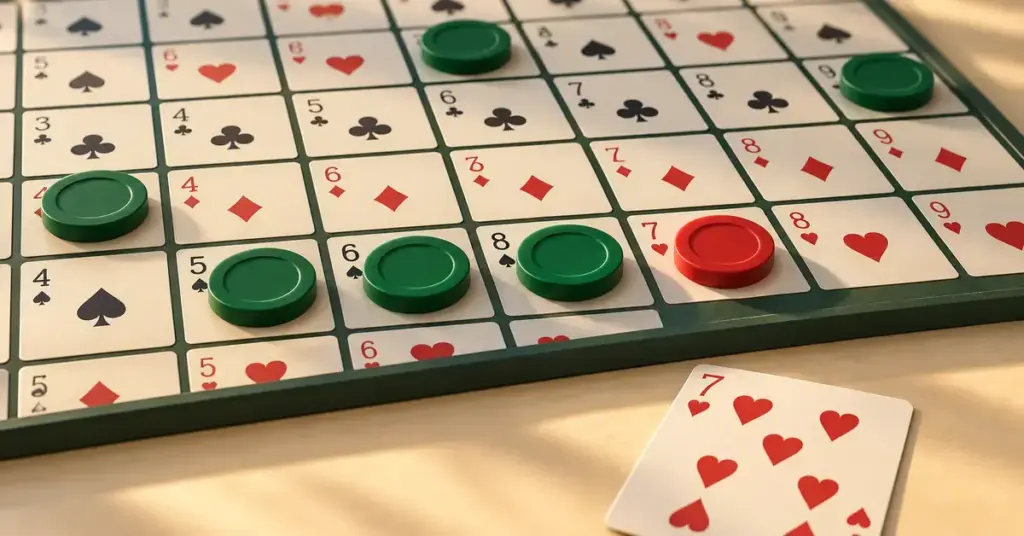
Sequence is a connection game: the goal is to be the first player or team to complete the required number of sequences, where a sequence is a line of five of your own marker chips (small round counters) in a row — horizontally, vertically or diagonally. The board is a 10×10 grid printed with the faces of two standard playing-card decks, so every non-Jack card appears twice. Each turn you play a card from your hand and place one of your coloured chips on a board space that shows that card. Match cards to spaces, build a line of five, and you score.
Part of the appeal is how familiar it feels. Anyone who recognises a standard deck can follow the board, and the rules fit on a single page, so new players are usually up and running within a few minutes. Underneath that simplicity sits a genuine tactical layer: you are weighing offence against defence, tracking where opponents are building and deciding when to spend your most powerful cards.
- Players: 2 to 12, with anyone beyond three organised into two or three teams.
- Age: listed for 7 and up, which makes it a genuine family and multi-generational game.
- Playing time: roughly 10 to 30 minutes, depending on player count and how much blocking goes on.
- Skill vs. luck: the cards you draw are luck, but where and when you place chips is pure decision-making.
How to Play: Setup and the Deal
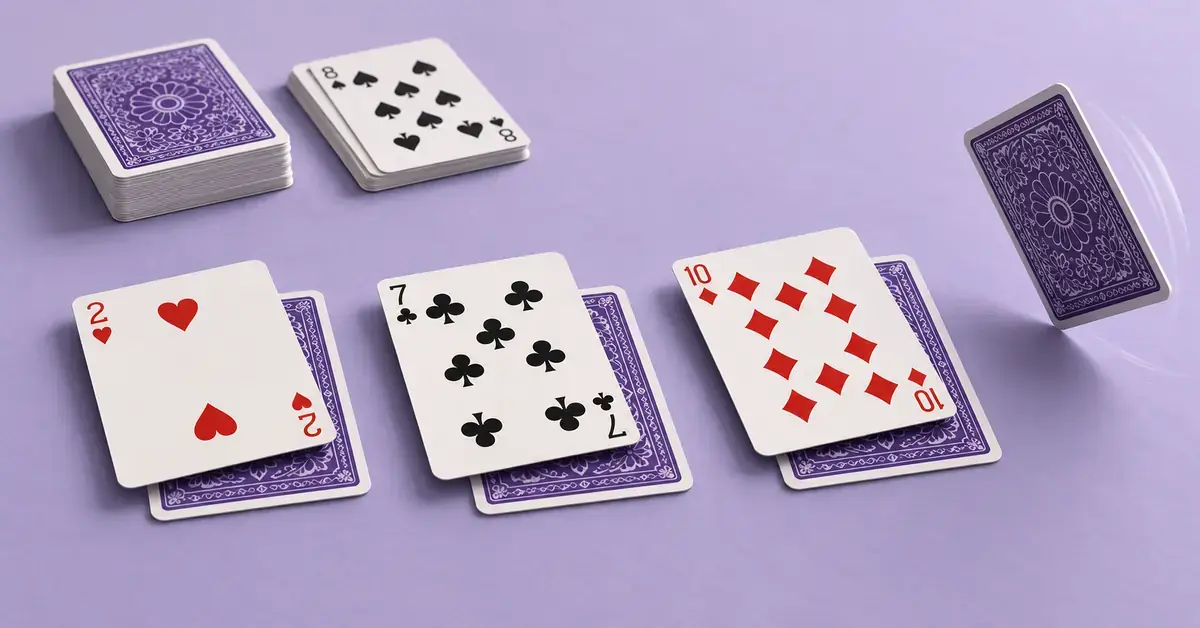
A standard set contains the folding board, two full decks of cards (104 cards, with no Jokers) and marker chips in up to three colours. Each player or team takes a single colour. If you are playing in teams, players sit in alternating positions around the table so no two teammates are next to each other — this keeps the turn order rotating between opposing sides and limits any chance to coordinate. One player shuffles and deals a hand to everyone; the number of cards dealt drops as the table gets bigger, and the rest of the cards form a face-down draw pile.
| Players | Cards dealt each | Teams |
|---|---|---|
| 2 | 7 | No teams |
| 3 | 6 | No teams |
| 4 | 6 | 2 teams of 2 |
| 6 | 5 | 2 or 3 teams |
| 8 | 4 | 2 teams of 4 |
| 9 | 4 | 3 teams of 3 |
| 10 | 3 | 2 teams of 5 |
| 12 | 3 | 3 teams of 4 (or 2 of 6) |
If you enjoy family titles that scale from two players up to a crowded table like this, the same flexibility shows up across many of the picks in our guide to family board games in New Zealand.
A Turn, Step by Step
On your turn you do three things in order:
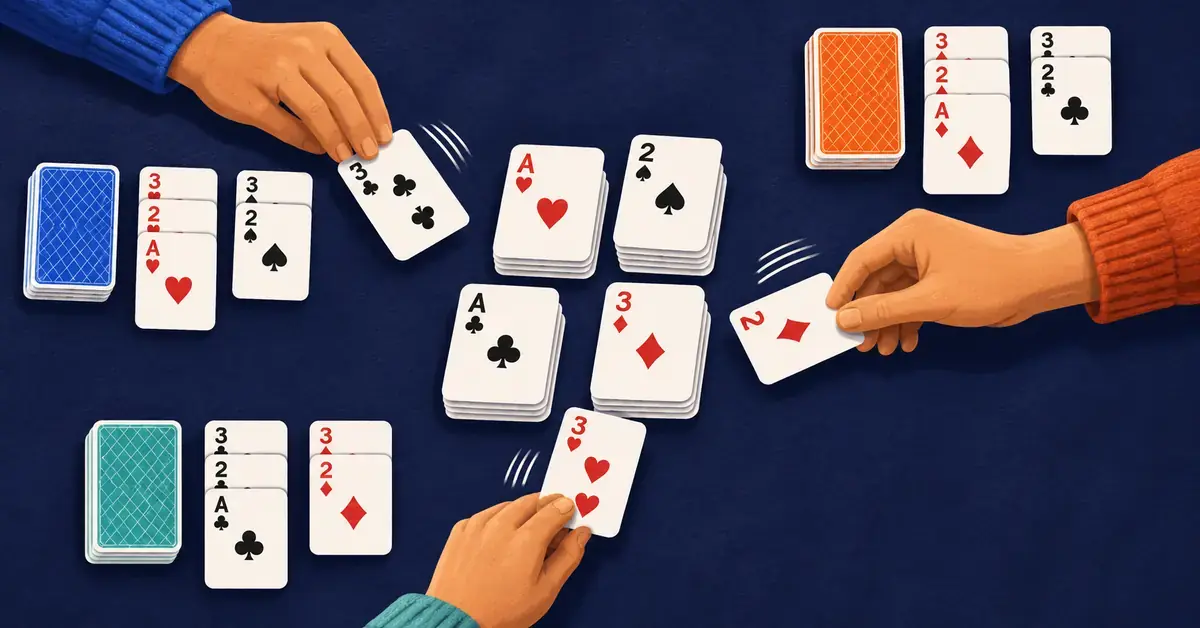
- Choose a card from your hand and place it face-up on the discard pile.
- Place one of your chips on an open board space that matches that card (either of the two copies of that card on the board is fine).
- Draw one replacement card from the draw pile so your hand returns to its starting size.
Play then passes to the next person. The simple-looking sequence of “play a card, place a chip, draw a card” is the entire engine of the game.
The “Loss of Card” Rule
Drawing your replacement card is easy to forget, and the rulebook is strict about it. If you fail to draw before the next player has taken their turn and drawn, you lose the right to replace that card for the rest of the game and must continue with a smaller hand. It is a small penalty that quietly matters, because a short hand gives you fewer options every single turn. Many NZ families relax this for young or new players as a house rule, but organised clubs usually apply it as written.
Winning: Sequences, Corners and Teams
How many sequences you need depends on how many sides are playing, not simply on head count:
- Two players or two teams: you must complete two sequences to win.
- Three players or three teams: only one sequence is required.
Two completed sequences are allowed to share a single chip where they cross, so a well-placed counter at an intersection can count toward both lines at once. If no one reaches the target and the cards run out, the game is declared a draw.
The Free Corners
The four corner spaces on the board are marked as free (bonus) spaces that belong to everyone. Any player may count a corner as if it were one of their own chips. In practice that means a sequence that runs off a corner needs only four of your chips rather than five, which makes the corners the most contested real estate on the board. More than one team can use the same corner for their own separate sequences.
Team Play and the “No Table Talk” Rule
Team games are where Sequence becomes genuinely social. Any member of a team can add chips toward a shared sequence, so partners are effectively building one line together. The catch is the “no table talk” rule: teammates may not coach each other, hint at strategy or point out board positions. If a player does, the penalty is that every member of that team must discard one card. The result is a quiet game of reading your partner’s intentions purely from the cards they play and the spaces they choose to block. For a wider look at how mechanics like this shape tabletop play, see our overview of board game strategy in New Zealand.
The Jacks: Wild and Removal Cards
The Jacks are the only cards not printed anywhere on the board, because they act as special-power cards instead of matching a space. There are two kinds, and telling them apart is the first real step toward playing well.
- Two-eyed Jacks (Diamonds and Clubs) — wild: play one to place a chip on any open space on the board, no matching card required. These are your best finishing tool for completing a line.
- One-eyed Jacks (Spades and Hearts) — removal: play one to take an opponent’s chip off the board, clearing that space. The one restriction is important — you can never remove a chip that is already part of a completed sequence.
Because completed sequences are protected from removal, finishing a line early is valuable in itself: it locks those chips in place forever. Experienced players tend to hold their Jacks until the mid-to-late game, when a single wild placement wins a line or a single removal breaks an opponent’s near-complete row.
Dead Cards
A “dead card” is a card in your hand for which both matching board spaces are already covered by chips, so it can never be played usefully. You are allowed to swap it out: on your turn, announce the dead card to the table, discard it, and draw a replacement before continuing with a normal move. Spotting dead cards quickly keeps your hand full of live options instead of dead weight.
Strategy Tips for New Players
Sequence rewards patience and board awareness far more than it rewards rushing to five. A few priorities consistently separate stronger players from beginners.
| Focus | Why it matters | Priority |
|---|---|---|
| Corner control | A line off a free corner needs only four of your chips, so corners shorten the race. | Very high |
| Blocking | Dropping one chip into an opponent’s near-complete row can be worth more than extending your own. | High |
| Jack timing | Holding Jacks for the late game gives you a flexible, game-deciding move when the board is crowded. | Very high |
| Spreading out | Building toward several possible lines at once keeps your plan alive if one gets blocked. | Medium |
Diagonal lines are often the easiest to sneak through, because opponents tend to watch the obvious horizontal and vertical rows first. If you like this kind of block-and-build tension, the plastic-peg classic Trouble scratches a similar itch for families, while 5 Crowns offers comparable hand-management decisions with cards alone.
What’s in the Box and Which Edition to Pick
Before a first game, check the contents so you have everything for the full range of player counts. The standard edition published by Goliath (previously Jax Ltd.) includes the following.
| Item | Quantity | Purpose |
|---|---|---|
| Folding board | 1 | The 10×10 grid of card faces plus four free corners. |
| Sequence cards | 104 | Two standard decks, no Jokers. |
| Blue chips | 50 | Markers for one player or team. |
| Green chips | 50 | Markers for a second player or team. |
| Red chips | 35 | Used only when a third player or team joins. |
| Instructions | 1 | Official rules and the dealing table. |
That is 135 chips in total for the standard Goliath set sold in New Zealand; some regional editions instead ship 144 chips (48 of each colour), so counts can vary slightly between boxes. Because the cards are ordinary playing cards, you can substitute any two matching decks if you lose the originals — but the specialised chips are harder to replace.
Other Versions
Beyond the classic game, the range includes Sequence for Kids (animal pictures instead of card faces, aimed at ages 3–6 and requiring no reading), Sequence Numbers and Sequence Letters for early maths and literacy, plus travel tins and a dice-based spin-off. The kid and number versions are popular for classrooms and younger families; our family buying guide to kids’ board games by age explains which versions suit which ages.
Where to Buy the Sequence Board Game in New Zealand

Sequence is widely stocked in Aotearoa, both in store and online. Prices move around with sales, but it is one of the more affordable modern classics — expect roughly NZ$29 to NZ$50 for the standard edition. Kmart tends to carry the lowest everyday price, while bookshops and toy stores often run discounts off a higher list price. The comparison below reflects the main national options; secondhand copies also turn up regularly on Trade Me.
Where to Buy in New Zealand
| Retailer | Typical price (NZD) | Notes |
|---|---|---|
| Kmart NZ | About $29 | Usually the lowest everyday price; stock varies by store. |
| Paper Plus | About $35–$50 | Frequently discounted from a ~$44.99 list price. |
| Mighty Ape | Check listing | Online only, fast nationwide delivery. |
| Toyworld NZ | Check in store | Independent toy stores nationwide; good for browsing editions. |
| Trade Me | From about $20 | New, clearance and used copies from NZ sellers. |
History: From a 1974 Dream to a Modern Classic
The origin of Sequence is almost as well known as the game. Its inventor, Douglas Reuter, has said the idea came to him in a dream in 1974; he got up to write it down before it faded and first called it “Sequence Five.” Development and the search for a manufacturer took years. A licensing agreement with Jax Ltd. was signed in June 1981, and the game reached shops in early 1982. It went on to sell many millions of copies worldwide and became a staple “gateway” game that introduces new players to the hobby.
The business side kept moving. Goliath Game Company bought Jax in 2017 and acquired the licensor rights in 2018, so Goliath now publishes the game while Reuter continues to receive a royalty. The design is covered by US patent US5029871A, “Sequence board game.” In 2026, Reuter donated his early prototypes and the original 1981 Jax contract to The Strong National Museum of Play, cementing the game’s place in tabletop history. For the broader story of how games like this fit into New Zealand’s tabletop culture, see our guide to the clubs, cafes and shops behind the NZ board game scene.
Who the Sequence Board Game Suits
Sequence fits a wide range of players, which is a large part of why it endures. It works as a quick two-player duel, a lively party game for a full table, and an intergenerational game where a child and a grandparent can genuinely compete on even terms. The reading-free kids’ versions make it suitable for pre-schoolers, while the strict tournament rules give hobby clubs enough structure for serious play. If you want a game that is cheap, portable, easy to teach and still has room for skill, it is an easy recommendation.
Sources
Frequently Asked Questions
How many people can play Sequence?
Between 2 and 12 people. Up to three can play as individuals; any game with more than three players is organised into two or three evenly sized teams, and teams must split the table into either two or three sides.
What is the difference between a one-eyed and a two-eyed Jack?
Two-eyed Jacks (Diamonds and Clubs) are wild — you can place a chip on any open space. One-eyed Jacks (Spades and Hearts) are the opposite — you use them to remove one of an opponent’s chips, as long as that chip is not already part of a completed sequence.
How many cards do I hold in my hand?
It depends on the number of players. Two players get 7 cards each, three or four players get 6, six players get 5, eight or nine players get 4, and ten or twelve players get 3 each.
Can a completed sequence be broken or removed?
No. Once a line of five chips is finished it is protected, and a one-eyed Jack cannot remove any chip that forms part of it. That is why finishing a sequence early can be a strong defensive move.
Is Sequence a game of luck or skill?
Both. The cards you draw are down to luck, but deciding which card to play, where to place your chip, when to block an opponent and when to spend a Jack are all skill-based decisions — which is why stronger players win far more often over a run of games.