

The status of the UNO reverse card goes beyond this entertaining card game. This simple white arrow on a blue, red, yellow, or green background has become a widely recognized symbol in popular culture and achieved a level of fame even in the world of memes. But why does this card stand out so much? Let’s take a closer look at its history and strategic allure.
Understanding the Uno reverse card

The UNO reverse card is one of the most iconic and versatile special action cards in the game. Its primary function is to change the direction in which players take their turns during multiplayer gameplay. This shift in direction can dramatically alter the flow of the game, adding an element of strategy and unpredictability. If the game is being played with more than two players, the Reverse card flips the turn order, making the player who was previously going last take the next turn, and vice versa. This ability to change the turn sequence can create opportunities for players to disrupt their opponents’ strategies, making the game even more dynamic and exciting.
However, if there are only two players in the game, the UNO Reverse card takes on a slightly different role. In this case, it functions similarly to a “skip” card, which means that the player who plays the UNO Reverse card gets to take another turn immediately after. This alteration in gameplay offers a strategic advantage, allowing the player to gain extra time to play more cards or further manipulate the game’s flow to their benefit.
It’s important to note that the rules surrounding the Reverse card may vary slightly depending on the specific version of UNO being played. For instance, in special editions like UNO Flip or UNO Attack, the UNO Reverse card might have additional features or alternative uses that slightly change its function. In UNO Flip, for example, the Reverse card can flip the entire deck to a new side with different card types, further adding complexity to the game. Similarly, in UNO Attack, the Reverse card may trigger different actions due to the unique mechanics of the game, such as causing the card launcher to activate in certain scenarios.
Because of these variations, it’s crucial to assess which version of UNO you are playing before diving into the game. Understanding how the Reverse card works within the specific rules of your edition will ensure that you fully grasp its strategic potential and can leverage it to your advantage. Whether you’re switching turn directions in a multiplayer game or taking an extra turn in a two-player match, the Reverse card remains an essential tool for players looking to outwit their opponents and stay in control of the game.

History and origin of the reverse card
The UNO reverse card was part of the original action cards included in UNO, which was invented by Merle Robbins in 1971, along with “Skip” and “Draw Two” cards. These cards aimed to make the game more engaging by adding a surprising element that required gameplay strategy.
More recent variations of the game include different versions of the reverse card. For example, UNO Flip features a “Flip” card that changes the direction of play and flips all cards to their opposite side, revealing different actions and colors.
Rules and strategies
There is nothing too complicated about the reverse card: when played, it changes the direction of play. In a two-player game, playing the reverse card equals skipping the opponent’s turn and playing another hand. However, there are some key strategies to keep in mind when playing the reverse card to maximize its potential:
- Save the reverse card until a crucial moment in the game.
- Use a reverse card as a defensive move to disrupt the next player’s strategy.
- Take advantage of a reverse card to give yourself another turn.
Mastering the basics
To exploit the full potential of this seemingly simple card, players should focus on some key aspects of the game and read into the opponents’ possible moves. Consider the following factors when playing a reverse card for maximum impact:
- Pay attention to the current direction of play.
- Count how many cards your opponents have left in their hand.
- Try to assess how many reverse cards have been played already.
Advanced techniques and exceptions
With just a few rounds of UNO, you’ll begin to understand the rhythm of the game, refine your strategies, and develop a deeper appreciation for the tactical nuances involved. The Reverse card plays a key role in advanced gameplay, offering clever ways to disrupt the flow of the game and throw off your opponents’ carefully laid plans. Its ability to change the direction of play can be used to great effect, particularly when combined with other special action cards like Skip or Draw Two. Using these cards in synergy can create a chaotic environment where your opponents struggle to regain control, while you maneuver your way to victory.
In a two-player game, the UNO Reverse card has an even greater impact. When used strategically, it functions as a “skip” card, enabling the player who uses it to regain their turn. This allows you to play more cards, potentially clearing your hand faster and putting pressure on your opponent. The additional turn also opens up opportunities to manipulate the game in your favor, whether it’s by holding onto key cards or avoiding the need to draw from the deck.
UNO also has a rich history of house rules—alternative rules developed by players over the years that modify the original gameplay. These house rules often add extra excitement, depth, and unpredictability to the game. One popular variation, for instance, is stacking Reverse cards, a rule not included in the official version but embraced by many players worldwide. In this variation, if a Reverse card is played, other players may also play their own Reverse cards, causing the direction of play to switch multiple times in rapid succession. This creates a fast-paced, often chaotic environment, where the direction of play may change several times in a single round, depending on the number of players who choose to stack their UNO Reverse cards.
While this rule certainly makes the game more unpredictable, it can also work to the advantage of the player who initiated the stacking, as it gives them more control over the direction of play. However, it can also backfire if other players use the stacking strategy to turn the tide against you, creating a dynamic environment full of tension and surprise. Regardless of how you play, incorporating house rules like stacking Reverse cards can make UNO even more enjoyable and unpredictable.
By experimenting with these variations and developing your own strategies, you can deepen your understanding of the game and create new and exciting ways to challenge your friends or family. Whether you’re playing by the standard rules or with your own house rules, the UNO Reverse card remains an essential and powerful tool in your UNO arsenal, capable of creating chaos, controlling the game’s pace, and giving you a significant edge over your opponents.
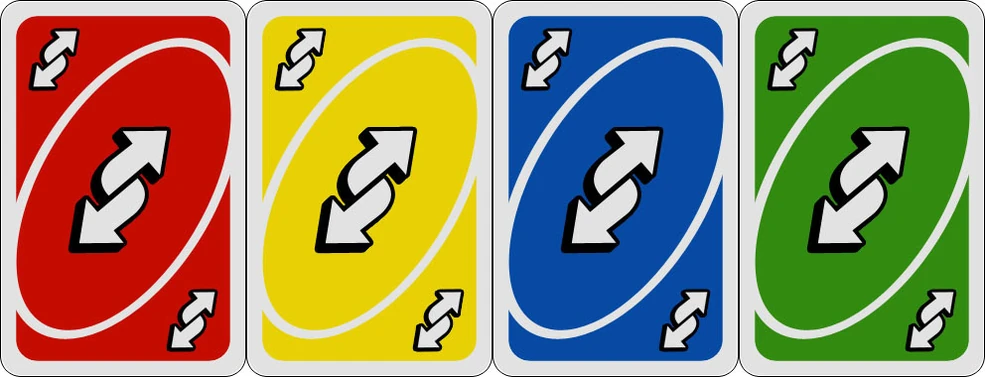
The UNO reverse card meme

During the Sidemen charity match, YouTuber Max Fosh made headlines by pulling out an UNO reverse card after receiving a yellow card from referee Mark Clattenburg. The stunt, which took place in the 77th minute after Fosh fouled Miniminter, went viral and was meticulously planned. Fosh explained on TikTok that he had prepared both regular and oversized UNO cards, waiting for the perfect moment to execute his plan. This unexpected move delighted fans and added a humorous twist to the event, cementing Fosh’s moment as a viral sensation. These revisions ensure the information is accurate and comprehensive, providing a clear and engaging overview of the UNO reverse card and its cultural impact.
Advanced Strategy: The “Reverse-Stack” and Turn-Order Traps
In competitive New Zealand play, the Reverse card is more than a directional switch; it is a tool for Turn-Order Manipulation. A common high-level tactic is the Pincer Trap. If the player to your left has only one card (“Uno!”), playing a Reverse card immediately removes their opportunity to win on the next turn.
Furthermore, master the Reverse-Stacking sequence if your house rules allow “Doubles”. Playing two Reverse cards of the same colour simultaneously performs a “Full Circle”—the direction flips twice, returning the turn order to its original state but allowing you to burn two cards from your hand without changing who plays next. This is particularly effective for shedding high-value Action cards (worth 20 points each) before an opponent can go out.
Two-Player Speed Rules: The “Skip” Transformation
A frequent point of confusion in New Zealand households is how the Reverse card functions in a one-on-one duel. Under official Mattel and NZ tournament regulations, the Reverse card loses its “direction-changing” property in two-player games and acts exactly like a Skip card.
-
The Double-Turn: When you play a Reverse card against a single opponent, it skips their turn and allows you to immediately play another card.
-
Defensive Chaining: In 2-player mode, you can chain a Reverse and a Skip card together. For example, playing a Green Reverse followed by a Green Skip allows you to play three times in a row, effectively “blitzing” the discard pile while your opponent is forced to watch.
Comparative Rules: Reverse Card Variations
| Variation | Reverse Card Function | Common in NZ? |
| Standard Uno | Changes direction (Clockwise ↔ Anticlockwise) | Yes |
| 2-Player Uno | Acts as a “Skip” (Take another turn) | Yes |
| Uno Flip (Dark) | Reverse AND Skip the next player | Growing |
| Uno Show ‘Em No Mercy | Stackable Reverse; direction flips per card | High Demand |
| Uno Reverse Pack | Special “Wild No U” counters draw penalties | Specialty |
Cultural Iconography: The “No U” Meme in Aotearoa
The Uno Reverse card has transcended the tabletop to become a staple of New Zealand’s digital lexicon, often referred to as the “Ultimate Comeback”. In local social media culture, the card is used as a metaphorical “No U”—a way to flip an insult or an argument back onto the sender.
This cultural phenomenon has led to the rise of “IRL Reverse” etiquette. In university flats across Dunedin and Auckland, it is not uncommon for players to carry a physical Reverse card in their wallet as a “get out of chores free” joke, though this is (unfortuantely) not a legally binding rule in the official game.
Educational and Cognitive Benefits for All Ages
In New Zealand, educators and health practitioners use the Reverse card to teach Cognitive Flexibility. The sudden shift in direction requires players to mentally re-map the “future” of the game, which is a key component of executive function.
-
For Tamariki: The Reverse card teaches “spatial sequencing.” Children must track the flow of play (left vs. right), which aids in developing directional awareness and social turn-taking skills.
-
For Seniors: Rapidly adapting to a direction change acts as a “neural reset.” It forces the brain to switch from a passive rhythm to active monitoring, helping to maintain mental sharpness and reaction speed.
Standard NZ Reverse Card Regulations and Scoring

| Regulation | Official Ruling | Penalty/Value |
| Starting Card | If flipped at start, the dealer goes first; play starts anticlockwise. | N/A |
| Point Value | When scoring, a Reverse card in your hand is a liability. | 20 Points |
| Stacking (Draw) | In NZ house rules, playing a Reverse can sometimes “pass” a Draw stack. | Variable |
| Colour Match | Can only be played on a matching colour or another Reverse. | N/A |
Advanced Strategy: The “2026 Pro Meta”
In high-level competitive UNO, the Reverse card is not just a tool for changing direction—it is a tactical weapon used for “Turn Manipulation.”
The “Squeeze” Play
If you notice the player to your right (in a clockwise game) has only one or two cards left, a Reverse card is your most powerful defensive move. By switching the direction to the left, you effectively “skip” the person about to win and give your other opponents more opportunities to force them into drawing cards before the turn eventually returns to them.
Reverse as a “Hand Cleaner”
In 2026 tournament play, keeping a “balanced” hand of colors is the priority. If you hold a single Green Reverse card and the current color is Green, it is often better to play it immediately even if you like the current direction. This “cleans” your hand of an action card (worth 20 points if you lose) while simultaneously forcing your opponents to adjust their mental tracking of the turn order.
The 2-Player “Skip” Hack
A common mistake for casual NZ players is misunderstanding how the Reverse card works in a 1v1 duel. According to the official 2026 competitive rules:
In a two-player game, the Reverse card acts exactly like a Skip card.
This means if you play a Reverse, you immediately take another turn. Mastering this allows you to “chain” moves (e.g., playing a Green 7, then a Green Reverse, then a Blue Wild) to dump half your hand before your opponent can react.
Cultural Phenomenon: “Uno Reverse” in 2026
Beyond the tabletop, the “Uno Reverse Card” has become the definitive digital symbol for a “comeback” or a “flipped script.”
-
The “No U” Evolution: In 2026 social media culture, the card is frequently used as a visual shorthand for the phrase “No U.” (Interestingly, “No U” is a near-perfect anagram of “Uno”).
-
Physical “Wallet” Cards: A major trend in Auckland and Wellington high schools is carrying a physical “Uno Reverse” card in one’s wallet. These are used as comedic “immunity idols” during verbal banter or as a way to “reverse” a joke back onto a friend.
-
Meme Longevity: Unlike many internet trends that fade in months, the “Uno Reverse” has survived over a decade because of its universal relatability—everyone understands the feeling of turning an opponent’s momentum against them.
Technical Specifications: 2026 Print Standards
For collectors and enthusiasts, the physical build of the card has seen minor updates in the 2025/2026 Mattel print runs to improve durability and inclusivity.
| Feature | Specification (2026) | Benefit |
| Card Stock | 320 GSM Black Core | Increased “snap” and prevents light transparency (anti-cheat). |
| Finish | “Linen” UV Coating | Better grip and resistance to moisture (perfect for humid NZ summers). |
| Iconography | High-Contrast Dual Arrows | Improved visibility for colorblind players and low-light environments. |
| Point Value | 20 Points | Standard scoring value used in all official NZ tournament circuits. |
Frequently Asked Questions
Can I play a Reverse card on a Draw Two?
In official rules, you can only play a Reverse card if it matches the colour of the Draw Two. However, in many NZ “Stacking” house rules, playing a Reverse on a Draw Two “bounces” the penalty back to the person who played it.
Does a Reverse card skip the next person?
In a game with 3 or more players, no—it simply changes the direction. However, in a 2-player game, the Reverse card does skip the other player, allowing you to go again.
What happens if the direction is reversed and there are only 3 players?
The turn order simply flips. If play was moving Player A → B → C, and Player B plays a Reverse, it moves back to Player A, then Player C.
Can a Reverse card be my final “Uno” card?
Yes, you can win the game by playing a Reverse card as your last card. The direction change still occurs, but since you have no cards left, the game ends immediately.
Is there a “Wild” Reverse card?
Not in the standard deck. However, variations like Uno Flip and the Uno Reverse Pack include “Wild Power Reverse” cards that allow you to change the direction and choose a new colour.
What is the “No U” card I see online?
The “No U” card is a popular internet meme based on the Reverse card. While not in standard decks, Mattel has recently released the Uno Reverse Pack which includes a “Wild No U” card that functions as a counter-attack.
Can I play a Reverse card of a different colour on another Reverse?
Yes. You can play any Reverse card on top of another Reverse card, regardless of the colour.
What if I play a Reverse card and forget to change direction?
In casual NZ play, if the next person plays out of turn because they forgot the direction, they usually have to take their card back and draw two cards as a penalty for an “out of turn” play.
Does the Reverse card affect the “Uno” shout?
No. If a direction change puts the turn back on a player with one card, they must still have already shouted “Uno!” or they can be caught and penalised.
Who goes first if a Reverse is the first card flipped?
The dealer plays first, but instead of the person to their left going next, play moves to the right (anticlockwise).
Can you play a Reverse card on a “Draw 2”?
No. In official UNO rules, a Draw card forces the next player to draw and forfeit their turn. Since your turn is skipped, you cannot play a Reverse card to “send it back.” (Note: This is a common “House Rule” in NZ, but it is not official).
What happens if a Reverse card is the first card flipped?
If the game starts with a Reverse card, the dealer goes first, and the direction of play immediately changes to counter-clockwise (to the dealer’s right).
Can you win the game with a Reverse card?

Yes. You can play a Reverse card as your final card to win the game. However, if playing for points, the game ends immediately, and your opponents’ remaining cards are tallied.
Is there a “Wild Reverse” card?
Yes, in specialty sets like UNO Reverse Pack and UNO All Wild, there are Wild Reverse cards. These allow you to change the current color AND the direction of play simultaneously.
How many Reverse cards are in a standard deck?

A standard 108-card UNO deck contains 8 Reverse cards (2 of each color: Red, Yellow, Green, and Blue).
Can I stack a Reverse on a Skip?
No. You can only play a Reverse card if it matches the current color of the Skip card or if the top card on the pile is another Reverse card.
What is the “Uno Reverse” meme origin?
The meme originated on platforms like Reddit and Twitter in the late 2010s, initially used in “image macros” to show a person literally holding up the card to deflect an insult.
Does the “Uno Reverse” card have text in the NZ version?

Most modern versions sold in New Zealand use universal symbols (the two arrows) rather than the word “REVERSE” to make the game language-agnostic.
Can I buy a metal “Uno Reverse” card?
While not official Mattel products, several NZ-based “Etsy” sellers and hobby shops sell novelty metal or 3D-printed cards designed to be carried as “EDC” (Everyday Carry) items.
What is “Double Reverse”?
If two players play Reverse cards back-to-back, the direction flips twice, effectively returning the game to its original rotation.
