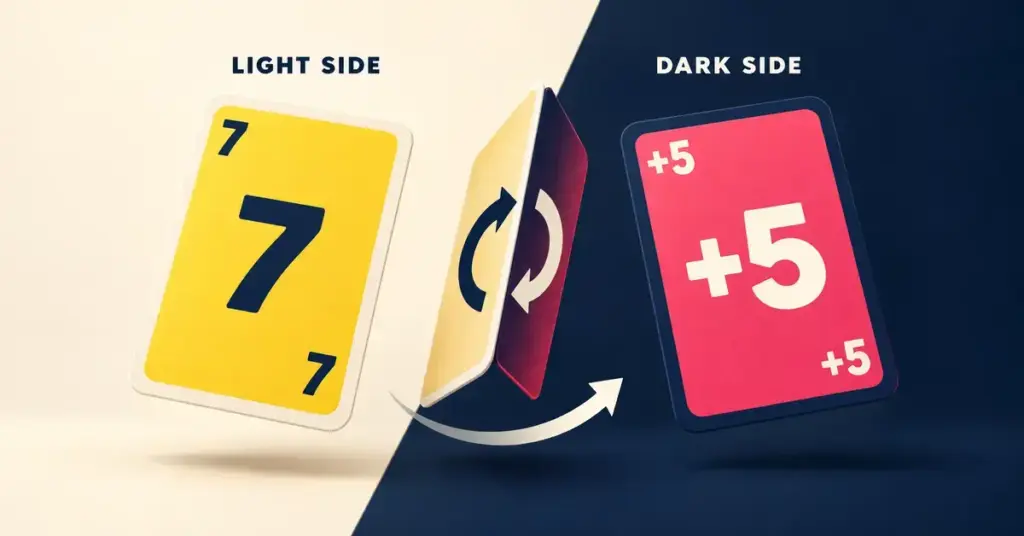
Uno Flip is a double-sided version of the classic shedding game Uno, published by Mattel in 2019 for 2 to 10 players aged 7 and up. Every card has two faces: a familiar “Light Side” and a harsher “Dark Side”, and a special Flip card turns the whole game from one to the other mid-round. This guide explains what the two sides contain, how the Flip card works, how scoring is actually calculated, and the practical decisions that separate a lucky round from a well-played one. For a step-by-step rundown of the core rules, you can also read our dedicated Uno Flip rules walkthrough.
Quick Facts
| Publisher | Mattel |
|---|---|
| Released | 2019 |
| Players | 2–10 |
| Age | 7+ |
| Deck | 112 double-sided cards |
| Cards dealt | 7 per player |
| Goal | Be first to discard your hand; reach 500 points to win the game |
| Signature mechanic | The Flip card switches every card between the Light Side and the Dark Side |
What Uno Flip is and how it differs from classic Uno
In standard Uno, every player holds a hand of single-sided cards and races to be the first to discard them all. Uno Flip keeps that goal but prints a second, hidden game on the back of every card. The deck contains 112 double-sided cards. While you play your own cards from the Light Side, the Dark Side of your hand faces the table, so your opponents can always see what you would be holding if someone triggered a flip — and you can see theirs. That single design choice turns Uno from a game of pure hand management into one that also rewards observation and timing.
The core rhythm is unchanged: match the top card of the discard pile by colour, number or symbol, or play a Wild. What changes is that the entire board can switch sides at any moment, converting mild penalties into severe ones and vice versa.
The double-sided deck: Light Side and Dark Side
Each card belongs to one of two colour families depending on which way up it is. The number cards run from 1 to 9 (there is no zero in Uno Flip), and each side has its own set of action cards.
- Light Side colours: blue, green, red and yellow — the familiar Uno palette.
- Light Side action cards: Draw One, Reverse, Skip, Flip, Wild and Wild Draw Two.
- Dark Side colours: pink, teal, orange and purple.
- Dark Side action cards: Draw Five, Reverse, Skip Everyone, Flip, Wild and Wild Draw Color.
The Dark Side is deliberately more punishing: a “draw one” becomes a “draw five”, a “skip” becomes a “skip everyone”, and the Wild Draw Two is replaced by the much nastier Wild Draw Color. Because both sides are always in play, a card that looks harmless now may be a weapon after the next flip.
Light Side vs Dark Side
| Feature | Light Side | Dark Side |
|---|---|---|
| Colours | Blue, green, red, yellow | Pink, teal, orange, purple |
| Draw card | Draw One (next player draws 1) | Draw Five (next player draws 5) |
| Skip card | Skip (next player misses a turn) | Skip Everyone (all others skipped, you go again) |
| Reverse | Reverses play direction | Reverses play direction |
| Wild options | Wild, Wild Draw Two | Wild, Wild Draw Color |
| Flip card | Switches to the Dark Side | Switches back to the Light Side |
How the Flip card works
The Flip card is the heart of the game. When a player plays a Flip, every card in play is turned over at once: each player’s hand, the draw pile and the discard pile all switch to the opposite side. Play then continues from the newly revealed top card of the discard pile, which sets the new active colour and value.
Flip is a coloured action card, not a Wild, so it must match the current colour or follow another Flip. A common point of confusion is that there is no separate “Wild Flip” card on the Light Side — the plain Wild simply lets you choose the next colour, and the Wild Draw Two forces the next player to draw two and lose their turn. Flipping and choosing a colour are two different actions.
If a Flip card is the very first card turned up to start the discard pile, the round begins on the Dark Side, and play proceeds normally from there.
The Dark Side cards worth respecting
Three Dark Side cards do most of the damage, and understanding them is the fastest way to improve.
- Draw Five: the next player draws five cards and misses their turn. On a full table this can single-handedly end someone’s chance of going out.
- Skip Everyone: every other player is skipped, so the person who played it immediately takes another turn. In a four-player game that is three players skipped in one move.
- Wild Draw Color: you choose a colour, and the next player must keep drawing until they draw a card of that colour. There is no fixed limit, so an unlucky opponent can draw a large handful at once.
As with the Wild Draw Two in classic Uno, the Wild Draw Color can be challenged: if a player suspects it was played while the person held a matching colour, they can ask to see the hand, and the penalty shifts depending on whether the challenge succeeds.
Setting up and starting a game
Setup is quick and mirrors ordinary Uno with one twist.
- Shuffle the deck and deal seven cards to each player.
- Players hold their cards Light Side toward themselves, which means the Dark Side faces outward for everyone else to read.
- Place the rest of the deck face down as the draw pile and turn the top card up to start the discard pile and set the opening colour.
- The player to the dealer’s left usually goes first; the deal passes to the left each round.
Because the game always starts on the Light Side (unless the opening card is a Flip), early turns feel like normal Uno until someone decides the moment is right to switch everything over.
Scoring and winning
The round ends when one player discards their last card. That player scores the total value of the cards still held by everyone else, and only the side currently in play is counted. The first player to reach 500 points across multiple rounds wins the game. The verified per-card values are below.
| Card | Points |
|---|---|
| Number cards (1–9) | Face value |
| Draw One | 10 |
| Draw Five | 20 |
| Reverse | 20 |
| Skip | 20 |
| Flip | 20 |
| Skip Everyone | 30 |
| Wild | 40 |
| Wild Draw Two | 50 |
| Wild Draw Color | 60 |
Note that Draw One is worth 10 points, not 20 — a detail many online summaries get wrong. The Wild Draw Color at 60 points is the single most valuable card to avoid being caught holding.
Strategy: timing the flip
Because you can see the Dark Side of every hand at the table, flip timing becomes a readable decision rather than a gamble.
Read the backs before you flip
Before playing a Flip card, glance at what your opponents will inherit. If the player to your left is showing a Wild Draw Color on their Dark Side, flipping the board hands them a powerful weapon. If instead their Dark Side looks thin or mismatched, a flip can leave them unable to play. Flipping is most valuable when your own Dark Side hand is strong and theirs is weak.
Save disruption for the right target
Draw Five and Wild Draw Color hurt most when aimed at a player who is close to going out. Holding them for a player with one or two cards left is usually better than spending them early to shave a card off someone with a full hand.
Keep both sides in mind
Your last card can be flipped to its other face before your next turn, which may change its colour or value entirely. When you are down to one card, call “Uno” and stay aware of which side of the deck is live, so a sudden flip does not leave you unable to finish.
Common mistakes and house rules
A few recurring errors trip up new players, and some tables add their own tweaks.
- Stacking penalties: the official rules do not allow you to stack a Draw Five on a Draw Five to pass the penalty along. Many groups allow stacking as a house rule, so agree before you start.
- Forgetting to call Uno: if an opponent catches you with one card before the next player’s turn begins, you draw two cards.
- Ignoring the Dark Side: players who only plan around their Light Side hand are caught flat-footed the moment someone flips. Track both faces from the first turn.
- Misreading the Wild Draw Color: it forces a draw until the chosen colour appears — it is not a simple “draw four”.
Who Uno Flip is for
Uno Flip suits groups who already enjoy Uno but want more swing and tension, and it works well as a family game thanks to its 7-and-up age rating. The added memory and timing elements give it more depth than the classic game without making it hard to learn. If you like this style of high-penalty Uno variant, the escalating Uno No Mercy and the much-memed Uno Reverse card are natural next stops, and you can find more group-friendly options in our guide to the best family card games in New Zealand. For wider context on how shedding games like this fit into the card-game world, see our complete guide to card game families.
Sources
Frequently asked questions
How many cards do you deal in Uno Flip?
Each player is dealt seven cards at the start of a round, held with the Light Side facing the player so the Dark Side shows to everyone else.
What does the Flip card actually do?
Playing a Flip card turns over every card in play at once — all hands, the draw pile and the discard pile — switching the whole game between the Light Side and the Dark Side. Play continues from the newly revealed top discard.
How does the Wild Draw Color card work?
The player chooses a colour, and the next player must keep drawing cards until they draw one of that colour. There is no fixed number, so the penalty can be large, and it can be challenged like a Wild Draw Two.
Can you stack a Draw Five on a Draw Five?
Not under the official rules — the next player simply draws the five cards and loses their turn. Stacking is a popular house rule, so agree on it before play if your group wants it.
What score do you need to win Uno Flip?
Rounds are played until one player reaches 500 points, scored from the cards left in opponents’ hands when someone goes out. The Wild Draw Color is the highest-value card at 60 points.