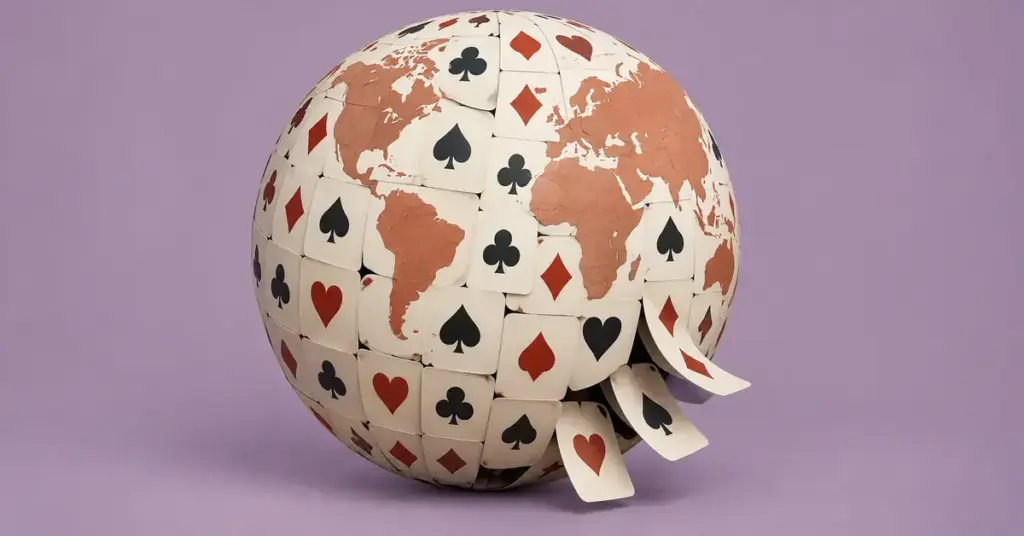

The phrase "world of cards" captures something remarkable: a single, portable deck of printed paper has grown into thousands of different games played in almost every country on Earth. From a quiet hand of Solitaire to a noisy family round of Snap, card games sit where history, mathematics and social connection meet. This guide explains where playing cards came from, how the major game families work, what separates skill from luck, and how card games are played, taught and regulated in New Zealand today. It is written for complete beginners, with each term explained as it appears.
Key Points
- Playing cards most likely began in Tang-dynasty China and were well established in Europe by the late 1300s.
- The hearts, diamonds, clubs and spades of the modern deck come from 15th-century France.
- Card games fall into a few families: trick-taking, shedding, rummy/melding, matching and speed, banking/casino, collectible, and solitaire.
- Skill versus luck is a spectrum – War and Snap are nearly pure chance, while Poker and Bridge reward strategy and memory.
- Magic: The Gathering (1993) launched the collectible card game genre.
- Most social card play in New Zealand is not gambling; money-based online casino play is regulated under the Online Casino Gambling Act 2026.
How playing cards travelled the world
Playing cards are old, but their exact origin is debated. Many historians believe cards were first used in China during the Tang dynasty more than a thousand years ago, though hard evidence is thin because paper rarely survives. What is better documented is their arrival in Europe in the late 1300s, most likely carried from Mamluk Egypt along Mediterranean trade routes. The earliest European records are bans and references from the 1370s in cities such as Bern and in Catalonia.
The Mamluk deck used four suits – polo-sticks, coins, swords and cups – and versions of these still appear in traditional Italian and Spanish decks. As cards spread north, regions invented their own symbols, and the story of how designs changed from place to place is a study in its own right; our overview of how different cultures play card games traces those regional branches in more detail.
From Mamluk decks to the French suits
Germany adopted suits of hearts, bells, acorns and leaves. France simplified things in the 15th century by splitting the suits into two colours, producing the hearts, diamonds, clubs and spades used on the standard 52-card deck today. The French design was cheap to print and easy to read, which is why it eventually became the most common deck worldwide, including in New Zealand, where cards arrived with British settlers in the 19th century.
The main families of card games

Most card games belong to a small number of families, grouped by their goal rather than their theme. Recognising the family a game belongs to makes it far easier to learn, because the core idea carries across dozens of titles. The table below summarises the main groups; the sections that follow explain each one.
Card Game Families at a Glance
| Family | Main objective | Example games | Skill vs luck |
|---|---|---|---|
| Trick-taking | Win or deliberately avoid specific tricks | Bridge, Hearts, Euchre, 500 | High skill |
| Shedding / climbing | Be first to empty your hand | Crazy Eights, Uno, Last Card, President | Medium |
| Rummy / melding | Form sets and runs | Rummy, Gin Rummy, Canasta | Medium to high |
| Matching / speed | Match ranks quickly | Snap, Go Fish, Speed, War | Low (reflex and luck) |
| Banking / casino | Beat the dealer or build the best hand | Blackjack, Poker, Baccarat | Varies (Poker high) |
| Collectible (CCG/TCG) | Build a custom deck and defeat opponents | Magic, Pokémon, Yu-Gi-Oh! | High |
| Solitaire | Sort the deck onto foundations, solo | Klondike, FreeCell, Spider | Medium |
Trick-taking games
In a trick-taking game, each player plays one card per round and the strongest card wins the "trick" (the small pile of played cards). Many of these games use a trump suit – a nominated suit that beats all others. Bridge, Whist, Euchre, Spades and 500 reward players who remember which cards have gone and who plan several tricks ahead. Hearts flips the idea: the aim is to avoid winning hearts and the Queen of Spades. A hand of Hearts carries 26 penalty points in total (one for each heart and 13 for the Queen of Spades), which is why the daring "shooting the moon" play – deliberately taking all 26 – can turn the scoreboard on its head. If you are new to the genre, start with the the rules of Hearts before moving on to Bridge.
Shedding and climbing games
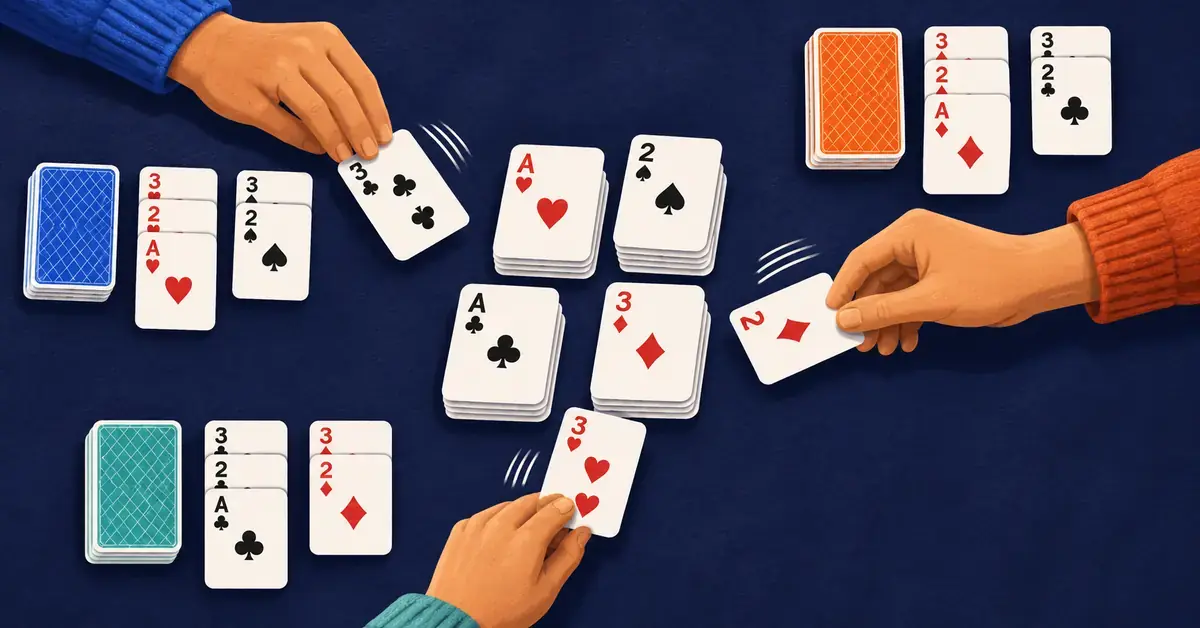
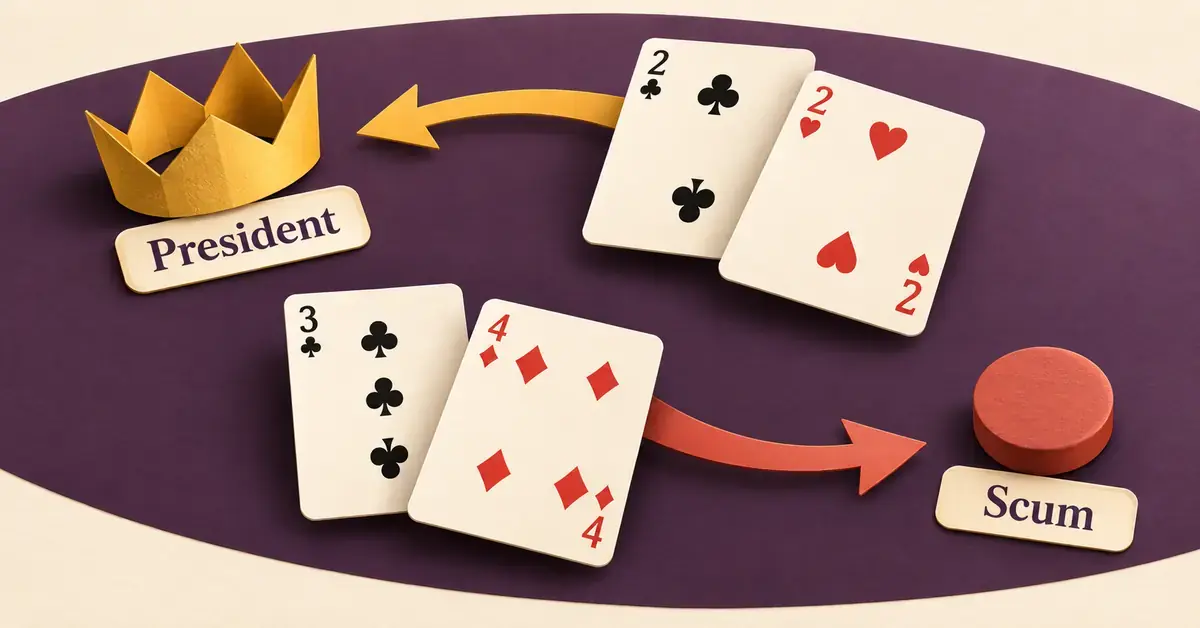
Shedding games ask you to get rid of every card in your hand before anyone else. Crazy Eights, Uno, the New Zealand favourite Last Card, President and Palace all share this goal, usually by matching the rank or suit of the previous card or by playing a higher value. They are fast, social and easy to teach, which makes them a staple of family evenings.
Rummy and melding games
Melding means combining cards into valid groups: a set (three or four of the same rank) or a run (three or more consecutive cards of one suit). Rummy, Gin Rummy, Canasta and Rummy 500 are built on this idea, rewarding planning and a good memory for what opponents pick up and discard.
Matching and speed games

These games rely mostly on quick reactions and luck rather than long-term planning. Snap and Slapjack reward the fastest hand when matching cards appear; Go Fish and Old Maid are about collecting or avoiding pairs; War simply compares the top card of each player’s pile, with the higher card winning. Because they need almost no strategy, they are perfect first games for young children.
Banking and casino games
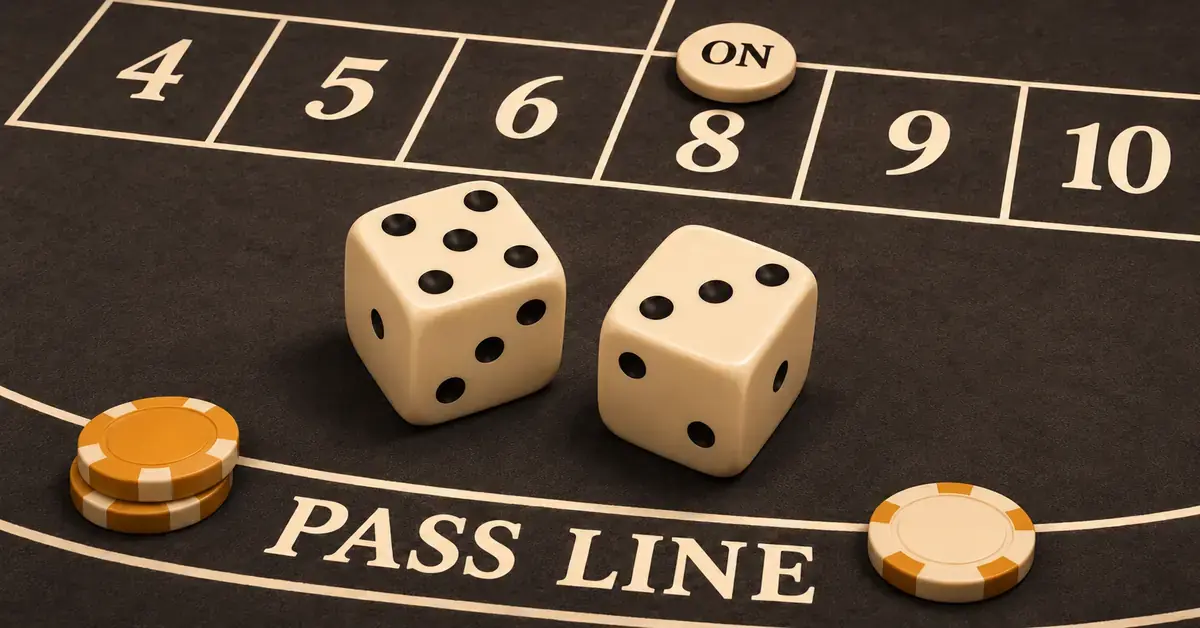
Banking games pit players against a dealer or a shared pot. Blackjack asks you to beat the dealer’s hand without exceeding 21; Baccarat compares two hands against fixed drawing rules; Poker combines hidden cards, betting and bluffing. Poker is the clear outlier here, because skilled reading of opponents and odds has a large effect over time – our guide on how to play poker explains the basics. When these games are played for money they become gambling, which is covered in the legal section below.
Collectible and trading card games
Collectible card games (CCGs), also called trading card games (TCGs), replaced the fixed 52-card deck with thousands of unique cards that players buy, collect and combine into custom decks. Magic: The Gathering, designed by Richard Garfield and released by Wizards of the Coast on 5 August 1993, is widely recognised as the first modern game of this type. Pokémon and Yu-Gi-Oh! soon followed. If you want to try the genre, see our roundup of trading card games for beginners.
Solitaire: the one-player world of cards

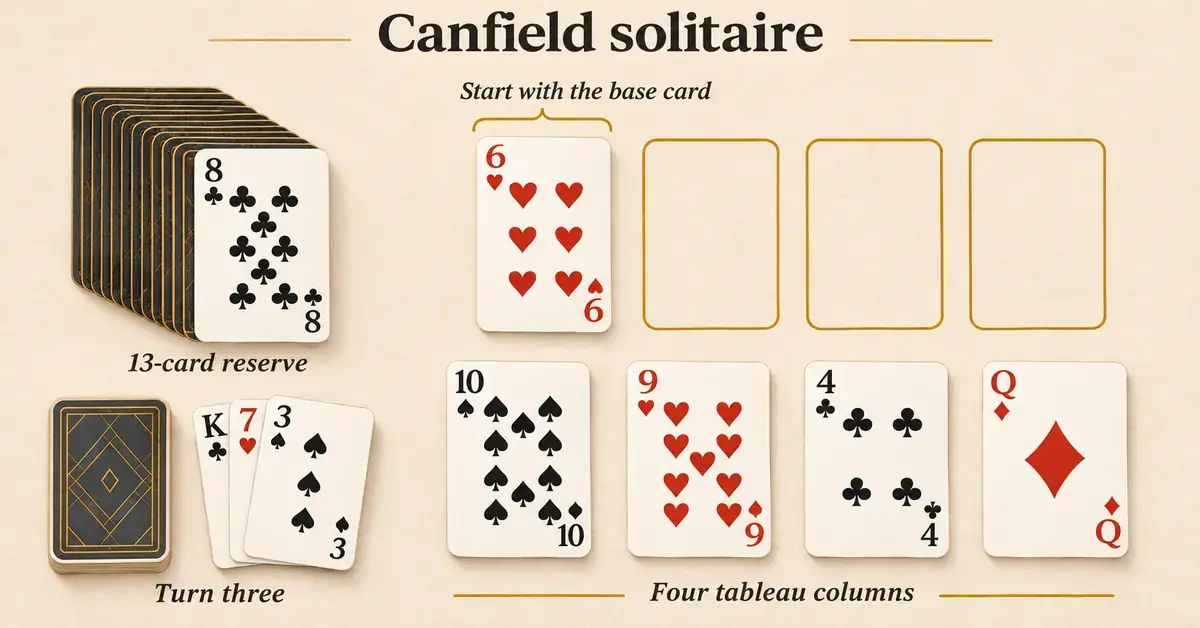
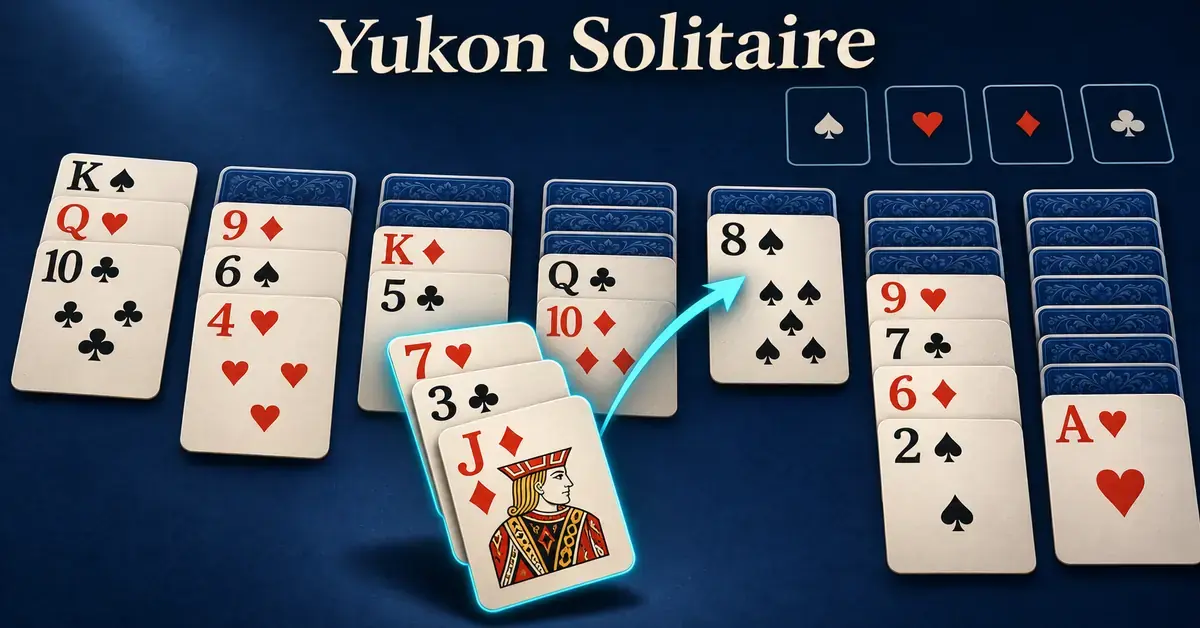
Not every card game needs company. Solitaire (known as Patience in some countries) is a family of single-player games in which you sort a shuffled deck into ordered piles. In Klondike, the best-known version, the aim is to build four "foundation" piles by suit, from Ace up to King, while arranging the tableau in descending rank and alternating colours. FreeCell, Spider and Pyramid change the layout and the rules, and the choice between drawing one card or three at a time changes the difficulty. Digital versions are especially popular with older players as a relaxing daily puzzle; our list of the best solitaire games covers the main variants.
Strategy: where skill meets chance
Every card game sits somewhere on a line between pure luck and pure skill. War and Snap are almost entirely chance, which is exactly why they suit beginners. Poker and Bridge sit at the skilled end, where the same players tend to win over many hands. A few ideas carry across the skilful games:
- Memory and counting: tracking which cards have been played narrows down what opponents can hold.
- Reading opponents: betting patterns, hesitation and discards all leak information – and good players feed false information back.
- Managing the lead: in trick-taking games, choosing which suit to play first can force opponents to spend their strongest cards early.
- Playing the odds: deciding whether to chase a draw or fold comes down to the probability of improving your hand versus the cost of staying in.
No strategy removes chance entirely. A strong starting hand helps, but part of the appeal of cards is that a well-timed decision can still overturn bad luck.
Card games in New Zealand homes and classrooms
In New Zealand, card games are mostly a social and family activity rather than a form of gambling. Simple shedding and matching games are common at family gatherings, and cards are increasingly used as teaching tools. The Game of Awesome, for example, is a free resource commissioned by the Ministry of Education and aimed at students in years 5 to 8. It uses Idea cards to supply loose story prompts that players turn into their own narratives, encouraging creative writing. Bilingual decks – Te Reo Māori versions of Snap, Memory and Go Fish – help learners pick up vocabulary and sentence structure through play. These uses show how the same mechanics that drive competitive games can support learning and connection.
The legal picture: card games and gambling in New Zealand
Playing cards at home, among friends or for no money is not gambling and is not regulated. The rules change when money is staked. Gambling in New Zealand is governed by the Gambling Act 2003, and casino table games such as Blackjack, Poker and Baccarat are offered only in licensed venues – the first of which, Christchurch Casino, opened in 1994. Online casino play has recently been brought into a formal framework: under the Online Casino Gambling Act 2026, the Department of Internal Affairs is establishing a licensing regime for a limited number of online platforms (capped at 15), with player-set spending limits, self-exclusion tools, advertising restrictions and a ban on credit-card payments; the first licences are expected in 2027. If money-based card play is part of your life, our guide to responsible gambling explains the safeguards available.
Disclaimer
This article is for general information only and is not gambling, legal, financial or health advice. Card games played for money carry a risk of financial loss, and no strategy, demo mode or "tip" can guarantee a win or remove the house edge. Gambling in New Zealand is restricted to adults, and licensed casinos admit patrons aged 20 and over. If gambling is causing harm to you or someone you know, free and confidential help is available 24/7 from the Gambling Helpline Aotearoa on 0800 654 655. Regulatory information is published by the Department of Internal Affairs. Contact details for these services are listed in the sources below.
Sources
- International Playing-Card Society – history of playing cards
- Guinness World Records – first modern trading card game (Magic: The Gathering)
- New Zealand Legislation – Gambling Act 2003
- Department of Internal Affairs – Online Gambling Regulatory Implementation
- Christchurch Casino – New Zealand’s first casino
- Ministry of Education (TKI) – Game of Awesome
- Gambling Helpline Aotearoa – free support, 0800 654 655
Frequently Asked Questions (FAQ)
Where did playing cards come from?
Many historians believe cards began in Tang-dynasty China over a thousand years ago, although firm evidence is limited. They are well documented in Europe from the late 1300s, probably arriving from Mamluk Egypt. The hearts, diamonds, clubs and spades on a modern deck were standardised in 15th-century France.
What is the difference between a standard deck and a collectible card game?
A standard deck is a fixed set of 52 cards used for many different games. A collectible or trading card game, such as Magic: The Gathering, uses thousands of unique cards that players collect and combine into their own custom decks, so no two decks need be the same.
Which card games rely on skill rather than luck?
Games sit on a spectrum. War and Snap are almost entirely luck. Poker and Bridge reward skill most strongly, because memory, probability and reading opponents have a large effect over many hands. Most games fall somewhere in between.
What does "shooting the moon" mean in Hearts?
It is a high-risk play in which a single player deliberately wins every heart and the Queen of Spades – all 26 penalty points in the hand. Instead of taking the points, that player usually scores zero and 26 points are added to each opponent.
Are online card games legal in New Zealand?
Playing social or free card games online is fine. Online casino games played for money are now covered by the Online Casino Gambling Act 2026, under which the Department of Internal Affairs is licensing a limited number of regulated platforms, with the first licences expected in 2027.