Poker is a family of betting card games in which players wager on who is holding, or can represent, the strongest five-card hand. What makes it distinctive is the mix of hidden information and public betting: you can see how much your opponents commit, but not the cards they hold. In New Zealand it is played informally at home and in clubs, at the country’s licensed casinos, and online. This guide explains how poker works, the hand rankings every player needs to know, the main variants, the core ideas of position and odds, and how the game is regulated in New Zealand — with the jargon explained as it comes up.
Key Points
- What it is: a family of betting card games where the best, or best-represented, five-card hand wins the pot.
- Deck: standard 52 cards; most games use a rotating dealer button and forced bets (blinds or antes).
- Hand ranks: ten, from Royal Flush (highest) to High Card (lowest).
- Most popular form: Texas Hold’em, played over four betting rounds (pre-flop, flop, turn, river).
- Core actions: fold, check, call, bet/raise, all-in.
- In New Zealand: played at home, in clubs and at licensed casinos; online casino gambling is being licensed under the Online Casino Gambling Act 2026. Casino gambling is 18+.
How a hand of poker works
In most forms of poker the aim is to win the “pot” — the pile of chips or money everyone has bet during a hand. You win either by having the best hand when the remaining players reveal their cards (the “showdown”) or by betting enough that everyone else gives up and “folds”. Because opponents can fold, it is possible to win without the best cards at all.
A standard 52-card deck is used, and players are given chips that represent their stake. To make sure there is always something to play for, most games use forced bets. In community-card games these are the “blinds”: the player to the dealer’s left posts a small blind and the next player a big blind before any cards are dealt. A rotating marker called the “dealer button” shows who is the nominal dealer and sets the order of play, moving one seat clockwise after each hand so the forced bets are shared fairly. Some games use an “ante” instead — a small bet from every player.
The betting actions
On your turn you choose from a small set of actions. New players should learn these before anything else:
- Fold — give up your cards and forfeit any chance at the pot.
- Check — pass the action on without betting, only allowed if no one has bet before you in that round.
- Call — match the current bet to stay in the hand.
- Bet / Raise — put in the first bet of a round, or increase an existing bet.
- All-in — commit every chip you have left in one move.
Betting is also governed by a limit structure agreed before play: No-Limit (you can bet any amount up to your whole stack), Pot-Limit (the maximum bet is the current size of the pot) or Fixed-Limit (bets come in set increments). If you are completely new, our step-by-step guide to how to play poker walks through a full hand from the deal to the showdown.
Poker hand rankings
Every poker decision rests on the hand rankings, because they decide who wins at showdown. A poker hand is always the best five cards you can make. The ten standard rankings run from the Royal Flush at the top down to High Card at the bottom; the rarer a hand is, the higher it ranks.
| Rank | Hand | What it is | Example |
|---|---|---|---|
| 1 | Royal Flush | Ace, King, Queen, Jack, 10, all one suit | A♦ K♦ Q♦ J♦ 10♦ |
| 2 | Straight Flush | Five cards in sequence, all one suit | 6♦ 7♦ 8♦ 9♦ 10♦ |
| 3 | Four of a Kind | Four cards of the same rank | 9♠ 9♦ 9♣ 9♥ A♣ |
| 4 | Full House | Three of one rank plus a pair of another | A♦ A♠ A♣ 7♣ 7♥ |
| 5 | Flush | Five cards of one suit, not in sequence | K♦ Q♦ 8♦ 6♦ 2♦ |
| 6 | Straight | Five cards in sequence, mixed suits | 7♠ 8♦ 9♣ 10♥ J♠ |
| 7 | Three of a Kind | Three cards of the same rank | 10♠ 10♦ 10♣ 6♥ A♠ |
| 8 | Two Pair | Two different pairs | Q♠ Q♥ 6♠ 6♦ K♠ |
| 9 | One Pair | Two cards of the same rank | J♦ J♠ K♠ 9♥ 7♣ |
| 10 | High Card | No combination; judged by highest card | K♥ J♠ 10♥ 8♣ 7♦ |
For a fuller breakdown with every tie-break case, see our dedicated page on poker hand rankings.
How ties are broken
When two players hold the same type of hand, the higher cards decide it. The unmatched cards that settle these ties are called “kickers”. For example, two players each holding a pair of Kings are separated by their next-highest card. If every one of the five cards matches in rank, the players split the pot evenly. Suits have no ranking value in standard poker, so they never break a tie.
Texas Hold’em and the betting rounds
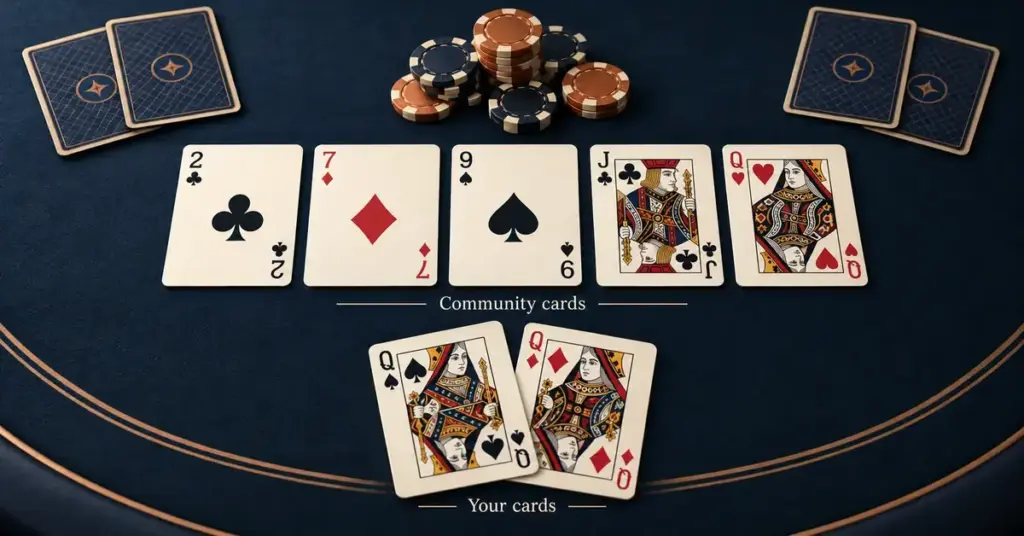
Texas Hold’em is by far the most widely played form of poker in New Zealand and worldwide. Each player receives two private cards (the “hole cards”), and up to five shared “community cards” are dealt face-up in the middle. You make your best five-card hand from any combination of your two cards and the five on the board.
Hold’em is played across four betting rounds, which are worth knowing by name:
- Pre-flop — betting after the hole cards are dealt, before any community cards.
- The flop — the first three community cards are revealed, then betting.
- The turn — a fourth community card, then betting.
- The river — the fifth and final community card, then the last round of betting before showdown.
Players who want to go deeper can read our guide to Texas Hold’em strategy.
Popular poker variants
Although Texas Hold’em dominates, several other variants are played in New Zealand homes, clubs and online. Each changes how many cards you hold and how a hand is built, which in turn shifts the typical strength of a winning hand. In Omaha, for instance, winning hands are generally stronger than in Hold’em because players have more cards to work with.
Poker Variant Comparison
| Variant | Cards per player | Community cards | Key feature |
|---|---|---|---|
| Texas Hold’em | 2 hole cards | 5 shared | Most common form; use any mix of hole and board cards. |
| Omaha | 4 hole cards | 5 shared | Must use exactly two hole cards and three from the board. |
| Omaha Hi-Lo | 4 hole cards | 5 shared | Pot is split between the highest and a qualifying lowest hand. |
| Seven-Card Stud | 7 cards (mix of face-up and face-down) | None | Older format with no community cards; was popular before Hold’em. |
| Five-Card Draw | 5 cards, all private | None | Simplest form; players may swap cards once. |
| Short Deck (6+) | 2 hole cards | 5 shared | Played with a 36-card deck (2s–5s removed); altered hand values. |
Core concepts: position, odds and bankroll
Three ideas come up constantly in poker. Understanding them is less about winning and more about following the game and making informed choices.
Table position
Position describes where you sit relative to the dealer button and therefore when you act. Acting later is an advantage because you have seen what others did before you decide. Players in “early position” (just left of the blinds) act first with the least information, while the button acts last. This is why experienced players treat the same two cards differently depending on where they are sitting.
Pot odds and outs
“Pot odds” compare the cost of a call to the size of the pot. If the pot holds $100 and it costs $20 to call, you are being offered 5-to-1. “Outs” are the unseen cards that would complete a drawing hand, such as the remaining cards of a suit when you are one short of a flush. Comparing your outs to the pot odds is how players judge whether a call is mathematically reasonable rather than a guess.
Bankroll management
Bankroll management simply means only playing at stakes you can comfortably afford to lose, and treating the money set aside for poker as separate from everyday spending. It is a harm-reduction habit as much as a strategic one: it keeps a single bad run from causing real financial stress. Set a limit before you sit down and stop when you reach it.
Reading opponents and bluffing
Poker involves people as much as cards. A bluff is a bet made with a weak hand to represent a strong one; for it to work, your betting over the hand has to tell a believable “story”. Players also watch for “tells” — habits in timing, bet sizing or body language that hint at how confident someone is — and try to keep their own behaviour consistent, the origin of the phrase “poker face”. None of this guarantees a result: cards are dealt at random, and no bluff, system or “tip” changes the odds of the next card. If you are starting out, our beginner poker tips cover the habits that matter most.
Table etiquette and the dealer’s role
Whether a dedicated dealer runs the game, as in a casino, or dealing rotates with the button at a home game, the same courtesies keep play fair. The main ones are easy to remember:
- Act in turn — wait for your turn so you do not leak information to others still to act.
- No string bets — put your full bet out in a single motion rather than in stages.
- Protect your hand — keep your hole cards covered and on the table.
- Showdown order — the last player to bet or raise usually shows their cards first.
Poker in New Zealand: where it is played and the rules
Poker is enjoyed widely in New Zealand, from kitchen-table games to club nights and the poker rooms at licensed casinos such as those operated by SkyCity. Home games played purely among friends, where no one profits except as a player, are generally treated as private social gambling under the Gambling Act 2003.
Online poker and casino gambling have historically sat in a grey area: it was not illegal for an individual in New Zealand to play on an offshore site, but those operators were not licensed or regulated locally. That is changing. In 2026 New Zealand passed the Online Casino Gambling Act 2026, which creates a licensing system administered by the Department of Internal Affairs, caps the number of online casino licences and sets consumer-protection and harm-minimisation duties for operators. The rollout is being phased in, so the available and lawful options are evolving — check the Department of Internal Affairs for the current position before playing online for money.
Common beginner mistakes
A few errors turn up again and again among new players. Being aware of them helps you follow the game and keep it enjoyable:
- Playing too many hands — entering pots out of boredom rather than with a reason.
- Chasing draws — calling bets to complete a flush or straight when the pot odds do not justify it.
- Ignoring position — playing weak hands from early position where you have the least information.
- Not setting a limit — playing without a loss limit or a fixed stake, which is where bankroll management matters most.
Responsible gambling
Poker played for money is a form of gambling and carries financial risk. Outcomes depend on chance as well as decisions, and no strategy, demo game or “tip” removes the house edge or the long-run risk of losing. This section is information only and is not advice. Set a budget before you play, never bet money you cannot afford to lose, and avoid chasing losses. Gambling in New Zealand is restricted to adults (18+ at casinos). If gambling is causing harm to you or someone you know, free, confidential help is available 24/7 from the Gambling Helpline Aotearoa on 0800 654 655 (text 8006) and the Problem Gambling Foundation of New Zealand on 0800 664 262. You can also read our guide to responsible gambling.
Sources
Frequently asked questions
What is the highest hand in poker?
The highest hand in standard poker is the Royal Flush — the Ace, King, Queen, Jack and 10 all of the same suit. It is the top end of the Straight Flush category and cannot be beaten.
How many cards are dealt in Texas Hold’em?
Each player receives two private hole cards, and up to five community cards are dealt face-up in the middle. You make your best five-card hand from any mix of those seven cards.
What are the blinds in poker?
The blinds are forced bets posted before the cards are dealt by the two players to the left of the dealer button — a small blind and a larger big blind. They ensure there is money in the pot to play for every hand.
Is poker legal in New Zealand?
Private social poker among friends is generally lawful under the Gambling Act 2003, and casino poker is offered at licensed venues. Online casino gambling is being brought under a new licensing regime by the Online Casino Gambling Act 2026; check the Department of Internal Affairs for the current status.
Is poker a game of luck or skill?
Both. Luck decides the cards dealt in any single hand, but over many hands skill in betting, reading situations and managing risk has a clear influence on results. Chance never disappears, which is why it remains a form of gambling.