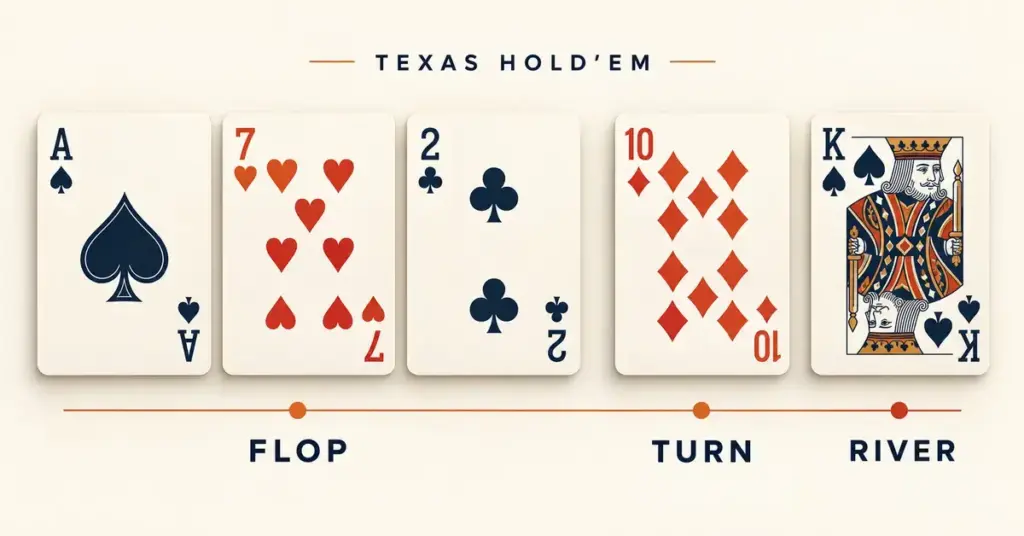

Texas Hold’em is the most widely played form of poker in the world, from friendly kitchen-table games across New Zealand to the biggest televised tournaments. The appeal comes from a simple idea that hides enormous depth: every player builds the best five-card hand they can from two private cards and five shared community cards, while betting, folding and bluffing their way toward the pot. This guide explains the rules from the ground up, including how a hand is dealt, the four betting rounds, how hands are ranked, why seating position matters, and the legal picture for players in Aotearoa.
Quick Facts
| Players | 2 to 10 (heads-up to a full ring table) |
| Equipment | Standard 52-card deck, poker chips, dealer button |
| Game type | Community-card poker |
| Betting formats | No-Limit, Pot-Limit, Fixed-Limit |
| Community cards | 5 shared cards (flop, turn, river) |
| Betting rounds | 4 (pre-flop, flop, turn, river) |
| Origin | Widely credited to Robstown, Texas, early 1900s |
| Status in New Zealand | Legal in licensed casinos; home and club games regulated under the Gambling Act 2003 |
What Texas Hold’em is
Texas Hold’em is a “community-card” poker game, meaning most of the cards on the table are shared by everyone rather than kept hidden. It is widely credited to Robstown, Texas, in the early 1900s, and it spread through the United States before becoming the headline game of modern poker. Each player receives two private cards, called hole cards, and then combines them with five face-up community cards to make a five-card hand.
A standard 52-card deck is used, with no jokers. Players use chips to bet, and a round marker called the dealer button shows whose turn it is to be the nominal dealer. The game can be played in several betting formats — No-Limit (you can bet all your chips at any point), Pot-Limit (the maximum bet is the current size of the pot) and Fixed-Limit (bets come in set amounts). No-Limit Hold’em is the version used in most major tournaments. If you are completely new to the game, our overview of how to play poker covers the shared basics of all poker variants.
The objective and basic flow of a hand
The goal of each hand is to win the pot — the pile of chips that all players have bet. You can do this in one of two ways: by having the best five-card hand once all betting is finished (the showdown), or by making every other player fold before then, so you are the last one standing. Because you can win without ever showing your cards, betting and deception are as important as the cards themselves.
A single hand follows a clear sequence. The blinds are posted, two hole cards are dealt to each player, and then play moves through four betting rounds separated by the dealing of community cards. At the end, surviving players reveal their hands and the strongest one takes the pot. The button then moves one seat clockwise and a new hand begins.
The blinds and the dealer button
Before any cards are dealt, two players must put chips in the pot to get the action started. These forced bets are called the blinds. The player immediately to the left of the button posts the small blind, and the next player posts the larger big blind. The blinds guarantee there is always something worth competing for and stop everyone from simply folding every hand.
The dealer button rotates one seat clockwise after each hand so that the responsibility of posting blinds, and the advantage of acting last, is shared fairly. In a casino a professional croupier deals every hand, but the button still marks the theoretical dealer; in a home game the deal usually rotates with the button. Cards are dealt one at a time, starting with the small blind, and a “cut card” is often placed under the deck so the bottom card cannot be seen.
The four betting rounds explained
Texas Hold’em is defined by four rounds of betting. Community cards are revealed between the rounds, and each new card gives players more information to act on.
- Pre-flop: Each player looks at their two hole cards and the first round of betting takes place, starting with the player to the left of the big blind.
- The flop: Three community cards are dealt face up at once, followed by a second round of betting.
- The turn: A fourth community card is added, followed by the third round of betting.
- The river: The fifth and final community card is dealt, followed by the fourth and last round of betting. If two or more players remain, there is a showdown.
In a casino, the dealer “burns” (discards) the top card of the deck before dealing the flop, turn and river. This long-standing practice helps protect against any card being marked or accidentally exposed. By the river, all five community cards are visible, so every remaining player has the most complete picture of what is possible — which is why the biggest decisions, including going “all-in” with every chip, often happen here.
Betting actions you can take
On your turn you always have a defined set of options, depending on whether anyone has bet before you in that round:
- Check: Pass the action to the next player without betting. This is only allowed if no one has bet yet in the current round.
- Bet: Put chips into the pot when no one else has in that round.
- Call: Match the amount of the current bet to stay in the hand.
- Raise: Increase the current bet, forcing others to call the higher amount or fold.
- Fold: Give up your cards and any chance at the pot, losing anything you have already bet.
Poker hand rankings from strongest to weakest
Knowing the order of poker hands by heart is essential, because at showdown the pot goes to the best five-card combination. The ranking below is standard across Texas Hold’em and most other poker variants. Remember that suits have no value of their own — a flush in spades does not beat a flush in hearts; only the card values matter.
Poker Hand Rankings
| Rank | Hand | What it is | Example |
|---|---|---|---|
| 1 | Royal Flush | Ace to ten, all the same suit | A♠ K♠ Q♠ J♠ 10♠ |
| 2 | Straight Flush | Five cards in sequence, all one suit | 7♥ 8♥ 9♥ 10♥ J♥ |
| 3 | Four of a Kind | Four cards of the same rank | Q Q Q Q 3 |
| 4 | Full House | Three of a kind plus a pair | K K K 8 8 |
| 5 | Flush | Five cards of one suit, not in sequence | A♦ J♦ 9♦ 6♦ 3♦ |
| 6 | Straight | Five cards in sequence, mixed suits | 5 6 7 8 9 |
| 7 | Three of a Kind | Three cards of the same rank | 9 9 9 K 4 |
| 8 | Two Pair | Two different pairs | J J 4 4 A |
| 9 | One Pair | Two cards of the same rank | 10 10 A 7 3 |
| 10 | High Card | None of the above; highest card plays | A Q 9 5 2 |
For a fuller explanation of each hand with more examples, see our dedicated guide to poker hand rankings.
Kickers, ties and reading the board
When two players hold the same type of hand, the winner is decided by the next highest card, known as the kicker. For example, if both players have a pair of aces, the player whose remaining cards are higher wins. If the five best cards are identical for both players — which can happen when the strongest hand is formed entirely by the community cards — the pot is split evenly. Learning to “read the board” means quickly seeing the best hand the community cards could make, and judging whether your two hole cards improve on it.
Choosing which starting hands to play
Most of the money in Texas Hold’em is won or lost before the flop, simply through which two hole cards you decide to play. New players lose chips fastest by entering too many pots with weak cards, so having a rough plan for your starting hands is one of the quickest ways to improve. A hand’s strength depends on the cards themselves, how many players are at the table and where you are sitting.
A few general principles apply. Big pairs and two high cards play well; two cards of the same suit (“suited”) can make a flush and are worth slightly more than the same cards of different suits (“offsuit”); and cards close together in rank (“connectors”) can make straights. The table below groups common hands to give beginners a starting framework rather than a strict rulebook.
| Hand group | Examples | General approach |
|---|---|---|
| Premium pairs | A-A, K-K, Q-Q | Raise and re-raise from any seat |
| Strong high cards | A-K, A-Q, K-Q | Raise to build the pot and narrow the field |
| Medium pairs | J-J down to 7-7 | Play readily, but take care against big raises |
| Suited connectors | 8-9, 9-10 of one suit | Worth playing cheaply from late position |
| Weak, unconnected cards | 7-2, J-4 offsuit | Fold in almost every situation |
Notice how much this advice leans on position, which the next section explains. The later you act, the wider the range of hands you can play profitably, because you gather information before committing chips.
Table position and why it matters

Where you sit relative to the dealer button has a large effect on how you should play, because players who act later in a round get to see what everyone else does first. That extra information is a real advantage. Players in early position (including the blinds) act first after the flop and see the least, so they usually play only strong hands. Players in late position, especially on the button, act last and can play a wider range of hands with more confidence.
Because the button acts last on the flop, turn and river, it is generally regarded as the most powerful seat at the table. Experienced players use it to control the size of the pot, to bet when opponents show weakness by checking, and to “steal” the blinds. If you want to turn these ideas into a full game plan, our guide to Texas Hold’em strategy goes much deeper into position and bet sizing.
Bluffing and reading opponents
Poker rewards the ability to “play the player” as well as the cards. A bluff is a bet or raise made with a weak hand to convince opponents you are strong, hoping they fold a better hand. A good bluff tells a consistent story: your bets across all four rounds should make sense for the strong hand you are pretending to hold. A semi-bluff is a bet made with a drawing hand that is weak now but could improve, giving you two ways to win.
Alongside bluffing, players watch for tells — betting patterns or physical habits that hint at hand strength — and for the right moments to make a value bet, which is a bet made with a strong hand to get a weaker hand to call. Beginners often improve fastest by focusing on discipline rather than tricks; our collection of beginner poker tips is a practical starting point.
Counting outs and pot odds
A good deal of the skill in Texas Hold’em comes down to simple arithmetic you can do at the table. An out is any remaining card that would turn your hand into a likely winner. If you hold four cards to a flush after the flop, nine cards of that suit are still unseen, so you have nine outs.
A handy shortcut called the rule of 2 and 4 turns outs into a rough percentage. Multiply your outs by four when two cards are still to come (on the flop) and by two when only one card remains (on the turn). Nine flush outs therefore work out at roughly 36 per cent to hit by the river, or about 18 per cent on the turn alone — close enough to the true odds to guide a quick decision.
| Draw | Outs | Approx. chance by the river (from the flop) |
|---|---|---|
| Flush draw | 9 | About 35% |
| Open-ended straight draw | 8 | About 32% |
| Two overcards | 6 | About 24% |
| Gutshot (inside) straight draw | 4 | About 16% |
Pot odds tell you whether chasing a draw is worth it. They compare the amount you must call with the size of the pot after you call. If you have to put in $20 to win a pot that would then be worth $120, you are being offered one in six, or about 17 per cent — so a flush draw that completes around 35 per cent of the time is a clearly profitable call. Whenever the chance of improving is higher than the price the pot is asking, calling makes mathematical sense over the long run.
Common beginner mistakes
New players tend to lose chips for a handful of predictable reasons. Being aware of them early will save you money and frustration.
- Playing too many hands: Entering pots with weak hole cards is the most common leak. Folding more often, especially from early position, is usually correct.
- Ignoring position: Treating every seat the same, rather than playing tighter early and looser on the button.
- Chasing draws blindly: Calling bets to complete a flush or straight without weighing the cost against the size of the pot (the “pot odds”).
- Going on tilt: Letting a bad beat trigger reckless, emotional play. Stepping away for a few hands restores discipline.
- Poor bankroll management: Playing at stakes you cannot comfortably afford, so a single losing session does real harm.
Cash games versus tournaments
Texas Hold’em is played in two broad formats, and they reward quite different approaches. In a cash game, every chip stands for real money, the blinds stay the same throughout, and you can join or leave the table whenever you like. If you run low you can usually “re-buy” and keep playing. In a tournament, everyone pays the same entry fee for an equal starting stack, the blinds rise at set intervals, and play continues until one person holds all the chips, with the last players remaining sharing a prize pool.
Because tournament blinds keep climbing, stacks shrink in relative terms and players are forced to take more risks as the event goes on, often committing all their chips before the final cards are revealed. Cash games tend to allow deeper, more patient play because stacks are larger compared with the blinds. If you want to test yourself in organised events, our guide to NZ card game tournaments covers where structured play happens around the country.
| Feature | Cash game | Tournament |
|---|---|---|
| Blinds | Stay the same | Increase at set intervals |
| Chip value | Equal to real money | Points only; prizes paid at the end |
| Joining and leaving | Any time | Fixed start; play until eliminated |
| Re-buys | Usually allowed | Limited or not permitted |
| Payouts | Taken whenever you cash out | Top finishers share the prize pool |
Playing Texas Hold’em in New Zealand
In New Zealand, gambling is governed by the Gambling Act 2003, administered by the Department of Internal Affairs (DIA) and the Gambling Commission. Poker played for money in a licensed casino — such as SkyCity venues — is legal and regulated. Poker run outside a casino, including club tournaments and “poker nights”, falls into the Act’s categories of Class 1, 2 or 3 or “private gambling”, each with its own conditions; organisers generally cannot take a profit or commission, and doing so can make an event unlawful. Purely social home games among friends, where no one profits except by winning, are treated as private gambling.
Online casino gambling in New Zealand is now covered by the Online Casino Gambling Act 2026, which the DIA has begun to implement. If you want to understand the mathematics behind casino games before you sit down, our explainer on casino card games for beginners is a useful companion. Whatever the setting, poker involves real money and real risk, so it should always be played within limits you set in advance.
Table etiquette and common courtesies

Whether you are at a casino, a club or a kitchen table, a few shared conventions keep the game fair and friendly. Most are about acting clearly and in turn so that no one gains an unfair read on the hand.
- Act in turn: Wait for the players before you to act. Folding, betting or reacting out of turn gives away information and can change how others play.
- Make one clear motion: Announce “call”, “raise” or “fold” and move your chips in a single action. Adding chips in several motions is called a “string bet” and is not allowed, because it can be used to gauge reactions.
- Keep cards and chips visible: Hole cards stay on the table in full view, and higher-value chips sit at the front of your stack so everyone can see roughly what you hold.
- Do not slow roll: If you hold the winning hand at showdown, turn it over promptly rather than pausing to taunt an opponent.
- Keep quiet on live hands: Avoid discussing cards you have folded or coaching other players while a hand is still in play.
These courtesies matter just as much in casual pub card games as they do in formal settings, and following them helps every session run smoothly.
Responsible gambling
This article is an informational guide to the rules of Texas Hold’em and is not gambling advice. No strategy, bluff or practice session can guarantee a win, and the house or other players can always take your money; poker involves real financial risk and should only be played with money you can afford to lose. Set time and spending limits before you play and never chase losses.
If gambling is causing harm to you or someone you know in New Zealand, free and confidential help is available. You can contact the Gambling Helpline Aotearoa on 0800 654 655 or by texting 8006, any time of day. General information on staying in control is available from our responsible gambling resource.
Sources
Frequently Asked Questions
How many cards does each player get in Texas Hold’em?
Each player is dealt two private cards, called hole cards, at the start of every hand. These are combined with the five shared community cards to make the best possible five-card hand.
What is the best possible hand?
The strongest hand is the royal flush — the ace, king, queen, jack and ten all of the same suit. It is the top of a ten-tier ranking that runs down through straight flush, four of a kind and so on to a simple high card.
Do the blinds change during a game?
In a cash game the blinds usually stay the same size throughout. In tournaments the blinds increase at set time intervals, which forces the action and gradually reduces the number of players as stacks are put at risk.
Can you win without the best cards?
Yes. If you bet or raise enough that every other player folds, you win the pot regardless of what you were holding. This is the basis of bluffing, and it is why poker is considered a game of skill over the long run.
What happens if two players have the same hand?
The highest unused card, called the kicker, decides the winner. If both players’ best five cards are identical — for instance when the board itself makes the strongest hand — the pot is split equally between them.
How many people can play Texas Hold’em?
A single table takes two to ten players. Two-player poker is called “heads-up”, while a full table of nine or ten is known as a “full ring” game. Larger events simply run several tables at once and merge them as players are knocked out.
What does it mean to go all-in?
Going all-in means betting every chip you have left in one move. You cannot be forced out of the hand for lack of chips, but you can only win the portion of the pot you have matched; any further betting between other players forms a separate “side pot”.