Golf is a simple-to-learn card game in which the aim is the opposite of most card games: you want the lowest score, not the highest. Played over several rounds — known as “holes”, in keeping with the sport it is named after — each player manages a small grid of mostly hidden cards, swapping high cards for low ones and matching cards into columns that cancel to zero. It is a popular choice for family evenings, camping trips and community game nights across New Zealand because the rules fit on a single page yet the decisions stay interesting. This guide explains the standard six-card and nine-card versions, the card values, how a turn works, how scoring is tallied, the main variations and a few practical strategy tips.
Quick facts
| Players | 2–4 (one deck); up to ~8 with two decks |
|---|---|
| Deck | Standard 52-card pack (Jokers optional) |
| Objective | Lowest total score |
| Grid (six-card) | 6 cards, two rows of three |
| Start | Turn 2 of your cards face up |
| Game length | 9 “holes” (rounds); 18 for a longer match |
| Skill level | Easy to learn; memory and judgement reward practice |
The objective: lowest score wins
In Golf, each player is dealt a grid of face-down cards. Across a fixed number of holes you try to keep the total value of your grid as low as possible, because here high cards are a liability rather than a prize. Through a series of draws and discards you replace high cards with lower ones, or pair matching cards in a column so they cancel out. The winner is the player with the lowest cumulative score once every hole has been played. The game uses a standard 52-card deck and works well with two to four players; for larger groups you shuffle two decks together.
Golf rewards memory and judgement rather than luck alone. You must remember what your own face-down cards are, read what opponents are collecting, and decide when to gamble on an unknown card from the stock versus take a known card from the discard pile.
Setting up and dealing the grid
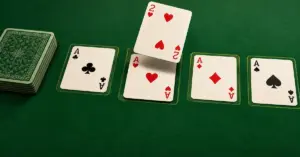
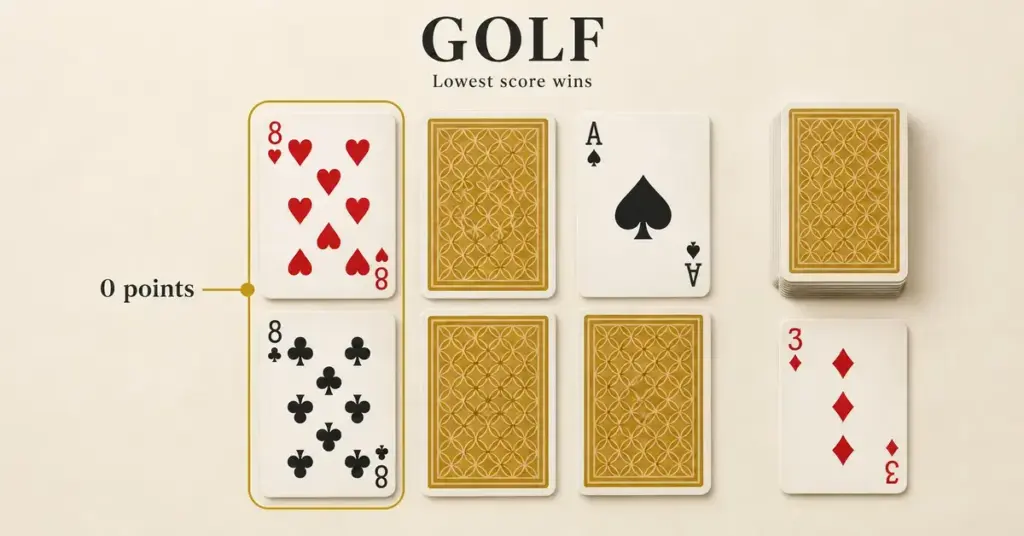
For the standard six-card game, the dealer gives each player six cards face down, arranged in two rows of three. The rest of the deck becomes the stock (draw) pile in the centre, and the top card is turned over to start the discard pile beside it. Before play begins, each player turns any two of their six cards face up and leaves them that way. Those two revealed cards, plus whatever you can remember of the rest, are the information you start the hole with.
Card values and scoring
Knowing the point value of each rank is the foundation of good play. The values below follow the standard six-card rules published by Bicycle:
- Ace — 1 point.
- 2 — minus 2 points (the most valuable single card to hold).
- 3 to 10 — face value.
- Jack and Queen — 10 points each (the cards you most want to get rid of).
- King — 0 points.
| Card rank | Point value | Strategic status |
|---|---|---|
| 2 | −2 | Best card to keep |
| King | 0 | Excellent |
| Ace | 1 | Very good |
| 3 – 10 | Face value | Neutral to poor |
| Jack / Queen | 10 | High risk |
Cancelling cards with column pairs
The key scoring twist in six-card Golf is the column pair. If you end a hole with two cards of the same rank in the same vertical column (one card in the top row, one directly below it), that column scores 0 instead of the two card values added together. For example, two Queens in a column score 0 rather than 20. This lets you safely keep an otherwise expensive card if you can find its match, and it adds real depth to which cards you choose to discard.
How a turn works
Play passes clockwise. On your turn you draw one card from either the stock pile or the top of the discard pile, then choose one of two actions:
- Swap it in. Place the drawn card face up into your grid in place of any one of your cards — face up or still face down — and put the replaced card face up on the discard pile. Swapping always reveals that grid position.
- Discard it. If you drew from the stock and do not want the card, simply place it on the discard pile and your turn ends. In standard six-card Golf you do not have to flip one of your face-down cards when you discard — a common misconception borrowed from other grid games.
One restriction applies: a card taken from the discard pile must be used — you cannot pick it up and immediately put it back. Because the only way to reveal a face-down card is to replace it, your grid gradually turns face up as the hole goes on.
| Draw from | What you get | Trade-off |
|---|---|---|
| Discard pile | A known card | Opponents see what you are building |
| Stock pile | An unknown card | Risk of drawing a 10-point Jack or Queen |
Ending a hole
A hole ends as soon as a player has all six of their cards face up. Under Bicycle’s rules the round stops at that moment; many groups add a house rule giving every other player one final turn to improve their grid before the cards are totalled. Either way, once play stops, all remaining face-down cards are flipped and each player adds up their grid, applying any column-pair cancellations. The timing of your last reveal matters: ending the hole too early can leave you stuck with a higher total than opponents who were still improving.
Key points
- Lowest score wins, so high cards are a liability and low cards are prizes.
- Values: Ace 1, 2 = −2, 3–10 face value, Jack/Queen 10, King 0.
- Two matching cards in the same column cancel to 0 points.
- Each turn: draw from the stock or discard pile, then swap it in or discard it — no forced flip when you discard.
- A hole ends when a player’s whole grid is face up; a game is nine holes.
- Always confirm house rules (Jokers, pairs-anywhere, going-out penalty) before dealing.
Six-card Golf: the standard game
The six-card version is the one most people mean by “Golf” and the format usually played socially in New Zealand. With three columns there are plenty of chances to form cancelling pairs, so it balances quick play with meaningful choices. Memory is central: because you only ever see two cards at the start, you must track what sits under each face-down position to know whether a freshly drawn low card is worth a swap. A full game is nine holes, after which the lowest cumulative score wins; some groups play eighteen holes for a longer match.
Dealing with a stranded high card
If you are left holding a Jack or Queen (10 points), your priorities are to swap it out for something lower, or to pair it with a matching card in the same column so the column cancels to zero. Watch the discard pile: a second Queen appearing there can rescue a column, but taking it also signals your plan to the table. Weigh the points saved against the information you give away.
Nine-card Golf and other grid sizes
Golf scales to several grid sizes. Four-card Golf (a 2×2 square) is fast and casual, while nine-card Golf uses a 3×3 grid for a longer, more demanding game. In standard nine-card rules the cancelling unit is a full vertical column of three matching cards, which scores 0; a pair on its own does not cancel. Some groups use house rules that award negative scores for three of a kind, or that allow pairs and rows to cancel — agree on these before you deal, because they change strategy considerably.
| Grid size | Layout | Feel |
|---|---|---|
| 4 cards | 2×2 square | Fast, casual |
| 6 cards | 2 rows of 3 | Standard social play |
| 9 cards | 3×3 square | Longer, more strategic |
Whichever size you choose, the core loop — draw, decide, swap or discard, and chase cancelling matches — stays the same. If you enjoy this style of lowest-score grid game, the commercially published Skyjo card game uses almost identical mechanics with its own custom deck.
Strategy: reading the table
Beyond managing your own grid, strong play means watching what everyone else is doing. The discard pile and the cards opponents pick up tell you which ranks are leaving the deck and what your rivals are trying to pair.
- Track which low cards (2s, Aces, Kings) have already been taken — the fewer that remain, the less likely you are to draw one from the stock.
- If an opponent is clearly collecting a particular rank for a column, avoid discarding that rank and handing them the match.
- Use the discard pile as a running map of what is still available, and lean towards the known discard when the stock looks risky.
- Near the end of a hole, play defensively: dumping a 10-point card for a mediocre one can beat clinging to a pair that may never complete.
Common variations and house rules
Golf has many regional and family variants, so it is worth confirming the rules before the first deal. Frequently seen options include:
- Jokers: added to the deck and usually scored as minus 2 in six-card Golf, making them the lowest card available.
- Pairs anywhere: allowing matching cards to cancel even when they are not in the same column.
- Going-out penalty: if the player who triggers the end of the hole does not finish with the lowest grid, their score for that hole is doubled or carries a fixed penalty.
- Peek charges: paying a point to look again at a face-down card.
- Game length: playing nine or eighteen holes, or continuing until someone reaches a set total such as 100 points.
Golf also sits nicely alongside other easy social games. If you are planning a games night, our guides to the best family card games and to good card games for groups suggest plenty of companions, while two-player card games cover the nights when it is just the two of you.
Who Golf suits
Golf works for a wide range of players. Children can grasp the lowest-score goal quickly, making it a solid pick from the classic Kiwi card games families already know. Its slow-to-medium pace leaves room for conversation, so it suits relaxed evenings, and the constant mental arithmetic and memory work make it a gentle brain workout often enjoyed in community and retirement groups. It also travels well: all you need is a deck and a flat surface, so it is a natural fit for the bach, a campsite or a picnic blanket — durable plastic cards help on a breezy beach.
Common mistakes to avoid
- Forgetting your own grid. If you lose track of your face-down cards you cannot judge whether a swap actually helps.
- Hoarding a pair that never lands. Keeping two expensive cards hoping for a column match can cost you the hole if it fails.
- Taking the discard too freely. Every discard you take reveals your plan; take it only when the points clearly justify it.
- Ignoring the variation in use. Whether 2s score minus two, whether Jokers are in, and how columns cancel all change the maths — agree the rules first.
Frequently Asked Questions
How many people can play the Golf card game?
Two to four players works well with a single 52-card deck. For a larger group of roughly five to eight, shuffle two decks together so there are enough cards for everyone’s grid.
What are the card values in Golf?
In the standard six-card game an Ace is 1, a 2 is minus 2, cards 3 to 10 are face value, Jacks and Queens are 10 each, and Kings are 0. Two matching cards in the same vertical column cancel out and score 0 for that column.
Do I have to flip a face-down card when I discard a drawn card?
No. In standard six-card Golf, if you draw from the stock and do not want the card you simply discard it and your turn ends. Cards are only revealed when you swap one into your grid — the forced-flip rule belongs to other grid games, not six-card Golf.
How does a round end and how many rounds are there?
A hole ends when a player has all of their cards face up; many groups let everyone else take one final turn first. A full game is normally nine holes (some play eighteen), and the lowest cumulative score wins.
Can I cancel cards that are not in the same column?
Not in the standard six-card rules, where only vertical column pairs score zero. Some house rules allow matching cards to cancel anywhere in the grid, so check which version your group is playing before you start.