
<div><img src="https://card-games.nz/wp-content/uploads/2026/02/board-game-nz-hero.jpg"></div>
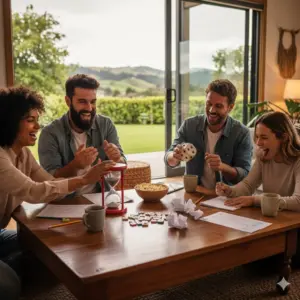
The "board game NZ" market has entered a significant renaissance in 2026, driven by a growing cultural shift toward offline social interaction and "screen-free" family entertainment across New Zealand. From the bustling board game cafes of Auckland and Nelson to the competitive hobby circuits in Christchurch, tabletop gaming has transitioned from a niche hobby into a mainstream pillar of domestic connection and cognitive development. This comprehensive guide provides an expert deep dive into the New Zealand board gaming landscape, covering everything from the most anticipated 2026 releases like RoboMon and Everdell Emerland to timeless strategic classics such as Catan and Ticket to Ride. We explore the practical benefits of gaming—including enhanced numeracy, social-emotional resilience, and executive function—while providing actionable advice on selecting the right titles for different age groups and skill levels. Whether you are a parent looking for the best "stealth learning" tools for your children, a competitive strategist hunting for the latest Eurogame expansions, or a casual group seeking the next viral party hit like Flip 7, this guide serves as your professional roadmap to the tabletop world. By the end of this article, you will have a clear understanding of the local market trends, where to find the most active gaming communities in the South Pacific, and how to build a high-value home library that fosters lasting memories and sharpens the mind.
- Market Growth: The global board games market is projected to reach USD 23.8 billion by 2035, with a stable CAGR of 5.6% starting in 2026.
- Key 2026 Titles: Most anticipated releases include RoboMon, Witchbound, Cyberpunk 2077: The Board Game, and Sanibel.
- Cognitive Benefits: Games like Chess, Go, and Sushi Go! are statistically linked to improved memory, planning, and focus.
- Local Hubs: New Zealand's gaming culture is anchored by premier venues like Cakes n Ladders (Auckland) and Flock Board Game Cafe (Nelson).
- Strategic Selection: Modern families are increasingly pivoting toward cooperative games to build teamwork and reduce sibling conflict.
Market Growth: The global board games market is projected to reach USD 23.8 billion by 2035, with a stable CAGR of 5.6% starting in 2026.
Key 2026 Titles: Most anticipated releases include RoboMon, Witchbound, Cyberpunk 2077: The Board Game, and Sanibel.
Cognitive Benefits: Games like Chess, Go, and Sushi Go! are statistically linked to improved memory, planning, and focus.
Local Hubs: New Zealand's gaming culture is anchored by premier venues like Cakes n Ladders (Auckland) and Flock Board Game Cafe (Nelson).
Strategic Selection: Modern families are increasingly pivoting toward cooperative games to build teamwork and reduce sibling conflict.
The Resurgence of Tabletop Gaming in New Zealand
The board game NZ scene is currently witnessing an unprecedented surge in popularity, fuelled by a collective desire to combat digital fatigue and rediscover face-to-face social engagement. In 2026, the local market is no longer defined just by the classics like Monopoly or Scrabble; instead, Kiwi households are embracing sophisticated "Eurogames" and thematic adventures that offer deep narrative immersion. This shift is supported by a robust infrastructure of specialty retailers and community events, which have seen a 25% increase in attendance over the past year. Parents and educators are leading this charge, recognizing that board games provide a unique platform for "gamified learning" where children can master complex math and literacy skills in a low-pressure, playful environment.
| Aspect | Trend in 2026 | Impact on NZ Families |
| Market Value | Rising (CAGR 6.5%) | Greater accessibility and variety of titles |
| Popular Genre | Puzzles & Strategy | Focus on logic-building and spatial awareness |
| Tech Integration | AR & Digital Hybrids | Enhanced immersion and automated mechanics |
| Sustainability | Eco-friendly materials | Alignment with NZ’s environmental values |
- Screen Fatigue: 88% of NZ gamers cite a desire for offline activities as their primary motivation for playing board games.
- Community Growth: Local board game cafes report record bookings for "Learn to Play" nights.
- Diversity: Games now cover niche themes from scientific ecosystems (Wingspan) to historical dramas.
- Accessibility: Subscription-based models are making high-end titles more affordable for regional households.
Screen Fatigue: 88% of NZ gamers cite a desire for offline activities as their primary motivation for playing board games.
Community Growth: Local board game cafes report record bookings for "Learn to Play" nights.
Diversity: Games now cover niche themes from scientific ecosystems (Wingspan) to historical dramas.
Accessibility: Subscription-based models are making high-end titles more affordable for regional households.
Strategic Value: Why Board Games Matter in 2026
The "Stealth Learning" Advantage
Board games are essentially high-performance "brain gyms" that activate critical frontal brain functions. When a child plays Sushi Go!, they aren't just matching cards; they are engaging in probability analysis, pattern recognition, and delayed gratification. In New Zealand schools, these games are increasingly utilized as supplementary tools to reinforce numeracy and literacy. For adults, complex strategy games like Catan provide a vital outlet for mental stimulation, requiring intense resource management and interpersonal negotiation that mirrors professional workplace challenges.

Social and Emotional Resilience
Beyond the mental workout, board games are a primary vehicle for developing emotional intelligence. Learning to handle a sudden "Go Fish" or a "Chutes and Ladders" slide helps children build resilience and understand that outcomes aren't always within their control. Modeling a calm response to defeat is a powerful way for parents to teach sportsmanship. In a world of instant gratification, the structured patience required for a 45-minute game of Ticket to Ride is a rare and valuable developmental asset.
Anticipated 2026 Releases: What’s New on the Shelf?
The 2026 release calendar is one of the most ambitious in years, with several high-profile titles set to land in New Zealand hobby shops. RoboMon is a standout, offering an open-world adventure book where players befriend mechanical creatures in a narrative-heavy quest. For fans of cozy aesthetics, Everdell Emerland provides a jungle-themed spin-off that invites players to build animal villages among capybaras and frogs. These titles represent the modern "board game NZ" standard: high-quality components, engaging storytelling, and mechanics that reward creative problem-solving rather than just a lucky roll of the dice.
| Game Title | Expected Release | Players | Theme/Mechanic |
| RoboMon | Q1/Q2 2026 | 1-2 | Open-world quest / Creature taming |
| Everdell Emerland | Q2 2026 | 1-4 | Cozy jungle village building |
| Cyberpunk 2077 | Q3 2026 | 1-4 | Story-based tactical adventure |
| Sanibel | Q4 2026 | 2-4 | Light-hearted biological strategy |
- RoboMon: Translates "Pokémon-like" gameplay into a rich, quest-filled board game world.
- Witchbound: A cozy adventure focused on discovery and magic in a world of scarcity.
- Labyrinth: Chronicles: A modern 3D refresh of the 1980s classic with cooperative campaigns.
- All In: Predictions: A "gamery" take on poker designed by the creator of Sushi Go!.
RoboMon: Translates "Pokémon-like" gameplay into a rich, quest-filled board game world.
Witchbound: A cozy adventure focused on discovery and magic in a world of scarcity.
Labyrinth: Chronicles: A modern 3D refresh of the 1980s classic with cooperative campaigns.
All In: Predictions: A "gamery" take on poker designed by the creator of Sushi Go!.
Competitive Hubs: NZ’s Best Board Game Cafes
The social heart of the board game NZ community resides in its specialized cafes and libraries. Auckland’s Cakes n Ladders remains the gold standard, offering access to a massive library for a small hourly fee, making it a perfect testing ground for new titles. In Nelson, Flock Board Game Cafe & Bar combines craft beers and local wines with an extensive collection of modern Eurogames. These venues serve as vital "third spaces" where hobbyists can meet, trade strategies, and participate in local tournaments. For many, these cafes are where they first encounter the "World of Cards" beyond standard family decks.

Top Gaming Venues in New Zealand
- Cakes n Ladders (Auckland): Premier destination for hard-core gamers and families alike.
- Flock Board Game Cafe (Nelson): Exceptional atmosphere with a focus on local craft beverages and gaming.
- New Lynn War Memorial Library (Auckland): Hosts regular community board game afternoons for kids and families.
- Meepleopolis (Christchurch): A hub for the growing Canterbury tabletop community.
Cakes n Ladders (Auckland): Premier destination for hard-core gamers and families alike.
Flock Board Game Cafe (Nelson): Exceptional atmosphere with a focus on local craft beverages and gaming.
New Lynn War Memorial Library (Auckland): Hosts regular community board game afternoons for kids and families.
Meepleopolis (Christchurch): A hub for the growing Canterbury tabletop community.
Cooperative Gaming: The Rise of Teamwork
A significant trend in 2026 is the increasing preference for cooperative games, where players work together against the "game system." Titles like Sky Team (a 2-player cockpit simulation) and Pandemic have become staples for families who want to foster collaboration rather than conflict. In these scenarios, the win or loss is shared, which is particularly effective for younger children who are still learning to manage the sting of defeat. Cooperative gaming teaches "Theory of Mind"—the ability to understand an opponent’s or teammate’s perspective to achieve a shared goal.
| Cooperative Title | Players | Core Challenge |
| Sky Team | 2 | Land a plane safely through communication |
| The Crew: Mission Deep Sea | 2-5 | Silent trick-taking under water |
| Pandemic | 2-4 | Stop global outbreaks through coordinated moves |
| Forbidden Island | 2-4 | Collect treasures before the island sinks |
- Sky Team: Requires high-stakes coordination and is a top-seller in NZ for 2026.
- The Crew: A masterpiece of "silent communication" that has redefined the trick-taking genre.
- Labyrinth: Chronicles: Introduces a co-op campaign to the classic maze-running formula.
- Sail Legacy: An ambitious cooperative pirate experience with branching storylines.
Sky Team: Requires high-stakes coordination and is a top-seller in NZ for 2026.
The Crew: A masterpiece of "silent communication" that has redefined the trick-taking genre.
Labyrinth: Chronicles: Introduces a co-op campaign to the classic maze-running formula.
Sail Legacy: An ambitious cooperative pirate experience with branching storylines.
Educational Integration: Board Games in NZ Classrooms
New Zealand educators are increasingly integrating board games into the national curriculum to stimulate motor skills and mathematical reasoning. Games involving counting spaces, managing resources, or basic probability—such as Monopoly Pokémon or Sushi Go!—are seen as essential tools for early childhood development. The use of games to teach Te Reo Māori is also a growing trend, with bilingual versions of Snap and matching games helping students acquire language skills through immersive play. This academic validation has helped propel the board game NZ market into a respectable educational sector. Read more about the logical structures of these activities on the global board game Wikipedia.

Developmental Milestones and Games
- Ages 3-5: Focus on fine motor skills and turn-taking (First Orchard, Dino Snap).
- Ages 6-8: Introduction to basic arithmetic and reading instructions (Guess Who, Uno).
- Ages 9-12: Advanced strategy and deductive logic (Catan Junior, Ticket to Ride).
- Ages 13+: Complex resource management and "Theory of Mind" (Codenames, Coup).
Ages 3-5: Focus on fine motor skills and turn-taking (First Orchard, Dino Snap).
Ages 6-8: Introduction to basic arithmetic and reading instructions (Guess Who, Uno).
Ages 9-12: Advanced strategy and deductive logic (Catan Junior, Ticket to Ride).
Ages 13+: Complex resource management and "Theory of Mind" (Codenames, Coup).
Sustainable and Eco-Friendly Gaming Trends
As environmental awareness grows among New Zealand consumers, the "board game NZ" industry is pivoting toward sustainable production. Major publishers like HABA are leading the way by using wood sourced from sustainable forests (PEFC certified) and recycled cardboard for game components. In 2026, many Kickstarter-backed projects highlight eco-friendly manufacturing as a primary selling point. This shift aligns with New Zealand’s national values regarding conservation, making eco-conscious board games a preferred choice for gifts and school libraries.
- FSC Certified: Increasing use of Forest Stewardship Council certified paper and wood.
- Plastic Reduction: Moving away from plastic inserts in favour of compostable alternatives.
- Biodegradable Components: Use of soy-based inks and non-toxic coatings.
- Local Production: A rise in boutique NZ-made games to reduce international shipping footprints.
FSC Certified: Increasing use of Forest Stewardship Council certified paper and wood.
Plastic Reduction: Moving away from plastic inserts in favour of compostable alternatives.
Biodegradable Components: Use of soy-based inks and non-toxic coatings.
Local Production: A rise in boutique NZ-made games to reduce international shipping footprints.
Digital Hybridization: The Future of Play
The line between physical and digital gaming is blurring in 2026 with the rise of "Hybrid Puzzles" and app-driven board games. Technologies like Augmented Reality (AR) allow players to see 3D characters come to life on their physical boards, while digital companions automate complex rule tracking in games like Gloomhaven. This hybridization makes sophisticated games more accessible to novices, as the app handles the "heavy lifting" of the rules, allowing the players to focus on the fun. Digital board game platforms also allow Kiwi players to connect with friends remotely, overcoming the geographical limitations of rural New Zealand.
| Tech Feature | Example Game | Benefit |
| Companion App | Chronicles of Crime | Automates story narration and clues |
| AR Integration | Labyrinth 3D | Brings maze hazards to life visually |
| Online Multiplayer | Catan Universe | Play with friends across different cities |
| Automated AI | 7 Wonders Digital | Challenging single-player practice |
Selecting the Right Game: A Professional Guide
When building a "board game NZ" collection, the key is variety. A balanced home library should include at least one "Gateway Game" (easy to teach), a "Party Game" (high player count), and a "Cooperative Game" (teamwork). For New Zealand families, portability is also a factor—games that can fit in a bag for a trip to the bach or a camping weekend are highly valued. Always check the "age recommendation" on the box, but remember that "developmental age" is more important; a bright 8-year-old may be ready for the strategy of Ticket to Ride even if it's rated for 10+.

Top Recommended Titles for NZ Households
- Gateway Game: Ticket to Ride – Easy to learn, beautiful map-building.
- Party Game: Articulate – Hysterical, fast-paced word descriptions.
- Family Classic: Rummikub – Excellent for numeracy and pattern matching.
- Modern Hit: Flip 7 – A push-your-luck card game that is taking NZ by storm in 2026.
- Strategy: Catan – The definitive resource-trading game.
Gateway Game: Ticket to Ride – Easy to learn, beautiful map-building.
Party Game: Articulate – Hysterical, fast-paced word descriptions.
Family Classic: Rummikub – Excellent for numeracy and pattern matching.
Modern Hit: Flip 7 – A push-your-luck card game that is taking NZ by storm in 2026.
Strategy: Catan – The definitive resource-trading game.
Competitive Play and the NZ Tournament Circuit
For those who have mastered the kitchen table, the board game NZ community offers numerous competitive outlets. Sanctioned tournaments for games like Warhammer 40k: Darktide and Magic: The Gathering draw hundreds of participants to events in Auckland and Christchurch. These competitions are not just about winning; they are massive social gatherings where players can trade rare cards, meet game designers, and see the latest "Big Box" editions of classics. The rise of "Speed-Puzzling" and competitive Rummikub leagues also provides accessible entry points for those who prefer logic over combat.
| Tournament Type | Major Event | Location |
| Trading Card Game | One Piece Booster Display | Auckland Showgrounds |
| Strategy Board Game | NZ Nationals (Catan/Carcassonne) | Wellington / Christchurch |
| Roleplaying | D&D “Heroes of the Borderlands” | Local Hobby Stores |
| Abstract Strategy | NZ Chess Championships | Various Regions |
Final Thoughts
The board game NZ landscape of 2026 is a vibrant, inclusive, and growing sector that offers far more than just "passing the time." By blending traditional logic with modern storytelling and sustainable production, tabletop gaming has become a vital tool for family bonding and mental wellness in New Zealand. Whether you are navigating the intricate rules of a deep-space legacy game or laughing over a round of Articulate with friends, the shared experience of gaming remains one of our most effective social glues. As we look toward the future, the integration of new technology and a focus on educational excellence will ensure that the "board game NZ" community continues to thrive, providing endless opportunities for discovery and connection around the table.
FAQ
What are the best board games for families in NZ?
Ticket to Ride, Catan, and Sushi Go! are consistently rated as the best family games due to their balance of simple rules and strategic depth.
Where can I play board games in Auckland?
Cakes n Ladders is the premier board gaming cafe in Auckland, featuring a massive library and regular community events.
Are there any new board games coming out in 2026?
Yes, highly anticipated 2026 titles include RoboMon, Everdell Emerland, and Cyberpunk 2077: The Board Game.
How do board games help with a child's development?
They improve numeracy, literacy, spatial awareness, and social-emotional skills like turn-taking and resilience.
What is a "cooperative" board game?
A game where all players work together as a team against the game's mechanics, rather than competing against each other.
Is there a competitive board game scene in NZ?
Absolutely. There are national tournaments for Catan, Carcassonne, and various trading card games held throughout the year.
What is the most popular strategy game in NZ?
Catan (formerly Settlers of Catan) remains the most popular "gateway" strategy game for NZ households.
Are eco-friendly board games available in NZ?
Yes, many brands like HABA and Orchard Toys use sustainable wood and recycled materials for their NZ-available games.
How long does a typical game of Ticket to Ride take?
A standard game usually lasts between 30 and 60 minutes, making it perfect for a weeknight family activity.
Can board games help with digital detox?
Yes, 88% of NZ tabletop gamers use board games specifically to reduce screen time and improve face-to-face connection.