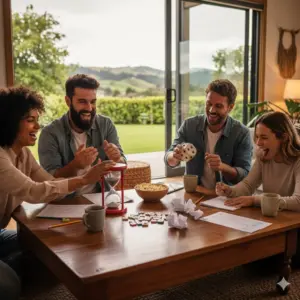


Family board games represent a sophisticated intersection of social infrastructure and cognitive development, offering a high-yield return on time invested within the New Zealand domestic setting. In an era dominated by digital saturation, the analog resurgence of tabletop gaming provides a critical "circuit breaker" for Kiwi households, fostering face-to-face interaction and the refinement of executive functions such as strategic planning, risk assessment, and emotional regulation. From the high-stakes resource management of modern classics like Catan to the rapid-fire deductive reasoning required in Sushi Go!, these games serve as a controlled environment for children and adults alike to practice complex decision-making and interpersonal negotiation. The New Zealand market, in particular, has seen a robust 15% growth in the tabletop sector as families increasingly prioritize "tech-free" Tuesday nights and social connectivity. Beyond mere entertainment, the strategic deployment of family board games acts as an educational "stealth" tool, improving numeracy and literacy while building a resilient family culture that values sportsmanship and collaborative problem-solving. This guide explores the diverse landscape of modern gaming, providing actionable insights into selection criteria, developmental benefits, and the burgeoning community scenes in Auckland and Christchurch.
- Strategic Growth: Board games activate frontal brain functions, including problem-solving and response inhibition.
- Economic Value: High replayability ensures a low "cost-per-hour" of entertainment compared to cinema or digital subscriptions.
- Social ROI: Builds "soft skills" like turn-taking, patience, and empathetic communication.
- NZ Market Trends: Increasing shift toward "Eurogames" (strategy-focused) and Cooperative titles.
- Local Connectivity: Regional clubs in Canterbury and Auckland provide professional-grade gaming libraries and community support.
Strategic Growth: Board games activate frontal brain functions, including problem-solving and response inhibition.
Economic Value: High replayability ensures a low "cost-per-hour" of entertainment compared to cinema or digital subscriptions.
Social ROI: Builds "soft skills" like turn-taking, patience, and empathetic communication.
NZ Market Trends: Increasing shift toward "Eurogames" (strategy-focused) and Cooperative titles.
Local Connectivity: Regional clubs in Canterbury and Auckland provide professional-grade gaming libraries and community support.
The Fundamentals of Modern Family Game Selection
Selecting a board game for a multi-generational household requires a nuanced understanding of "game weight" and mechanical complexity to ensure maximum engagement across all age brackets. Professional gamers often categorize titles into "Gateway Games"—those with simple rules but deep strategy—and "Heavy Euros," which may be better suited for teenagers and adults. For the typical New Zealand family, a successful acquisition should balance the "luck-to-skill" ratio; too much luck can frustrate competitive players, while too much skill can alienate younger children. Modern staples such as Ticket to Ride or Azul have mastered this equilibrium, providing accessible entry points that still offer significant depth for veteran strategists.
| Game Category | Ideal For | Key Benefit |
| Gateway Games | Beginners & Mixed Ages | Easy onboarding with meaningful choices |
| Cooperative Games | Team-building & Low Conflict | Encourages collective problem-solving |
| Abstract Strategy | Logic & Pattern Recognition | Sharpens cognitive focus and spatial awareness |
| Party/Reflex Games | High Energy & Large Groups | Enhances social bonding and quick thinking |
- Rule Complexity: Choose games that can be explained in under five minutes for younger participants.
- Player Count: Ensure the game scales well (e.g., plays as well with 2 people as it does with 5).
- Time Commitment: Most family-friendly sessions should conclude within 30 to 60 minutes to maintain focus.
- Component Quality: High-tactile pieces (wooden trains, resin tiles) improve the sensory experience and durability.
Rule Complexity: Choose games that can be explained in under five minutes for younger participants.
Player Count: Ensure the game scales well (e.g., plays as well with 2 people as it does with 5).
Time Commitment: Most family-friendly sessions should conclude within 30 to 60 minutes to maintain focus.
Component Quality: High-tactile pieces (wooden trains, resin tiles) improve the sensory experience and durability.
Cognitive Development and the "Stealth Learning" Advantage
Enhancing Executive Function Through Play
Family board games are essentially "brain gyms" that require players to engage in complex mental gymnastics disguised as fun. When a child decides whether to save their resources in Catan or spend them on a road, they are practicing delayed gratification and resource allocation—skills directly transferable to financial literacy. The "stealth learning" aspect of tabletop gaming means that math and literacy skills are reinforced naturally; for instance, calculating scores in Scrabble Junior or reading event cards in The Game of Life provides practical application of classroom concepts without the pressure of a formal academic setting.
Social-Emotional Intelligence and Conflict Management
The tabletop environment provides a unique "safe zone" for children to encounter and navigate failure. Losing a game of Monopoly or being "outfoxed" in a cooperative mystery game allows parents to model resilient behaviour and emotional regulation in real-time. This exposure to "fair play" and the necessity of following a structured rule set helps children internalize social boundaries and the importance of integrity. In a professional context, these skills mirror the negotiation and diplomatic requirements of the modern workplace, making early exposure to gaming a long-term career asset for the next generation of Kiwis.

Key Social Skills Developed
- Resilience: Learning to lose gracefully and view failure as a learning opportunity.
- Empathy: Understanding an opponent's perspective to anticipate their moves.
- Negotiation: Trading resources or forming alliances in games like Settlers of Catan.
- Communication: Articulating complex strategies to teammates in cooperative games.
Resilience: Learning to lose gracefully and view failure as a learning opportunity.
Empathy: Understanding an opponent's perspective to anticipate their moves.
Negotiation: Trading resources or forming alliances in games like Settlers of Catan.
Communication: Articulating complex strategies to teammates in cooperative games.
Economic Analysis: The Return on Investment of Tabletop Play
From a wealth management perspective, family board games offer an exceptional "entertainment-to-dollar" ratio. A premium game like Pandemic may cost $60 NZD, but if played 20 times by a family of four, the cost per person, per hour, drops to less than $1.00. This compares favourably against a single cinema outing, which can exceed $100 for a family after tickets and concessions. Furthermore, high-quality board games often maintain their value on the secondary market; Christchurch and Auckland have thriving trade groups where "gently used" games can be liquidated or swapped, further reducing the net cost of the hobby. Learn more about the history of these games on the global board game Wikipedia.
| Entertainment Type | Average Cost (Family of 4) | Duration | Cost Per Hour |
| Cinema Outing | $120.00 | 2.5 Hours | $12.00 |
| Theme Park Day | $350.00 | 6 Hours | $14.50 |
| Premium Board Game | $65.00 | 100+ Hours (Replayable) | $0.16 |
| Digital App Sub | $20.00 / month | Variable | Variable |
Cooperative Gaming: Team-Building for the Modern Whānau
A significant trend in 2026 is the rise of cooperative board games, where players work together against the "game system" rather than each other. This is particularly effective for families with siblings who are prone to high conflict. In titles like Forbidden Island or The Crew, the win-loss condition is shared, forcing players to communicate clearly and leverage each other's unique character strengths. This collaborative framework mirrors the "high-performance team" structures found in professional environments, teaching children that collective success often requires individual sacrifice and coordinated effort.

Top Recommended Cooperative Titles
- Pandemic: A race against time to stop global outbreaks through coordinated logistics.
- Forbidden Island: A high-speed escape from a sinking island requiring careful resource sharing.
- Outfoxed!: A detective game for younger children that builds deductive reasoning and teamwork.
- The Crew: A trick-taking card game that requires "silent" communication and deep trust.
Pandemic: A race against time to stop global outbreaks through coordinated logistics.
Forbidden Island: A high-speed escape from a sinking island requiring careful resource sharing.
Outfoxed!: A detective game for younger children that builds deductive reasoning and teamwork.
The Crew: A trick-taking card game that requires "silent" communication and deep trust.
The "Analog Break": Digital Detox and Mental Wellbeing
In an increasingly "always-on" society, family board games provide a vital sanctuary for mental wellbeing. The physical nature of the cards, boards, and pieces anchors players in the present moment, reducing the cortisol spikes associated with blue-light exposure and social media notifications. Many New Zealand psychologists recommend "Unplugged Tuesdays" as a way to combat anxiety and foster deeper familial connections. By focusing on a shared physical task, families can engage in "parallel play" and conversation that is often missing during passive activities like watching television.
- Focus: Increases attention span by requiring sustained engagement over 30–60 minutes.
- Tactile Joy: The physical act of rolling dice and moving pieces provides sensory satisfaction.
- Presence: Eliminates the "distracted parent" syndrome caused by smartphones.
- Memory: Encourages "storytelling" moments that become cherished family history.
Focus: Increases attention span by requiring sustained engagement over 30–60 minutes.
Tactile Joy: The physical act of rolling dice and moving pieces provides sensory satisfaction.
Presence: Eliminates the "distracted parent" syndrome caused by smartphones.
Memory: Encourages "storytelling" moments that become cherished family history.
Regional Spotlight: The Christchurch and Auckland Gaming Scene
New Zealand's "World of Cards" and board games is anchored by vibrant regional communities that offer resources beyond the retail shelf. Christchurch, for instance, is home to Meepleopolis, a gaming café and club that provides access to hundreds of titles and "Learn to Play" nights. Auckland Board Gamers host regular meetups in Mt Albert and Albany, allowing families to "test drive" expensive games before committing to a purchase. Engaging with these local clubs is a professional way to stay updated on the latest releases and connect with other families who value the tabletop lifestyle.

| City | Key Venue/Club | Focus Area |
| Christchurch | Meepleopolis | Library rentals and family social nights |
| Auckland | Auckland Board Gamers | Competitive strategy and “Euro” meetups |
| Wellington | Counter Culture | High-end tabletop experiences and craft coffee |
| Dunedin | Dice Jar Games | Community trading and collectible card focus |
Educational Integration: Board Games in the NZ Curriculum
Many New Zealand schools are now intentionally incorporating board games into their curriculum as part of a "play-based learning" strategy. Titles that focus on historical events, biological ecosystems (like Wingspan), or basic physics help students visualize abstract concepts. For parents, mirroring these educational games at home reinforces the school’s efforts and shows children that learning is a continuous, enjoyable process. The use of games to teach Te Reo Māori (through bilingual Snap or Matching games) is also on the rise, proving that the board game format is an excellent vehicle for cultural preservation and language acquisition.
Academic Skill Mapping
- Math: Calculation of scores, probability of dice rolls, and resource counting.
- Literacy: Reading rulebooks, interpreting card text, and narrative storytelling.
- Science: Understanding ecosystems in Cascadia or viral spread in Pandemic.
- History: Navigating historical timelines in Timeline or 7 Wonders.
Math: Calculation of scores, probability of dice rolls, and resource counting.
Literacy: Reading rulebooks, interpreting card text, and narrative storytelling.
Science: Understanding ecosystems in Cascadia or viral spread in Pandemic.
History: Navigating historical timelines in Timeline or 7 Wonders.
Strategic Tips for Successful Family Game Nights
To ensure a game night doesn't devolve into frustration, a professional approach to facilitation is required. Designate a "Lead Learner" (usually an adult or older teen) to read the rules beforehand so the group doesn't have to wait during setup. Create a "distraction-free zone" where phones are placed in a basket away from the table. It is also helpful to have a "no-questions-asked" restart policy for the first five turns of a new game; this lowers the stakes and allows players to experiment with the mechanics without fear of a permanent disadvantage.
- Snack Selection: Choose non-greasy foods to protect the game components.
- Background Music: Low-volume instrumental music can set a thematic mood (e.g., train sounds for Ticket to Ride).
- House Rules: Don't be afraid to simplify rules for younger siblings to ensure everyone has a path to victory.
- The "Golden Rule": The primary goal is connection; if the game is causing stress, pivot to a simpler activity.
Snack Selection: Choose non-greasy foods to protect the game components.
Background Music: Low-volume instrumental music can set a thematic mood (e.g., train sounds for Ticket to Ride).
House Rules: Don't be afraid to simplify rules for younger siblings to ensure everyone has a path to victory.
The "Golden Rule": The primary goal is connection; if the game is causing stress, pivot to a simpler activity.
Future Trends: Hybrid and Sustainable Gaming in 2026
Looking ahead, the New Zealand board game market is moving toward greater sustainability and digital integration. Many manufacturers are shifting away from plastic "inserts" in favour of compostable cardboard and responsibly sourced wood. Additionally, "App-Driven" games are becoming popular, where a smartphone app acts as a "Dungeon Master" or timer, reducing the cognitive load on the players and allowing for more immersive storytelling. While these hybrid games use screens, the primary interaction remains the physical pieces and the people around the table, representing a "best of both worlds" approach for the modern family.

- Eco-Friendly: Rise of "Eco-Box" editions and plastic-free components.
- AR Integration: Using phones to see "hidden" clues on a physical board.
- Crowdfunding: More Kiwi designers are using platforms like Kickstarter to launch local titles.
- Accessibility: Games designed with colour-blind friendly palettes and larger text for elderly players.
Eco-Friendly: Rise of "Eco-Box" editions and plastic-free components.
AR Integration: Using phones to see "hidden" clues on a physical board.
Crowdfunding: More Kiwi designers are using platforms like Kickstarter to launch local titles.
Accessibility: Games designed with colour-blind friendly palettes and larger text for elderly players.
Final Thoughts
Family board games are a powerful medium for nurturing the next generation of strategic thinkers, empathetic leaders, and resilient problem-solvers. By viewing tabletop play not as a frivolous distraction but as a purposeful investment in family dynamics, New Zealand parents can build a domestic culture that values deep engagement over passive consumption. Whether you are racing trains across Europe, building a settlement on a distant island, or working together to save the world from a plague, the shared memories created around the gaming table are among the most valuable assets a family can hold. Start small, select with purpose, and let the dice roll toward a more connected and capable future.
FAQ
What is the best board game for all ages?
Sushi Go! and Ticket to Ride are consistently rated as the best "all-rounders" because they have simple mechanics but offer enough strategy to keep adults engaged.
How do I teach my child to lose gracefully?
Focus on the "process" rather than the outcome. Praise the clever moves they made during the game, and model a calm, positive attitude when you lose yourself.
Are board games expensive to start as a hobby?
While some premium games cost $80+, many excellent "gateway" games are available for $25–$40. Given their high replayability, the cost-per-hour is very low.
What is a "Cooperative" board game?
A cooperative game is one where all players work together as a team against the game's mechanics. You either all win together or all lose together.
Can board games help with math skills?
Absolutely. Games involve counting spaces, managing resources, calculating final scores, and understanding the probability of dice rolls.
What are some good games for 5-year-olds?
Outfoxed!, Catan Junior, and My First Castle Panic are designed specifically for the developmental needs of younger children.
Where can I find board game clubs in Auckland?
Auckland Board Gamers is a major community group that meets in Mt Albert and Albany. They can be found on Meetup and Facebook.
Why should I choose board games over video games?
Board games encourage face-to-face interaction, eliminate blue-light exposure, and foster social skills like negotiation that are often absent in solo digital play.
What is "Catan" and why is it so popular?
Catan (formerly Settlers of Catan) revolutionized modern gaming by focusing on trading and resource management rather than direct player elimination.
How long does a typical family board game last?
Most family-oriented games are designed to be played in 30 to 60 minutes, fitting perfectly into a post-dinner or weekend afternoon slot.