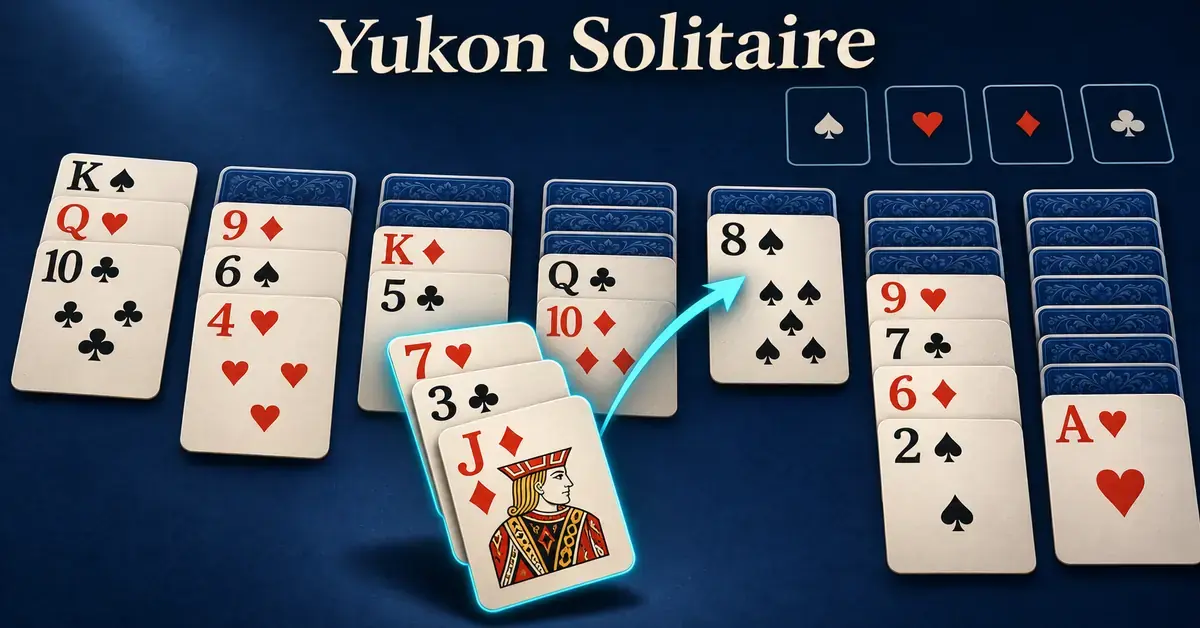
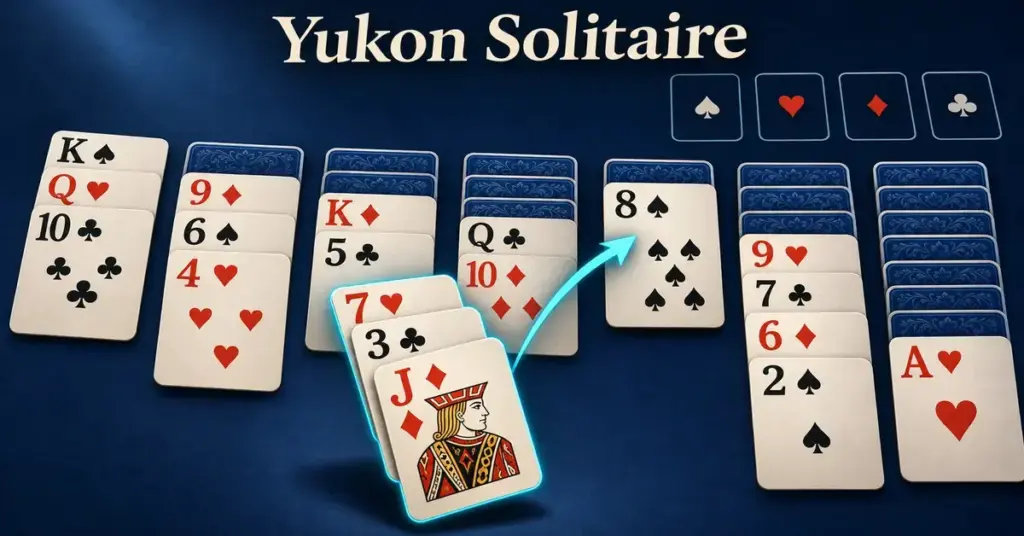
Yukon Solitaire is a single-deck patience game in the same family as Klondike, but with a faster, more open feel. Every card is dealt to the table at the start, there is no stock pile to draw from, and you are free to pick up almost any face-up card and the whole stack sitting on top of it. That one rule makes Yukon feel generous and tactical at the same time: you can see most of your options from the first move, yet a careless shuffle of the columns can still leave you stuck. This guide covers what the game is, how to set it up, the full rules, and a practical strategy for winning more often.
Quick facts
| Game type | Single-player patience (solitaire), Klondike family |
|---|---|
| Deck | One standard 52-card deck, no jokers |
| Tableau | 7 columns, all cards dealt at the start |
| Stock / waste | None — no cards left to draw |
| Foundations | 4, built up by suit from Ace to King |
| Goal | Move all 52 cards to the foundations |
| Difficulty | Moderate; more winnable than many variants |
What is Yukon Solitaire?
Yukon is a variation of Klondike Solitaire, the version most people simply call “Solitaire”. It keeps Klondike’s goal and its seven-column table, but changes how cards are dealt and how they can be moved. The biggest difference is that Yukon has no stock or waste pile: all 52 cards are on the table from the start, so there is nothing left to deal and no hidden draw to rescue a bad position.
The game shares its signature move with Scorpion, another relative in the wider family of solitaire games: you may lift a face-up card out of the middle of a column along with every card covering it, even when those covering cards are in no particular order. Because so much is visible and movable from the opening deal, Yukon rewards planning several moves ahead rather than luck of the draw.
What you need and the objective
You play Yukon with one standard 52-card deck, with the jokers removed. No special cards or extra decks are needed, so it works just as well with a physical pack on a table as it does in an app.
The objective is the same as in most solitaire games: build four foundation piles, one per suit, each running up from Ace to King. You win when all 52 cards have been moved to the foundations.
How to set up Yukon Solitaire
Deal all 52 cards into seven columns (also called the tableau). Each column gets more cards than the one before it, and only the lower part of each column is hidden:
- Column 1: 1 card, face up.
- Column 2: 6 cards (1 face down, then 5 face up).
- Column 3: 7 cards (2 face down, then 5 face up).
- Column 4: 8 cards (3 face down, then 5 face up).
- Column 5: 9 cards (4 face down, then 5 face up).
- Column 6: 10 cards (5 face down, then 5 face up).
- Column 7: 11 cards (6 face down, then 5 face up).
That adds up to 52 cards: one face-up card in the first column, and five face-up cards on top of a growing block of face-down cards in each of the other six. The four foundation spaces beside the table start empty. There is no stock pile, so once the deal is done, every card you will ever touch is already in front of you.
The rules of play
On each turn you move cards between columns and up to the foundations, trying to uncover the face-down cards and free the Aces underneath.
Building the foundations
Foundations are built up by suit, starting with an Ace and finishing with a King (A, 2, 3 … J, Q, K, all the same suit). As soon as an Ace becomes free at the bottom of a column, you can move it to a foundation, then add the 2 of that suit, the 3, and so on. Cards sent to a foundation can be left there for the rest of the game.
Building on the tableau
Within the columns, you build downward in alternating colours. A card can be placed on another face-up card that is one rank higher and the opposite colour — for example, a black 10 goes on a red Jack, and a red Queen goes on a black King.
Here is where Yukon breaks from Klondike. You may move any face-up card, no matter how deeply it is buried in a column, and all the cards stacked on top of it move with it as a single unit. Those covering cards do not need to be in sequence or alternating colour — only the card you are moving has to land legally on its new column (one rank lower and the opposite colour of the card it joins). This lets you shift big, messy stacks around to dig out what you need. In standard Klondike you can only move a run that is already in perfect sequence, which is a much tighter restriction.
Filling empty columns
If you clear a column completely, only a King — or a group of cards headed by a King — may be moved into the empty space. Empty columns are valuable because they give you somewhere to park a King and everything riding on it, so creating one is often a turning point in the game.
Turning over face-down cards
Whenever a move leaves a face-down card at the bottom of a column exposed, you turn it face up straight away and it becomes available to play. You cannot move a face-down card; you must first uncover it.
Yukon vs Klondike
| Feature | Yukon Solitaire | Klondike Solitaire |
|---|---|---|
| Stock / waste pile | None; all 52 cards dealt at the start | Stock pile you draw from during play |
| Face-up cards at deal | Top 5 cards of columns 2–7 (and column 1) | Only the bottom card of each column |
| Moving cards | Any face-up card plus everything on top of it, in any order | Only a run already in correct sequence |
| Tableau build | Down by alternating colour | Down by alternating colour |
| Empty column | King or King-headed group only | King or King-headed group only |
Winning strategy
Yukon gives you a lot of freedom, so most losses come from decisions rather than an impossible deal. These habits make a real difference:
- Uncover face-down cards first. Hidden cards are the only unknown in the game. Prioritise moves that flip them, because every card you reveal widens your options.
- Do not rush Aces and low cards to the foundations. A 2 or 3 left in the columns can be a useful landing spot for higher cards. Send cards up only when keeping them no longer helps you dig.
- Plan the whole stack, not just one card. Because a move drags every covering card along, think about where the bottom of the moved group will end up, not only the card you grabbed.
- Work towards an empty column. The column with the fewest face-down cards is usually the easiest to clear. An empty column, plus a free King to fill it, is one of the strongest positions you can reach.
- Use the Undo button to read a deal. In digital versions, trying a line of play and undoing it is a fair way to learn which order of moves actually works.
Common mistakes to avoid
- Clearing foundations too eagerly. Sending every available card up early strips the columns of the mid-rank cards you need to build sequences.
- Burying a face-down card you could have revealed. Dropping a big stack onto a short column can re-cover cards you were about to free.
- Wasting an empty column on the wrong King. Move the King that unlocks the most buried cards, not simply the first one you see.
- Playing on autopilot. Yukon’s looser moves tempt quick shuffling; a few seconds of planning per turn wins far more games.
Variations of Yukon Solitaire
Several games build on the Yukon deal and move rule:
- Russian Solitaire uses the same layout but forces you to build the tableau down in the same suit instead of alternating colours, which makes it much harder. Our guide to Russian Solitaire rules explains the differences in full.
- Double Yukon is played with two decks and more columns for a longer game.
- Alaska changes the tableau so you can build sequences both up and down in the same suit.
- Scorpion is a close cousin that shares Yukon’s buried-stack move but deals differently; it sits alongside Spider Solitaire in the harder, Spider-style group of patience games.
If you enjoy Yukon’s style, our round-up of the most difficult solitaire games points to other challenging single-player games worth trying.
How winnable is Yukon Solitaire?
Yukon is usually considered one of the more winnable solitaire variants, because every card is visible and almost every face-up card can be moved, so you rarely lose purely to bad luck. Exact figures vary between sources and no peer-reviewed solver study published for Yukon gives a single confirmed percentage, but reference sites generally estimate that a large majority of deals are solvable with careful play. Casual win rates are far lower than that, which tells you most of the challenge is in the decisions, not the deal. Treat any precise “winnable” percentage you see online as an estimate rather than a hard fact.
Sources
Frequently Asked Questions (FAQ)
Is every Yukon Solitaire game winnable?
No. Most deals can be won with careful play, which is why Yukon is seen as relatively friendly, but some layouts leave no winning line no matter how well you play. If you get stuck with no legal moves left, the deal is lost and you start a new one.
Can you play Yukon Solitaire with a real deck of cards?
Yes. Yukon is a traditional tabletop patience game that needs only one standard 52-card deck with the jokers removed. Apps add conveniences like an Undo button and automatic dealing, but the rules are identical to the physical game.
What do “two-suit” and “four-suit” Yukon Solitaire mean?
Classic Yukon is always played with one full deck containing all four suits. The “two-suit” and “four-suit” labels you see on some apps are difficulty or display settings those apps add; they do not change the standard seven-column deal or the core rules described above.
Is Yukon Solitaire a good game for beginners?
It is a fair first step up from basic Solitaire. The open layout is easy to understand and more forgiving than draw-based games, but the freedom to move buried stacks means you still have to think ahead, so it stays interesting as you improve.