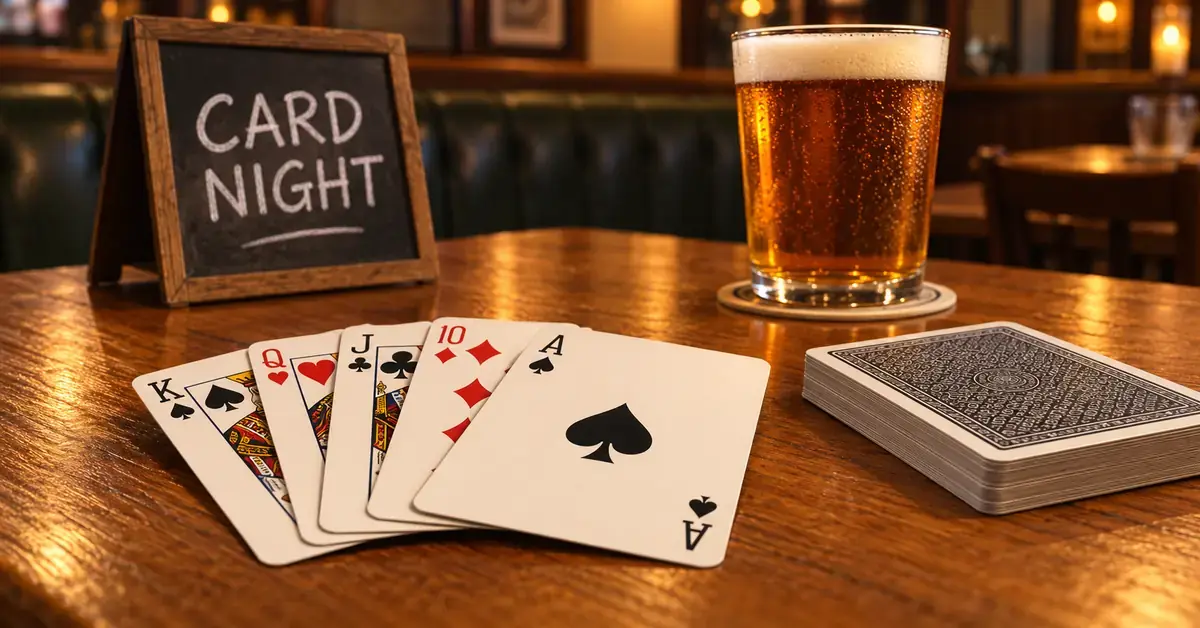
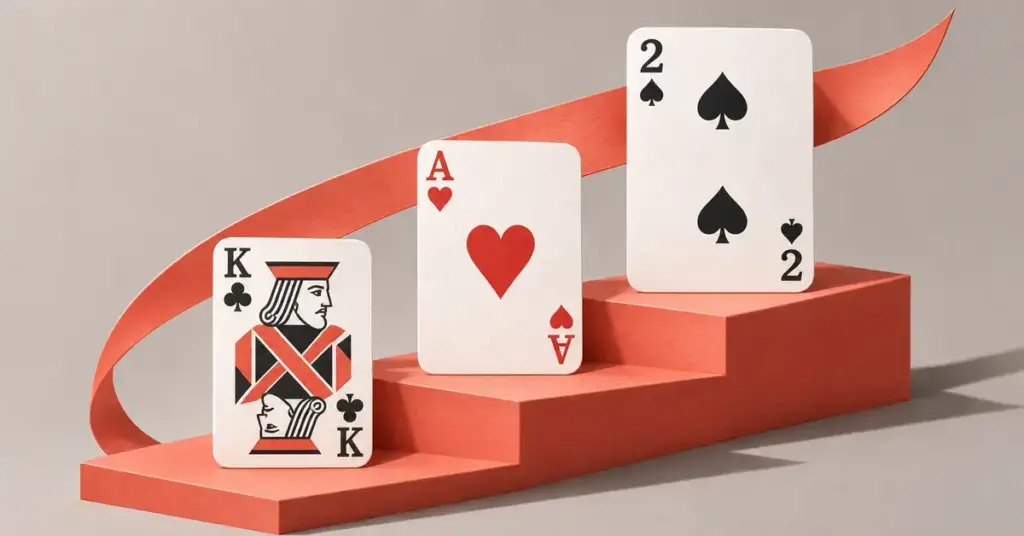
Big Two is a fast, tactical shedding game where the goal is simple: be the first player to get rid of every card in your hand. It is played across much of East and Southeast Asia under names such as Choh Dai Di, Da Lao Er, Pusoy Dos and Capsa, and it has spread worldwide thanks to a quick setup and poker-style hands that most people already half-recognise. This guide covers the standard rules, the full card and suit ranking order, every combination you are allowed to play, how scoring works, the most common regional variations, and the strategy that separates casual players from consistent winners.
What is Big Two?
Big Two belongs to the family of climbing games (also called shedding games), where players take turns beating the previous play with a higher one of the same shape until everyone passes. It is closely related to games Kiwi players may already know, such as President and Shithead (Palace), but Big Two has its own twist: the card ranks are reshuffled so the humble 2 is the most powerful card, and the four suits are ranked against each other to break ties.
The game is thought to have taken its modern form in the Guangdong region and Hong Kong, spreading rapidly from the 1980s onward. It works best with four players, each playing for themselves, though versions exist for two and three players. No teams, no trumps, no bidding — just a scramble to empty your hand before anyone else.
Big Two is sometimes played for small stakes, with a set amount paid per point at the end. It is not a casino game and involves no house or operator; this guide treats it purely as a social card game. If you choose to play for money, keep stakes small and agree the amount before you start.
Quick Facts
| Players | 2–4 (best with 4) |
|---|---|
| Deck | Standard 52 cards, no jokers |
| Cards dealt | 13 each (4 players); 17 each (3 players) |
| Type | Climbing / shedding game |
| Highest card | 2 of spades |
| Lowest card | 3 of diamonds (leads the first play) |
| Playing time | About 10–20 minutes per hand |
| Aim | Be the first to play all your cards |
What you need and how to deal
You need a standard 52-card deck with the jokers removed. Nothing else — no score pad is required unless you want to track points over several hands.
- Four players: deal all 52 cards out, 13 to each player. This is the classic game.
- Three players: deal 17 cards each; the final card is placed face up in the centre and taken by whoever holds the 3 of diamonds.
- Two players: practice varies. A common method is to deal 13 cards each and set the remaining 26 aside unused; other groups deal 17 each (18 set aside) or 21 each (10 set aside).
Shuffle well and deal the cards out one at a time. In the traditional game, dealing and play run anticlockwise, but direction is a matter of habit — just pick one and keep it consistent.
Card and suit rankings
Getting the rankings right is the single most important thing for a new player, because they are not the same as in poker or most trick-taking games.
Card ranking (high to low)
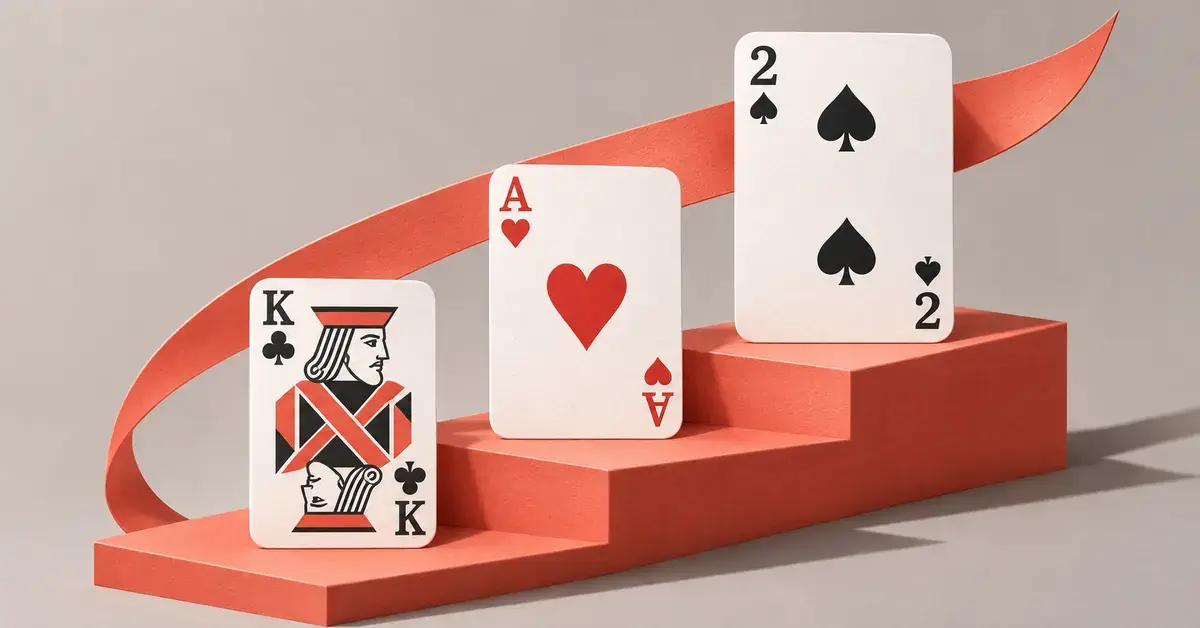
The order runs: 2 (highest), then A, K, Q, J, 10, 9, 8, 7, 6, 5, 4, 3 (lowest). In other words, the 2 is the strongest rank and the 3 is the weakest. This is why the game is called “Big Two” — the twos dominate.
Suit ranking (high to low)
When two cards or combinations are the same rank, the suit decides which is higher. The standard order from highest to lowest is:
- Spades (highest)
- Hearts
- Clubs
- Diamonds (lowest)
So the 2 of spades is the single most powerful card in the deck, and the 3 of diamonds is the weakest. Suit only matters as a tie-breaker; a higher rank always beats a lower rank regardless of suit.
The hands you can play
On your turn you play one of a fixed set of combinations. A combination can only be beaten by a higher combination of the same number of cards — a pair cannot beat a single, and a five-card hand cannot beat a triple. Players either beat the previous play or pass.
Singles, pairs and triples
- Single: one card. A higher card beats a lower one; equal ranks are split by suit.
- Pair: two cards of the same rank. Compare by rank first; if two pairs share a rank, the one containing the higher suit wins.
- Triple (three of a kind): three cards of the same rank. The higher rank wins.
There is no two-card or four-card combination outside these in the standard game — four of a kind is played as part of a five-card hand (see below).
Five-card hands
Big Two uses five of the classic poker hands. They are ranked against each other by type, so a stronger type always beats a weaker type, and within the same type you compare the key cards. From lowest to highest:
- Straight: five cards in consecutive rank, mixed suits. For straights the ranking reverts closer to natural order — the 2 does not count as high inside a straight, and an ace may sit at the top (10-J-Q-K-A) or bottom (A-2-3-4-5) but not in the middle. A straight is compared by its highest card.
- Flush: five cards of the same suit, not in sequence. In the standard game a flush is compared by suit first, then by its highest cards.
- Full house: three of one rank plus a pair of another. The rank of the three-of-a-kind decides which full house is higher.
- Four of a kind plus one: all four cards of a rank plus any fifth card. The four-card rank decides.
- Straight flush: five consecutive cards all of one suit — the highest hand in the game.
If you are coming from poker, note the two big differences: the strongest card is the 2 rather than the ace, and flushes in the standard game are separated by suit rather than purely by card value. If you want a refresher on the poker versions of these hands, see our guide to poker hand rankings.
Five-Card Hand Rankings
| Rank | Hand | What it is | Compared by |
|---|---|---|---|
| 1 (lowest) | Straight | Five consecutive ranks, mixed suits | Highest card |
| 2 | Flush | Five cards of one suit, not in sequence | Suit, then high cards |
| 3 | Full house | Three of a kind plus a pair | Rank of the triple |
| 4 | Four of a kind + 1 | All four of a rank plus any card | Rank of the four |
| 5 (highest) | Straight flush | Five consecutive cards, one suit | Highest card |
How a game of Big Two works
Once everyone has their cards, play follows a clear rhythm.
- Who starts: the player holding the 3 of diamonds leads first, and must include that card in their opening play. They may play it as a single, or as part of a pair, triple or five-card hand that contains it.
- Taking turns: moving around the table, each player must either beat the previous play with a higher combination of the same size, or pass. You are never forced to play even if you can.
- Passing: passing on one turn does not stop you playing again when the turn comes back to you. A “trick” continues until all other players pass in succession.
- Leading again: the last player to put down cards wins the trick, clears the played cards away, and leads a brand-new combination of any legal type and size.
- Winning: the first player to play their very last card wins the hand, and play stops immediately. The others are left holding cards.
A common courtesy rule is to announce when you are down to your last card, so the other players know to try to block you.
A worked example
Suppose you hold the 3 of diamonds and lead it as a single. The next player beats it with the 7 of hearts, the third player plays the 10 of spades, and the fourth plays a king of clubs. Back to you — if you cannot or choose not to beat the king, you pass. Say the next two players also pass but the last stays in with the 2 of diamonds. With everyone now passed, that player wins the trick, clears the table, and leads anything they like — perhaps a pair, a run of five, or another single. The lead shape resets each time a trick is won, which is why controlling who leads is so central to the game.
Scoring
Many casual games are simply “first to empty their hand wins” with no written score. When you want to play a series of hands, the usual method penalises each non-winner for the cards left in their hand:
- 9 or fewer cards left: 1 point per card.
- 10 to 12 cards left: 2 points per card.
- All 13 cards left (you never played a card): 3 points per card, for 39 points.
The winner scores nothing. Points are penalties, so the aim over several hands is to finish with the lowest total. Groups often set a target — for example, play until someone reaches 50 points, at which point the lowest score wins. If you are playing for money, a fixed stake is paid per point. Some circles add bonuses, such as doubling a player’s penalty if they are caught holding a 2 or an unplayed four-of-a-kind at the end.
Common variations
Big Two is one of those games where almost no two groups play it identically, so it pays to agree the house rules before dealing. These are the most common differences you will meet:
- Suit order: the version known as Pusoy Dos (popular in the Philippines) ranks suits diamonds > hearts > spades > clubs, with the 3 of clubs leading. Some Taiwanese and Hong Kong players swap clubs and diamonds.
- Straights with 2s and aces: rulesets differ on whether A-2-3-4-5 or 2-3-4-5-6 counts as the highest straight, and some bar twos from straights entirely.
- Flush comparison: in Hong Kong play, flushes are often compared by their top card like poker rather than by suit.
- The Dragon: in some Hong Kong rules, a player dealt one card of every rank (3 up to 2, thirteen different ranks) wins the hand instantly.
- Butterfly (two-pair-junk): a few groups add a sixth, weakest five-card hand made of two pairs plus an odd card, ranked by the higher pair.
- No re-entry: in some Indonesian rules, once you pass you cannot rejoin that trick.
- Last-card rules: extra restrictions on the player sitting before someone with one card left, or special rules around the 2 of spades.
None of these is more “correct” than another — they are simply regional flavours. Pick a set and keep it consistent for the whole session. The two decisions worth settling first are the suit order and how straights handle twos and aces, because those come up almost every hand; the rarer rules like the Dragon or Butterfly can be agreed only if someone actually wants them.
Big Two also sits naturally beside other shedding games if you want to compare. President uses card exchanges between ranked players and no suit ordering; Shithead adds face-down cards and special “magic” ranks. Big Two keeps the table flat — no roles, no powers — and leans entirely on the reshuffled card ranks and the suit tie-breaker, which is why many players find it the cleanest of the three to teach.
Strategy tips
Big Two rewards patience and planning far more than luck once you know the rules. A few principles help new players win more often:
- Hold your twos. Single twos are the best cards for seizing control of a trick when nobody else can beat you. Spend them to win the lead at the right moment, not early for no reason.
- Break your hand into combinations first. Before you play anything, mentally sort your cards into the pairs, triples and five-card hands you can make. Loose high cards are far less useful than cards working together.
- Get rid of low cards early. Threes, fours and fives are hard to win tricks with, so shed them while the table is still playing small singles and pairs.
- Count what has gone. Watching which twos and high cards have already been played tells you when a modest card is suddenly unbeatable.
- Control the lead at the end. When your hand is small, the player who wins a trick and leads the next one dictates the shape everyone must follow. Winning a trick late lets you dump a run of cards in a shape no one can answer.
- Watch short hands. If an opponent is close to going out, use your strong cards to block them rather than racing your own cards out.
Common mistakes to avoid
- Playing twos too early and having no way to regain the lead when it matters most.
- Trying to beat a different-sized play — remember a combination can only be beaten by the same number of cards.
- Forgetting the 3 of diamonds must lead the very first play of the hand.
- Leaving combinations unbroken until too late, so you are stuck holding a five-card hand you can never lead.
- Not agreeing house rules first, then arguing mid-game about straights, flushes or suit order.
Who Big Two suits
Big Two is an excellent choice for a group of four who want something quick to learn but deep to master — it is one of the best 4 player card games and a reliable pick when you want a game for a group of friends. Players who enjoy poker-style hand values but prefer a game with no betting will feel at home immediately, and anyone who likes President or Shithead will pick it up in a hand or two. If you enjoy exploring how different games are built, our overview of the world of card games and their families puts Big Two in context alongside its climbing-game cousins.
Sources
Vanliga frågor (FAQ)
Is the 2 really the highest card in Big Two?
Yes. In Big Two the ranking runs 2 (highest), then ace, king, queen and so on down to 3 (lowest). The twos are the most powerful cards, which is where the game gets its name. The 2 of spades is the single strongest card in the deck under the standard suit order.
How many players can play Big Two?
It is best with four players, each for themselves. Three-player and two-player versions exist, mainly differing in how many cards are dealt and how many are set aside, but the four-player game using the full 52-card deck is the classic form.
Do I have to beat the previous play, or can I pass?
You can always pass, even when you are able to play. You only ever play a combination that is higher than the last one and the same number of cards. When everyone else passes, the last player to put down cards leads a fresh combination of any type.
Why do the suits have a ranking?
Suit ranking (spades highest, then hearts, clubs and diamonds) is used only to break ties when two cards or combinations share the same rank. A higher rank always beats a lower one regardless of suit; the suit order simply decides between otherwise equal plays.
What is the difference between Big Two and Pusoy Dos?
Pusoy Dos is a Philippine version of Big Two. It uses the same basic shedding idea but changes the suit order (diamonds highest, clubs lowest) so the 3 of clubs leads, and it often uses a positive scoring system with bonuses. The core play — beating the previous combination or passing — is the same.