Shithead is a fast, social shedding game played with an ordinary pack of cards, and it turns up under plenty of politer names: Palace, Karma, Shed, Caboodle and China Hand are all the same game. If you have seen it called the Idiot card game, that is the identical ruleset under a tidier title. The goal is simple — get rid of all your cards before everyone else — but the clever part is the stack of face-up and face-down cards sitting in front of each player, which keeps the outcome in doubt right to the final flip. This guide walks through the deck, the deal, the swap phase, every turn, the all-important power cards, the blind endgame, how someone wins, and the most common variations you will meet.
What Shithead Is and Where It Comes From
Shithead belongs to the shedding family of card games, where the aim is to empty your hand rather than to build sets or win tricks. It became a backpacker and hostel favourite in the late twentieth century because it needs nothing but a standard deck, scales easily from a pair of players up to a full table, and rewards both luck and a bit of nerve. David Parlett’s Penguin Encyclopedia of Card Games records it under several names, which is why no two groups seem to agree on the finer points.
Because it is a folk game rather than a published one, there is no single “official” rulebook. The core described below is the version documented by card-game authorities and shared by most players; the variations section covers the house rules you are most likely to run into. If it helps to see how it sits alongside other hand-emptying games, our overview of the world of card games maps out the main families.
What You Need to Play
Setup is deliberately light:
- Players: 2 to 5, and it plays best with 3 or 4. Six can join using the Jokers variation described later.
- Cards: one standard 52-card deck. No Jokers in the base game.
- Card ranking: aces are high, then King, Queen, Jack, 10 down to 3. The 2 sits outside the order as a special card (more on that below).
- Objective: be among the players who shed all of their cards. The last person still holding cards loses and is crowned the “shithead”.
Quick Facts
- Also known as: Palace, Karma, Shed, Caboodle, China Hand, Idiot
- Players: 2–5 (best with 3–4; up to 6 with Jokers)
- Equipment: one standard 52-card deck
- Game type: shedding / hand-emptying
- Card ranking: aces high; 2 and 10 are special
- Difficulty: easy to learn, light strategy
- Typical game length: 10–20 minutes
- Objective: get rid of all your cards and avoid being last
How to Set Up the Game
Every player ends up with three small layers of cards in front of them plus a hand, so the deal has a rhythm worth learning once:
- Choose a dealer at random for the first game. After that, the loser of the previous game deals.
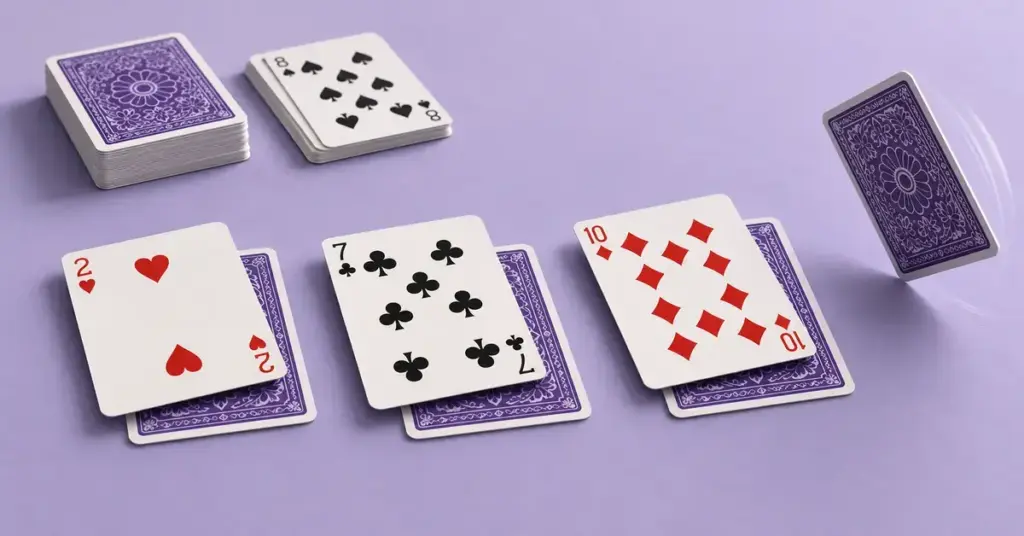
- Deal three cards face down in a row to each player. Nobody looks at these.
- Deal three cards face up, one on top of each face-down card, so each player has three little stacks.
- Deal three cards to each player’s hand, which they pick up and keep secret.
- Place the remaining cards face down in the middle as the draw pile (the stock).
That is nine cards per player in total: three hidden, three on show, and three in hand. The face-down cards are a gamble you cannot plan around, so the skill sits in how you use the two layers you can see.
The Swap Phase
Before the first card is played, each player may swap any number of cards between their hand and their face-up table cards. You never touch the face-down row — those stay a mystery until the very end.
The point of the swap is that your face-up cards are played last of the two visible layers, so you want strong cards there: a pair of 2s, a 10 or two, and high cards such as aces and kings. Weaker low cards are better kept in your hand, where you can get rid of them early. Spend a moment on this stage — a smart swap often decides who finishes first.
Who Leads and How a Turn Works
The player holding the lowest starting card leads — traditionally the first 3, then moving up through the ranks if nobody has one. Many groups simply agree that whoever has the lowest card goes first. Play then moves clockwise.
On your turn you play a card, or a set of equal-ranked cards, onto the central discard pile. The one rule that drives everything is this: your card must be equal to or higher than the top card of the pile. A few more points to keep straight:
- You may lay down several cards of the same rank at once (for example, three 7s together).
- After playing, draw from the stock to bring your hand back up to three cards, while any stock remains. Once the draw pile is empty, you stop refilling and simply run your hand down.
- You must play from your hand for as long as you hold any hand cards. The table cards come into play only after your hand is empty.
- If you cannot (or choose not to) play a legal card, you pick up the entire discard pile into your hand and play nothing that turn. The next player then starts a fresh pile with any card.
That pick-up penalty is the heart of the tension: a pile loaded with high cards is a nasty thing to be forced to scoop up. If you enjoy this press-your-luck feel, you will find it in other shedding games such as Last Card and UNO.
The Special (Power) Cards
A handful of cards break the equal-or-higher rule and give Shithead its swing. These are the ones everyone agrees on:
Special Cards
| Card | Effect | Who plays next |
|---|---|---|
| 2 | Resets the pile — can be played on any card, and any card can follow it | Next player (clean slate) |
| 10 | Burns the whole pile out of the game; can be played at any time | Same player plays again |
| Four of a kind | Four matching ranks in a row burn the pile | Player who completed the set plays again |
| 7 (variation) | Next card must be lower than 7 (a 10 may still be played) | Next player |
| 8 (variation) | “Transparent” — next player must beat the card beneath it | Next player |
Twos — the reset
A 2 can be played on top of any card, no matter how high, and any card can then be played on top of the 2. In effect it resets the pile to its lowest value, giving the next player a clean slate. A 2 does not remove the pile; it just lowers the bar. Keep one or two for moments when the pile has climbed out of reach.
Tens — burning the pile
A 10 can be played at any time, even on an ace or onto an empty pile. When you play it, the whole discard pile is “burned” — removed from the game entirely — and the same player immediately plays again to start a brand-new pile. Burning the pile at the right moment both clears a dangerous stack and hands you a free extra turn, so tens are among the most valuable cards you can hold.
Four of a kind — the other burn
If four cards of the same rank end up on top of the pile in a row — whether you lay all four down at once or complete the set by matching cards already there — the pile burns exactly as it does with a 10. Again, the player who completed the quartet plays again. This is easy to forget in the heat of a game, so watch the pile when a rank is being repeated.
Clearing Your Table Cards: the Endgame
Once the draw pile is gone and you have played the last card from your hand, you move on to your table cards in a fixed order — and this is where Shithead earns its reputation for last-second reversals.
Face-up cards first. With an empty hand you play from your three face-up cards, one or a matched set at a time, following the normal equal-or-higher rule. If none of your face-up cards can beat the pile, you add one of them to the pile and pick the whole thing up into your hand. You then have to clear that hand again before you can return to the table cards.
Face-down cards last. When your face-up cards are gone, you play the three face-down cards blind — you flip one onto the pile without looking first:
- If the flipped card legally beats the pile, it stays and play continues to the next person.
- If it does not, you pick up the whole pile including that card, and you are back to clearing a hand before you can try another face-down card.
Because those last three cards are pure chance, a player who looked unbeatable can still get stuck flipping a losing card into a loaded pile. That is the moment every Shithead game lives for.
How to Win and Who Becomes the Shithead
A player who gets rid of every card — hand, face-up and face-down — is safely out and drops from play. The game keeps going until just one player is left holding cards. That final player is the shithead, the loser of the round, and they deal the next game. Groups often add a light-hearted forfeit, such as making the tea or fetching the next round of drinks; it is a classic fixture in social and drinking card games. There is no points scoring — winning is simply not being last.
Strategy Tips
Shithead has more depth than its name suggests. A few habits that help:
- Build a strong face-up row in the swap. Put 2s, 10s and high cards face up so your final visible layer can fight back; dump low cards into your hand to shed early.
- Clear low cards while the stock is alive. Early on you keep drawing back to three, so burning through 3s, 4s and 5s costs you little and keeps your hand flexible.
- Save a 10 or a 2 for emergencies. Holding one escape card means a sky-high pile is never a death sentence — you can burn it or reset it rather than scooping it up.
- Watch the pile for pairs and triples. If three of a kind are showing, a fourth matching card burns the pile and earns you another go.
- Count what has gone. Once aces and 2s have been spent, mid-range cards become far safer to lead with.
Common Variations
Almost every group plays with a tweak or two. The best approach is to agree the house rules before you deal. The most common ones:
- Sevens — “play lower”: after a 7, the next player must play a card lower than 7 (a 10 may still be played). A popular twist that adds a second squeeze card.
- Eights — “transparent”: an 8 is see-through, so the next player must beat whatever card lies beneath it. Some groups use 3s this way instead.
- Tens restricted: a 10 may not be played on a face card (J, Q, K), limiting the free burn.
- Jokers for six players: add two Jokers that reverse the direction of play, letting six people join.
- Six-and-choose deal: deal six face-down cards and let each player pick three to turn face up, instead of the dealer setting them.
- Winner, not loser: some play that the first person to shed all cards simply wins and the game stops there.
These are house rules rather than the base game, so none of them is “wrong” — just make sure everyone is playing the same version.
Common Mistakes to Avoid
- Playing table cards too soon. You must empty your hand first; table cards are off-limits while you hold hand cards.
- Forgetting to draw. While the stock lasts, refill to three after every turn — skipping it leaves you short and weak.
- Wasting your 10s. Burning a near-empty pile throws away a card that could have saved you later.
- Peeking at face-down cards. They stay hidden until flipped in the endgame; looking early is cheating.
- Missing a four-of-a-kind burn. Completing four of a rank clears the pile and gives you another turn — do not play past it.
Who Shithead Suits
Shithead is ideal for casual groups, flatmates, travellers and family game nights: the rules take minutes to learn, games are quick, and the blind face-down finish keeps weaker players in with a chance. It works from two players up to a crowd, which makes it a reliable pick among card games for groups. If you like the bluff-and-dump feel, the Cheat card game scratches a similar itch with a dose of lying thrown in.
Sources
Frequently Asked Questions (FAQ)
Is Shithead the same as Palace and Karma?
Yes. Shithead, Palace, Karma, Shed, Caboodle, China Hand and the Idiot card game are all the same shedding game under different names. Small rule differences between groups are house variations, not different games.
How many players do you need for Shithead?
Between two and five players with one deck, and it plays best with three or four. A variation that adds two Jokers lets up to six people play.
What do the 2 and the 10 do?
A 2 resets the pile — it can be played on any card, and any card can follow it. A 10 burns the whole pile out of the game and lets the same player play again to start a fresh one.
What happens when you cannot play a card?
You pick up the entire discard pile into your hand and play nothing that turn. The next player then starts a new pile with any card they like.
How do you win, and who is the shithead?
You are safely out once you have shed every card — hand, face-up and face-down. The last player still holding cards loses, is called the shithead, and deals the next game.