Baseball cards are small printed cards featuring professional players, and they sit at the centre of the wider sports-collectibles hobby. What began as a marketing giveaway tucked inside cigarette and gum packs in the late 1800s and early 1900s has grown into a global market where condition, scarcity and a player’s importance decide what a card is worth. This guide explains what baseball cards are, the main types and brands, how grading works, how to store them and what drives their value — written for newcomers as much as experienced collectors.
Key Facts
- What they are: collectible cards featuring MLB players, valued for history, fandom and resale.
- Main card types: base, inserts, parallels, autographs, memorabilia (relic) and rookie cards.
- Who makes them: Fanatics, which owns the Topps and Bowman brands and holds the exclusive MLB/MLBPA licence.
- What drives value: player, scarcity (print run), condition and professional grade.
- Main grading scale: 1–10, with 10 (Gem Mint) the highest.
- Record sale: a 1952 Topps Mickey Mantle sold for about US$12.6 million in 2022.
What Baseball Cards Are
A baseball card is usually a rectangular piece of cardboard with a player’s photograph on the front and biographical or statistical details on the back. Early cards were produced to sell other products, but over the decades they became collectibles in their own right, valued for both sentimental and financial reasons. Some people collect to preserve the history of the game, others chase cards of a favourite player or team, and some treat selected cards as alternative assets.
Baseball is one of the most heavily documented sports in the hobby, but the same collecting principles apply across many categories, from NRL trading cards to Pokémon cards. If you are new to collectible cards generally, it helps to understand how sets, rarity and condition interact before spending money.
Types of Baseball Cards
Most modern products contain several categories of card, each with different scarcity and appeal:
- Base cards: the standard cards that make up a set, usually the most common.
- Inserts: themed cards added randomly to packs, often with distinctive designs.
- Parallels: variations of a base card that differ in colour, foil or serial numbering.
- Autograph cards: cards signed by players, typically produced in limited quantities.
- Memorabilia (relic) cards: cards containing a piece of a game-used jersey, bat or other equipment.
- Rookie cards: a player’s first officially licensed card, frequently the most sought after.
Within these groups, small details matter. Autographs applied directly to the card (“hard-signed”) are generally preferred over stickers that are later affixed, and serial-numbered parallels with very low print runs — such as those marked 1/10 or 1/25 — tend to attract more interest because of their scarcity.
Major Brands and Who Makes Baseball Cards Now
A few companies have shaped the baseball-card market. Topps produced Major League Baseball (MLB) cards for roughly seven decades and is known for long-running sets such as Topps Chrome, Topps Heritage and the prospect-focused Bowman and Bowman Chrome lines. In January 2022 the collectibles company Fanatics acquired Topps’ trading-card and collectibles business, and Fanatics holds the exclusive MLB and MLB Players Association licence to make baseball cards. Topps continues as a brand name under Fanatics ownership.
Other names appear across the hobby. Upper Deck once made MLB cards and its older sets are still collected, though it no longer holds an MLB licence. Panini has produced logo-less cards under player-association agreements rather than full MLB team branding. Because licensing arrangements change, it is worth checking a manufacturer’s current status before assuming a product is officially licensed.
Collecting Approaches
Collectors organise their hobby in different ways. Set builders try to complete every card in a release, such as the annual Topps Series 1 and Series 2 sets. Player and team collectors chase every card of a particular athlete or franchise, including parallels and inserts. Others simply buy what they like.
Online databases help track collections and historical sale prices. “Breaks” are also popular: a group of buyers share the cost of a sealed box or case, and each receives the cards that come from their assigned teams or slots when the product is opened on a livestream. The same community dynamics drive other hobbies, including Magic: The Gathering and the broader world of trading card games for beginners.
Is Collecting Baseball Cards a Good Investment?
Some collectors treat cards as alternative assets, but prices can rise and fall sharply, and there are no guaranteed returns. People who buy with resale in mind tend to focus on rookie cards of established players, low-numbered serial cards and professionally graded examples. Condition is critical — small flaws can significantly reduce value — and population reports from grading companies indicate how many examples exist at each grade. A player’s performance, injuries and career milestones all feed into demand, so research and patience matter more than hype.
Grading and Authentication
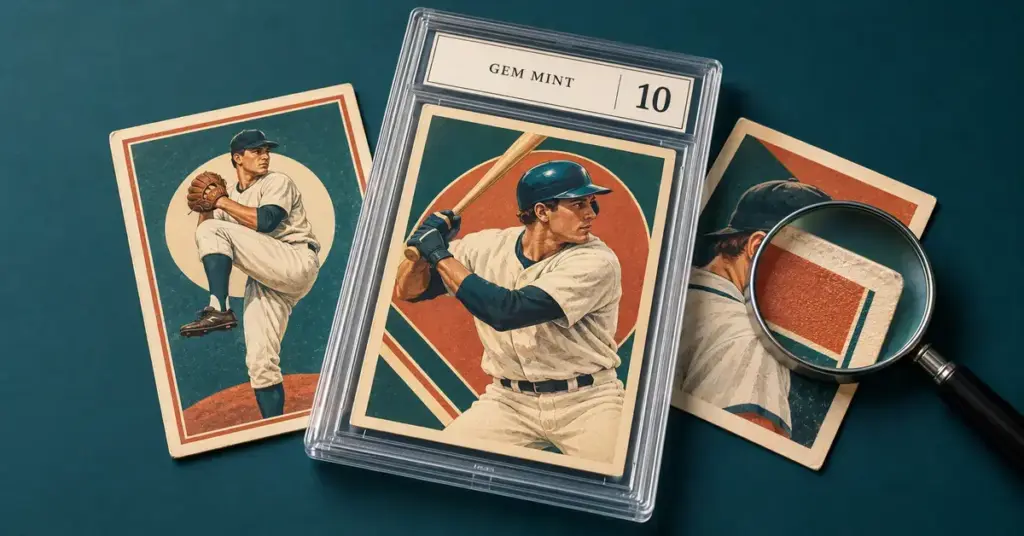
Third-party grading companies examine a card’s centring, corners, edges and surface, then seal it in a tamper-evident plastic holder (a “slab”) with an assigned grade. Most use a 1–10 scale, where a 10 (often labelled Gem Mint) is the highest and most valuable. Autograph cards can also have their signatures authenticated. Grading costs money and takes time, so it is usually reserved for higher-value cards; fees vary by the card’s declared value and the turnaround speed you choose, so check a grader’s current price list before submitting.
Card Grading Companies Compared
| Company | Abbreviation | Grade scale | Notes |
|---|---|---|---|
| PSA | PSA | 1–10 | Professional Sports Authenticator; one of the largest and most widely recognised graders. |
| SGC | SGC | 1–10 | Sportscard Guaranty; popular for vintage cards and known for distinctive black holders. |
| Beckett | BGS | 1–10 | Beckett Grading Services; offers subgrades for centring, corners, edges and surface. |
| CGC Cards | CGC | 1–10 | Expanded from comics into sports and trading cards in recent years. |
Storing and Handling Your Cards
Good storage protects both condition and value. Common practices include:
- Using soft “penny sleeves” and rigid top-loaders for individual cards.
- Keeping cards in binders with acid-free pages, or in boxes with dividers.
- Avoiding direct sunlight, humidity and large temperature swings.
- Adding silica-gel packs to help control moisture.
Graded cards are already sealed in their slabs. For raw (ungraded) cards, handle them by the edges to keep oils and dirt off the surface, and wash and dry your hands first.
Vintage vs Modern Cards
“Vintage” cards are generally those printed before 1980. They are valued for their scarcity and historical importance, but age and the casual storage of earlier decades mean well-preserved examples are hard to find. The 1952 Topps Mickey Mantle is one of the most iconic vintage cards.
Modern cards, from the 1980s onward, benefit from better printing, thicker stock and features such as serial-numbered parallels, inserts and on-card autographs. However, manufacturers massively overproduced cards in the late 1980s and early 1990s — the period collectors call the “junk wax era” — leaving huge surpluses that keep most cards from those years inexpensive today.
Market Trends and Where Cards Are Sold
Interest in cards surged during the COVID-19 pandemic, with many prices climbing steeply in 2020 and 2021 before cooling. Demand for scarce vintage and star-player cards has generally held up better than common modern cards. Fractional-ownership platforms (where several people own shares in a single high-value card) and digital collectibles have appeared, but physical cards remain the core of the hobby.
Auctions
Specialist auction houses such as Heritage Auctions, Goldin and others handle the most expensive sales, providing authentication, provenance and transparent bidding. High-grade trophy cards routinely sell here for six and seven figures. In August 2022 a 1952 Topps Mickey Mantle graded SGC 9.5 sold for US$12.6 million at Heritage Auctions, the highest price ever paid for any sports collectible at the time.
Communities and Tools
Collectors gather in online forums and social-media groups to trade, share knowledge and follow the market. New Zealand and Australian collectors often use Facebook groups and local meet-ups. Price-tracking tools and marketplace sold-listings help buyers gauge fair value rather than relying on asking prices alone.
Card Shows and Events in New Zealand
In-person shows let collectors inspect cards firsthand and meet other hobbyists. The largest conventions are held in North America, but New Zealand hosts smaller sports-memorabilia and collectible-card events from time to time, often alongside wider pop-culture or trading-card gatherings.
Common Mistakes to Avoid
- Overpaying during hype: buying at the peak of a player’s popularity often means paying more than a card is worth once attention fades.
- Grading low-value cards: grading fees can exceed a common card’s value, so weigh the cost against the likely grade and resale price.
- Poor storage: bending, sunlight and moisture can quickly downgrade an otherwise valuable card.
- Trusting asking prices: check recent completed sales, not listed prices, to understand real market value.
- Assuming older means valuable: most late-1980s and 1990s cards are common and inexpensive regardless of age.
A Note on Value and Investing
This article is general information, not financial advice. Collectible cards are not regulated financial products, their prices can be volatile, and past sale prices do not predict future value. Only spend what you can comfortably afford, and treat any resale gain as uncertain. New Zealand’s Financial Markets Authority publishes plain-language guidance on market volatility and on assessing risk, and the government-backed service Sorted (sorted.org.nz) offers free money-management tools. If a deal seems too good to be true or a seller pressures you to act quickly, take time to verify before buying.
Sources
- ESPN — 1952 Topps Mickey Mantle card sells for $12.6 million
- MLB.com — T206 Honus Wagner card sells for record $7.25 million
- Business Wire — Fanatics Acquires Topps Trading Cards and Collectibles Business
- CBS Sports — MLB and Fanatics strike trading-card licence agreement
- Sports Collectors Daily — PSA card grading prices and tiers
Frequently Asked Questions (FAQ)
Which baseball cards are actually worth money?
Cards of star players — especially genuine rookie cards — and professionally graded, high-grade examples tend to hold the most value. Scarcity, condition and the player’s importance to the game matter most, while common cards from any era are usually worth little.
Why are cards from the 1980s and 1990s often worth so little?
Manufacturers printed enormous quantities during that period, creating a lasting surplus. Collectors call it the “junk wax era.” Because so many copies survive in good condition, most of these cards remain inexpensive despite their age.
How do I know if a baseball card is valuable?
Identify the player, year, set and any serial numbering, then check recent completed sales on major marketplaces rather than asking prices. Condition and whether the card is graded and authenticated also affect value, and grading-company population reports show how scarce a particular grade is.
What is the most valuable baseball card?
The two most famous high-value cards are the 1952 Topps Mickey Mantle, a copy of which sold for about US$12.6 million in 2022, and the rare T206 Honus Wagner, which has changed hands privately for around US$7.25 million. Both command those prices because of a combination of extreme scarcity, condition and historical significance.
Who makes official MLB baseball cards today?
Fanatics owns the Topps brand (acquired in 2022) and holds the exclusive licence to produce Major League Baseball and MLB Players Association cards, so most new officially licensed cards carry the Topps or Bowman names under Fanatics.