The Digimon Card Game is a two-player trading card game from Bandai, built around the digital monsters that a lot of Kiwis grew up watching on the Digimon anime. It is fast, affordable to start, and easy enough that a child can learn the basics in one sitting — but it has enough depth to keep teenagers and adults coming back. If you are still deciding what to play, it sits alongside plenty of other card games to play in NZ.
What is the Digimon Card Game?
The Digimon Card Game is published by Bandai and is based on the long-running Digimon franchise (© Akiyoshi Hongo, Toei Animation). Bandai first released the game in 2020: three Starter Decks — Gaia Red, Cocytus Blue and Heaven’s Yellow — came out on 24 April 2020, followed by the first main booster, New Evolution, on 15 May 2020. An English-language version followed for Western markets, and that is the one you will find on New Zealand shelves.
It is a one-on-one duelling game. Each player brings their own deck, and the two of you take turns playing creatures, powering them up and attacking until someone breaks through the other player’s defences. The headline mechanic is digivolving — stacking a bigger, stronger Digimon on top of a smaller one, exactly the way the monsters evolve in the show.
One thing worth clearing up: this is not the same as the Digimon collectible cards Bandai sold back in the late 1990s and 2000s. Those were separate, older games. The cards in this guide only work with the 2020-onwards Digimon Card Game.
Quick Facts
| Game | Digimon Card Game (collectible trading card game) |
|---|---|
| Publisher | Bandai (© Akiyoshi Hongo, Toei Animation) |
| Players | 2 (one-on-one duel) |
| Main deck | Exactly 50 cards, up to 4 copies of any card |
| Digi-Egg deck | Up to 5 cards |
| Starting security | 5 cards per player |
| First released | 2020 (Starter Decks 24 April; first booster New Evolution 15 May) |
| Best way to start | A ready-to-play themed Starter Deck |
What you need to play
Two players, and each player brings two decks:
- A main deck of exactly 50 cards. You can include up to four copies of any single card.
- A Digi-Egg deck of up to five cards. This small side deck holds your starting-stage Digimon (the “eggs”) and also allows up to four copies of a card.
You also each need a memory gauge — a small cardboard strip with a marker that tracks whose turn it is. The good news for beginners is that you do not have to build anything from scratch. The simplest way in is a ready-to-play Starter Deck: these come with a themed 54-card deck and the memory gauges you need. The very first starter, Gaia Red, is built around Agumon and Tai’s partner Digimon, and newer starters follow the same idea with different colours and characters.
How to play Digimon: the basics
Below are the core rules, verified against Bandai’s official rulebook. House rules and tournament details go deeper, but this is everything you need for a first game.
Setting up a game
Both players draw an opening hand of five cards — you may take one full re-draw (a mulligan) if you do not like your hand — then set the top five cards of their deck aside face-down as their security stack and place the shared memory marker at zero. The first turn can then begin.
The goal: break the security
Think of your five-card security stack as your health or your shield. When you attack your opponent directly, they flip the top card of their security stack and resolve it. Your job is to grind that stack down from five to zero, and then land one more successful attack on a player who has no security left. Do that and you win.
The memory gauge
The memory gauge is the clever engine that makes Digimon feel different from other trading card games. There is one shared gauge between the two players, with 0 in the centre and the numbers 1 to 10 running out to each side — your memory on your side, your opponent’s on theirs.
Almost everything you do costs memory, and paying for it slides the marker across towards your opponent. You can keep taking actions while the marker is on your side or at zero. The moment it crosses onto your opponent’s side, your turn ends — and they start their turn already holding that much memory to spend. So a big, expensive play hands your rival fuel for their comeback. Managing that push-and-pull is the heart of Digimon strategy.
The four card types
- Digimon cards — your fighters. Each has a play cost and a DP (Digimon Power) value that decides who wins in battle.
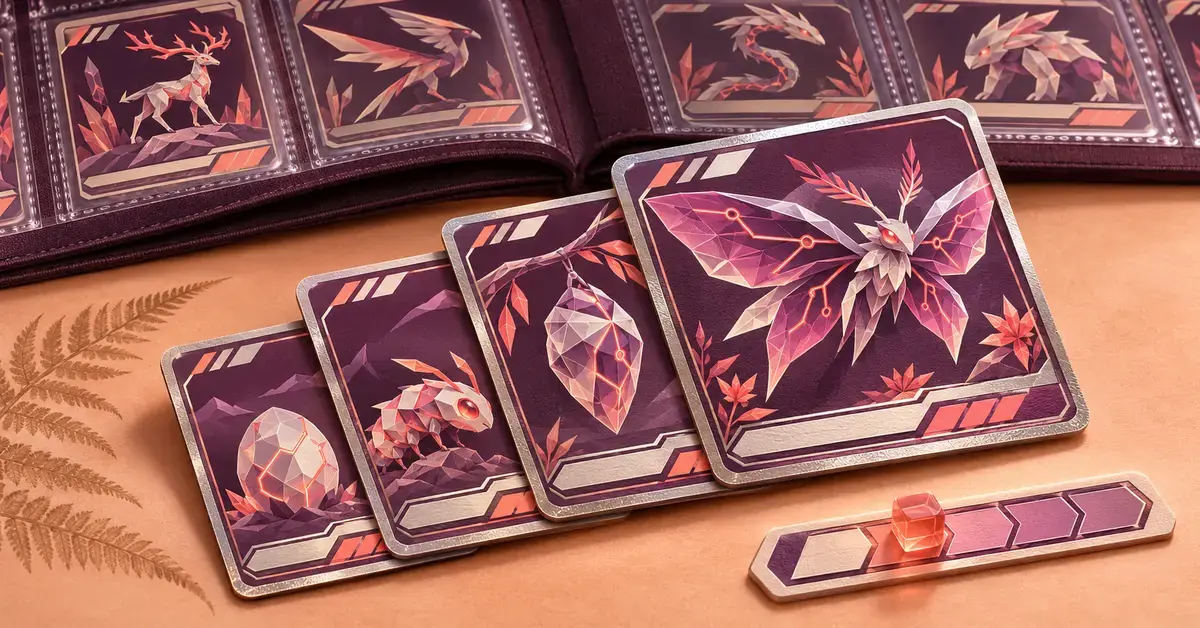
- Digi-Egg cards — the baby and in-training stages that live in your Digi-Egg deck and are “hatched” in the breeding area before growing up.
- Tamer cards — the human partners from the show. They stay in play and give ongoing support or extra memory.
- Option cards — one-off effects, a bit like spells, that do something and then go to the trash.
A turn, step by step
Every turn runs through four phases in the same order:
- Unsuspend — stand your tapped (suspended) cards back up so they can act again.
- Draw — draw one card. The very first player skips this on the opening turn to keep things fair.
- Breeding — do one thing in your breeding area: hatch a Digi-Egg, promote a grown Digimon out to the battlefield, or pass.
- Main — the busy phase. Play Digimon, Tamers and Options, digivolve, and attack, spending memory as you go until your turn ends.
When you digivolve, you place a higher-stage Digimon card from your hand on top of one already in play and pay a small digivolution cost — usually far cheaper than hard-playing that big Digimon from scratch. You also draw a card each time you digivolve, and the Digimon can still attack that same turn. Chaining cheap digivolutions to build a powerful creature while drawing cards is the loop you will use most.
Collecting Digimon cards in New Zealand
Once you are hooked on playing, the collecting side opens up. Digimon has grown quickly, so there is plenty to chase.
The product types
- Starter Decks — the cheapest, most beginner-friendly buy; ready to play out of the box.
- Booster packs — small random packs used to expand and customise your deck. The lowest-cost way to keep collecting.
- Booster boxes / displays — a full case of packs, better value per pack if you are chasing a whole set.
- Extra Boosters (EX) and Advanced sets (AD) — special releases built around particular themes or reprints.
Bandai adds a new main booster set every three to four months. By late 2026 the game had reached its 26th main set, Timeless Bonds (released 29 August 2026), with Time Stranger (17 January 2026) and Dual Revolution (16 May 2026) out earlier in the year — Dual Revolution introducing a new top-tier “Ultimate Rare” rarity for collectors. In other words, there is always a fresh set just around the corner, which is worth keeping in mind before you splash out chasing an older one.
Where to buy in New Zealand
Digimon cards are reasonably easy to find here:
- Specialist game and hobby stores. Auckland’s Vagabond, with shops in Chancery and Takapuna, is a Bandai trading card stockist that carries Digimon and runs regular in-store events. Most main centres — Auckland, Wellington, Christchurch — have a comparable hobby or anime store that stocks sealed product and loose singles and hosts casual play nights.
- Trade Me is the obvious first stop for second-hand singles, bulk lots and the occasional vintage find.
- Import marketplaces can bring in sealed boxes that have sold out locally, though you will usually pay freight and wait longer.
Prices move constantly with set availability, so always check the current NZD figure before buying. For a feel of international market values on singles, many Kiwi collectors cross-check listings on TCGplayer from NZ and convert to local dollars. It is also worth comparing Digimon with the other big trading card games on local shelves — the hugely popular Pokémon TCG in NZ and Bandai’s own Dragon Ball Z cards — before you decide where to put your money.
Spotting fakes and grading cards
As with any trading card game, counterfeit Digimon cards do circulate, especially among cheap online “rare” lots. Buy sealed product from reputable sellers, and when buying singles, check the print quality, the holographic foil, the colour and the card texture against a card you know is genuine. If you end up with a valuable chase card, you can protect its worth by getting it professionally slabbed — our guide to card grading in New Zealand explains how that works and whether it is worth the cost.
Common beginner mistakes
- Overspending memory. Emptying your hand in one turn feels great until your opponent starts their turn with a mountain of memory. Leave the marker near the centre where you can.
- Ignoring the breeding area. Hatching and promoting a Digi-Egg each turn is nearly free value — skipping it leaves you short of early Digimon.
- Forgetting to digivolve for the draw. Hard-playing big Digimon costs far more memory and skips the free card you would have drawn.
- Chasing an old set. With a new booster every few months, cards you want may be cheaper or reprinted soon.
Sources
- Bandai — Digimon Card Game General Rules (official rulebook)
- Digimon Card Game — About / How to Win (official)
- Digimon Card Game — Products & set release list (official)
- Digimon Card Game — Gaia Red [ST-1] Starter Deck (official)
- Digimon Card Game — Dual Revolution [BT-25] product page, Ultimate Rare (official)
- Digimon Card Game — Tutorial App (official)
- Wikipedia — Digimon (earlier Digimon card games, from 1997)
Frequently Asked Questions
Did Digimon have trading cards before this game?
Yes. Bandai first released a Digimon Collectible Card Game in Japan in 1997, and several different Digimon card games appeared over the following years. The current Digimon Card Game is a separate, modern game that began in 2020, and those vintage cards are not compatible with it — they can still be fun to collect for nostalgia, but keep them apart from your playable modern deck.
Is the Digimon Card Game good for younger kids?
The basics — play a Digimon, digivolve, attack — are simple enough for primary-aged children, especially using two ready-made Starter Decks so nobody has to build a deck. The deeper memory and timing tactics give older players plenty to think about, which makes it a decent mixed-age game for a family or a school holiday afternoon.
Can you play the Digimon Card Game online?
Bandai offers a free Digimon Card Game tutorial app that teaches the rules on iOS and Android, and many players use third-party simulators to practise or play remotely. For most Kiwis, though, the game is played in person with physical cards.
Are Digimon cards worth collecting?
Some rare and alternate-art cards hold real value on the second-hand market, but prices are unpredictable and most cards are inexpensive. Collect because you enjoy the game and the artwork rather than as an investment, and check recent sold listings before paying a premium for any single card.