Three Card Poker is a casino table game played against the dealer rather than other players, using a standard 52-card deck. Each person gets just three cards, there are only a couple of decisions to make, and a full round is over in under a minute. That simplicity is why it has become one of the easier casino card games to pick up. This guide walks through the rules, the two bets you can place, the payout tables you will see at the table, and the basic strategy that keeps the house edge as low as the game allows.
Quick Facts
| Players | One or more, each against the dealer |
|---|---|
| Equipment | Standard 52-card deck |
| Cards per hand | Three |
| Main bets | Ante + Play, and/or Pair Plus |
| Dealer qualifier | Queen-high or better |
| House edge (Ante/Play, optimal play) | About 3.37% of the Ante |
| Round length | Under a minute |
| Skill level | Beginner-friendly; one key decision per hand |
What Three Card Poker is
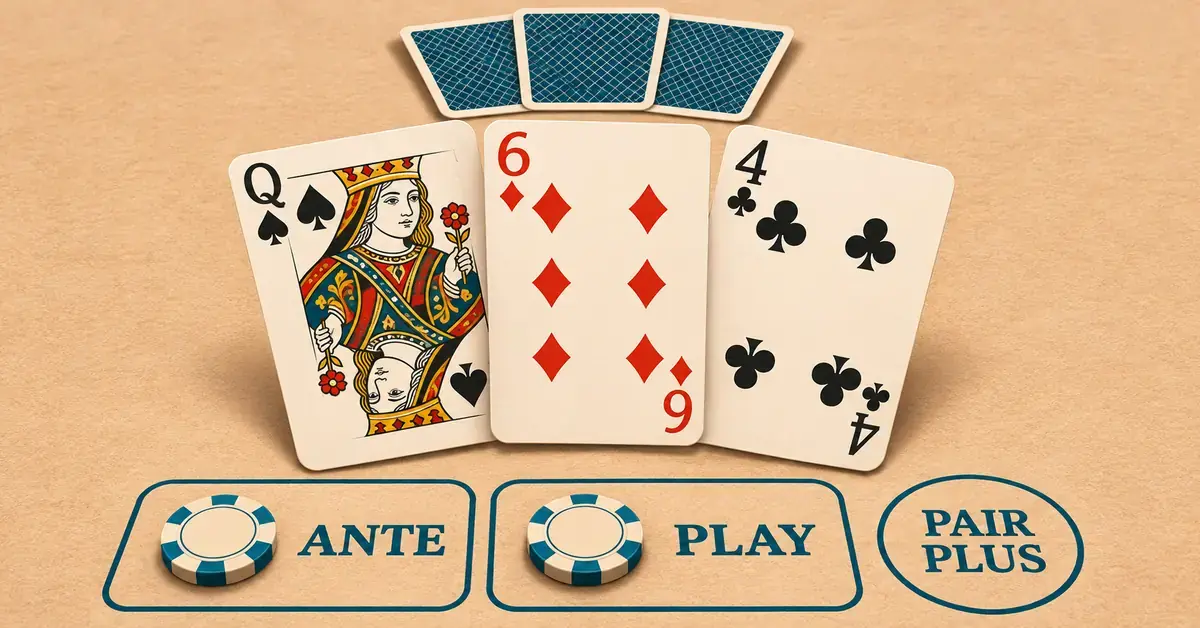
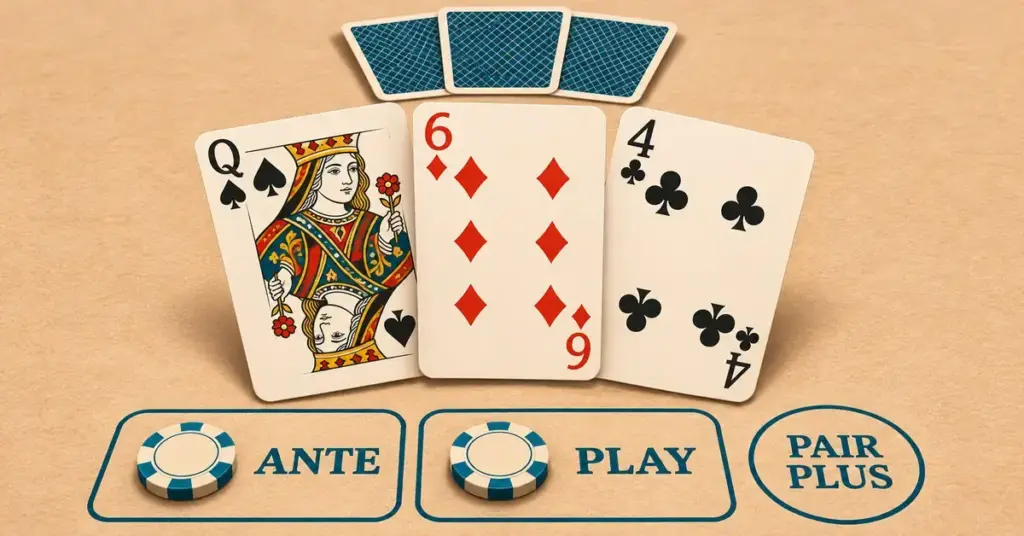
Three Card Poker was invented in the mid-1990s and combines two games in one layout. On the same hand you can bet against the dealer (the Ante and Play bets) and bet on the quality of your own three cards (the Pair Plus bet). You can place either bet on its own, or both together.
Because each hand is only three cards, the way hands rank is different from the five-card poker most people know. If you want a refresher on the standard order first, our guide to poker hand rankings covers every five-card hand, and the broader how to play poker walk-through explains the family the game belongs to.
How a round is played
A round follows the same short sequence every time:
- Place your opening bet. Put a wager in the Ante box, the Pair Plus box, or both. Each has its own minimum.
- Receive your cards. You and the dealer each get three cards face down.
- Look at your hand and decide. If you have an Ante bet, you now choose to either play or fold. To stay in, place a Play bet equal to your Ante. To fold, you surrender the Ante (and the hand is over for you).
- The dealer reveals. The dealer turns over their three cards.
- Hands are settled. The dealer compares hands and pays or collects according to the rules below.
The Pair Plus bet, if you made one, is settled entirely on your own three cards and has nothing to do with the dealer’s hand or your play/fold choice.
The dealer qualifier
The dealer only “qualifies” if their hand is Queen-high or better. This single rule drives how the Ante and Play bets pay:
- Dealer does not qualify (Jack-high or worse): your Ante pays even money (1 to 1) and your Play bet is returned to you, win or lose. You get paid without your hand ever being compared.
- Dealer qualifies and you win: both your Ante and Play bets pay even money.
- Dealer qualifies and you lose: you lose both the Ante and the Play.
- Tie: the bet pushes and your money is returned.
Three Card Poker hand rankings
The hands rank from strongest to weakest as follows. The important quirk is that a straight beats a flush — the reverse of five-card poker.
| Rank | Hand | Example |
|---|---|---|
| 1 (highest) | Straight flush | 9-10-J of hearts |
| 2 | Three of a kind | 7-7-7 |
| 3 | Straight | 5-6-7 mixed suits |
| 4 | Flush | 2-8-K of spades |
| 5 | Pair | Q-Q-4 |
| 6 (lowest) | High card | K-9-4 mixed suits |
Why does the straight outrank the flush here? With only three cards, a straight is actually rarer than a flush — roughly 3.3% of hands are straights against about 5.0% that are flushes — so the harder hand to make is ranked higher. When two hands are the same type, the higher top card wins; if those match, the next card decides, and so on.
Payouts: Ante Bonus and Pair Plus
There are two sets of bonus payouts, and both are paid regardless of what the dealer holds. Exact figures vary from casino to casino, so always read the paytable printed on the felt before you sit down.
Ante Bonus
If your hand is a straight or better, you also collect an Ante Bonus on top of the normal Ante result. You do not place a separate bet for it, and it is paid whenever you have made both the Ante and Play bets, whatever the dealer holds. A common table looks like this:
| Hand | Ante Bonus |
|---|---|
| Straight flush | 5 to 1 |
| Three of a kind | 4 to 1 |
| Straight | 1 to 1 |
Pair Plus
The Pair Plus bet wins whenever your three cards make a pair or better, and it is settled on your hand alone. A widely used paytable is:
| Hand | Pair Plus pays |
|---|---|
| Straight flush | 40 to 1 |
| Three of a kind | 30 to 1 |
| Straight | 6 to 1 |
| Flush | 3 to 1 |
| Pair | 1 to 1 |
Pair Plus paytables differ more than any other part of the game. Both the Hard Rock and PokerNews tables above pay a flush 3 to 1 and a straight 6 to 1, but other casinos shift the straight, flush or straight-flush payout, which changes the cost to the player, so always check the exact numbers printed on the felt.
Basic strategy: the Q-6-4 rule
The only real decision in Three Card Poker is whether to place the Play bet after seeing your cards. The mathematically correct rule is short and easy to remember:
Play any hand of Queen-6-4 or higher, and fold anything weaker.
In practice that means you play if your highest card is an Ace or King, you play any pair or stronger hand automatically, and when your top card is a Queen you order your three cards from highest to lowest and compare them against Q-6-4 in turn. A hand like Q-7-2 is a play because the second card (7) beats the 6. Q-5-3 is a fold because the second card (5) is below the 6, and Q-6-3 is a fold because the first two cards tie Q-6 but the third card (3) falls below the 4. Everything Jack-high or lower is a fold.
Folding feels wrong to some players because you give up the Ante, but staying in on weak hands loses more over time. This is the same idea behind the disciplined, fold-often approach in our beginner poker tips, and it is the sort of simple decision chart that, in another game, our blackjack strategy chart sets out move by move.
What the game costs you
Played perfectly with the Q-6-4 rule, the combined Ante and Play bet carries a house edge of about 3.37% of your Ante. The Pair Plus bet’s edge depends on the paytable. Wizard of Odds puts the house edge at 7.28% on the table shown above (straight flush 40 to 1, three of a kind 30 to 1, straight 6 to 1, flush 3 to 1, pair 1 to 1); the more generous version that pays a flush 4 to 1 instead carries a much lower edge of 2.32%.
No decision or betting pattern changes those numbers in the long run; the edge is built into the paytables. Side bets and bonuses are extra entertainment, not a way to turn the odds in your favour. If you are curious about how that edge works across the floor, our explainer on casino house edge goes deeper, and Three Card Poker sits alongside the other options in our round-up of casino card games for beginners.
Common mistakes to avoid
- Folding too often. The maths says play Q-6-4 and up; folding good hands below an Ace throws away value.
- Assuming a flush beats a straight. In three cards it is the other way round — check the ranking table before you act.
- Chasing the Pair Plus bet. It is fun and can pay big, but it is not a strategy, and a poor paytable makes it expensive.
- Not reading the felt. Payouts and minimums vary between tables and casinos; the numbers printed in front of you are the ones that count.
Where to play in New Zealand
Three Card Poker turns up on the table-games floor at New Zealand casinos such as SkyCity’s venues, though the exact mix of games changes, so check what is running before you go. To enter a casino gaming area in New Zealand you must be 20 or older, and casino gambling is regulated by the Department of Internal Affairs under the Gambling Act 2003. Since July 2025, SkyCity’s three New Zealand casinos have required carded play across both gaming machines and table games, meaning you need a SkyCity player card to sit at the tables.
Disclaimer
This article is general information about how Three Card Poker works, not betting advice or encouragement to gamble. Casino games are designed with a built-in house edge, so over time the game is expected to cost money; no strategy changes that. You must be 20 or older to enter a casino gaming area in New Zealand.
If gambling is causing harm for you or someone you know, free and confidential help is available 24/7 from the Gambling Helpline Aotearoa on 0800 654 655 (or text 8006), and support services can be found through Safer Gambling Aotearoa.
Reference sources
- Wizard of Odds — Three Card Poker: hand order, probabilities and house edge
- PokerNews — Learn to Play 3 Card Poker: Strategy, Rules, Tips
- Hard Rock Atlantic City — Three Card Poker rules and payouts
- Department of Internal Affairs — Casinos (Gambling Act 2003)
- Department of Internal Affairs — Gambling (online casino update)
- SkyCity Auckland — Age limits
- AGB — SkyCity implements mandatory carded play across New Zealand casinos
- Gambling Helpline Aotearoa
Frequently Asked Questions
Is Three Card Poker the same as three-card monte?
No. Three-card monte is a street con built on sleight of hand, where the operator makes it impossible to follow the winning card. Three Card Poker is a regulated casino game played with a standard deck and fixed, published payouts.
Should I always place the Pair Plus bet?
There is no need to. Pair Plus is an optional side bet settled only on your own three cards, and its house edge is often higher than the Ante and Play bets. It adds variety and the chance of a bigger single payout, but it does not improve your overall odds.
Can I count cards in Three Card Poker?
Not in any useful way. Cards are shuffled every hand and you only ever see your own three cards before deciding, so there is no running count to track and no advantage to be gained from one.
What is the 6 Card Bonus side bet?
The 6 Card Bonus is an extra optional wager offered on some tables. It combines your three cards with the dealer’s three to make the best five-card poker hand and pays if that hand is three of a kind or better. Like other side bets it has its own paytable and house edge, and it is settled independently of the main game.
Can I play Three Card Poker online in New Zealand?
Online casino gambling in New Zealand is now regulated under the Online Casino Gambling Act 2026, which the Department of Internal Affairs is in the process of implementing, so licensed online options are being introduced. If you do play online, stick to a licensed operator and check its standing first. And if you simply want to learn the game risk-free, practice or play-money tables are a safer way to get comfortable with the rules before putting money on the line.