Canfield solitaire is a single-player card game with a reputation for being one of the toughest patience games you can deal. You build four foundation piles upward from a base card that changes every game, feed a 13-card reserve into the tableau, and turn the stock three cards at a time. This guide walks through the full setup, the rules for each pile, how Canfield differs from Klondike, the real odds of winning, and a few habits that help whether you are playing with a real deck at a Kiwi bach or tapping away on your phone.
Quick Facts
| Players | 1 |
|---|---|
| Deck | Standard 52-card deck |
| Objective | Build all four foundation piles (52 cards) |
| Reserve | 13 cards, top card face up |
| Tableau | 4 columns, built down in alternating colours |
| Stock deal | 3 cards at a time |
| Redeals | Unlimited (standard home and digital version) |
| Difficulty | Hard |
| Typical win rate | Around 35% for skilled players |
What is Canfield solitaire?
Canfield is a patience game played with a single standard 52-card deck. The aim is to move all 52 cards onto four foundation piles. It belongs to the same family as the classic game most people simply call how to play solitaire, and it is a close cousin of Klondike Solitaire — but two twists make it notably harder, which we cover below.
In England the same game has long been known as Demon, and it has also been called Thirteen. The “Canfield” name comes from a 19th-century American casino, a story we return to near the end.
What you need to play
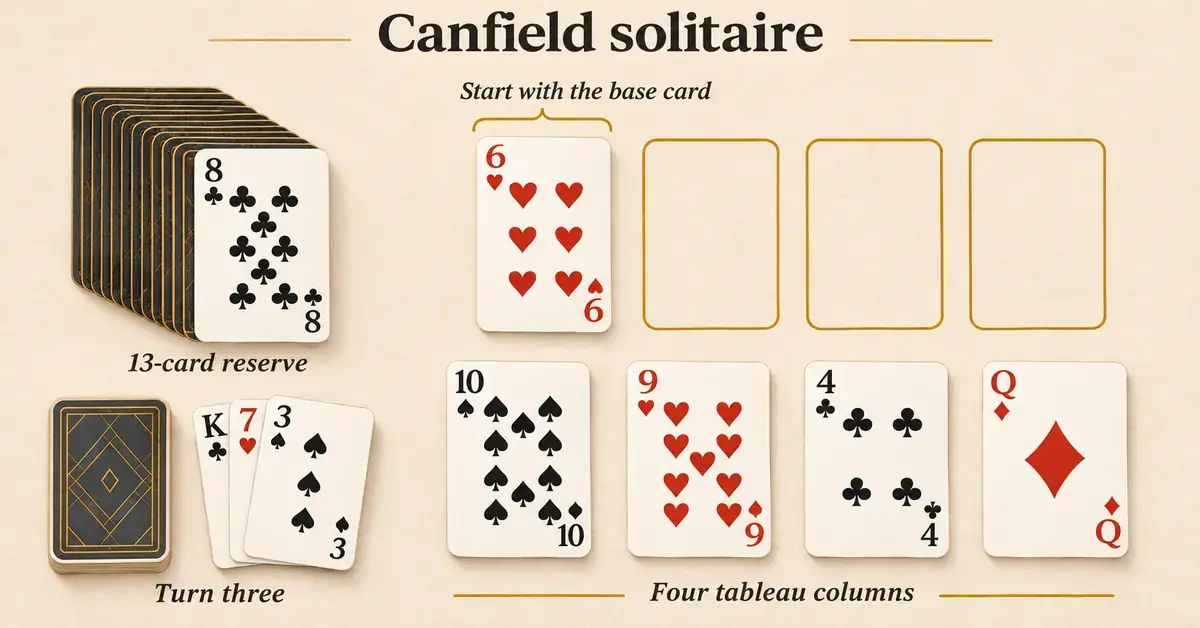
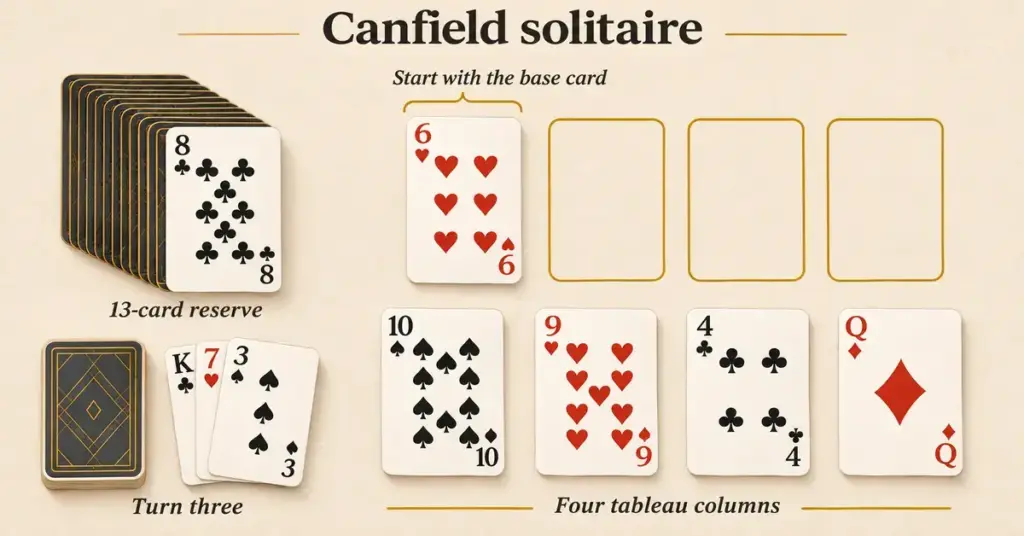
You only need a shuffled 52-card deck and a bit of table space. Canfield uses five areas:
- Foundations — four piles you build up, one per suit. Unlike most solitaire games these do not start on an Ace; they start on a base card dealt at the beginning.
- Reserve — a stack of 13 cards (sometimes called the “stock” or “storehouse”) with only the top card face up and available to play.
- Tableau — four columns, each starting with a single face-up card, where you build temporary sequences.
- Stock — the remaining cards, turned over in packets of three when you run out of moves.
- Waste — the face-up pile the stock cards land on; only the top card is in play.
How to set up Canfield
Setting up takes about a minute once you know the order:
- Shuffle the full 52-card deck.
- Count 13 cards into a face-down pile for the reserve, then turn the top card face up.
- Deal one card face up to start the first foundation. Whatever its rank is becomes the base rank for all four foundations that game.
- Deal one card face up to each of the four tableau columns.
- Keep the remaining 34 cards face down as the stock.
As the other three cards of the base rank appear during play, you move them up beside the first one so all four foundations are building from the same starting rank.
How to play Canfield, pile by pile
Building the foundations
Each foundation is built upward in the same suit, starting from the base rank and continuing until it holds 13 cards. The ranks wrap around: if the base card is an 8, that pile runs 8, 9, 10, Jack, Queen, King, then Ace, 2, 3, 4, 5, 6, 7. In short, Ace follows King and the count simply loops back. Getting all four foundations to 13 cards each wins the game.
Building the tableau
The tableau columns are built downward in alternating colours — a red card on a black one and vice versa, exactly as in standard solitaire. These sequences also wrap: you can place a King on an Ace to keep a run going. You can move a single card or a whole packed sequence from one column to another, as long as the alternating-colour order is preserved.
Using the reserve
The reserve is the heart of Canfield. Only its top card is face up, and your main job across the whole game is to peel those 13 cards away onto the foundations or tableau. Whenever the top reserve card fits somewhere, you can play it, which exposes the next card down.
Filling empty columns
When a tableau column is emptied, it is filled immediately from the reserve — this is the automatic refill that keeps the reserve moving. Once the reserve is exhausted, you fill empty columns from the waste pile instead, and at that stage you can usually choose when to do so.
Working the stock and waste
When you are stuck, deal three cards at a time from the stock onto the waste pile; only the top waste card is playable. In the standard home and digital game you may turn the stock over and deal through it again as many times as you like — redeals are unlimited — so a card buried early can come back around later.
How Canfield compares to Klondike
Canfield sits in the Klondike family, and the tableau behaves almost identically, so if you already know Klondike you are halfway there. The differences are what make Canfield a steeper challenge.
Canfield vs Klondike
| Feature | Canfield | Klondike |
|---|---|---|
| Foundation base | Variable base card, dealt each game (foundations wrap King to Ace) | Always starts on an Ace |
| Reserve pile | 13 cards, top card in play | None |
| Tableau columns | 4, one card each at the start | 7, staircased from 1 to 7 cards |
| Tableau building | Down in alternating colours | Down in alternating colours |
| Empty column fills with | Top reserve card automatically, then waste | Any King (and its sequence) |
| Relative difficulty | Harder | Easier |
The two sticking points are the variable base card — you rarely start a foundation on a convenient low rank — and the 13-card reserve, a locked stack you must dismantle in order. If you enjoy Canfield, the harder members of the family such as Russian Solitaire and the more forgiving FreeCell are natural next steps.
Is Canfield hard to win?
Yes — Canfield is famously difficult, and it was designed that way. A detailed computer analysis by Jan Wolter found that under standard draw-three rules a solver could win about 71% of deals when allowed to see every card, but that figure assumes perfect, hindsight-level play. Skilled human players who cannot see the hidden cards typically report winning around 35% of games, and a lot of that comes from careful use of the undo button in digital versions. The one-card-draw variant is much kinder, with win rates climbing to roughly 89–92%.
The practical takeaway: losing most games is completely normal. Progress in Canfield is often measured by how many cards you clear, not just by whether you win.
The casino origins of Canfield
The game is named after Richard A. Canfield, who bought a gambling house in Saratoga Springs, New York, in 1884 and ran it until 1911, when it was sold to the city amid growing anti-gambling pressure. In his casino a player could buy a deck of cards for $52, play one game, and collect $5 for every card they managed to get onto the foundations.
That pricing is why the game is so stingy: at $5 a card you needed to build at least 11 cards up just to come out ahead of your $52 stake, and clearing the whole deck was rare. The casino version was also tighter than the game we play today — early accounts describe the deck being dealt a single card at a time and gone through only once, with no redeal, which would make the house version harder still.
There is even a historical twist: solitaire researcher Michael Keller argues that the game actually dealt in Canfield’s casino may have been Klondike rather than the Demon game we now call Canfield, since many early rule books confusingly used “Canfield” as a name for Klondike. The naming has been muddled for over a century.
Strategy tips and common mistakes
- Attack the reserve first. Every decision should ask whether it helps you free the next reserve card. A stuck reserve almost always means a lost game.
- Do not rush cards to the foundations. A card sent up too early can leave you unable to build a tableau sequence you needed. Keep some low cards available.
- Think before emptying a column. While the reserve still has cards, an empty column refills from it automatically — useful when it frees a card you want, wasteful when it buries one you needed.
- Plan the draw-three order. Because the stock comes in threes, the cards that land on top of the waste depend on where you start. Cycling the stock can change which cards become reachable.
- Use unlimited redeals patiently. There is no penalty for turning the stock over again, so keep cycling as long as new moves keep appearing.
Playing Canfield online
Canfield is a staple of free solitaire sites and mobile apps, which is handy because it is slow to shuffle and re-deal by hand. Browser collections such as World of Solitaire include it, and you can compare it with other variants in our round-up of the best solitaire card games. Digital versions add undo and hints, which is a big part of why online win rates look higher than tabletop ones.
Sources
Frequently Asked Questions
Can you win every game of Canfield solitaire?
No. Many Canfield deals simply cannot be solved no matter how well you play, and even solvable ones are easy to lose with a wrong move. Clearing all 52 cards is genuinely uncommon, which is part of the game’s appeal.
Does the single-card draw make Canfield easier?
Yes, considerably. Turning the stock one card at a time instead of three gives you far more control over which cards reach the waste, which is why the single-card version wins far more often — see the “Is Canfield hard to win?” section above for the figures.
Can I play Canfield solitaire free online?
Yes. Plenty of free solitaire websites and phone apps include Canfield, usually with unlimited redeals, undo and hints. A real deck works just as well if you would rather play away from a screen.
Is Canfield a good solitaire game for beginners?
It is better suited to players who already know a game like Klondike. The variable base card and locked 13-card reserve make Canfield demanding, so newcomers often enjoy an easier variant first and come to Canfield once they want more of a challenge.