
Two is one of the most rewarding numbers in card gaming. With only a single opponent to read, a standard 52-card deck turns into a contest of memory, probability and bluffing that larger tables rarely match. This guide walks New Zealand players through the best head-to-head card games you can play tonight, from quick-fire classics to deep strategy games, with plain-English rules, setup notes and tips for getting better at each one.
Why games for two play differently
In a game with four or five people, luck is spread across many hands and your decisions are diluted by everyone else’s. With a single rival, almost every outcome traces back to a choice one of you made. You can track which cards have appeared, narrow down what your opponent is holding, and plan several moves ahead with far more certainty than in a crowded game. That is why many two-player card games reward patience, counting and bluffing more heavily than their multiplayer versions.
The practical appeal is just as strong. Most of these games need nothing more than one deck of cards and a flat surface, so they travel well and cost almost nothing to start. Rounds can run from a frantic two minutes to a thoughtful hour, which makes the format easy to fit around a coffee, a commute or a quiet evening at home.
Game Comparison
| Game | Deck | Game type | Difficulty | Typical length |
|---|---|---|---|---|
| Rummy | 52 cards | Draw and discard, melds | Easy | 15–30 min |
| Gin Rummy | 52 cards | Draw and discard, knocking | Easy–medium | 20–40 min |
| Speed | 52 cards | Real-time, no turns | Easy | 2–5 min |
| Double Solitaire | Two 52-card decks | Race on shared foundations | Medium | 15–30 min |
| Honeymoon Bridge | 52 cards | Trick-taking with bidding | Hard | 30–60 min |
| Cribbage | 52 cards (+ board) | Pegging and combinations | Medium | 20–45 min |
| Durak | 36 cards | Attack and defend | Medium | 10–30 min |
| Sixty-Six | 24 cards | Trick-taking to 66 | Medium | 15–30 min |
Rummy for two players
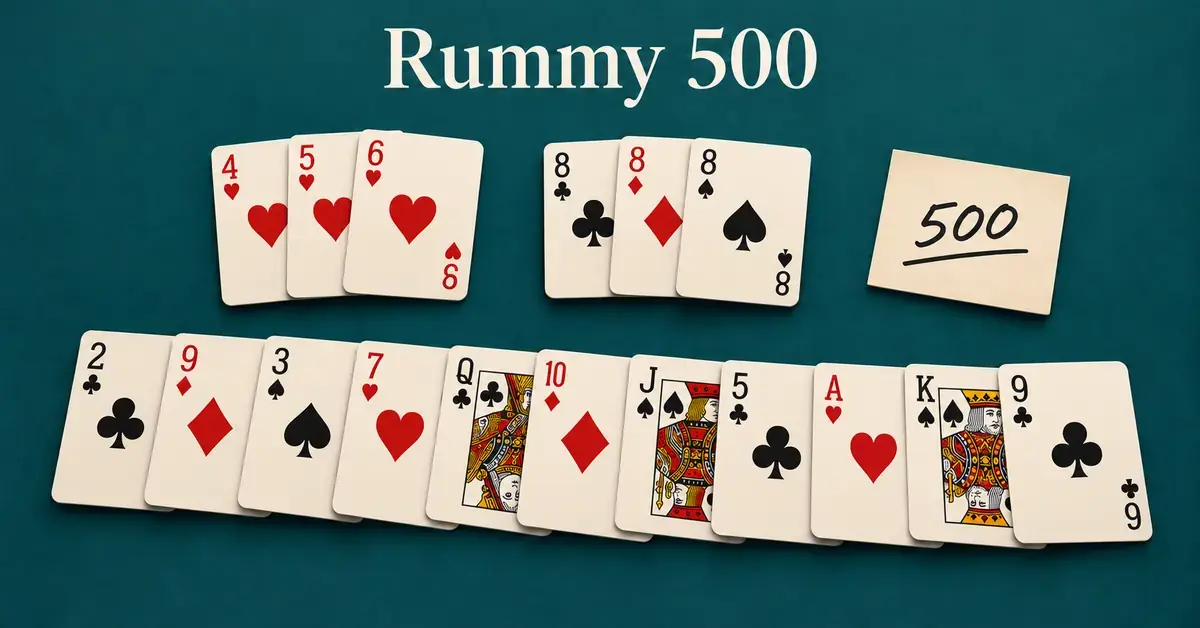
Rummy is a draw-and-discard game and one of the easiest entry points for two people. Each player is dealt ten cards, with the rest forming a face-down stock and one card turned up to start the discard pile. On your turn you draw either the top stock card or the top discard, then throw one card away. The aim is to arrange your whole hand into melds — sets of three or four cards of the same rank, or runs of three or more cards in the same suit — and be the first to lay them all down.
Against one opponent, the discard pile becomes a source of information. If your rival picks up the seven of hearts, you learn something about what they are collecting, so you avoid feeding them nearby hearts. Scoring is usually based on the point value of the cards your opponent is caught holding when you go out, played across several rounds to a target total. For a full breakdown of melds, scoring and the main variants, see our dedicated guide to the rules of Rummy.
Gin Rummy: knocking and deadwood

Gin Rummy is the two-player specialist of the Rummy family and arguably the most popular of the lot. Each player gets ten cards and tries to form the same sets and runs, but the ending is different. Instead of melding everything at once, you can knock as soon as your unmatched cards — called deadwood — add up to ten points or fewer. Aces count one, number cards their face value, and face cards ten each.
When you knock, both hands are revealed and the deadwood is compared. Knock with less deadwood than your opponent and you score the difference. Match every card for zero deadwood and you have “gin”, worth a bonus of about 25 points under common rules. The twist is the undercut: if the defender ends up with equal or fewer deadwood points than the knocker, they take a bonus instead, typically 25 points, though some house rules use 10 or 20. Games are usually played to 100 points. Our Gin Rummy rules explainer covers knocking, laying off and scoring in detail.
Speed: the fastest game on the table
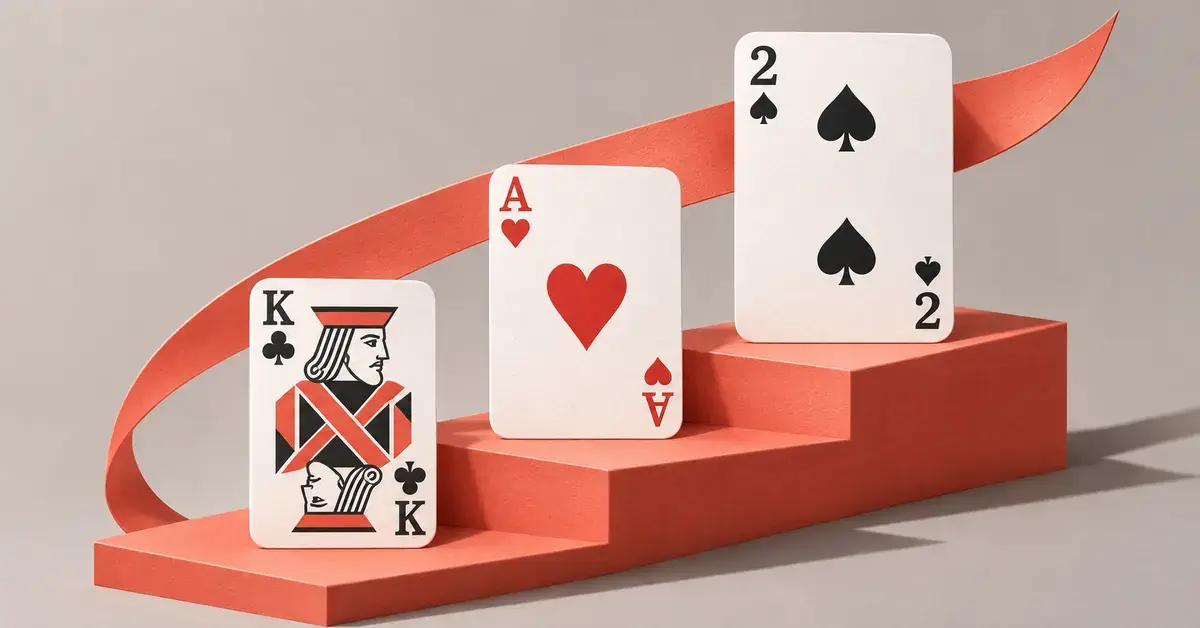
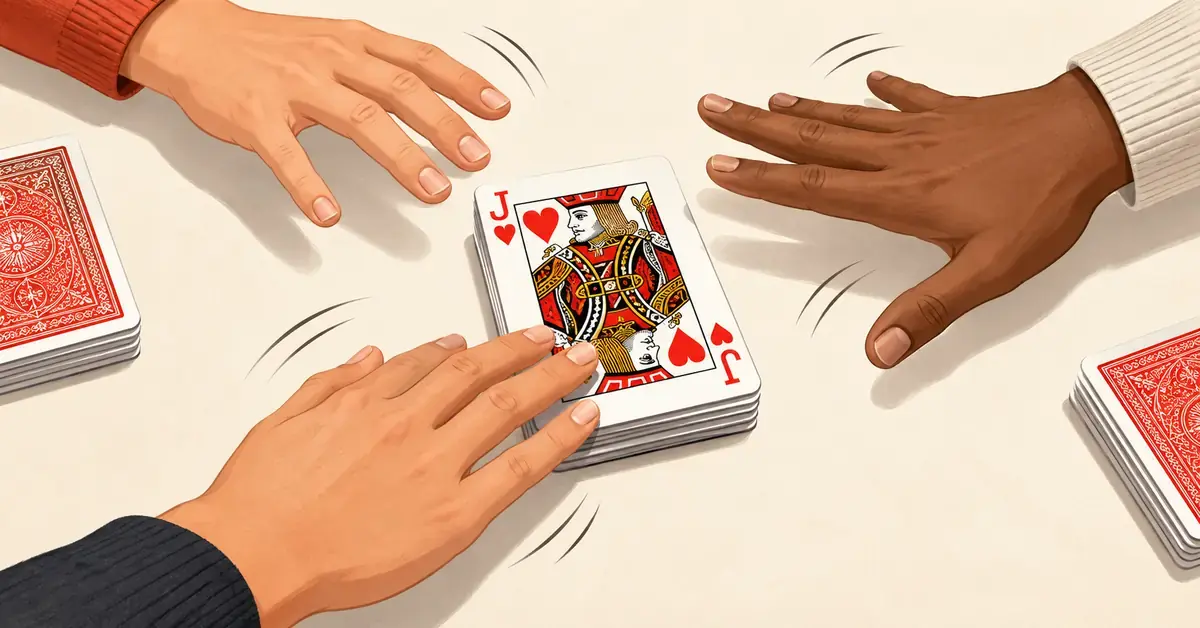
Speed strips card play down to pure reaction. There are no turns at all — both players race at the same time to get rid of their cards. Each person has their own stock and a small hand, and two piles sit face down in the centre. On a signal the centre cards are flipped, and players simultaneously slap down any card that is one rank higher or lower than a centre card, with aces wrapping around to twos and kings. You top your hand back up from your stock as you go, and whoever empties their cards first wins the round. When both players are stuck, fresh centre cards are flipped and the scramble restarts.
It is less about strategy and more about pattern recognition under pressure, which makes it a great warm-up or a game for restless kids and teenagers. Because setups differ between households, it pays to agree on the layout before you start; our Speed card game guide sets out a clear, consistent version.
Double Solitaire: a race on shared foundations
Solitaire is famous as a game for one, but it adapts neatly into a competitive duel. In Double Solitaire each player uses their own 52-card deck and builds their own private Klondike-style tableau, while the foundation piles in the middle are shared. If you play the ace of spades to a foundation, your opponent can drop the two of spades on top of it, and vice versa. The result is a race to shed your cards onto the shared foundations while quietly blocking the suits your rival needs.
It keeps the familiar rhythm of patience games but adds a social, interactive edge and some genuine spatial challenge, since you have to watch the centre and your opponent’s tableau as well as your own. If you want to brush up on the base game first, start with our overview of how to play Solitaire and its variants.
Honeymoon Bridge for couples and pairs
Standard Bridge needs four players, but Honeymoon Bridge (often called Draw Bridge) rebuilds it for two. In the common version, each player is dealt 13 cards and the remaining 26 form a face-down stock. The first 13 tricks are played with no trump suit; after each one, the winner draws the top stock card and the loser takes the next, so both hands quietly rebuild to 13 cards without either player seeing what the other collects. Once the stock is gone, players bid for a contract exactly as in Contract Bridge and play out the final 13 tricks, with scoring handled as in rubber bridge.
The clever part is the drawing phase: you are constantly deciding whether to win a trick to grab a card you can see, or deliberately lose it to take the hidden card underneath. It keeps much of Bridge’s bidding and trick-play logic while fitting onto a kitchen table for two, which makes it a popular stepping stone for players who want to learn the full game.
Cribbage: the board game with cards

Cribbage is instantly recognisable thanks to its wooden pegging board, and it remains a multi-generational favourite in many Kiwi households. Each player is dealt six cards and discards two into the dealer’s extra hand, the crib. A starter card is cut and turned up; if it is a jack, the dealer immediately pegs two points (“his heels”). Players then alternate laying cards face up, keeping a running total that must never pass 31 and scoring along the way for pairs, runs and combinations that add to 15.
After the play comes the “show”, where each player counts their own hand — and the dealer the crib — using the starter card for extra combinations. The first to reach 121 points around the board wins, though a shorter 61-point game is common. The real skill is deciding which two cards to throw into the crib, because when it is your opponent’s deal, those cards help them. Our guide to Cribbage rules and scoring explains pegging and the show step by step.
Durak: the game of the fool
Durak, a staple across Eastern Europe, flips the usual goal on its head: there is no winner, only a loser. Played with a 36-card deck (sixes up to aces), the bottom card is turned to set the trump suit, and each player draws six cards. One player attacks by laying down a card, and the defender must beat it with a higher card of the same suit or any trump. A trump attack can only be beaten by a higher trump. Fail to beat it and you must pick up every card in play; succeed and the cards are discarded.
After each exchange both players draw back up to six from the stock until it runs out. The last person still holding cards is the durak, or fool. Trump management is everything — spend your high trumps too early and you are defenceless in the endgame, but hoard them too long and you drown under cards you cannot beat. The swinging hand sizes and the “don’t be last” philosophy give it a very different feel from Western trick games.
Sixty-Six: marriages and closing the stock
Sixty-Six (closely related to the Austrian game Schnapsen) is a sharp trick-taking game for two using a 24-card deck of nines through aces. Cards score aces 11, tens 10, kings 4, queens 3, jacks 2 and nines nothing, and the goal is to be first to reach 66 points from tricks, bonuses and the last trick. Holding the king and queen of a suit lets you declare a marriage when you lead — 20 points for a plain suit, 40 for the trump suit — but only after you have won at least one trick.
While cards remain in the stock you can play loosely, without following suit. The signature move is closing the stock: if you believe you can reach 66 on your current cards, you turn the trump card face down, after which both players must follow suit and marriages can no longer be declared. Close and fall short, and your opponent is rewarded. It is faster than Bridge but far richer than War, which makes it a fine middle-ground game for two.
Choosing a game and getting started
With so many options, the right pick depends on your mood and the time you have. For a gentle, luck-based warm-up that anyone can learn in a minute, the classic War card game needs no explanation and suits the youngest players. For something quick and physical, reach for Speed. If you want a game you can grow into over years, Cribbage, Gin Rummy and Sixty-Six all reward repeated play.
Getting started is simple: a single complete 52-card deck covers most of these games, while Durak and Sixty-Six use a stripped-down deck you can make by removing the low cards. A cribbage board is handy but optional, since paper and pen track scores just as well. The most important step is agreeing on the house rules before the first hand, because small variations in scoring and setup are common and are the single biggest cause of mid-game arguments.
Key Points
- One opponent, more skill: fewer players means less random luck and far more room for counting, memory and bluffing.
- Minimal kit: most two-player games need only a single 52-card deck and a flat surface.
- Pick by mood: Speed and War for quick fun, Cribbage and Sixty-Six for depth, Honeymoon Bridge for a serious challenge.
- Shortened decks: Durak uses 36 cards and Sixty-Six uses 24, both made by removing low cards.
- Agree the house rules first: small differences in scoring and setup are common, so settle them before you deal.
Common mistakes beginners make
New players tend to trip over the same few things. In Rummy and Gin Rummy, many discard cards that obviously help an opponent rather than tracking what the discard pile reveals. In Cribbage, beginners often overload their own hand and forget that two of their cards are feeding the dealer’s crib. In Durak and Sixty-Six, the classic error is spending trump cards or high scorers too early, leaving nothing for the decisive endgame. The fix in every case is the same: slow down, watch what has already been played, and remember that with only one opponent, every card you reveal is a clue they can use against you.
Sources
Frequently Asked Questions
What is the best two-player card game to learn first?
For most people, Gin Rummy is the ideal starting point. It uses a standard deck, the sets-and-runs idea is easy to grasp, and the knocking and scoring add just enough depth to stay interesting without overwhelming a beginner. Speed and War are even simpler if you want something instant.
How many cards are dealt in two-player Rummy?
In the most common two-player version of standard Rummy, each player is dealt ten cards. The remaining cards form the stock, with one card turned face up to begin the discard pile. Gin Rummy also uses ten cards per player.
Can you really play Bridge with only two people?
Yes. A variant called Honeymoon Bridge adapts the game for two by adding a drawing phase: players compete across an initial set of no-trump tricks to rebuild their hands from a stock, then bid a contract and play out the remaining tricks much as in the four-player game.
Which two-player card games do not use a full 52-card deck?
Durak and Sixty-Six both use shortened decks. Durak is played with 36 cards (sixes through aces), and Sixty-Six uses just 24 cards (nines through aces). You can create either deck by removing the lower cards from a standard pack.
Are card games actually good for your mind?
Games that involve strategy, memory and quick arithmetic give the brain a genuine workout, and they are widely valued for keeping players mentally engaged and socially connected. Tracking a single opponent’s hand builds concentration, while scoring games like Cribbage sharpen mental maths through regular practice.