
Roulette is one of the most recognisable games in any casino: a numbered wheel, a small ball, and a betting layout where you back where that ball will come to rest. It is easy to join but has more depth than it first appears, from the different wheel designs to the many bets you can place and the maths that sits behind each one. This guide explains how a round works, the full range of inside and outside bets and what they pay, the house edge on each wheel type, and the practical etiquette and bankroll habits that make for a calmer session. It is written for players in New Zealand, where roulette is offered at the country’s licensed land-based casinos and, from 2026, under a new framework for licensed online operators.
Key points
- The game: bet on where a ball lands on a numbered spinning wheel; a croupier runs each spin.
- Wheels: European has 37 pockets (one zero); American has 38 (0 and 00); French uses the European wheel with extra player-friendly rules.
- House edge: about 2.70% on European/French wheels and about 5.26% on American wheels — the single-zero wheel is better value.
- Bet types: inside bets (fewer numbers, bigger payouts up to 35 to 1) and outside bets (big groups, smaller payouts, near coin-flip odds).
- No winning system: every spin is independent; no betting pattern beats the house edge over time.
- In New Zealand: available at licensed land-based casinos; licensed online play is being rolled out under the Online Casino Gambling Act 2026.
What roulette is and how a round works
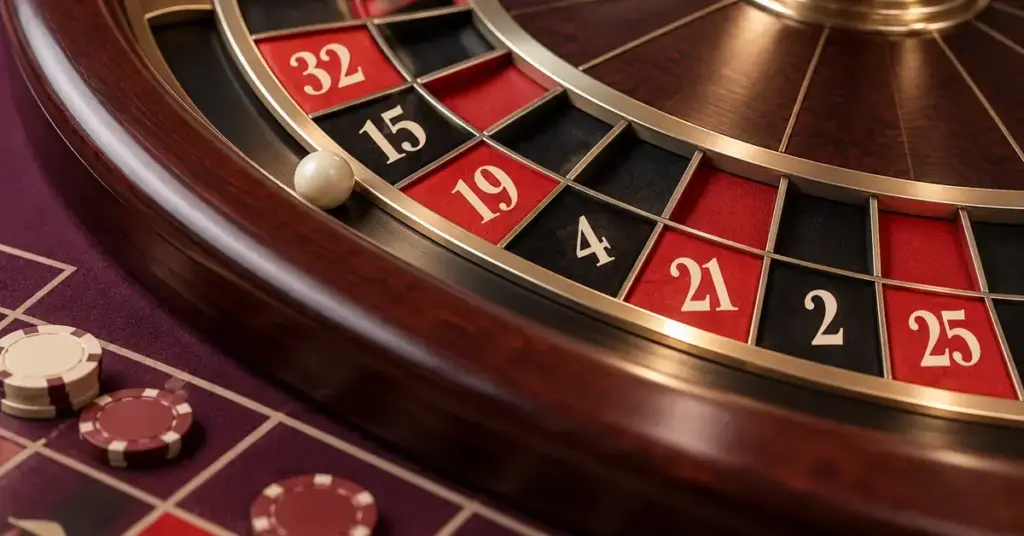
Roulette is a game of pure chance played on a spinning wheel divided into numbered pockets. On a standard European wheel there are 37 pockets, numbered 0 to 36; the American wheel adds a second zero pocket (00) for 38 in total. Each number is coloured red or black, while the zero (and the 00, where present) is green. The aim is simple: predict the pocket, colour or group of numbers the ball will settle in once the wheel stops.
The person running the game is the croupier, or dealer. They spin the wheel in one direction and roll the ball around the rim in the opposite direction. Players place chips on a betting layout that mirrors the numbers on the wheel plus a set of outside sections for broader wagers. If the ball lands where your chips back, you are paid at fixed odds; if not, the house collects the losing bets. Because the result is random on every spin, no amount of observation changes the underlying probabilities — a point we return to below. For a slower, click-by-click introduction, our step-by-step walkthrough of how to play roulette covers the same ground at a beginner’s pace.
The sequence of a single spin
A round of roulette follows the same rhythm whether you are at a table in Auckland or playing a live-dealer stream:
- Buy in. At a physical table you exchange cash for coloured “wheel chips” that are unique to you, so the dealer can tell players’ bets apart. Each player’s colour has no value printed on it; you set the denomination when you buy in.
- Place your bets. While the table is open, put your chips on the numbers or sections you want to back. You can place as many separate bets as you like, subject to the table minimum and maximum.
- “No more bets.” As the ball slows, the dealer waves a hand over the layout and calls “no more bets.” Chips placed after this are not valid.
- The result. The ball drops into a pocket. The dealer marks the winning number, clears losing chips, and pays the winners.
- Collect and repeat. Once the dealer removes the marker, winning chips are yours to collect or leave for the next spin.
The wheel and the betting layout
Two things define roulette: the wheel, which produces the random result, and the layout, where you express your prediction. On the wheel the numbers are not arranged in order; they are spread around the rim so that high and low, odd and even, and red and black numbers alternate as evenly as the design allows. That ordering does not change your odds — it simply spreads the numbers so no section of the wheel is “all red” or “all high.”
The layout is a grid. The main block holds the numbers 1 to 36 in three columns, with the zero (and 00 on American tables) at the top. Around that grid sit the outside boxes: red and black, odd and even, 1–18 (low) and 19–36 (high), the three dozens, and the three columns. Where you put a chip — on a single number, on a line between numbers, or in an outside box — determines which bet you are making and what it pays.
Inside bets, outside bets and what they pay
Bets fall into two families. Inside bets cover one number or a small cluster inside the number grid; they are harder to hit but pay more. Outside bets cover large groups — a colour, a dozen, or odd versus even — so they win far more often but pay less. The payouts are quoted as “to 1”: a 35 to 1 win returns 35 chips in profit plus your original stake. Importantly, the payouts are the same on European and American wheels; only your chance of winning changes, because the American wheel has one extra pocket.
Roulette bets and payouts
| Bet | Type | Numbers covered | Payout | Win chance (European wheel) |
|---|---|---|---|---|
| Straight up | Inside | 1 | 35 to 1 | 2.70% |
| Split | Inside | 2 | 17 to 1 | 5.41% |
| Street | Inside | 3 | 11 to 1 | 8.11% |
| Corner | Inside | 4 | 8 to 1 | 10.81% |
| Six line | Inside | 6 | 5 to 1 | 16.22% |
| Column | Outside | 12 | 2 to 1 | 32.43% |
| Dozen | Outside | 12 | 2 to 1 | 32.43% |
| Red/Black, Odd/Even, High/Low | Outside | 18 | 1 to 1 | 48.65% |
The win chances in that table are for the single-zero European wheel. On an American wheel each figure is slightly lower because the 00 adds a 38th pocket. Even-money outside bets — red/black, odd/even, high/low — give you close to a coin-flip on every spin and are popular with players who want longer, lower-variance sessions. Inside bets such as the straight-up single number deliver the big 35 to 1 return but land rarely. If you want to dig deeper into each wager, our guide to roulette betting in more detail breaks down combinations, odds and payouts, and the fuller breakdown of the wheel, bets and payouts works through worked examples.
European, American and French variants
The version of roulette you sit down to matters more than any betting pattern, because it sets the house edge — the long-run percentage the casino keeps.
- European roulette: a single green zero and 37 pockets. The house edge on almost every bet is about 2.70%.
- American roulette: a 0 and a 00, giving 38 pockets. The extra pocket roughly doubles the house edge to about 5.26%.
- French roulette: physically the same single-zero wheel as the European game, but it often adds player-friendly rules (below) that can halve the edge on even-money bets.
All else being equal, a single-zero (European or French) wheel is the better-value choice, and a French table with the special rules is better still. The layout and payouts you have already learned carry straight over; only the number of zeros and the special rules differ.
La Partage and En Prison
French tables frequently offer one of two rules that soften the sting of the zero on even-money bets (red/black, odd/even, high/low):
- La Partage (“the sharing”): if the ball lands on zero, you lose only half of an even-money bet and keep the other half. This cuts the house edge on those bets from 2.70% to about 1.35%.
- En Prison (“in prison”): instead of losing half, your even-money bet is held for the next spin. If it wins that spin, you get the original stake back with no profit; if it loses, the whole stake is gone.
These rules apply only to even-money bets and only when the table offers them — always check the game information before you sit down, as they are not universal.
The house edge and what it means for your odds
The house edge comes entirely from the zero (and the 00 on American wheels). Consider an even-money red bet on a European wheel: there are 18 red numbers, 18 black, and one green zero. If the zero lands, red and black both lose (unless La Partage or En Prison applies). That single green pocket is why a “50/50” bet actually wins about 48.6% of the time rather than half. Over many spins, that small gap is the casino’s guaranteed margin.
No betting system changes this. Progressive staking plans such as doubling after a loss can produce short winning runs, but they do not alter the odds of any single spin and run into table limits and finite bankrolls during a long losing streak. Roulette is designed so the house wins over time; the realistic goal is entertainment within a set budget, not profit. If you are curious about the underlying maths across casino games, we explain how the casino house edge works in a dedicated analysis.
The gambler’s fallacy
One of the most common mistakes is believing a result is “due.” If black has landed eight times in a row, red is not more likely on the ninth spin — the wheel has no memory, and every spin is an independent event with the same odds as the first. Electronic boards showing recent “hot” and “cold” numbers are entertainment, not a guide. Treating past results as a signal is the gambler’s fallacy, and it leads players to chase patterns that do not exist.
Table etiquette and the dealer’s calls
Roulette is a shared table, so a little etiquette keeps the game flowing for everyone:
- Place your own chips when the table is open; if a number is out of reach, ask the dealer to place the bet for you rather than leaning across other players.
- Stop betting the moment the dealer calls “no more bets.” Chips added after that are returned and not played.
- Do not touch your winning chips until the dealer lifts the marker from the winning number and completes all payouts.
- Cash chips cannot usually be bet on the inside numbers — use your coloured wheel chips there and cash them out at the same table when you finish.
- Tipping the dealer after a good win is customary but entirely optional.
The dealer’s two key calls — “place your bets” and “no more bets” — set the timing of the whole game and exist to protect its integrity, so that no wager can be added once the ball’s path becomes readable.
Managing a bankroll and common mistakes

Because the odds cannot be beaten in the long run, the most useful skill in roulette is managing how much you stake and when you stop. A few habits help:
- Set a loss limit before you start and treat it as the cost of the entertainment. When it is gone, the session is over.
- Set a win target too, and consider leaving once you reach it rather than giving it all back.
- Use small, even unit sizes — a consistent stake that is a small fraction of your budget — so one cold run does not end the session in a handful of spins.
- Never chase losses. Increasing your stakes to “win it back” is the fastest way to lose more than you planned.
- Watch the clock. Fatigue erodes discipline; a timer or break schedule helps.
If you are new to the casino floor generally, it is worth reading up on the basics of other games too — our overview of casino games for beginners explains how the tables and chips work before you play for real money.
Roulette in New Zealand: where to play and the law
Roulette is offered at New Zealand’s licensed land-based casinos, operated under the Gambling Act 2003, which has not allowed any new casino venues to open since it came into force. SkyCity Entertainment Group runs the largest of these, including its flagship venue in Auckland, where standard and rapid (electronic) roulette are both available.
Online play has changed significantly. The Online Casino Gambling Act 2026 created a regulated market for licensed online operators, administered by the Department of Internal Affairs (DIA). The government plans to issue a capped number of licences (up to 15) through a competitive process, with applications due by 1 December 2026 and the licensed market expected to be fully live in 2027. Until licensed sites launch, there is no New Zealand-licensed online roulette; offshore sites operate outside this framework and without local consumer protections. Always confirm a site’s licensing status before depositing, and check our notes on responsible gambling first.
Responsible gambling
This guide is for information only and is not advice to gamble. Roulette is a game of chance with a built-in house edge, so over time the casino is designed to win; no system, demo mode or betting pattern improves your odds on a real-money spin. Only ever stake money you can afford to lose, set firm limits before you play, and treat any winnings as a bonus rather than income.
If gambling is causing harm to you or someone you know in New Zealand, free and confidential help is available 24/7 from the Gambling Helpline Aotearoa on 0800 654 655 (or text 8006). You can also learn about your rights, operator obligations and the current rules at the Department of Internal Affairs gambling pages.
Sources
- Department of Internal Affairs — Gambling (New Zealand regulator)
- Gambling Helpline Aotearoa — about the service
- iGaming Business — New Zealand Online Casino Gambling Bill passes final reading
- Russell McVeagh — Online Casino Gambling Bill passes its final reading
- Nevada Gaming Control Board — Rules of Play: Roulette
Frequently asked questions
What is the difference between European and American roulette?
European roulette has 37 pockets with a single green zero, giving a house edge of about 2.70%. American roulette adds a second zero (00) for 38 pockets, which nearly doubles the house edge to about 5.26%. The bets and payouts are identical; only your chance of winning differs. Where you can choose, the single-zero wheel is the better value.
How much does a single-number bet pay?
A straight-up bet on one number pays 35 to 1, meaning you receive 35 chips in profit plus your original stake if it wins. It is the highest-paying bet on the table, but on a European wheel it only lands about once in 37 spins (roughly 2.7% of the time), so it is also the hardest to hit.
What happens if the ball lands on zero?
On a standard wheel, the zero (and 00) is a losing result for almost all inside and outside bets, because it is neither red nor black and neither odd nor even. The exception is a French table running the La Partage or En Prison rule, which returns half of an even-money bet or holds it for the next spin.
Does any strategy guarantee a win at roulette?
No. Roulette is a game of pure chance with a fixed house edge, and every spin is independent of the last. Staking systems like doubling after a loss can create short winning streaks but cannot overcome the edge, and they run into table limits and your own bankroll during a losing run. Treat roulette as entertainment with a set budget.
Can I play roulette online legally in New Zealand?
New Zealand passed the Online Casino Gambling Act 2026 to license online operators through the Department of Internal Affairs, with a capped number of licences and a licensed market expected to be fully running in 2027. Until those sites launch, there is no locally licensed online roulette; offshore sites fall outside New Zealand’s rules and consumer protections.