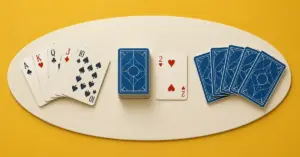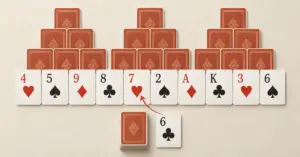
President is a fast, social “shedding” card game in which the goal is simple: get rid of all your cards before everyone else. Played with a single standard deck and anywhere from three to around seven people, it is best known for the pecking order it creates each round — the first player out is the President, the last one stuck with cards is the Scum — and for the card-swapping ritual that rewards winners and punishes losers at the start of the next hand. This guide explains the full rules in plain language: what you need, how cards rank, how a round plays out, how the all-important exchange works, and the popular house variations you are likely to meet.
Quick Facts
| Game type | Shedding / climbing card game |
|---|---|
| Also known as | Asshole, Scum, Capitalism, Daifugo |
| Players | 3–7 (best with 4–6) |
| Deck | One standard 52-card deck (two for 8+ players) |
| Card rank (high–low) | 2, A, K, Q, J, 10–3 |
| Objective | Be the first to play all your cards |
| Round length | A few minutes per round |
| Difficulty | Easy to learn, light strategy |
What is the President card game?
President is a climbing or shedding game, meaning players race to empty their hands by playing cards onto a central pile in ascending rank. It goes by many names around the world — Asshole, Scum, Bum, Capitalism, Warlords and Scumbags in English-speaking groups, and Daifugo or Daihinmin in Japan, where it is hugely popular. Suits never matter; only the rank of a card counts.
The social hook is the hierarchy. At the end of every round each player is assigned a title based on how quickly they went out, and those titles carry over into the next deal, where the winners literally take the losers’ best cards. That self-reinforcing loop — strong players staying strong, weak players clawing back — is what makes President a staple at family tables, student flats and party games nights. It belongs to the same family of easy group games as Crazy Eights and Cheat, and plays well alongside other card games to play with friends.
The game is thought to have grown out of older Chinese and Japanese climbing games and spread widely through the late twentieth century, picking up dozens of regional names and rule tweaks on the way. Because it travelled by word of mouth rather than a published rulebook, no two groups play it exactly the same way — which is why confirming the version in use is part of the setup, not an afterthought.
What you need to play
- Players: best with four to seven; it works with three and can stretch higher. With eight or more players, add a second deck shuffled together.
- Cards: one standard 52-card deck. Jokers are optional and only used in some variations.
- Table and seats: any flat surface; seating order matters once titles are assigned.
- Time: a single round takes a few minutes; a full game to a target score usually runs 20–40 minutes.
No scorepad is strictly required — many groups play purely for the titles — but a sheet of paper helps if you want to play to a points total.
How the cards rank
President uses an unusual ranking in which the 2 is the strongest card of all, not the weakest. From high to low the order is:
| Strength | Cards (high to low) |
|---|---|
| Highest | 2 |
| Very high | Ace, King, Queen, Jack |
| Middle | 10, 9, 8, 7, 6 |
| Lowest | 5, 4, 3 |
So the full sequence is 2, A, K, Q, J, 10, 9, 8, 7, 6, 5, 4, 3. Because suits are irrelevant, two cards of the same rank — say the 9 of hearts and the 9 of spades — are completely equal in value.
Dealing the cards
Deal out the entire deck one card at a time, clockwise, until none are left. With most player counts the hands will be slightly uneven, so one or two people hold an extra card — that is normal and fair, because it evens out over several rounds. On the very first round, when nobody has a title yet, choose a dealer at random. In later rounds the Scum (the previous round’s loser) always shuffles and deals.
How a round is played
Play moves clockwise. The idea is to beat the previous play or pass, and to shed your whole hand as quickly as possible.
Leading a trick
On the first round the player holding the 3 of clubs usually leads, and must include that card in their opening play; in later rounds the President leads first. The leader may play a single card or a set of equal-rank cards — a pair, three of a kind or four of a kind. The number of cards in that first play sets the format for the whole trick: if the lead is a pair, everyone must respond with pairs.
Following and beating
Each player in turn must either beat the previous play or pass. To beat it you play the same number of cards of a strictly higher rank. A single 8 beats a single 7; a pair of Kings beats a pair of 9s. You cannot beat a single with a pair, or a pair with a single — the count must match.
Passing
If you cannot or do not want to beat the current play, you pass. In the standard game, passing does not lock you out: if the trick comes back around to you, you may play again. (Some groups use a stricter rule where a pass ends your turn for that trick — agree which you are using before you start.)
Ending a trick
When every other player has passed in succession, the person who made the last and highest play wins the trick. Those cards are turned face down and set aside, and the winner leads a brand-new trick with any card or set they like. A player who has emptied their hand is simply skipped for the rest of the round.
Finishing the round: titles and seating
The first player to get rid of every card wins the round and becomes the President. The order in which the others finish decides the rest of the ranks, and the very last player left holding cards is the Scum (also called the Asshole or Beggar). A typical five-player table ranks as follows:
- President — first player out.
- Vice-President — second out.
- Citizen(s) — the middle finishers (sometimes called Neutral or Merchant).
- Vice-Scum — second-to-last out.
- Scum — the final player, still holding cards.
Before the next deal, players re-seat by rank. The President picks the best seat, the Vice-President sits to their left, and so on around the table until the Scum ends up to the President’s right — which is also where they deal from.
Exchanging cards between rounds
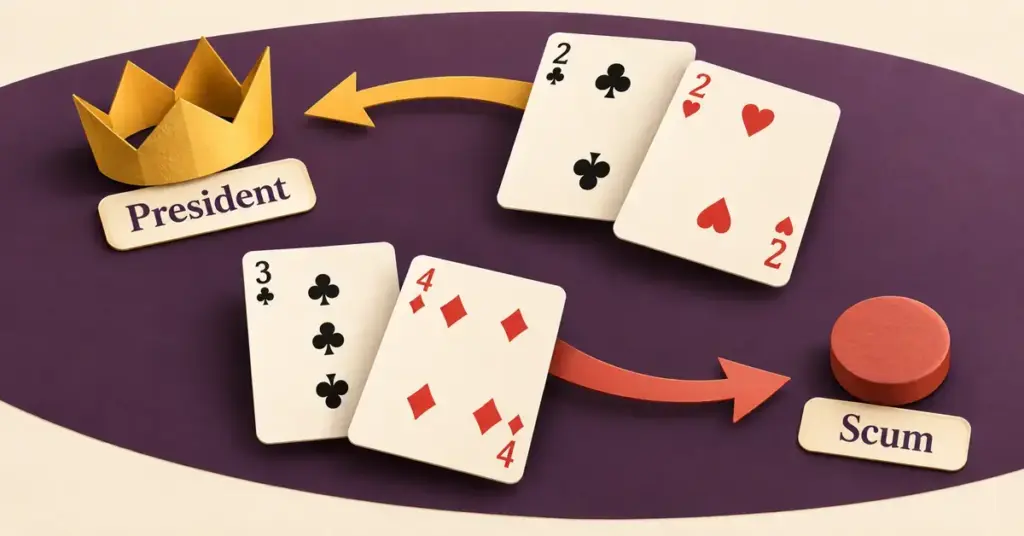
The exchange is the heart of President and the step most casual players get wrong. After the Scum deals the new hands — but before the first card is led — the losers must hand their best cards to the winners, and the winners return cards they do not want.
There are two common versions. Settle on one in advance:
| Exchange style | What the loser gives | What the winner returns |
|---|---|---|
| Basic (one card) | Scum gives the President their single highest card | President gives back any one unwanted card |
| Full (two card) | Scum gives the President their two highest cards; Vice-Scum gives the Vice-President one card | President returns any two cards; Vice-President returns any one card |
The key rule is that the loser has no choice — they must surrender their genuinely best cards (usually 2s and Aces), while the winner chooses freely which low cards to pass down. With only four players, many groups keep it simple and have just the President and Scum trade a single card, leaving the middle pair alone. Once the exchange is complete, the President leads the opening trick.
A worked example in the two-card version: suppose the Scum is dealt both black 2s as their two highest cards. They must hand both to the President, who looks at their own hand and gives back, say, a 3 and a 4 — the two cards they least want. The Scum starts the round two strong cards down and two weak cards up, while the President begins with an almost unbeatable grip on the lead. This is exactly why climbing out of the Scum seat feels like such an achievement, and why the President must play well to avoid sliding back down.
Key Points
- First player to empty their hand becomes President; the last player left is the Scum.
- Beat the previous play with the same number of cards of a higher rank, or pass.
- The 2 is the highest card; suits are ignored.
- Each new round, losers give their best cards to the winners and receive unwanted cards back.
- Players re-seat by rank, and the Scum always deals the next hand.
- Agree your house rules (exchange size, special 2s, four-of-a-kind) before you start.
Scoring and winning the game
Plenty of groups play endlessly just for bragging rights, but President scores easily if you want a defined winner. A common method awards 2 points to the President, 1 to the Vice-President and 0 to everyone else, with the game ending when someone reaches an agreed total such as 11. A tidy symmetrical alternative scales with the table: in a five-player game the ranks score +2, +1, 0, −1, −2 from President down to Scum, and in a seven-player game +3 down to −3. Whichever you choose, the overall winner is simply the player who has spent the most rounds at the top of the hierarchy.
Popular variations and house rules
President has no single official rulebook, so house rules are part of its charm. The most widespread optional rules include:
- Single 2 clears the pile: playing a lone 2 beats anything, clears the current trick and lets you lead again immediately.
- Four of a kind (bomb): completing four cards of the same rank on the pile clears it and the player who finished the set leads again.
- Revolution: in some versions, playing four equal cards flips the entire ranking upside down (3 becomes high, 2 becomes low) for the rest of the deal until another four of a kind flips it back.
- Completing a rank skips players: matching the exact rank just played (for example, a King on a King) can skip the next player’s turn.
- Jokers: added as the highest cards or as wild cards in some circles.
- 3 of clubs lead: the holder of the 3 of clubs opens the first round in many groups.
If you enjoy fast shedding games with twist cards, the special-card logic here will feel familiar from UNO.
Common mistakes to avoid
- Forgetting the 2 is highest. New players often treat it as the lowest card and waste it early.
- Mismatching set sizes. You can only beat a pair with a pair, a triple with a triple — never a single with a pair.
- Dumping your best cards too soon. Hold a couple of high cards and 2s so you can seize the lead and shed your low cards safely late in the round.
- Skipping the exchange. The trade is mandatory for the Scum and Vice-Scum; letting losers keep their 2s removes the whole point of the hierarchy.
- Not agreeing house rules first. Because versions differ so widely, confirm the player count rules, the exchange size and which special cards are in play before dealing.
Simple strategy tips
President rewards timing far more than luck once you learn a few habits. None of these guarantee a win, but they reliably move you up the table:
- Save your 2s and Aces for control. Because a single 2 can be played at almost any time (and clears the pile in many groups), holding one lets you grab the lead exactly when you need to dump a run of awkward low cards.
- Play your weakest cards first. Low singles and pairs are hard to get rid of late, when fewer players remain to pass. Shed 3s, 4s and 5s early while the table is still full and plays stay small.
- Count who has gone out. Once a player empties their hand they are skipped, so a trick can swing back to you faster than you expect — keep a card in reserve to take advantage.
- Break up pairs deliberately. If the lead is single cards, holding a pair of middling cards can strand you; sometimes it is better to split them across two turns.
- Expect the exchange tax. If you were the Scum, assume your two best cards are gone and plan the new hand around your middle cards rather than hoping to lead early.
Who the President card game suits
President is ideal for medium-to-large groups who want something livelier than a quiet two-hander and simpler than a trick-taking game with bidding. The rules are easy enough for older children and casual players to pick up in a round or two, yet the exchange, the special cards and the pressure of climbing out of last place give experienced players real decisions to make. It travels well — all you need is a deck — and sits comfortably in any collection of easy kids’ and family card games. If your group prefers head-to-head play, keep it for the nights when four or more people are around.
Sources
Frequently Asked Questions (FAQ)
How many people can play President?
President works with three players and up, but it is best with four to seven. For eight or more, shuffle two standard decks together so hands stay a sensible size.
Which card is the strongest in President?
The 2 is the highest-ranking card. The order from high to low is 2, Ace, King, Queen, Jack, 10, 9, 8, 7, 6, 5, 4, 3, and suits make no difference.
Do I have to exchange cards every round?
Yes, apart from the first deal. At the start of each later round the Scum must give their best card (or two) to the President, and the President returns unwanted cards. The Vice-Scum and Vice-President usually swap one card too.
Can I play a card after I have passed?
In the standard rules, yes — passing only means you skip that turn, and you may play again if the trick returns to you. Some groups use a stricter rule where a pass ends your involvement in the current trick, so agree which version you want before you start.
How do you win the whole game?
Winning a single round makes you President for the next deal, but the overall winner is the player who finishes top most often. If you are keeping score, set a target total and the player with the most points when it is reached wins.