Cheat is a fast, social card game in which the whole point is to lie convincingly — and to catch everyone else doing the same. Players race to empty their hands by discarding cards face down and announcing a rank, which may or may not be true. Known in different places as Bullshit or I Doubt It, it needs only a standard deck, suits groups of two to ten, and rewards a steady poker face far more than a lucky deal. This guide explains the rules from scratch, the all-important challenge mechanic, the common New Zealand house variations, and simple, honest strategy for beginners.
Quick Facts
| Players | 2–10 (best with 3–6) |
| Deck | One standard 52-card deck (two decks for 5+ players) |
| Game type | Shedding and bluffing game |
| Difficulty | Easy to learn |
| Playing time | About 10–30 minutes |
| Also known as | Bullshit, I Doubt It |
| Objective | Be the first player to empty your hand |
What is the Cheat card game?
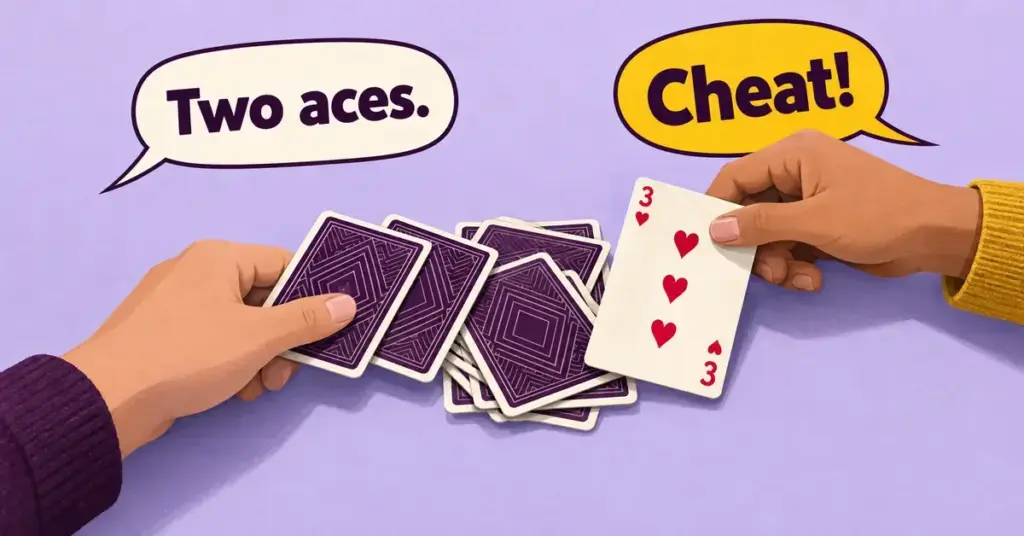
Cheat is a “shedding” game, meaning the goal is to get rid of every card in your hand before anyone else. What makes it different from other shedding games is that cards are played face down and you are allowed — in fact expected — to lie about what they are. On your turn you place one or more cards in the middle and state their rank out loud, for example “three Sevens.” If no one believes you, they can challenge the claim by calling “Cheat!” The cards are then turned over to reveal the truth.
Because every player can see only their own hand, the game becomes a contest of bluffing and deduction rather than luck. The deal still matters, but the player who reads other people well, keeps track of what has been played, and keeps a calm face usually comes out ahead. It works well as a family game, a party filler or a travel game, and younger players enjoy the licence to fib within clear rules.
What you need to play
- Players: two to ten, though it plays best with three to six.
- Cards: one standard 52-card deck with the jokers removed. For five or more players, two decks are usually shuffled together so no one is left with a tiny hand.
- Space: a table or flat surface where everyone can reach a central discard pile.
- Time: a single game usually lasts about 10 to 30 minutes.
No scorepad is required for a basic game — the first player to empty their hand simply wins. If you want to play several rounds, you can keep a running tally of who wins each one.
How to play Cheat, step by step
Dealing the cards
Shuffle the deck and deal all of the cards out one at a time, going clockwise, until none are left. It does not matter if the hands are uneven; with most player counts a few people will hold one card more than others, and that is fine. Everyone picks up their cards and looks at them without showing anyone else.
Playing in rank order
The player to the dealer’s left goes first and must play Aces. The next player plays Twos, the one after that plays Threes, and so on up through the ranks. After Kings the sequence simply loops back to Aces and keeps climbing again. On your turn you must claim the current rank, so the pressure is on when you have none of it.
To take your turn, place between one and four cards face down on the central pile and announce how many of the required rank you are supposedly playing — for example “two Fours.” You can tell the truth, or you can bluff by slipping in cards of other ranks. Because a single deck holds only four of each rank, no honest claim can ever be more than four cards.
Calling “Cheat!”
After someone plays and makes their announcement, any other player who suspects a lie can challenge by calling out “Cheat!” (or “Bullshit” or “I doubt it,” depending on your group). The cards that were just played are turned face up for everyone to see. The key timing rule is that a challenge must happen before the next player lays down their cards — once the next turn begins, the previous play can no longer be questioned.
If no one challenges, the claim stands, the cards stay on the pile, and play passes to the next person and the next rank.
A quick example round
Imagine four players. The first player lays one card and says “one Ace.” The second player genuinely has a couple of Twos and lays “two Twos,” telling the truth. The third player has no Threes at all, so they slide a random card forward and bluff “one Three.” The fourth player, holding two Threes themselves, realises a third Three is unlikely and calls “Cheat!” The card is flipped, the bluff is exposed, and the third player scoops up the whole pile. Play then resumes with the fourth player laying Fours. That single exchange shows the rhythm of the game: claim, judge, and decide whether the risk of challenging is worth it.
Penalties and how to win
A challenge always has a loser, and the loser picks up the entire central pile and adds it to their hand — a heavy setback that is the main way players fall behind. The outcome depends on whether the challenged player was actually lying:
Key Points
- Aim: be the first to get rid of all your cards.
- Cards are played face down, and you may lie about their rank.
- Ranks climb from Aces up to Kings, then loop back to Aces.
- Any player can challenge with “Cheat!” — but only before the next player lays their cards.
- The loser of a challenge picks up the entire pile.
- Logic and a steady face beat luck: check claims against your own hand.
| Situation | What the reveal shows | Who picks up the pile |
|---|---|---|
| Correct challenge | The player was lying about their cards | The player who lied takes the whole pile |
| Wrong challenge | The player told the truth | The challenger takes the whole pile |
| No challenge | Cards are not revealed | No one; play moves on to the next rank |
| Last card not challenged | The player has emptied their hand | No one; that player wins the game |
You win the moment you get rid of your final card without being successfully challenged. Because of this, your last play attracts the most suspicion, so getting out cleanly is often the hardest part of the game. If several players run low at once, the pile can swing back and forth for a while as challenges send cards flying between hands, which is part of the fun and the reason a “winning” position can evaporate in a single bad call.
Strategy and tips for beginners
Cheat is built on lying, yet the most reliable way to win is to use logic and observation rather than pure nerve. A few habits make a big difference.
Use the cards in your own hand
The cards you hold are proof of what others cannot be holding. If you have three Kings yourself and the player before you claims to be laying “two Kings,” you know at least one of them must be a lie, so you can call “Cheat!” with very little risk. Quietly checking a claim against your own hand is the single most useful habit in the game.
Pick your moment to bluff
Bluff when the pile is small, because being caught early only costs you a few cards. When the pile has grown to twenty or thirty cards, the penalty for a failed bluff — or a wrong challenge — becomes severe, so play it straight if you can. For the same reason, many players save their challenges for a large pile, when catching a liar does the most damage.
Keep a consistent face
Try to behave exactly the same whether you are telling the truth or lying. Players who only look nervous when they fib are easy to read. Some people even act slightly hesitant when they are being honest, hoping to bait an opponent into a wrong challenge that hands them the pile. Watching others for these “tells” — and giving none away yourself — is the heart of the game.
Think ahead to your last card
Winning is hardest when you are down to one or two cards, because everyone will be watching you and may challenge your final play on principle. A common tactic is to hold back a card that genuinely matches a rank coming up later, so you can finish on an honest play that survives any challenge.
Common variations and house rules
Like most traditional games, Cheat is played slightly differently from one household to the next. Agree on the rules before you start so no one is caught out. Popular variations include:
- Two decks: for five or more players, shuffle two 52-card decks together to keep hands a reasonable size and make card counting harder.
- Rank flexibility: allow a play of the same rank as the previous one, or one rank above or below, instead of a strict ascending sequence. This speeds the game up and makes the order harder to track.
- Fixed rank (“I Doubt It” style): in some versions everyone plays the same rank each round rather than climbing through the deck.
- Lying about the count: some groups let you lie not only about the rank but about how many cards you are putting down.
- Reveal everything: after a challenge, turn over the whole play rather than only the top cards, so disputes are clear-cut.
If you enjoy the race to empty your hand, you will find the same appeal in shedding games such as Last Card and Crazy Eights, while the frantic pace of a rank-flexible game of Cheat is close in spirit to the Speed card game.
Etiquette and keeping it fun

Because the whole game is about deception, a little good humour keeps it enjoyable for everyone. Make your announcements clearly so the whole table can hear the claimed rank and number, and accept the pile without complaint when a challenge goes against you — being lied to is the point of the game, not a reason to take offence. Keep the central pile tidy so cards are not accidentally exposed, and avoid hiding how many cards you have left, which other players are entitled to see. The best players are the ones who can laugh at their own failed bluffs.
Who is Cheat best for?
Cheat suits almost any casual group. It is easy enough for children to learn in a couple of minutes, flexible enough to stretch from three friends to a large party, and portable enough for a holiday bach or a long flight, since it needs nothing but a deck. If you are putting together a games night, it sits comfortably alongside other crowd-pleasers in our guide to the best family card games in New Zealand, and it is a gentler, funnier introduction to bluffing than a game like Snap is to speed and reflexes. For background on how games like this fit into the wider card-playing tradition, see our complete guide to card games.
Sources
Frequently Asked Questions (FAQ)
How many cards are dealt in Cheat?
The whole deck is dealt out evenly, one card at a time, until none are left. With most player counts some hands will end up one card larger than others, which does not affect play.
What happens if you get caught cheating?
If a challenge proves you were lying, you must pick up every card in the central pile and add it to your hand, which usually sets you well back in the race to empty it.
What happens if a “Cheat!” call is wrong?
If you challenge a player who was actually telling the truth, you take the penalty instead and pick up the entire pile, so it pays to challenge only when you have good reason.
Do you have to tell the truth on your last card?
No. You may bluff on your final card, but if someone calls “Cheat!” and you were lying, you pick up the pile and keep playing, so many players try to finish on an honest card.
Why is Cheat sometimes called “I Doubt It”?
“I Doubt It” and “Bullshit” are just other names for the same game, with “I Doubt It” often preferred in family settings where a milder challenge call is wanted.