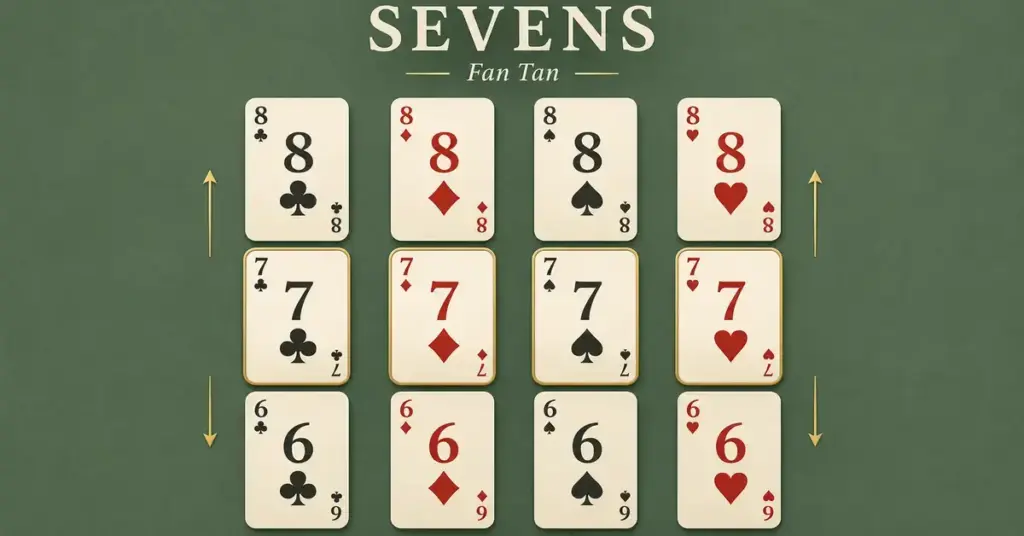
Sevens is a classic shedding game for 3 to 8 players that uses a single standard 52-card deck and almost no equipment. The goal is simple: be the first player to get rid of every card in your hand by adding cards to a shared layout that grows outward from the four sevens. It is quick to learn, works well for families and mixed age groups, and is known around the world by several names — Fan Tan in the United States, Parliament in Britain and Domino in France. This guide explains the deck, the deal, the layout, passing, how to win and the most common variants.
Key Points
- Game type: shedding / layout card game (the “stops” family).
- Players: 3–8, best with 4–6.
- Cards: one standard 52-card deck, no jokers.
- Goal: be the first to get rid of all your cards.
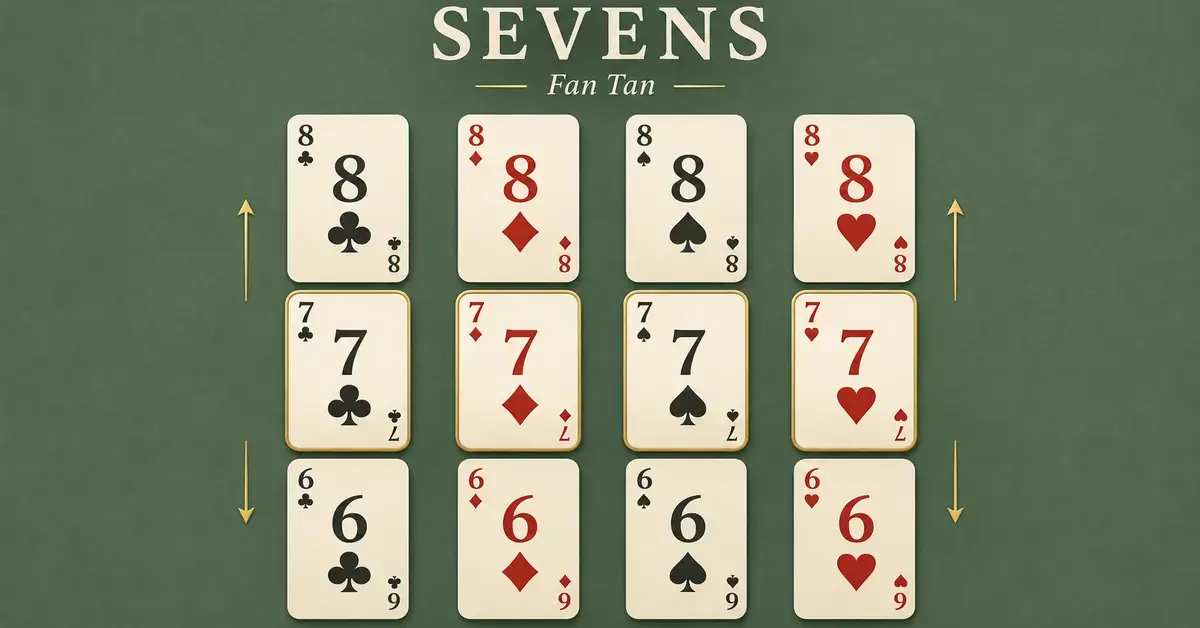
- Foundations: the four sevens start each suit; cards build up (8–K) and down (6–A) from them.
- Key rule: you must play if you can; you may only pass with no legal card.
- Also known as: Fan Tan (US), Parliament (UK), Domino (France).
What is Sevens (Fan Tan)?
Sevens belongs to the “layout” or “stops” family of card games, where players build sequences of cards on the table and are sometimes blocked (“stopped”) until a needed card appears. Close relatives include Crazy Eights and other matching-and-shedding games. The game is purely about playing the right card at the right time — there is no bidding, no trumps and no partnerships in the basic version.
The card game is unrelated to the old Chinese banking game also called fan-tan, which is played with beads or buttons rather than cards. The playing-card version spread through the western United States in the second half of the 19th century and has been a family favourite ever since. If you enjoy card-game history and how different games relate to one another, our guide to card game families and strategy puts Sevens in context.
What you need to play
- Players: 3 to 8. Four to six players gives the best balance of a busy layout and a reasonable hand size.
- Cards: one standard 52-card deck, no jokers.
- Optional: chips, counters or pen and paper if you want to keep score (explained below).
- A table: you need a clear surface, because the layout can spread across all four suits.
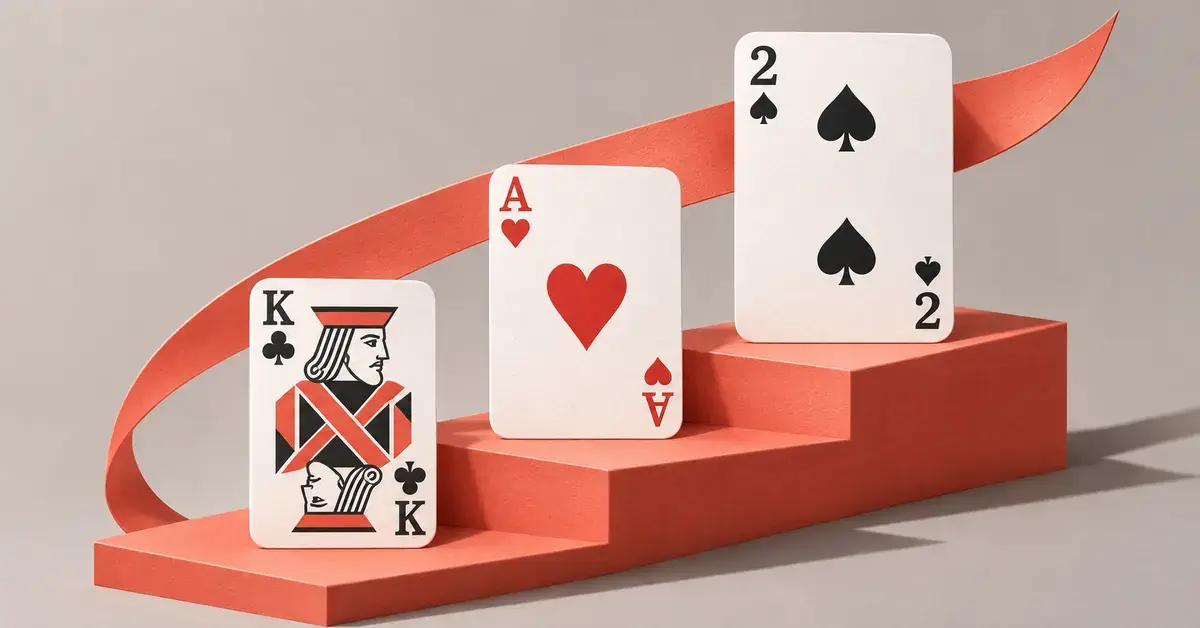
Within each suit the cards run in sequence. Most households play with the ace low, so each suit reads Ace-2-3-4-5-6-7-8-9-10-Jack-Queen-King, but see the note on aces further down, because this is the one rule groups most often differ on.
Quick Facts
| Detail | Sevens (Fan Tan) |
|---|---|
| Players | 3–8 (4–6 ideal) |
| Deck | Standard 52 cards |
| Foundation card | The four sevens |
| Suit sequence | Ace (low) to King, or Ace high by agreement |
| Object | Shed all cards first |
| Round length | About 10–15 minutes |
| Recommended age | 6+ |
| Game family | Layout / stops games |
| Other names | Fan Tan, Parliament, Domino |
Setting up the game
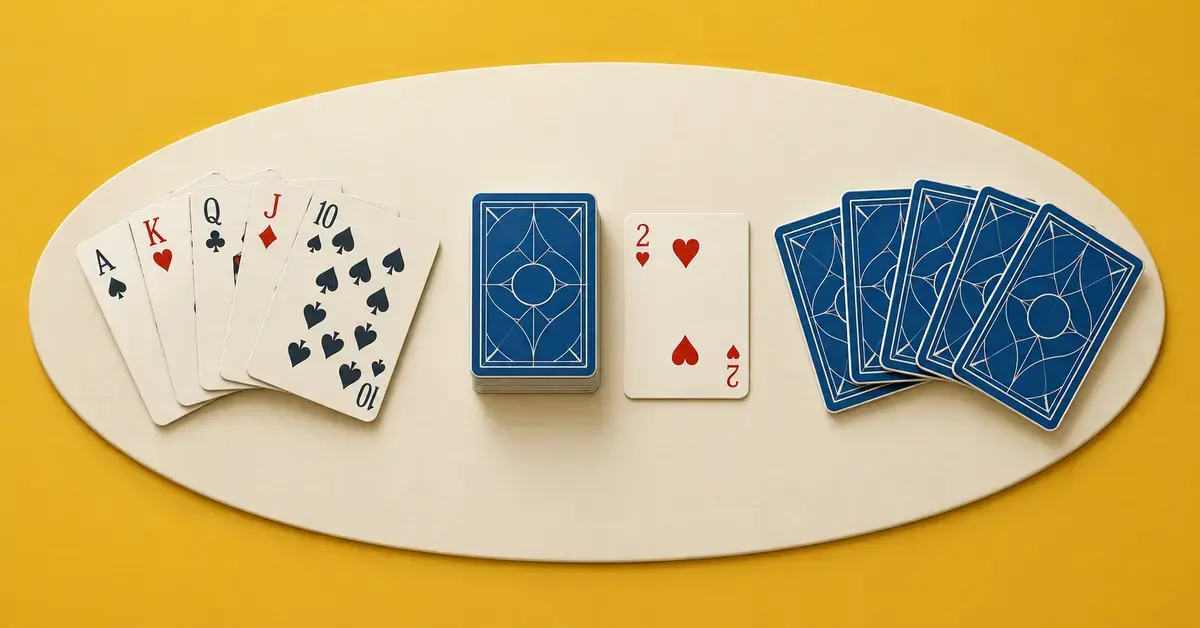
Any player can deal first; afterwards the deal passes to the left for each new round. Shuffle the full 52-card deck and deal all the cards out one at a time, clockwise, starting with the player to the dealer’s left.
With exactly four players everyone gets 13 cards. With any other number the cards will not divide evenly, so some players receive one extra card. This is normal and makes little difference — the player who ends up with more cards simply has slightly more to shed. Keep your hand private; you do not reveal cards until you play them.
How to play Sevens: the rules
The aim of the game
On your turn you want to legally place one card from your hand onto the shared layout. The first player to run out of cards wins the round. Because you can only play cards that connect to the layout, part of the skill is deciding which playable card to let go of and which to hold back.
Playing the sevens
The four sevens are the foundations of the whole layout. A seven can always be played, and each seven starts a brand-new row for its own suit in the centre of the table. Nothing else in that suit can be played until its seven is down, so getting the sevens onto the table early is what opens the game up.
Building the layout
Once a suit’s seven is on the table, players add the next card up or down in that same suit, building two sequences outward from the seven:
- Upward: the 8, then 9, 10, Jack, Queen and King of that suit.
- Downward: the 6, then 5, 4, 3, 2 and the ace of that suit.
You can only add a card if the card directly before it in the same suit is already showing. For example, you cannot play the 9 of clubs until the 8 of clubs is down, and you cannot play the 8 of clubs until the 7 of clubs has started that row. To keep the table tidy, many players stack the higher cards neatly on top of the 8s and the lower cards on top of the 6s so each suit takes up a compact line.
Passing
If you have no card that fits the layout, you must pass your turn, often by knocking the table so everyone knows. Passing is only allowed when you genuinely cannot play — it is against the rules to pass when you are holding a card that could legally be played. Deliberately sitting on a card you could play (especially a seven, which unblocks a whole suit) is the move other players will watch for, and it carries a penalty in the scoring version below.
How to win
The round ends the moment one player plays their last card; that player wins. If you are keeping score, the win is usually enough on its own, but many groups add points for the cards everyone else is left holding (see below). Sevens plays quickly, so a session is normally several short rounds rather than one long game.
Playing for chips or points
Sevens can be played purely for fun with no scoring at all. If you want to keep score, the common method uses chips or counters simply as points — no money is required:
- Before the deal, each player puts one chip into a central pool.
- Every time a player passes, they add one chip to the pool.
- When a player goes out, the others pay the pool one chip for each card still in their hand, and the winner takes the pool.
- Penalties: a player who passes when they could have played pays three chips to the pool; a player who holds back a seven they could have played additionally pays five chips to the holders of the matching six and eight.
A simpler running-score alternative is to give each player one point per card left in their hand at the end of every round, play until someone reaches 100, and declare the player with the fewest points the overall winner.
Popular variants
- Seven of diamonds opens: instead of the player left of the dealer starting, whoever holds the seven of diamonds must lead with it, setting a fixed first move.
- Ace high: some groups rank the ace above the king, so each suit builds 7 up to King and then the Ace sits at the very top rather than at the bottom of the downward run.
- Domino (French style): the first player chooses any rank to be the foundation, and every suit must then start from that rank instead of from the seven.
- Different starting rank: variants such as starting each suit from the 10 change which card unblocks a suit, which speeds up or slows down the game.
Common mistakes to avoid
- Forgetting you must play: if you have a legal card you have to play it — you cannot choose to pass to hold your hand together.
- Sitting on your sevens too long: a seven opens a whole suit for everyone, but refusing to play one when you have no other move is an illegal pass.
- Dumping high and low cards carelessly: aces, kings and other end-of-row cards are the hardest to shed, so plan which cards you free up for yourself.
- Not agreeing the ace rule first: settle ace-high or ace-low before you deal, as it changes the endgame.
Who Sevens suits
Sevens is a strong pick for family game nights and casual groups: the rules fit on a postcard, younger players can follow the build-up sequences, and rounds are short. It scales well, so it is a handy option for larger groups and sits comfortably alongside other easy classics in our best family card games roundup. For smaller tables it still works at three players — see our guide to card games for three players — and if you enjoy the shedding mechanic, the President card game offers a livelier, more tactical take on getting rid of your cards first.
Sources
Frequently Asked Questions (FAQ)
Is Sevens the same game as Fan Tan?
Yes. Sevens, Fan Tan and Parliament are all names for the same layout card game; Fan Tan is the common American name and Parliament the British one. It is not the same as the Chinese banking game also called fan-tan, which uses beads rather than cards.
How many players do you need for Sevens?
You can play with 3 to 8 people using one standard 52-card deck. Four to six players usually gives the best game, with a busy layout and hands that are neither too large nor too small.
What card is played first in Sevens?
The sevens are the foundations, so the game cannot build in any suit until that suit’s seven is down. A common house rule is that whoever holds the seven of diamonds must lead with it; otherwise the player to the dealer’s left starts.
Can you pass in Sevens if you have a playable card?
No. You must play a legal card whenever you can. You are only allowed to pass when you have no card that connects to the layout, and in the scoring version an illegal pass costs you penalty chips.
How do you win at Sevens?
The first player to play every card from their hand wins the round. If you are keeping score, the other players usually lose points for the cards they are still holding, and you play several rounds to decide an overall winner.