Nertz is a real-time card game in which everyone plays at once, racing to empty a personal pile of cards onto shared piles in the middle of the table. It feels like several games of solitaire happening side by side, except players are competing for the same spaces at speed, so quick eyes and quick hands matter as much as the layout. The game goes by many names — Nerts, Pounce, Racing Demon, Peanuts and Squeal among them — but the rules below are the ones most groups recognise. This guide covers what you need, how to set up, how a round plays out, how scoring works, and the small rule differences worth agreeing on before you start.
What is Nertz?
Nertz is best described as a hybrid of two familiar games. From solitaire it borrows the idea of building ordered runs of cards; from a fast reaction game it borrows simultaneous, no-waiting-your-turn play. If you have ever played the Speed card game, the frantic, grab-the-card-first feel will be familiar — Nertz simply adds the structure of solitaire on top.
Because there are no turns, two people can play a tight duel or a larger group can play a noisy free-for-all. That flexibility is why it turns up both as a quiet two-player game and as one of the louder party games a group can set up with nothing more than a few decks of cards.
At a Glance
| Players | 2 or more (best as 2–4; 6+ play in partnerships) |
|---|---|
| Equipment | One standard 52-card deck per player, each with a different back |
| Nertz pile | 13 cards (12 face down, 1 face up) |
| Work piles | 4, one face-up card each to start |
| Stock | Remaining 35 cards, turned three at a time |
| Centre foundations | Built up by suit, Ace to King, shared by all |
| Scoring | +1 per card on a foundation; −2 per card left in your Nertz pile |
| Game ends at | An agreed target, usually 100 points (some play to 150) |
| Suits | Families and groups; children who can sort by number and suit (roughly age 7+) |
What you need to play
The one rule that catches new players out is the decks. In Nertz, each player uses their own full 52-card deck, and every deck must have a different design on the back.
- Players: Two or more. It is an excellent two-player game and great fun for three or four. Five starts to get crowded; with six or more, players usually pair up and play in partnerships.
- Cards: One standard 52-card deck per player (jokers removed for the basic game). A four-player table therefore needs four separate decks.
- Different backs: Cards from every deck end up mixed together in the centre, so at the end of each round you sort them back out by their backs to work out who played what. Matching decks make scoring impossible.
- Space: A table everyone can reach, because the centre of the table is shared by all players.
Setting up a round
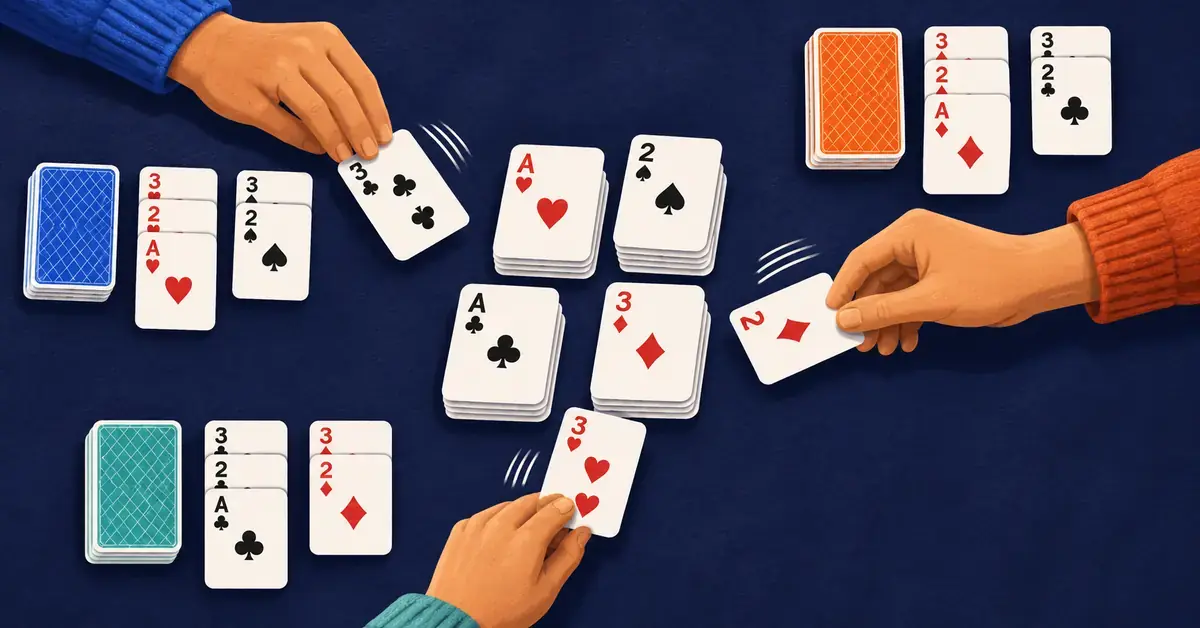
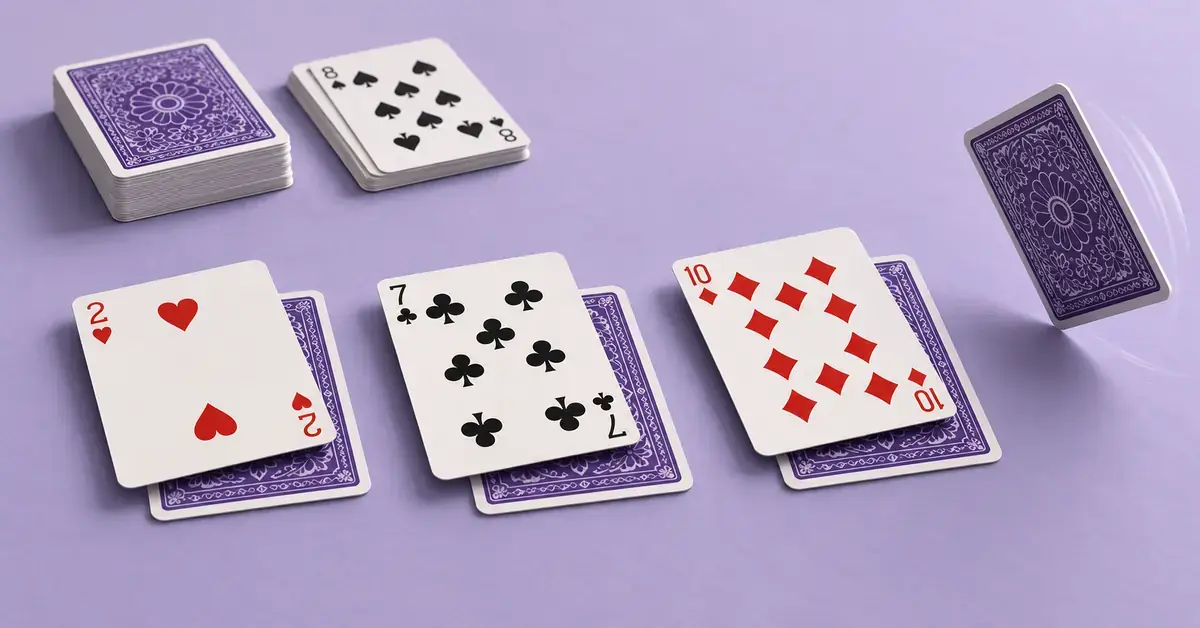
Each player shuffles their own deck and builds the same four areas in front of them. None of the centre piles exist yet — players create those during play.
- The Nertz pile: Deal 13 cards into a single stack, 12 face down with the 13th turned face up on top. This is the pile you are racing to get rid of.
- The work piles: Deal four more cards face up in a row beside the Nertz pile, not overlapping. These four cards are the starting point of your four work piles.
- The stock: Hold the remaining 35 cards face down in your hand. You will turn these over, three at a time, onto a face-up waste pile during play.
The middle of the table stays empty at the start. It becomes the shared foundation area once someone plays an Ace there.
How to play
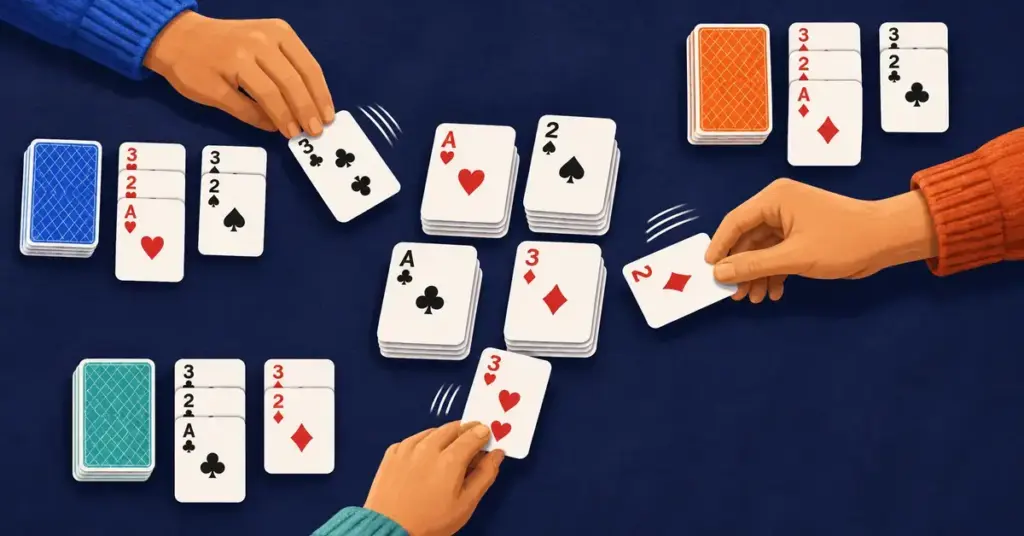
Someone calls “Go,” and everyone plays at the same time, as fast as they like, with no turns. Your goal is to clear your 13-card Nertz pile by moving its cards onto the centre foundations or into your own work piles. A few handling rules keep it fair: move cards with one hand (you can hold the stock in the other), move one card at a time except when shifting a run between work piles, and only ever touch your own layout or the shared centre — never another player’s cards.
Building your work piles
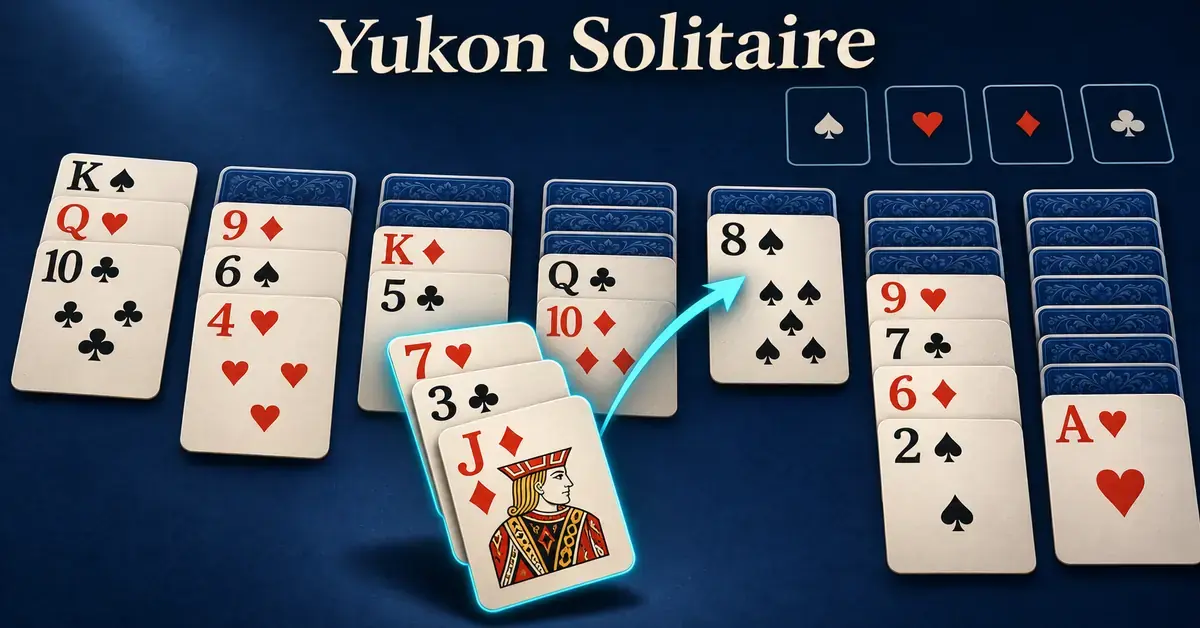
Your four work piles are built the same way as a tableau in classic solitaire: downwards in rank and in alternating colours. A red six goes on a black seven, a black five on that red six, and so on. You can move a card together with everything stacked on top of it from one work pile to another whenever it fits. When a work pile becomes empty, fill the gap with the top card of your Nertz pile (ideal, because it shrinks the pile you are racing to clear), the top card of your waste pile, or a card from another work pile.
Playing to the centre foundations
The foundations are the shared piles in the middle, and anyone can play to any of them. They work in the opposite direction to your work piles: built up by suit, from Ace to King. Whenever an Ace becomes available, place it in the centre to start a new foundation; after that, the two, three, four and so on of the same suit are added by whichever player can reach them first. Once a foundation reaches the King it is complete and set aside. The cards you can send to a foundation are the top card of your Nertz pile, the lowest exposed card of each work pile, and the top card of your waste pile. If two players slap a card onto the same foundation at once, the one who got there first keeps it and the other takes their card back.
Working through your stock
When you run out of obvious moves, turn the top three cards of your stock face up onto your waste pile, keeping them in order. Only the top card of the waste pile is playable. Keep cycling three at a time; when fewer than three cards remain, add them to the waste pile, flip the whole waste pile over, and carry on with a fresh stock. The same mix of solitaire layout and speed is what makes games like Klondike solitaire good practice for the pattern-spotting Nertz demands.
Ending a round and scoring
The instant any player empties their Nertz pile they shout “Nertz!” and all play stops immediately — only cards already mid-move are allowed to land. You are not forced to call the moment your pile is empty; you may keep playing to add more cards to the foundations and raise your score, but that is a gamble, because anyone else can end the round first.
When the round ends, mix the foundation piles apart by their backs and score each player:
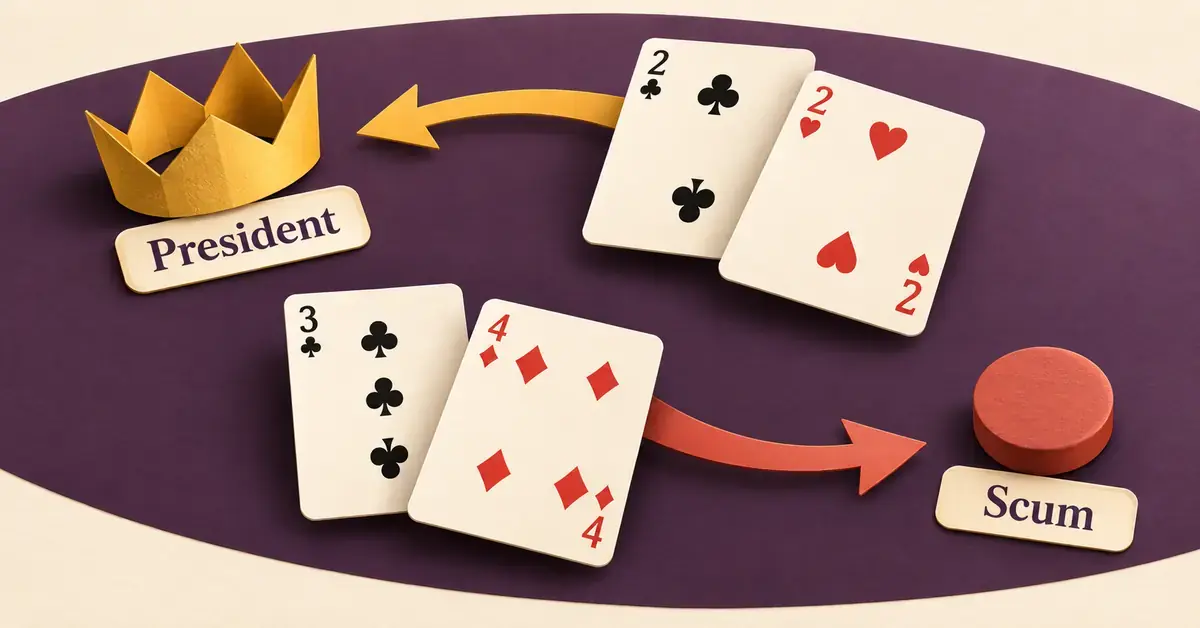
- +1 point for every card you managed to play onto the centre foundations.
- −2 points for every card left in your Nertz pile — this penalty is taken by everyone who did not call Nertz.
Rounds are repeated until a player reaches the agreed target, commonly 100 points (many groups play to 150). The highest total wins. A few scoring differences are worth settling before you deal:
- Some groups give the player who calls Nertz a fixed bonus (often around 10 points) on top of not taking the penalty.
- If every player gets stuck with no legal moves, the round simply ends and everyone — including anyone whose Nertz pile is empty — takes the −2-per-card scoring as usual.
- The Pounce version of the game awards a larger 25-point bonus to the player who calls, and some groups deduct only one point per leftover card.
Playing with two players or larger groups
With two players, the rules above apply unchanged; the two of you share just a handful of foundations, so the race to each Ace is intense and runs end quickly. This is many people’s favourite way to play.
Three or four players widen the centre and add to the scramble without any rule changes. From five players up, the table gets hard to reach and cards pile up, so larger groups usually switch to the partnership game: partners sit next to each other, share one deck, and help each other — one works the stock while the other watches for plays. A partnership scores as a single player.
Tips and common mistakes
- Clear the Nertz pile first. Points are nice, but the round ends when someone empties their pile, so prioritise any play that moves a Nertz card — especially using Nertz cards to fill empty work piles.
- Do not hoard Aces and twos. Low cards get foundations started and keep them moving; playing them fast opens up the centre for your higher cards.
- Keep your waste pile flowing. If you stall, turn your stock rather than staring at the table — the card you need is often two flips away.
- Watch the whole centre. Because anyone can play to any foundation, the chance to unload a card can appear and vanish in a second.
- Agree the rules first. Pile size, bonuses and the target score genuinely vary between groups; a 30-second chat before the first deal prevents arguments later.
How Nertz compares to similar games
Nertz sits in a small family of fast, simultaneous card games. If you enjoy its pace, its cousins are worth a look, and if you find it overwhelming, a calmer relative such as classic how to play solitaire rebuilds the same skills at your own speed. It is also an easy step up for households that already enjoy quick card games for kids, since the only hard part is the speed, not the rules.
How Nertz Compares
| Game | Players | Cards used | Core idea | Pace |
|---|---|---|---|---|
| Nertz | 2+ | One 52-card deck per player | Race to empty a 13-card pile onto shared foundations | Fast, simultaneous |
| Speed | 2 | One shared 52-card deck | Play all your cards onto two central piles in sequence | Fast, simultaneous |
| Spit | 2 | One shared 52-card deck | Empty your stock onto two shared piles | Fast, simultaneous |
| Dutch Blitz | 2–4 | Special 40-card decks (1–10) | Commercial version of Nertz with its own cards | Fast, simultaneous |
| Ligretto | 2–4+ | Special 40-card decks (1–10) | Near-identical proprietary version of Dutch Blitz | Fast, simultaneous |
Frequently Asked Questions
How many cards are in a Nertz pile?
Thirteen — twelve face down with one turned face up on top. Some groups play a shorter game with 12 or even 11 cards instead, but 13 is standard. Agree the number before you deal.
Can you play Nertz with two players?
Yes, and many players rate it as the best two-player version. The rules are identical; with only two decks in play there are fewer foundations, so the race to each Ace is faster and rounds end quickly.
Do you really need a separate deck for each player?
Yes. Each player uses their own 52-card deck, and every deck must have a different back design. All the cards mix together in the centre, so the different backs are how you sort them out and score each player at the end of a round.
What is the difference between Nertz and Dutch Blitz?
Dutch Blitz is a commercially sold version of the same idea. It uses special 40-card decks numbered 1 to 10 in four colours rather than standard playing cards, and renames the piles, but the race-to-empty-your-pile mechanic is the same.
What score do you play to?
Most groups play until someone reaches 100 points, though 150 is also common. You play as many rounds as it takes to get there, and the highest total wins.