A deck of cards is one of the cheapest and most portable learning tools a family can own. Behind the fun of shouting “Snap!” or hunting for the last matching pair, children are quietly practising counting, memory, patience and polite conversation. This guide walks through card games for kids from toddlers to tweens — what each game teaches, roughly what age it suits, and how to introduce it so the table stays happy. Ages below are general guides; always check the age rating printed on any boxed game, as publishers set their own recommendations.
Key points
- Card games build numeracy, memory, attention and social skills from as young as three, and the evidence is strongest for early maths.
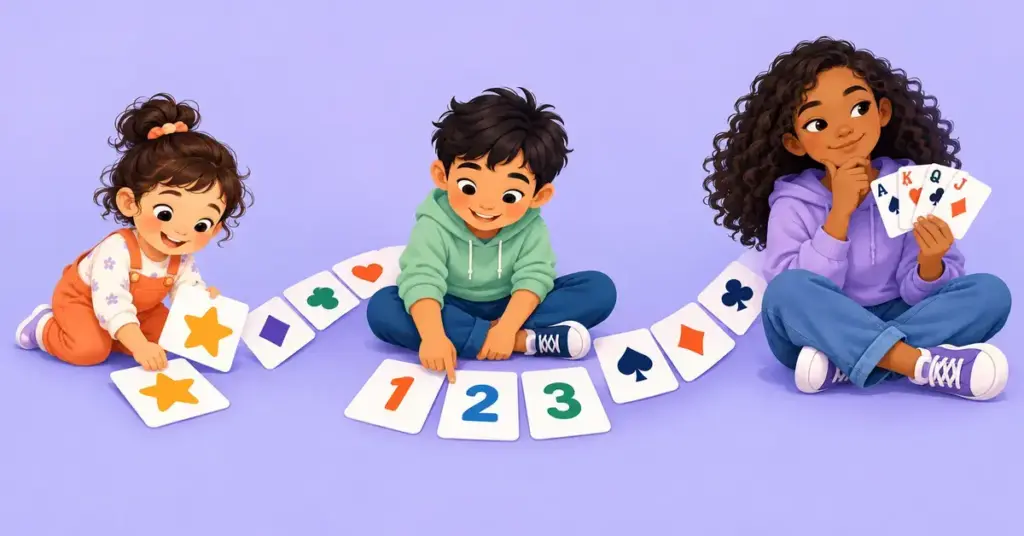
- There is a good option at every stage — matching games for toddlers, action and set-collecting games for school-age children, and trick-taking and strategy games for tweens.
- Check the age rating on each box: Uno and Skip-Bo are rated 7+, Spot It! / Dobble 6+ (Dobble Kids 4+), and Sleeping Queens 8+.
- Many games level the field so children and adults can play together fairly.
- How you teach a game — one rule at a time, thinking out loud, short early sessions — matters as much as which game you choose.
Why card games are good for children’s development
Card play looks like simple fun, but it exercises several skills at once in a low-pressure setting. The evidence is strongest for early numeracy: a randomised study of preschoolers by Scalise, Daubert and Ramani (published in The Journal of Experimental Education in 2019) found that short, repeated sessions of numerical card games improved children’s counting and number knowledge, building on earlier work by the same researchers. You do not need a special educational deck to get these benefits — a standard pack and fifteen minutes a few times a week is plenty.
Thinking skills children build at the table
- Numeracy: counting, comparing and sorting card values gives abstract numbers a concrete, meaningful context.
- Memory and attention: remembering which cards have been played or asked for strengthens working memory and concentration.
- Pattern recognition: matching and sequencing games train children to spot relationships between objects — a foundation for both maths and reading.
- Planning: deciding which card to keep or discard is early strategic thinking, done without any screen.
Social and emotional skills
- Turn-taking: waiting patiently for a turn is a hard skill for young children, and card games rehearse it gently.
- Coping with winning and losing: the card table is one of the kindest places to learn that losing a round is not the end of the world.
- Communication: asking for a card, negotiating a house rule or explaining the score all stretch a child’s language.
Card games for toddlers (ages 3 to 5)
Little ones need games that are visual, fast and need no reading. Big, bright cards suit small hands, and the best choices finish in well under ten minutes before attention wanders. At this stage the ritual of shuffling and dealing is half the fun, so do not rush it.
Good first games
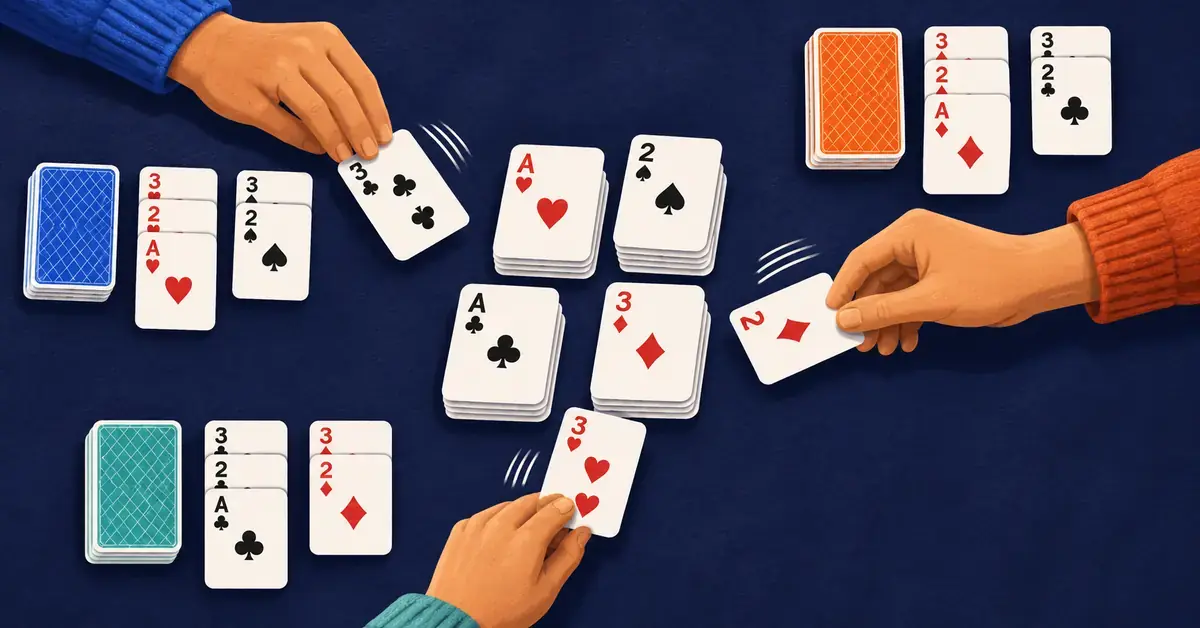
- Snap: the classic matching game, usually recommended from around age 3. Players turn cards onto a pile and shout “Snap!” when two match. It builds visual matching and quick reactions, and the full rules and variations are covered in our guide to the Snap card game.
- Old Maid: a simple matching game, commonly rated 4+, with a gentle twist — nobody wants to be left holding the unmatched card. Themed decks with animals or characters are easy for young children to follow.
- Happy Families: children collect sets by politely asking other players for cards, which quietly rehearses taking turns and asking questions.
- Memory (Concentration): cards are laid face down and players flip two at a time, looking for pairs. Pure, focused memory practice — and toddlers are often startlingly good at it.
Keep sessions short and praise effort rather than the result. A child who shuffled badly and lost but stayed cheerful has had a good game.
Card games for ages 5 to 8
Once children start school they can handle a few more rules, slightly longer games and a first taste of strategy. This age group loves games that feel exciting and a little unpredictable.
School-age favourites
- Go Fish: a timeless game of collecting sets that practises number recognition, memory and polite requests. Our Go Fish rules guide shows how quickly it can be taught; packs are commonly rated from around 5 to 7.
- Crazy Eights: matching by suit or rank with wild eights, playable with any standard deck and generally suited to ages 5 and up. It is the simpler ancestor of Uno and a great stepping stone.
- Uno: colour-and-number matching with action cards (Skip, Reverse, Draw Two) that keep everyone on their toes. Mattel prints a recommended age of 7+ on the box; many children manage a simplified game a little earlier once they know their colours and numbers. The full UNO rules explain scoring and house rules.
- Slapjack: fast, physical and loud — players slap the pile when a Jack appears. Perfect for burning off energy on a rainy afternoon.
Around this age children start to genuinely strategise — holding back a useful card, watching what others pick up — so do not be surprised when they beat you fairly.
Card games for ages 8 to 12
Older children can follow multi-step rules, sit through longer games and enjoy real competitive tension. This is the ideal age to introduce games that reward planning and reading your opponents.
Games that keep tweens engaged
- Rummy: building sets and runs from your hand rewards thinking a few moves ahead. Our Rummy rules and variants guide also covers Gin Rummy, a popular two-player version.
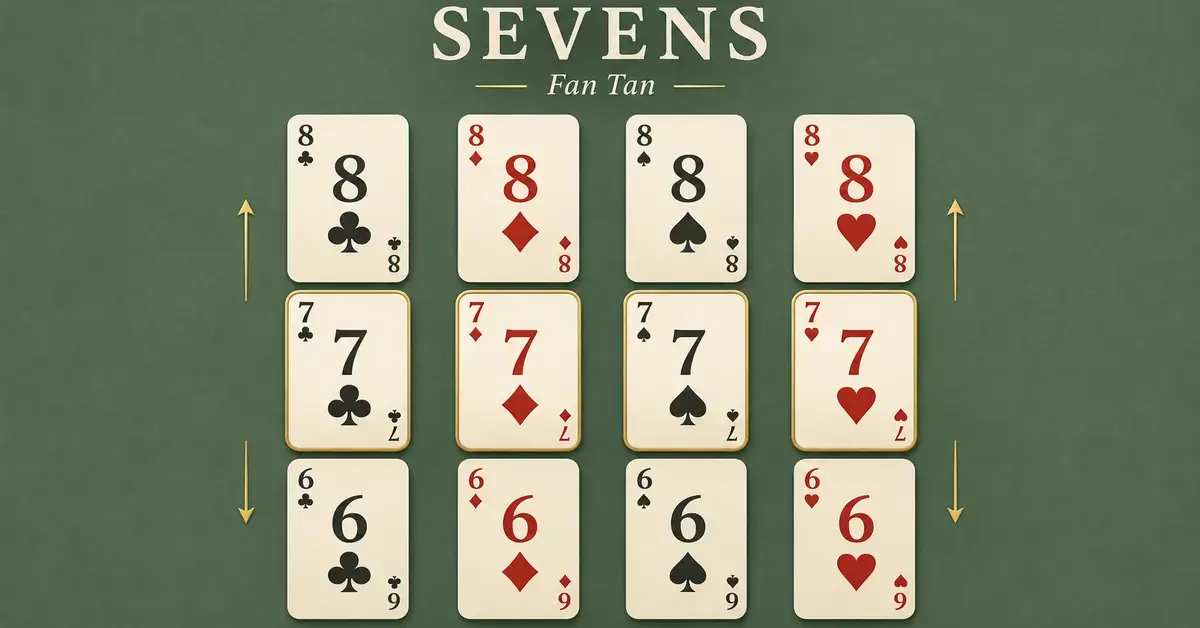
- Sevens (Fan Tan): players build sequences outward from the sevens. Easy to learn but quietly tactical, because holding a key card can block an opponent.
- Spit (Speed): a lightning-fast, play-at-the-same-time game that rewards sharp eyes and quick hands — children at this age tend to love it.
- Whist: a proper trick-taking game with trump cards and partnerships. Our Whist guide is a gentle on-ramp to more serious games like Bridge later on.
Game comparison
| Game | Typical age | Players | Approx. time | Main skills |
|---|---|---|---|---|
| Snap | 3+ | 2–6 | 5–10 min | Matching, reactions |
| Old Maid | 4+ | 3–6 | 10–15 min | Matching, turn-taking |
| Go Fish | 5–7+ | 2–6 | 10–20 min | Numbers, memory |
| Crazy Eights | 5+ | 2–7 | 15–20 min | Matching, planning |
| Uno | 7+ | 2–10 | 20–30 min | Colours, numbers, tactics |
| Rummy | 8+ | 2–6 | 30–45 min | Sets, forward planning |
| Whist | 10+ | 4 | 45–60 min | Trick-taking, partnership |
Card games the whole family can play together
One of the nicest things about card games is how they can level the field. A well-chosen family game gives every player a genuine chance to win, which keeps everyone invested.
- Uno: wild cards and Draw Twos mean luck plays a real part, so younger players stay competitive with adults.
- Snap: reaction speed wins, not age — and children routinely beat the grown-ups fair and square.
- Spot It! / Dobble: every pair of cards shares exactly one symbol, and the first to spot it wins. The standard game is rated from around age 6, while the simpler Dobble Kids edition is designed for ages 4 and up.
- Sleeping Queens: a charming game of waking queens with number and power cards, printed with an age of 8+ though many families find younger children can join in with a little help.
- Skip-Bo: sequential card-building, rated 7+, that lets a child compete happily against grandparents.
The quiet secret to a good family game night is agreeing in advance that the youngest player can ask for a rule reminder without losing their turn — and keeping a bowl of something to snack on within reach.
Card games that build maths and memory
If you want to slip a little learning into the school holidays without anyone noticing, card games are ideal. Several classics map neatly onto the numeracy and memory skills children work on at school.
Games that sharpen maths
- Twenty-One: adding card values to reach — but not pass — twenty-one is a brisk mental-arithmetic workout. Played purely as a counting game with no betting, it suits classrooms and kitchen tables alike.
- War: each player flips a card and the higher value wins the pair. It is dead simple and genuinely effective for number comparison, as our War card game guide explains.
- Beat That / number-building games: making the biggest number from the cards in your hand turns place value into a race.
Games that sharpen memory
- Concentration (Memory): flipping face-down pairs is focused, enjoyable memory training at any age.
- Go Fish: remembering which cards other players have asked for — and been refused — gives attentive children a real edge.
- Sushi Go!: a card-drafting game (rated 8+) that asks players to track what their opponents are collecting, exercising memory and planning at once.
How to teach a new card game
How you introduce a game matters as much as the game itself. A few habits make the first session go smoothly and keep frustration low.
- Explain one rule at a time. Deal a practice round with hands face up and add the trickier rules (like Uno’s action cards) only once the basics stick.
- Narrate your thinking. Saying “I’ll keep this card because…” out loud models decision-making in a way children can copy.
- Keep early games short. Stop while everyone is still having fun rather than pushing to a bitter end.
- Make a ritual of the ending. A high-five or handshake after every game, win or lose, turns good sportsmanship into a habit.
- Choose games with enough luck. For younger players, a game where chance plays a part gives them a real shot at winning and makes losing easier to take.
Moving older kids on to strategy games
When a child has mastered the classics and wants more of a challenge, strategy games are the natural next step — games where thinking a few moves ahead genuinely changes the outcome.
- Start with hybrids. Games that blend luck and skill, such as Sushi Go! or Sleeping Queens, bridge the gap between pure-luck and full-strategy games.
- Introduce trick-taking. Whist and Hearts reward reading the table and remembering what has been played, and they grow with a child over years.
- Teach a few simple habits. Watch what opponents pick up and discard, avoid playing your strongest card too early without a reason, and think about what the other players need — not only your own hand.
- Accept the role of luck. Sometimes the best play still loses to the shuffle, and learning to shrug that off is part of the game.
Where to find kids’ card games in New Zealand
Most of the games here are easy to track down. The Warehouse, Farmers, Toyworld, Whitcoulls and Paper Plus all carry a rotating range of children’s card games in store, while Mighty Ape and Fishpond cover the online side with wider back catalogues. For a full breakdown by age, skill level and price, see our companion guide to kids’ card games in New Zealand. When buying for younger children, check the age rating on the box and look for sturdy, oversized cards that will survive enthusiastic small hands.
Sources
- Scalise, Daubert & Ramani (2019), ‘Benefits of Playing Numerical Card Games on Head Start Children’s Mathematical Skills’, The Journal of Experimental Education (PMC)
- Mattel (publisher of Uno and Skip-Bo — age ratings)
- Asmodee (publisher of Spot It! / Dobble — age ratings)
- Gamewright (publisher of Sleeping Queens and Sushi Go! — age ratings)
Frequently asked questions
What is a good first card game for a 3-year-old?
Snap is a popular first game for around age three. It needs no reading, uses simple matching, and the rules fit in a single sentence. Toddler editions use large, chunky cards with bright pictures that are easy for small hands to hold, and a game usually finishes in under ten minutes, which suits short attention spans. Old Maid and simple Memory games are good alternatives.
At what age can children play Uno?
Mattel prints a recommended age of 7 and up on the Uno box. Many children can enjoy a simplified version a little earlier, once they reliably recognise colours and numbers, if you introduce the action cards gradually rather than all at once. By about seven most children can play a full game, including remembering to call “Uno!” on their last card.
Are card games really educational for children?
Yes, especially for early maths. A randomised study by Scalise, Daubert and Ramani found that short, repeated sessions of numerical card games improved preschoolers’ counting and number knowledge. Card games also give regular practice at memory, concentration, turn-taking and conversation, which makes them a useful, screen-free supplement to school learning.
How do I stop younger children getting upset when they lose?
Keep early sessions short, praise effort rather than the result, and choose games with enough luck to give younger players a genuine chance of winning. A household habit of a high-five or handshake at the end of every game helps losing feel ordinary rather than painful. Over time, the card table becomes one of the gentlest places to practise losing gracefully.
Which card games are best for mixed-age family play?
Games where reaction speed or luck matters tend to work best across ages, because they stop adults dominating. Snap, Uno, Spot It! / Dobble and Skip-Bo all let children compete fairly with grown-ups. Agreeing that the youngest player can ask for a rule reminder without losing their turn keeps everyone included.