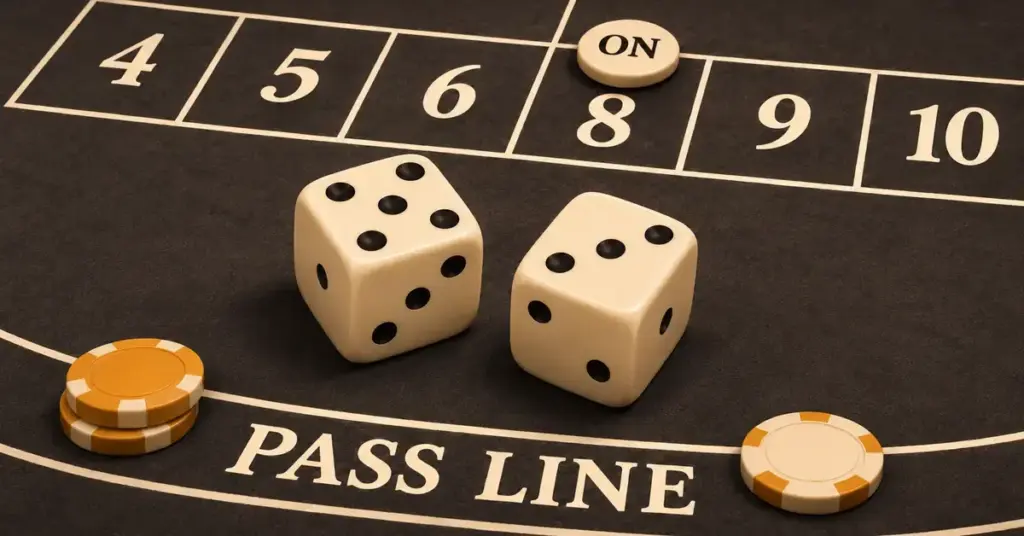
Craps is a casino dice game built around the roll of two six-sided dice, and it has a reputation for being loud, fast and far simpler than the crowded table makes it look. Strip away the jargon and most of a round comes down to a single question: will the shooter make their number before a 7 turns up? This guide walks through how a round works, the main bets and what they pay, and the house edge sitting behind each wager, so you can follow the action whether you meet it online, overseas or around a Kiwi kitchen table.
Key Points
- Craps is a casino dice game played with two six-sided dice; everyone bets on the outcome of the shooter’s roll.
- A round has two phases: the come-out roll, then the point phase if a 4, 5, 6, 8, 9 or 10 is rolled.
- The pass line and don’t pass line are the simplest bets and have the lowest house edge (about 1.4%).
- The free-odds bet, placed after the point is set, is the only standard craps bet with no house edge.
- Centre-table proposition bets (hardways, any seven) pay big but have the worst odds — up to a 16.67% edge.
- Craps is rarely found on New Zealand casino floors; Kiwis usually meet it overseas or online.
What craps actually is
Craps is played with two standard dice on a long, sunken table marked with betting areas. One player, the shooter, throws the dice; everyone at the table (the shooter included) bets on the outcome. In the casino version, known as bank craps, you always bet against the house rather than against each other, and the same betting areas are open to every player.
The dice are passed around the table, so each player gets a turn as shooter. A throw must hit the far wall of the table to count, which keeps the game fair. There is also an informal street version played without a table, where players bet against each other, but the rules below describe the casino game that most people mean by “craps”.
How a round works: the two phases
Every round has two possible stages. The round begins with a come-out roll, and depending on what the shooter rolls, it either ends straight away or moves into the point phase.
The come-out roll
The come-out roll is the shooter’s first throw of a new round. On it, the numbers behave like this for the most common bet, the pass line:
- 7 or 11 — an instant win for pass line bets. This is called a “natural”.
- 2, 3 or 12 — “craps”. Pass line bets lose and the round ends.
- 4, 5, 6, 8, 9 or 10 — this number becomes the point, and the round moves to the second phase.
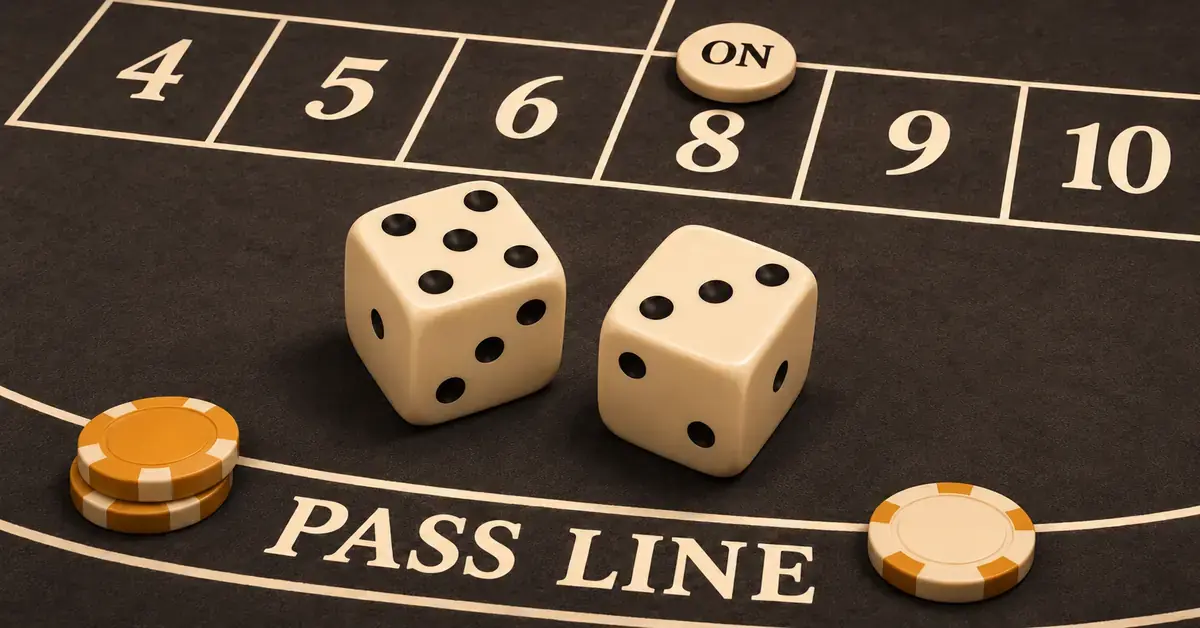
When a point is set, a marker called the “puck” is flipped to its ON side and placed on that number so everyone can see it.
Making the point
Once a point is established, the shooter keeps rolling with one goal: roll that same number again before rolling a 7.
- If the point comes up first, pass line bets win and a new round begins.
- If a 7 comes up first, it is called a “seven-out”. Pass line bets lose, the dice pass to the next shooter, and a new round begins.
Any other number rolled in this phase does nothing to a pass line bet — the shooter simply rolls again. This is why the 7 flips from hero to villain: it wins instantly on the come-out but ends your pass line bet once a point is set.
The main bets
You could spend an evening at a craps table making only the line bets below. They are the simplest wagers and, conveniently, the ones with the lowest house edge.
Pass line
The pass line is the classic craps bet and the one most players make. You place it before the come-out roll. It wins on a come-out 7 or 11, loses on 2, 3 or 12, and otherwise rides on the point being made before a 7. The house edge is about 1.41%, among the better bets on any casino floor.
Don’t pass line
The don’t pass line is the mirror image: you are effectively betting with the house. It loses on a come-out 7 or 11, wins on 2 or 3, and then wins if a 7 appears before the point is made. A come-out 12 is usually a “push” (a tie, your stake is returned) rather than a win, which is how the casino keeps a small edge. That edge is about 1.36%, a touch lower than the pass line. Betting this way is sometimes called playing the “dark side”, and it wins while most of the table is losing, so it is quieter company.
Come and don’t come bets
Come and don’t come bets work exactly like the pass and don’t pass bets, except you make them after a point has already been established. A come bet treats the next roll as its own personal come-out roll, setting its own point. They let you have several numbers working at once and carry the same low house edge as the line bets.
Odds bets: the only standard craps bet with no house edge
After a point is set, you can back your pass, don’t pass, come or don’t come bet with an extra wager called the odds (or “free odds”). It is the only standard craps bet paid at true odds, so the house has no edge on it at all. (A few casinos also run a field bet that pays triple on both the 2 and 12, which Wizard of Odds calculates at a 0% edge, but that pay table is rare.) On the pass side the odds pay:
| Point | Odds payout (pass side) |
|---|---|
| 4 or 10 | 2 to 1 |
| 5 or 9 | 3 to 2 |
| 6 or 8 | 6 to 5 |
Because the odds bet is paid fairly, adding it lowers the overall house edge on your total stake. Most tables cap how much you can put behind the line (often shown as “3x, 4x, 5x odds”). On the don’t pass side the equivalent is “laying” the odds, which pays the reverse ratios (1 to 2 on 4 or 10, and so on).
Place, field and proposition bets
The centre and sides of the table are crowded with other bets. They are optional, and the further you move from the line bets, the more the house edge climbs.
- Place bets — you bet that a specific number (4, 5, 6, 8, 9 or 10) will be rolled before a 7. Placing the 6 or 8 is the most sensible of these at a 1.52% edge; the 4 or 10 is far worse at 6.67%.
- Field bet — a one-roll bet that wins if the next roll is 2, 3, 4, 9, 10, 11 or 12. The 2 and 12 usually pay extra. The house edge is around 2.78% on the common pay table.
- Hardways — a bet that a number is rolled as a pair (a “hard” 8 is 4-4) before it comes up any other way or a 7 appears. The hard 6 or 8 carries a 9.09% edge; the hard 4 or 10 an 11.11% edge.
- Proposition bets — the one-roll bets in the centre, such as “any seven”. These look exciting but are the worst value on the table; any seven has a house edge of roughly 16.67%.
Bet types and house edge
| Bet | How it works | Approx. house edge |
|---|---|---|
| Free odds | Added behind a line bet after the point is set | 0% |
| Don’t pass line | Bets with the house; wins on a seven-out | 1.36% |
| Pass line | Wins 7 or 11 on the come-out, then makes the point | 1.41% |
| Place 6 or 8 | Number rolled before a 7 | 1.52% |
| Field | One-roll bet on 2, 3, 4, 9, 10, 11 or 12 | 2.78% |
| Place 5 or 9 | Number rolled before a 7 | 4.00% |
| Place 4 or 10 | Number rolled before a 7 | 6.67% |
| Hard 6 or 8 | Rolled as a pair before any other way or a 7 | 9.09% |
| Hard 4 or 10 | Rolled as a pair before any other way or a 7 | 11.11% |
| Any seven | One-roll bet that the next roll is a 7 | 16.67% |
Figures are for standard US pay tables and can vary slightly by casino.
Craps odds and the house edge
The house edge is the average percentage of each bet the casino expects to keep over time. A 1.41% edge on the pass line means that, on average, the house keeps about $1.41 of every $100 wagered on it — small, but the house never loses it over the long run. If you want the mechanics of why the casino holds an advantage in every game, our explainer on the casino house edge covers it in detail.
The practical takeaway is simple: the line bets and the odds are the mathematically kindest wagers at a craps table, while the centre proposition bets are the most expensive. No bet, and no “system”, changes the long-run edge — the dice have no memory, so every roll is independent of the last.
Can you play craps in New Zealand?
Craps is far less common on New Zealand casino floors than you might expect from Hollywood films. SkyCity Auckland, the country’s largest casino, offers 150 table games built around blackjack, baccarat, roulette and poker, but craps is not part of its standard table line-up. In practice, New Zealanders usually meet craps either overseas — it is a Las Vegas staple — or on licensed online platforms.
If you would rather learn a game you can actually sit down to locally, the same skills of reading a layout and understanding payouts carry across to other casino table games. Beginners often start with blackjack, which has a comparably low house edge, work through roulette rules for a pure dice-and-wheel experience, or learn how to play poker for a game of skill against other players rather than the house.
Responsible gambling
Craps is a game of chance played for entertainment, not a way to make money. The house holds a mathematical edge on every bet, so over time the odds favour the casino, and no skill or system changes that. In New Zealand, the Department of Internal Affairs requires patrons to be 20 to enter a casino, and the same caution applies online. Set a budget before you play, never bet money you cannot afford to lose, and treat any winnings as a bonus rather than income. If gambling is causing you or someone you know harm, free, confidential help is available in New Zealand from Gambling Helpline Aotearoa on 0800 654 655 (or text 8006), 24 hours a day. You can also read our guide to responsible gambling.
Reference sources
Frequently asked questions
What is the smartest bet in craps?
The pass line and don’t pass line are the smartest bets because they carry the lowest house edge (about 1.41% and 1.36%). Backing either with a free-odds bet after the point is set is even better, since the odds portion is paid at true odds with no house edge at all.
Is rolling a 7 good or bad in craps?
It depends on the phase. On the come-out roll a 7 is an instant win for pass line bets. But once a point has been established, a 7 is a “seven-out” that ends the round and loses pass line bets. The same number is a hero on the first roll and a villain afterwards.
What number do you avoid in craps?
After a point is set, pass line players dread the 7, because it ends the round before the point is made. There is no way to avoid it being rolled — it is simply the most likely total on two dice — which is exactly why the game is built around it.