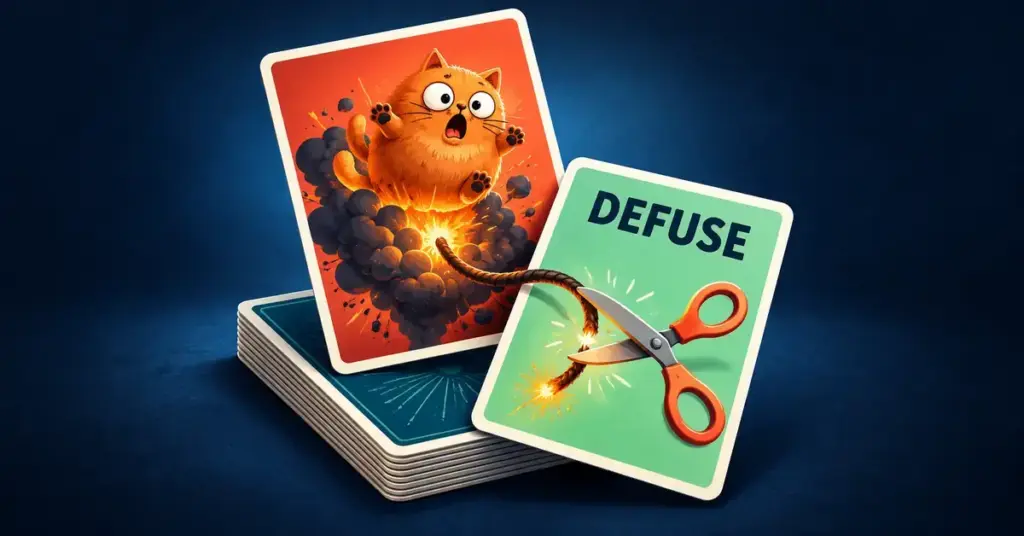
Exploding Kittens is a fast, light-hearted card game in which players take turns drawing from a shared pile while trying to avoid the one card that knocks them out: the exploding kitten. It plays a bit like a kitten-powered game of Russian roulette, softened by cartoon humour and a handful of action cards that let you dodge danger, peek at the deck or shove the risk onto someone else. A round rarely takes longer than about fifteen minutes, which is why it has become a staple at family tables and party nights across New Zealand. This guide explains the setup, what every card does, which cards belong to the base game versus the expansions, and the tactics that help you stay in the game.
Quick Facts
| Game type | Card game (party / family) |
| Designers | Elan Lee and Shane Small |
| Illustrator | Matthew Inman (The Oatmeal) |
| First released | 2015 (via Kickstarter) |
| Players | 2–5 (base game); up to 6 with Imploding Kittens; up to 10 with the Party Pack |
| Recommended age | 7+ |
| Playing time | About 15 minutes |
| Base deck | 56 cards, including 6 Defuse cards |
| Approx. NZ price | Around NZ$25–30 for the Original Edition; the Party Pack is higher |
| Official site | explodingkittens.com |
Where Exploding Kittens came from
Exploding Kittens was designed by Elan Lee and Shane Small, both former Xbox staff, with illustrations by Matthew Inman, the cartoonist behind The Oatmeal. It launched on Kickstarter in January 2015 under the working name “Bomb Squad” and quickly became one of the most-backed campaigns in the platform’s history, drawing more than 200,000 supporters. The appeal is deliberately simple: absurd artwork, quick rounds and just enough strategy to keep adults interested while remaining easy for children aged seven and up to follow.
The base game is a self-contained deck of 56 cards for two to five players. Over the years the publisher has added expansions and alternative editions, so the exact cards in your box depend on which version you own. This guide describes the standard base game first, then explains the most common additions.
How to play: the basic rules
The goal never changes: be the last player who has not drawn an exploding kitten they could not defuse. On your turn you may play as many cards as you like from your hand (or none at all), and then you end your turn by drawing one card from the central draw pile. The tension builds because the longer a round runs, the thinner the deck becomes and the more likely your next draw is a kitten.
A few rules are worth fixing in your mind before the first round:
- The draw pile holds the kittens. The number of exploding kittens in the deck is always one fewer than the number of players, so eventually all but one person is caught.
- A turn only ends when you draw. Playing action cards does not end your turn on its own — you must either draw a card or play a card (such as Skip or Attack) that specifically lets you end without drawing.
- No hand-size limit. You can hold as many cards as you manage to collect, so hoarding for a strong late game is a legitimate tactic.
- Drawing a kitten you cannot stop is elimination. If you draw an exploding kitten and have no Defuse card, you are out and your remaining cards go to the discard pile.
If you enjoy quick, social games like this, it sits naturally alongside other party games and makes a good addition to a shelf of family card games for mixed-age groups.
Setting up the deck
To set up, first remove every exploding kitten and every Defuse card from the deck and set them aside. Shuffle the remaining cards and deal each player a hand — current editions typically deal seven cards each, while the original 2015 printing dealt four, so check the rulebook in your box. Then give every player one Defuse card, so each person starts with a single safety net. Return any spare Defuse cards to the deck, shuffle in a number of exploding kittens equal to one fewer than the number of players, and place the combined draw pile face down in the middle. Any leftover kittens and Defuse cards go back in the box.
The scarcity of Defuse cards is the engine of the whole game: everyone begins protected, but there are only a few extra defuses hidden in the deck, which makes them the most fought-over resource at the table.
The base-game cards and what they do
The standard deck mixes defensive cards, information cards, disruption cards and the combo-only “cat” cards. Learning each card’s exact effect is the foundation of good play.
- Defuse: Your lifeline. Play it when you draw an exploding kitten to neutralise the kitten and stay in the game.
- Attack: End your turn without drawing and force the next player to take two turns in a row.
- Skip: End your turn immediately without drawing a card.
- Favor: Choose a player; they must hand you one card of their choice.
- Shuffle: Reshuffle the entire draw pile.
- See the Future: Privately look at the top three cards of the draw pile and return them in the same order.
- Nope: Cancel another player’s action — the only things it cannot stop are an exploding kitten and a Defuse.
- Cat cards: Five illustrated cats (such as Tacocat and Cattermelon) with no power on their own; they only matter in matched combinations.
The Defuse card and where to hide the kitten
When you draw a kitten and play a Defuse, you secretly return the kitten to the draw pile anywhere you choose, without showing the other players. This placement decision is one of the most skilful moments in the game. If the next player has few cards and no obvious escape, slipping the kitten onto the top can eliminate them immediately. If they are likely holding a Skip or Attack, that plan can backfire and send the kitten straight back toward you. A common compromise is to bury the kitten two or three cards down, creating a delayed trap that is harder for anyone to track.
Attack, Skip and Nope: controlling the turn
Attack is the main offensive tool. Because it hands the next player two turns, repeated Attacks can snowball: if that player responds with their own Attack, the turns stack and the following player can be forced to take four turns at once, draining their Defuse cards fast. Skip is a gentler option that simply ends your turn without a draw, which is invaluable when you suspect a kitten is on top. Nope is the great equaliser — you can play it out of turn to cancel almost any action, and you can even Nope another Nope, creating a back-and-forth “Nope chain” that resolves only when nobody adds another one. Holding a Nope back for the final rounds often decides who wins.
See the Future and information play
See the Future lets you peek at the top three cards, turning a blind draw into an informed one. Used honestly, it tells you whether to draw safely or play a Skip. Used as a bluff, it is even stronger: you can glance at three harmless cards, then act anxious to bait an opponent into wasting a Skip or Attack on a danger that was never there. Information is only as valuable as your ability to disguise what you know.
Cat cards and combos
Cat cards do nothing alone, but in combination they let you raid other hands — the main way to hunt for a Defuse when your own supply is gone. The base rulebook supports pairs and three-of-a-kind steals; some editions also include a five-different-cards rule that pulls a card from the discard pile. Keeping a rough count of who has drawn heavily without playing much tells you who is most likely hiding a Defuse.
- Matching pair: Play two identical cat cards to steal one random card from a chosen player.
- Three of a kind: Play three identical cat cards to name the exact card you want; if that player has it, they must give it to you.
- Five different cards: In editions that use this rule, play five different cards to take any one card from the discard pile.
Deciding when to spend a combo is a judgement call. Cashing in a five-card combo to reclaim a discarded Defuse is a strong emergency move late in a round, but doing it early leaves you thin and exposed to Attacks and Favors.
Editions and expansions
Several cards that people assume are “standard” actually arrived with later products, so it helps to know what belongs where. The first expansion, Imploding Kittens (2016), raised the maximum to six players and added cards such as Alter the Future (rearrange the top three cards rather than only viewing them), Draw from the Bottom, Targeted Attack and the Feral Cat, plus the Imploding Kitten itself, which cannot be defused. The Streaking Kittens expansion (2018) introduced further cards including Super Skip and Reverse. There are also standalone boxes — a tuned two-player version, a Party Pack that supports up to ten players, and adult-themed editions — as well as a digital app.
Edition Comparison
| Edition | Players | Needs base game? | Notable feature |
|---|---|---|---|
| Original Edition | 2–5 | No | The standard 56-card game |
| 2-Player Version | 2 | No | Tuned for head-to-head duels |
| Party Pack | Up to 10 | No | Extra cards for large groups |
| Imploding Kittens | Raises base to 6 | Yes | Adds the un-defusable Imploding Kitten, Alter the Future and more |
| Streaking Kittens | As base | Yes | Adds Super Skip, Reverse and new mechanics |
If you are weighing up what else to bring to game night, Exploding Kittens pairs well with other quick group titles such as Uno and the hidden-word party game Codenames, and it fits comfortably into a wider collection of board games for the whole household.
Strategy tips and common mistakes
The biggest beginner error is being too aggressive too early. Firing off Attacks for fun feels good, but it empties your hand before the deck becomes genuinely dangerous. More consistent players stay conservative, playing only what they must to survive while quietly building a hand that can dominate the final turns. A few principles hold up across most games:
- Bank your escape cards. Keep at least one Skip, Attack or Nope for the endgame, when a single safe pass can win the round.
- Track the Defuse cards. Count how many have been played; once the known defuses are gone, every draw is life-or-death and caution pays off.
- Use placement as a weapon. After defusing, think about the next player’s likely hand before deciding where the kitten goes.
- Bluff with your body language. Opponents can see how many cards you hold but not which ones, so calm confidence — or fake panic — shapes their decisions as much as the cards do.
Who Exploding Kittens suits
Exploding Kittens is aimed at casual and family play rather than deep strategy gaming. The rules are simple enough for a seven-year-old, rounds are short, and the humour keeps groups laughing even when someone is knocked out early. It works best as a filler between longer games, an icebreaker at a gathering, or a reliable travel game. Players who want heavier tactical depth may find it light, but for accessible, repeatable fun it remains one of the easiest card games to pull out for a mixed crowd. For a broader look at how games like this fit into the wider hobby, see our guide to the world of card games.
Sources
Frequently asked questions
How many people can play Exploding Kittens?
The base game is built for two to five players. The Imploding Kittens expansion raises the maximum to six, and the standalone Party Pack supports up to ten, so larger groups are best served by one of those options rather than the standard box.
What happens when you draw an exploding kitten?
If you draw an exploding kitten and hold a Defuse card, you play the Defuse, neutralise the kitten and secretly return it to the draw pile. If you have no Defuse, you are eliminated immediately and your remaining cards are discarded.
Can you play a Nope card on a Defuse?
No. A Nope can cancel most actions, but the rules make exploding kittens and Defuse cards immune, so you cannot stop someone from defusing a kitten or being knocked out by one.
Do you have to draw a card at the end of every turn?
Yes, unless you play a card that specifically ends your turn without drawing — most often a Skip or an Attack. Otherwise the only way to finish your turn is to draw one card from the central pile.
How long does a game of Exploding Kittens take?
A single round usually lasts around fifteen minutes with two to five players, which makes it easy to play several games back to back or to slot one in between longer board games.