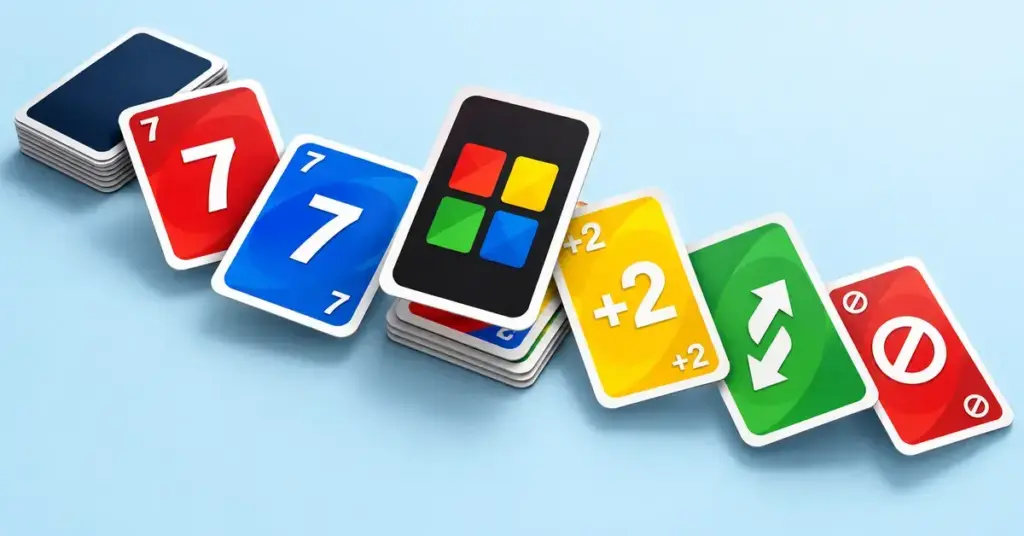

UNO is one of the most recognisable shedding card games in the world, and it remains a fixture of family game nights and social evenings across New Zealand. The aim is simple to grasp but surprisingly tactical in practice: match the card on the pile by colour, number or symbol, play out your hand before anyone else, and collect points from the cards your rivals are left holding. This guide walks through the standard deck, how a turn works, every action and Wild card, the official challenge and scoring rules, and the house variations many Kiwi households play by.
Key Points
- Goal of a round: be the first to empty your hand and score the cards left in opponents’ hands.
- Deck: 108 cards in four colours (Blue, Green, Red, Yellow) plus Wild cards.
- Deal: seven cards to each player; the rest form the draw pile.
- Matching: play a card that matches the top of the pile by colour, number or symbol, or play a Wild.
- The call: say “UNO” when you play your second-to-last card or risk a two-card penalty.
- Winning the game: traditionally the first player to 500 points over several rounds.
What UNO is and what is in the deck
UNO was invented in 1971 by Merle Robbins, a barber from Reading, Ohio, who wanted a tidier way to settle family arguments over the rules of Crazy Eights. The rights were sold in 1972 and the brand has been owned by Mattel since the company acquired International Games in 1992. It belongs to the same family as Crazy Eights and the traditional German game Mau-Mau, which is why it feels familiar to anyone who has played similar “matching” games.
A standard UNO deck contains 108 cards. (Many sets made since 2015 ship with a few extra customisable Wild cards, so a box may show 112, but the playable core is the same.) The cards split into four colour suits — Blue, Green, Red and Yellow — plus the colourless Wild cards:
- 76 number cards: each colour has a single 0 and two each of the numbers 1 to 9.
- 24 action cards: each colour has two Skip, two Reverse and two Draw Two cards.
- 8 Wild cards: four Wild and four Wild Draw Four cards, which carry no colour of their own.
The game is designed for 2 to 10 players and is rated for ages 7 and up, which is why it works so well at multi-generational gatherings where skill levels differ. The round goal is to be the first to empty your hand; the overall game goal is to reach a target score (traditionally 500 points) across several rounds.
Setting up a game
Shuffle the deck and deal seven cards to each player. Place the rest face-down in the middle as the draw pile, then turn the top card over to start the discard pile. If that first card is an action card, its effect usually applies to the first player — for example, a Skip means the starting player misses their turn, and a Draw Two means they draw two and are skipped. If the first card turned up is a Wild Draw Four, it is normally returned to the deck and a new card is drawn. Agreeing on these small set-up points before you start keeps the game fast and dispute-free.
How a turn works
On your turn you play one card from your hand that matches the top card of the discard pile in colour, number or symbol. A Red 7 can be followed by any other Red card, by a 7 of any colour, or by a Wild. Wild cards can be played at any time. If you cannot (or choose not to) play, you draw a single card from the draw pile; if that card is playable you may put it down straight away, otherwise play passes on.
Play normally moves clockwise, but Reverse cards flip the direction at any point. When the draw pile is used up, the discard pile is shuffled (leaving its top card in place) to form a fresh draw pile, so a game can continue indefinitely until someone goes out.
Quick Facts
| Game type | Shedding / matching card game (Crazy Eights family) |
| Publisher | Mattel (owner since 1992) |
| Created | 1971 by Merle Robbins, Reading, Ohio |
| Players | 2 to 10 |
| Recommended age | 7 and up |
| Cards | 108 in a standard deck (some sets since 2015 show 112) |
| Round goal | Be first to play every card in your hand |
| Game goal | Reach the target score, traditionally 500 points |
The action cards: Skip, Reverse and Draw Two
Action cards are where UNO stops being a game of luck and starts rewarding timing. They let you control who plays next and how many cards your opponents are forced to pick up. The most effective moment to use one is against the player on your left when they are close to winning — a well-timed Skip or Draw Two can stop someone reaching their final card.
| Card | Effect | Best used to |
|---|---|---|
| Skip | The next player loses their turn. | Deny a turn to a player who is down to one or two cards. |
| Reverse | Play direction switches (clockwise to anti-clockwise or back). | Change who plays next and protect yourself from a threat on your left. |
| Draw Two | The next player draws two cards and misses their turn. | Punish the current leader and grow their hand. |
All three of these cards are worth 20 points each if they are still in a hand when the round ends, so holding on to them too long is a gamble.
Using Reverse well
Reverse is easy to underrate. In a two-player game it behaves exactly like a Skip, giving you an immediate second turn. In a larger group it is most valuable when the person who just played is holding a full hand while the player about to go is nearly finished — flipping the direction keeps the pressure on the strongest players and buys you time to find the cards you need. Games like Uno Flip build whole new layers on top of this same turn-manipulation idea.
Wild and Wild Draw Four cards
Wild cards are the most flexible assets in the deck because they can be played on any card regardless of colour or number. A standard Wild lets you declare which colour play must continue in. The Wild Draw Four does the same and forces the next player to draw four cards and miss their turn, making it the single most powerful card in the game.
There is an important restriction on the Wild Draw Four under the official rules: you may only play it when you have no card in your hand that matches the current colour of the discard pile. (You are still allowed to hold matching numbers or Wilds.) This is the rule that makes the game’s famous challenge possible.
- The challenge: the player targeted by a Wild Draw Four may challenge it if they suspect it was played illegally.
- If the challenge succeeds (the player did hold a matching colour), the person who played the card draws the four cards instead.
- If the challenge fails (the play was legal), the challenger draws six cards — the original four plus two more — and still misses their turn.
Both Wild cards are worth 50 points each at the end of a round, the highest value in the game, so a Wild left in your hand when someone else goes out hurts.
When to play a Wild Draw Four
Deciding when to use a Wild Draw Four is an exercise in risk management. If you genuinely have no matching colour and need to change the game, it is a safe and powerful play. Many competitive players prefer to save it for late in a round so opponents are hit with the maximum penalty, but holding a 50-point card too long is dangerous if someone else finishes first. If you bluff a Wild Draw Four while holding the matching colour, be ready for a challenge — a successful one leaves you drawing the four cards yourself.
Scoring and winning

Each round ends the moment one player discards their last card. That player scores the combined value of every card still held by their opponents, so the more cards (and the higher their value) left around the table, the bigger the reward.
| Card category | Point value |
|---|---|
| Number cards (0–9) | Face value (0 to 9 points) |
| Skip, Reverse, Draw Two | 20 points each |
| Wild and Wild Draw Four | 50 points each |
If the winning card is a Draw Two or Wild Draw Four, the next player must still draw those cards, and they are counted before the score is tallied. The traditional format plays rounds until one player reaches 500 points and is declared the overall winner.
Reaching the target score
The 500-point target is a convention rather than a fixed law, and many groups adjust it to suit the time they have — 250 points makes for a quick session, while a higher total stretches the game out. Consistency usually beats heroics: winning several modest rounds is often more reliable than banking on one huge round full of Wild Draw Fours. Keeping a running tally after each hand adds a layer of tension that lasts until the final card. An alternative version flips the aim entirely, with the first player to reach 500 being the loser.
Saying “UNO” and playing your last card
The game’s signature rule is the call itself. When you play your second-to-last card — leaving you with just one — you must say “UNO” out loud. If another player catches you failing to do so before the next player begins their turn, you draw two cards as a penalty. If nobody notices in time, there is no penalty. It is a rule that keeps everyone watching each other’s hands and turns the end of a round into a race between the player trying to call it and the opponents trying to catch them out.
You are allowed to win on an action card. If your final card is a Skip, Reverse, Draw Two or Wild Draw Four, the round still ends when your hand is empty — the next player simply absorbs the effect (drawing the relevant cards, which then count towards the score). A last card that is a Wild is almost a guaranteed win because it plays on anything, so experienced players try to arrange their final card to match the dominant colour of the round.
Hand management and simple strategy

Strong players do more than read their own cards. A few habits make a clear difference:
- Keep your colours balanced. Hoarding one colour leaves you stranded if play switches away from it; a mix of colours plus an action card gives you an answer to most situations.
- Track what is being played. If a colour has not appeared for several turns, opponents may be short of it — switching to that “dry” colour with a Wild can force them to draw.
- Hold action cards for threats. Save Skips and Draw Twos for the player who is close to going out rather than spending them early.
- Watch hand sizes. The player with one or two cards is the one to target; the player with a full hand is rarely a danger.
Table talk and gentle bluffing are part of the fun too — persuading the person with a Wild to pick a colour that happens to suit you is a time-honoured move. If you enjoy this mix of social reading and quick decisions, you will find similar appeal in titles like Exploding Kittens, and UNO sits comfortably alongside the simpler kids’ card games that are easy to teach at a family table.
Official rules versus common house rules
Many New Zealand families play with “house rules” that differ from Mattel’s printed instructions. The most important thing is to agree which set you are using before you start, because most mid-game disputes come from players assuming different rules. The table below compares the official position with popular variations.
| Rule | Official rule | Common house variation |
|---|---|---|
| Stacking | Not allowed — the next player simply takes the penalty. | A Draw Two can be played on a Draw Two to pass on a growing penalty. |
| Jump-in | You must wait for your turn. | A player holding the identical card (same colour and number) may play it out of turn. |
| Drawing when stuck | Draw one card; your turn then passes if it is unplayable. | Keep drawing until you find a playable card. |
| Zeros and sevens | No special effect; they are ordinary number cards. | Playing a 0 rotates all hands; playing a 7 lets you swap hands with a chosen player. |
House rules such as stacking and “Seven-O” swaps add chaos and swing, but they also create far larger hands, so decide in advance how far you want to take them. If you like the shedding-and-matching format but want a distinctly local version, the New Zealand favourite Last Card uses a normal 52-card deck with similar power cards, and it is one of many card games enjoyed across New Zealand.
Reference sources
Frequently Asked Questions (FAQ)
What happens if you forget to say “UNO”?
If you are down to one card and fail to call “UNO” before the next player begins their turn, you must draw two cards as a penalty — but only if another player catches you in time. If nobody notices before the next turn starts, there is no penalty.
Can you win on an action card?
Yes. You can go out with a Skip, Reverse, Draw Two or Wild Draw Four. The round still ends when your hand is empty, and the next player absorbs the card’s effect, with any cards they draw counting towards the score.
Is stacking Draw cards allowed in the official rules?
No. Under Mattel’s official rules you cannot stack a Draw Two on a Draw Two or a Wild Draw Four on a Wild Draw Four. The targeted player simply draws the cards and misses their turn. Stacking is a popular house rule, not an official one.
What happens when the draw pile runs out?
When the draw pile is exhausted, take the discard pile, leave its top card in place, shuffle the rest and turn it over to form a new draw pile. Play then continues as normal.
How does the Wild Draw Four challenge work?
You may only play a Wild Draw Four if you have no card matching the current colour. The targeted player can challenge it: if the play was illegal, the player who used it draws the four cards; if the play was legal, the challenger draws six cards and still misses their turn.