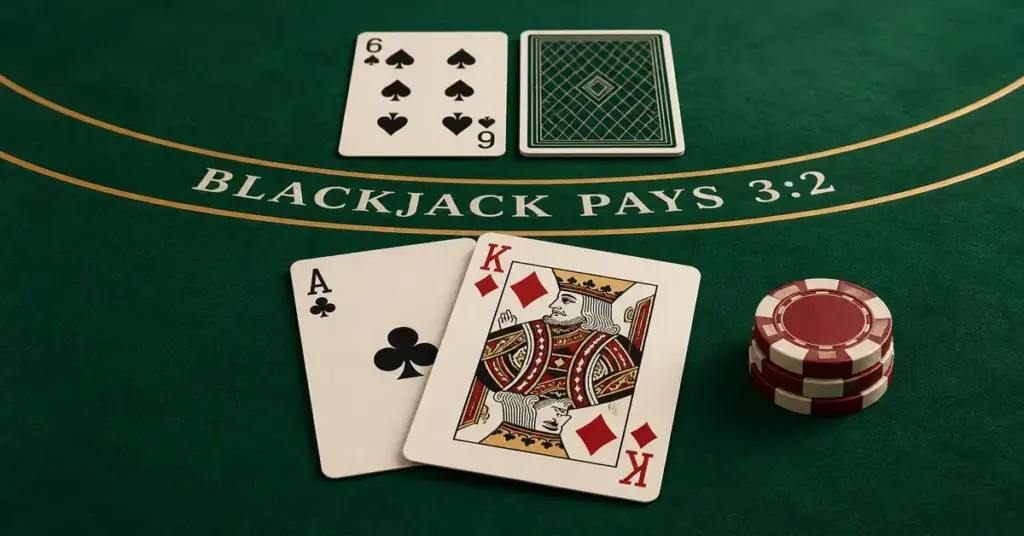

Blackjack is the banked card game where you try to build a hand worth more than the dealer’s without going over 21. It rewards a little arithmetic and a lot of discipline: learn the handful of rules the dealer must follow, make the mathematically correct move each time, and the casino’s advantage shrinks to about half a percent. This guide explains the card values, the four moves you can make, how dealer rules and payouts shape the odds, and how blackjack fits into the regulated gambling scene in New Zealand.
Key Points
- You play against the dealer only — other players at the table are not your opponents.
- Aces are flexible: count 1 or 11; a two-card 21 is a “natural” blackjack.
- The dealer must follow fixed rules — draw on 16 or less, stand on 17 or more.
- Basic strategy can bring the house edge down to about 0.5% in a good 3:2 game.
- Decline insurance and avoid 6:5 tables — both quietly raise the casino’s edge.
- Set a loss limit before you start and never chase losses; blackjack still favours the house over time.
What blackjack is and how a hand works
At a blackjack table you play only against the dealer, never against the other players seated beside you. Everyone is dealt two cards, and the dealer takes one card face up (the “upcard”) and one face down (the “hole card”). Your aim is to finish with a total closer to 21 than the dealer’s — or to still be standing when the dealer goes over 21, which is called a “bust”.
Card values are simple. Number cards count their face value, the Jack, Queen and King each count as 10, and an Ace counts as either 1 or 11, whichever helps your hand more. A two-card total of 21 — an Ace with any 10-value card — is a “natural” or blackjack, the strongest possible start.
- Goal: beat the dealer’s total without exceeding 21.
- Card values: 2-10 at face value, face cards 10, Ace 1 or 11.
- The deal: two cards to each player; the dealer keeps one card hidden.
- You win by: holding a higher total than the dealer, or watching the dealer bust.
Before any cards come out you place a bet inside the marked betting circle on the felt. Casinos deal from a “shoe” holding several shuffled decks, and each table posts a minimum and maximum stake. It is worth reading those limits before you sit down so your betting stays within a plan rather than drifting upward hand by hand.
Hard hands versus soft hands
A “soft” hand is any hand containing an Ace that is still being counted as 11, such as an Ace and a 6 (a “soft 17”). Because the Ace can drop to 1, you cannot bust a soft hand by taking one more card, which makes these hands safer to improve. A “hard” hand either has no Ace or has an Ace that must count as 1 to avoid busting. Knowing which kind of hand you hold is the first step toward making the right decision, because the correct play for a soft 17 is very different from the correct play for a hard 17.
The four moves you can make
Once the cards are dealt you choose from four actions. Picking the right one for your total against the dealer’s upcard is the whole skill of the game.
- Hit: take another card to raise your total. You can keep hitting until you stand or bust.
- Stand: keep your current total and pass the decision to the next player or the dealer.
- Double down: double your original bet in return for exactly one more card. It suits strong starting totals such as a hard 10 or 11 when the dealer looks weak.
- Split: when your first two cards are a pair, separate them into two hands, each with its own matching bet, and play them one at a time.
Some tables add “surrender”, which lets you give up a hand and reclaim half your bet before drawing. It is uncommon in New Zealand, so check the table rules rather than assuming it is available.
Splitting aces and eights
Two plays come up again and again in strategy charts: always split Aces, and always split a pair of 8s. Splitting Aces gives you two fresh chances at a 10-value card and a total of 21, which is why it is such a strong move — though most houses let you draw only one card to each split Ace, and a 10 drawn then usually counts as 21 rather than a bonus-paying blackjack. Splitting 8s turns a weak hard 16, the worst total in the game, into two hands that each start on 8. By contrast, you should never split 10s (a 20 is already excellent) or 5s (a 10 is far better played as one hand).
Dealer rules and the house edge
The dealer has no choices to make. House rules fix exactly what they do: draw cards while their total is 16 or lower, and stop once they reach 17 or more. If the dealer busts, every player still in the hand wins. This predictability is what gives the game real decisions in a way most casino games do not have, because you always know the dealer’s obligation before you act.
- Dealer draws: they must take a card on a total of 16 or less.
- Dealer stands: they must stop on a total of 17 or more.
- Dealer bust: if the dealer goes over 21, all remaining players win.
- Payout: a natural pays 3:2 on good tables, or the worse 6:5 on some.
The “house edge” is the casino’s long-run mathematical advantage. In a typical game where the dealer stands on all 17s and a natural pays 3:2, perfect play keeps the edge to roughly 0.5% — among the best odds on any casino floor. The dealer’s upcard drives most of your decisions: a 4, 5 or 6 is weak because the dealer busts often from those, so you can stand on modest totals, while an Ace or a 10 is strong and you need a higher total to compete.
The soft 17 rule and blackjack payouts
Two printed rules change the odds more than any other. The first is whether the dealer “hits soft 17” or “stands on all 17s” — a line usually written on the felt. If the dealer hits soft 17, they get an extra chance to improve, and that adds about 0.2% to the house edge. The second is the natural payout: a 3:2 table pays $3 for every $2 staked on a blackjack, while a 6:5 table pays only $6 for every $5, which adds roughly 1.3-1.4% to the edge. A 6:5 game is far costlier than it looks, so the payout is worth checking before you sit down. The maths here is the same principle that shapes the odds in roulette and baccarat.
Rule Variations and the House Edge
| Rule or situation | What it means | Effect on the house edge |
|---|---|---|
| Natural pays 3:2 | Blackjack pays $3 for every $2 staked | Standard, player-friendly |
| Natural pays 6:5 | Blackjack pays only $6 for every $5 staked | Adds roughly 1.3-1.4% |
| Dealer stands on all 17s | Dealer stops on any 17, including soft 17 | Standard, better for the player |
| Dealer hits soft 17 | Dealer draws on a soft 17 (Ace + 6) | Adds about 0.2% |
| Perfect basic strategy | Always making the mathematically best play | Keeps a typical 3:2 game near 0.5% |
| Insurance / side bets | Optional wagers such as insurance or 21+3 | Higher edge; reduce your expected return |
Insurance, even money and side bets

When the dealer’s upcard is an Ace, they offer “insurance” before checking the hole card. It is a side bet of up to half your original stake that pays 2:1 if the dealer has a 10-value card for a blackjack. It sounds protective, but mathematically it loses money over time for anyone not tracking the deck, so basic strategy is to decline it. “Even money” is the same bet dressed up: if you hold a blackjack and the dealer shows an Ace, taking even money guarantees a 1:1 win but gives up the extra value of your 3:2 natural over the long run. Other side bets, such as “21+3” or “Perfect Pairs”, carry much higher house edges than the main game and are best treated as entertainment rather than strategy.
Basic strategy and card counting
“Basic strategy” is the complete set of mathematically best decisions for every player total against every dealer upcard, worked out from probability. It is usually shown as a colour-coded chart, and following it exactly is what brings the house edge down to around half a percent. Nothing about it is secret or against the rules — many tables even allow a printed strategy card at the table.
Card counting is a separate, more advanced technique: a player tracks the ratio of high to low cards left in the shoe to vary their bets when the odds briefly favour them. Counting is not illegal in New Zealand, but casinos are private venues and may change dealers, shuffle early or ask a suspected counter to stop playing. For almost everyone, mastering basic strategy delivers the real benefit, while counting is difficult, easily disrupted by multi-deck shoes, and not a reliable way to make money. If you are new to banked games generally, our guide to casino card games for beginners is a gentler starting point.
Playing blackjack in New Zealand
Gambling in New Zealand is regulated under the Gambling Act 2003, administered by the Department of Internal Affairs with the independent Gambling Commission handling licensing decisions. The Act permanently caps the number of casinos, so no new venues can open; the country’s six licensed casinos are SkyCity Auckland, SkyCity Hamilton, SkyCity Queenstown, the Wharf Casino in Queenstown, Christchurch Casino and Dunedin Casino. Each offers blackjack among its table games, with posted minimums, maximums and house rules on display.
Online casino gambling is being brought into a new licensing regime, with the government legislating a regulated market expected to issue its first licences from around late 2026. Until a site holds a New Zealand licence, treat offshore online blackjack with caution: payouts, dispute resolution and player protections are not guaranteed the way they are at a licensed venue. It also makes a fine home game — it needs only a standard 52-card deck — though casual home play has no formal regulation and should stay low-stakes and social. If you enjoy banked games, you might also like our walkthrough of how to play roulette or the rules of poker.
Common mistakes to avoid
Most avoidable losses at the table come from a short list of habits rather than from bad luck:
- Taking insurance: it is a losing side bet for ordinary players, however safe it feels.
- Standing too low against a strong upcard: if the dealer shows a 7 through Ace, modest totals usually need to be improved.
- Not splitting Aces and 8s, or splitting 10s: both run against the proven correct play.
- Playing 6:5 tables: the worse payout quietly costs you far more than the fun is worth.
- Chasing losses: raising your stake to “win it back” is the fastest route to a bad session.
Bankroll and responsible play
It is still a game with a built-in house edge, which means the casino is expected to win over time no matter how well you play. Sound bankroll management means deciding in advance how much you can afford to lose, staking only a small fraction of it on any one hand, and walking away when you reach a loss limit or a win goal. A flat, consistent bet size protects you from the “gambler’s ruin” that chasing losses invites. Remember too that every hand is independent — a shuffled shoe has no memory, so a dealer is never “due” to bust and a losing streak does not make the next hand more likely to win.
Disclaimer
This article is for general information only and is not gambling, financial or legal advice. Blackjack is a game of chance with a house edge, no strategy guarantees a win, and you can lose money. Gambling is for adults only. If gambling is affecting you or someone you know, free, confidential help is available in New Zealand from the responsible gambling resources below and from Gambling Helpline Aotearoa on 0800 654 655 (or text 8006), available 24 hours a day.
Sources
Frequently asked questions
What is the goal of blackjack?
You aim to finish with a hand total closer to 21 than the dealer’s, without going over 21. You win if your total beats the dealer’s or if the dealer busts, and you lose if you bust or the dealer’s total is higher.
Does hitting or standing depend on the dealer’s card?
Yes. The dealer’s upcard is the most important clue to your decision. A 4, 5 or 6 is weak, so you can often stand on a lower total, while a 7 through Ace is strong and usually means you should keep improving your hand.
Should I take insurance when the dealer shows an Ace?
Generally no. Insurance is a side bet that loses money over the long run for players who are not counting cards, and it increases the overall house edge. Basic strategy is to decline it.
What is the house edge in blackjack?
In a typical game where the dealer stands on all 17s and a natural pays 3:2, perfect basic strategy keeps the house edge to roughly 0.5%. A 6:5 payout or a dealer who hits soft 17 both make that edge worse.
Is card counting illegal in New Zealand?
Counting cards in your head is not a crime, but casinos are private venues and may shuffle early, change dealers or ask a suspected counter to leave. For most players, learning basic strategy is far more practical and reliable.