Settlers of Catan — usually just called Catan — is one of the most popular strategy board games in the world, and it is a favourite for game nights, baches and rainy-day afternoons across New Zealand. You collect resources, trade with your mates, and build roads, settlements and cities on an island that is different every time you play. The first player to reach 10 victory points wins. This guide walks absolute beginners through the whole game: what is in the box, how to set up, how a turn works, what everything costs to build, and the handful of rules that trip new players up.
Quick Facts
| Players | 3–4 (5–6 with the Catan Extension) |
|---|---|
| Ages | 10+ |
| Playing time | 60–90 minutes |
| Designer | Klaus Teuber |
| Goal | Be first to reach 10 victory points |
| Type | Strategy, trading and resource management |
What is Catan?
Catan is a game of trading and building for three to four players (you can add a fifth and sixth with the separate Catan Extension). It was designed by Klaus Teuber and first published in 1995. A typical game takes around 60 to 90 minutes and it is recommended for ages 10 and up, though younger children can usually join in with a little help.
The clever part is that the island is built fresh each game from hexagonal tiles, so no two games play out the same way. You never knock anyone out of the game, and almost every turn involves talking, haggling and deciding who to trade with — which is why it works so well as a sociable game for mixed-age groups. If you are putting together a shelf of crowd-pleasers, it sits comfortably alongside gateway games like Azul and Sequence.
What is in the box
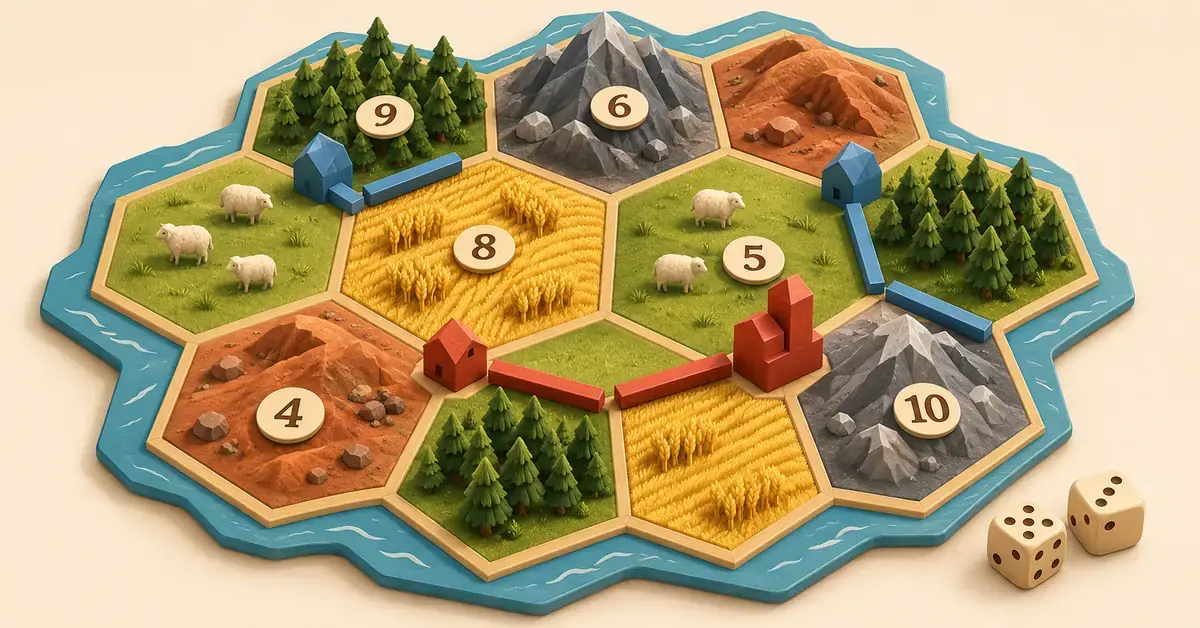
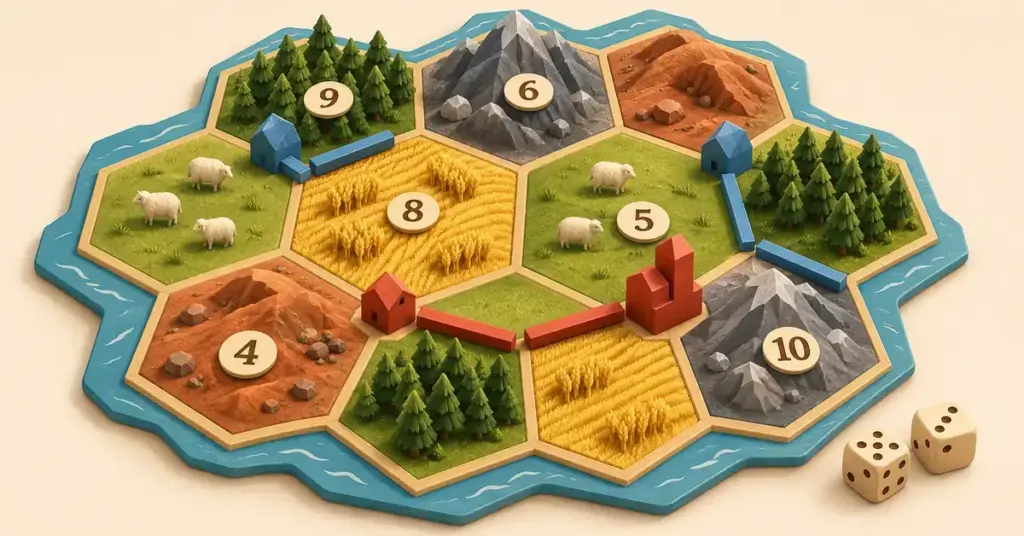
The base game includes a modular board made of 19 terrain hexes, plus water and harbour frame pieces that hold the island together. In short, you get:
- 19 terrain hexes — the five resource-producing land types plus one desert.
- 18 number tokens — marked 2 to 12 (there is no 7). Each number except 2 and 12 appears twice.
- 95 resource cards — brick, lumber, ore, grain and wool.
- 25 development cards — 14 knights, 5 victory point cards and 6 progress cards.
- Playing pieces — roads, settlements and cities in each player’s colour, plus the robber figure.
- Two dice and the harbour frame.
Resources and terrain
Everything you build is paid for with resource cards, and each type of land produces one resource. Learning this table is half the battle for a new player:
| Terrain | Resource it produces |
|---|---|
| Hills | Brick |
| Forest | Lumber (wood) |
| Mountains | Ore |
| Fields | Grain (wheat) |
| Pasture | Wool (sheep) |
| Desert | Nothing — the robber starts here |
Setting up the board
If it is your first game, the official rulebook includes a fixed beginner map that spreads the resources out fairly — it is well worth using while everyone learns. Once you are comfortable, switch to the random setup, which is where Catan really comes alive.
To set up:
- Build the island. Arrange the 19 terrain hexes inside the water frame. For a random game, shuffle them face down and lay them out.
- Place the number tokens. Put a number token on every land hex except the desert. A hex produces its resource when its number is rolled.
- Place the robber. Put the robber figure on the desert to start.
- Deal the pieces. Each player takes all the roads, settlements and cities in their colour.
- Place starting pieces. In turn order, each player places one settlement and one connecting road. Then, in reverse order, each player places a second settlement and road. You collect one resource card for each hex touching your second settlement.
A settlement always sits on a corner where hexes meet, and a road runs along the edge between them. Because corner spots next to three different resource hexes are the most productive, choosing your first two settlements is one of the most important decisions in the whole game.
The goal: 10 victory points
You win the instant you reach 10 victory points on your own turn. Points come from several places:
- Settlement — 1 point each.
- City — 2 points each (a city replaces one of your settlements).
- Longest Road — 2 points.
- Largest Army — 2 points.
- Victory point development cards — 1 point each, kept hidden until you win.
Because victory point cards and the two special bonuses are hidden or can change hands, a trailing player can sometimes leap to 10 in a single turn — so keep an eye on everyone’s board, not just your own.
How a turn works
Play passes clockwise. On your turn you always do these three phases in order.
1. Roll for resources
Roll both dice and add them up. Every player — not just you — who has a settlement or city touching a hex marked with that number collects resources: one card per settlement and two cards per city. If you roll a 7, nobody produces and the robber comes out (see below).
The numbers 6 and 8 are the most likely rolls, so hexes carrying those tokens are the richest spots on the board. The 2 and 12 are the rarest.
2. Trade
Now you can trade to get the cards you are missing. There are two kinds of trade:
- Trading with other players (domestic trade). Only the active player may propose trades, but anyone can offer a deal. You might swap two ore for a grain, for example — the rate is whatever you can negotiate.
- Trading with the bank (maritime trade). You can always give the bank four identical cards for one of your choice (4:1). If you own a settlement on a generic harbour, that improves to 3:1, and a special 2:1 harbour lets you trade two of one named resource for any single card.
3. Build
Finally, spend your resources to build roads, settlements and cities, or buy development cards. You can build as much as you can afford, in any order.
Building costs
Keep this table handy for your first few games — it is the heart of the whole game:
| What you build | Cost | Worth |
|---|---|---|
| Road | 1 brick + 1 lumber | Extends your network; counts for Longest Road |
| Settlement | 1 brick + 1 lumber + 1 wool + 1 grain | 1 victory point |
| City | 3 ore + 2 grain | 2 victory points (upgrades a settlement) |
| Development card | 1 ore + 1 wool + 1 grain | Varies (see below) |
Two placement rules matter here. A new road must connect to one of your existing roads, settlements or cities. And the distance rule means every settlement must be at least two road segments away from any other settlement or city — including your own. A city is never built from scratch; you upgrade an existing settlement into one.
The robber and rolling a 7
A 7 is the most dramatic roll in the game. When it comes up:
- No one produces resources that turn.
- Anyone holding more than 7 resource cards must discard half of them, rounded down. If you are sitting on 10 cards, you lose 5.
- You move the robber to any land hex. That hex stops producing anything until the robber is moved again.
- You steal one random card from a player who has a settlement or city touching that hex.
The robber is both a defensive tool — park it on an opponent’s best number — and a nudge to spend rather than hoard. Holding a big hand is risky, because the next 7 could cost you half of it.
Development cards
Development cards add a hidden layer of strategy. You buy one at random for 1 ore, 1 wool and 1 grain, and keep it secret. There are three kinds in the 25-card deck:
- Knight (14 cards). Play it to move the robber and steal, exactly as if you had rolled a 7 — but without triggering discards. Played knights also count towards Largest Army.
- Progress (6 cards). Two each of Road Building (place two free roads), Year of Plenty (take any two resources from the bank) and Monopoly (name a resource and take every matching card from all opponents).
- Victory point (5 cards). Each is worth 1 point. You keep these hidden and reveal them only when they take you to 10.
You may play only one development card per turn, and you cannot play a card the same turn you buy it (victory point cards are the exception — they just sit in your hand).
Longest Road and Largest Army
These two bonuses are each worth 2 victory points and can swing a game.
- Longest Road goes to the first player to build a continuous road of at least five connected segments. If someone later builds a longer one, the card — and its 2 points — moves to them.
- Largest Army goes to the first player to play three knight cards. Again, if another player plays more knights, they take the card and the points.
Because both can change hands, 4 points’ worth of bonuses are never truly locked in until the game ends.
Common beginner mistakes
- Ignoring the dice odds. A settlement on a 6 or 8 produces far more often than one on a 3 or 11. Prioritise the strong numbers.
- Hoarding cards. More than 7 in hand means you lose half on the next 7. Spend, build or trade instead.
- Forgetting the distance rule. You cannot wedge a settlement right next to another — it must be two road edges away.
- Refusing every trade. You usually cannot win without trading. Deals that help you a little more than your opponent are still good deals.
- Chasing brick and lumber only. Roads and settlements need them early, but cities and development cards run on ore, grain and wool — balance your spots.
Playing with two players or solo
The base game is built for three to four players and plays best that way, because open trading is part of the design. It does not shine head-to-head, but the official rules do include a two-player variant for the core game: you place two extra sets of pieces to act as imaginary players, and when the robber comes out it provides resources instead of stealing a card. For a purpose-built duel, the standalone card game Rivals for CATAN is designed for exactly two players.
There is no official single-player mode in the classic base box. To play Catan on your own, your best options are the official digital versions, which let you play against AI opponents, or the pocket-sized CATAN Dice Game, which can be played as a single-player game.
If you are after more games that suit a Kiwi games night, browse our wider guide to family board games in New Zealand, have a look at fast card games like Monopoly Deal, or find a board game club or café near you. Copies of Catan are widely stocked by New Zealand game shops and major retailers, including board games at The Warehouse.
Reference sources
Frequently Asked Questions
How many cards can you hold in Catan?
There is no limit during normal play. The catch comes when someone rolls a 7: every player holding more than 7 resource cards must discard half of them, rounded down. That is why experienced players spend their resources rather than sitting on a big hand.
How does a city work in Catan?
A city is an upgrade of one of your existing settlements, not a new building. It costs 3 ore and 2 grain, is worth 2 victory points instead of 1, and produces two resource cards from each adjoining hex instead of one. You return the settlement piece to your supply when you upgrade.
Can you build a settlement between your own roads?
Only if it satisfies the distance rule. A settlement must sit on a corner that is at least two road segments away from every other settlement or city, including your own, and it must connect to your road network. If another building is too close, that corner is blocked.
How long does a game of Catan take?
A typical three or four player game runs about 60 to 90 minutes once everyone knows the rules. Your first game or two will take longer while you get used to the turn order and the building costs.
Is Catan good for beginners and families?
Yes. It is recommended for ages 10 and up, no one is eliminated, and the trading keeps everyone involved every turn. Using the fixed beginner map for your first game makes it easy to pick up, which is why it is a popular choice for mixed-age game nights.