Spider Solitaire is a two-deck patience game in which you build descending runs of cards from King down to Ace and clear them off the table. It is best known from the version Microsoft bundled with Windows from the late 1990s onward, but the game is much older and can be played with ordinary cards on any flat surface. This guide explains the full rules from scratch: the setup, how cards move, how the stock works, the difference between the one, two and four-suit versions, and how a game is won. Every term is explained the first time it appears, so no prior experience is needed.
Quick Facts
- Type: Single-player card game (solitaire / patience)
- Players: 1
- Cards: Two 52-card decks shuffled together (104 cards)
- Setup: 54 cards dealt into ten columns (four of six, six of five); 50 cards held in the stock
- Difficulty settings: One suit (easiest), two suits, four suits (hardest)
- Goal: Build eight complete King-to-Ace runs, each in a single suit, and clear them all
- Typical length: Several minutes to well over half an hour, depending on difficulty
What Spider Solitaire is
Spider is a single-player card game — a form of “solitaire” (also called “patience”), meaning you play alone against the layout rather than against other people. Unlike many solitaire games that use one 52-card deck, Spider uses two full decks shuffled together, giving 104 cards in play. That larger deck, and the fact that you work toward eight separate completed runs, is what gives the game its name: the eight finished sequences are often likened to a spider’s eight legs.
The game is usually compared to Klondike Solitaire, the “classic” solitaire most people learn first. The key difference is that Spider does not ask you to sort cards by colour onto four foundation piles. Instead, you build long descending sequences directly in the main playing area and remove each one once it is complete. This makes Spider a longer, more deliberate game that rewards planning several moves ahead.
A short history of the game
Spider is a long-established member of the two-deck patience family and predates computers by decades. For most modern players, though, it became familiar through Windows: Microsoft released a Spider Solitaire game in the Plus! 98 add-on pack for Windows 98 and later bundled it with Windows ME, XP and the editions that followed, before folding it into the Microsoft Solitaire Collection. An earlier computer version was written for Windows 3.x in 1991. That decades-long presence as a free, pre-installed game is a large part of why Spider is one of the most-played solitaire variants in the world today.
The objective and how you win
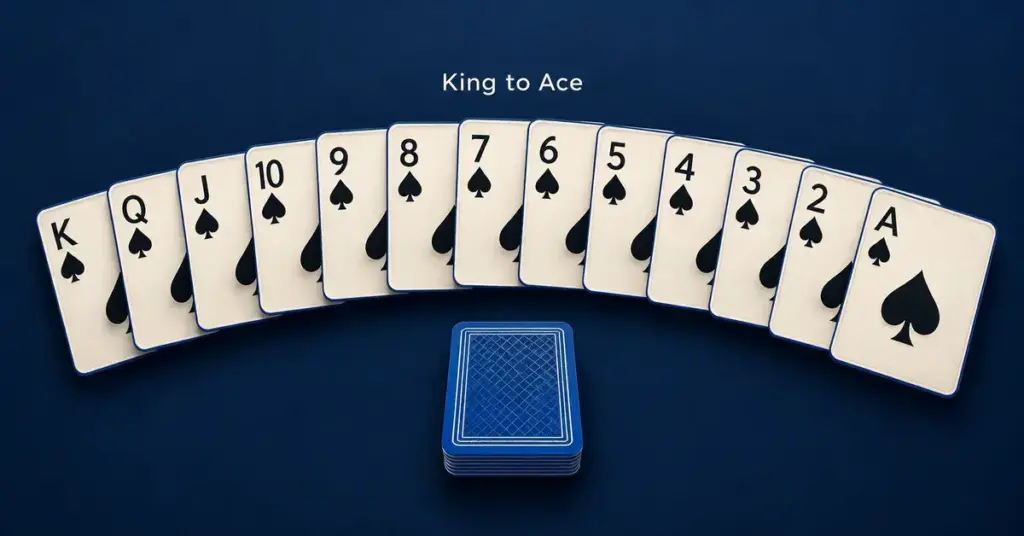
The goal is to arrange all 104 cards into eight complete sequences, each running in descending order from King to Ace in a single suit (King, Queen, Jack, 10, 9, 8, 7, 6, 5, 4, 3, 2, Ace). Each complete sequence is thirteen cards, and eight sequences account for all 104 cards (8 × 13 = 104).
Whenever a full King-to-Ace run of one suit forms at the bottom of a column, it is automatically removed from the table. Spider has no active foundation piles that you build up card by card — completed runs simply leave play, though many digital versions stack the cleared sets neatly to one side so you can see your progress. You win when all eight sequences have been removed and the table is empty.
Setting up the game
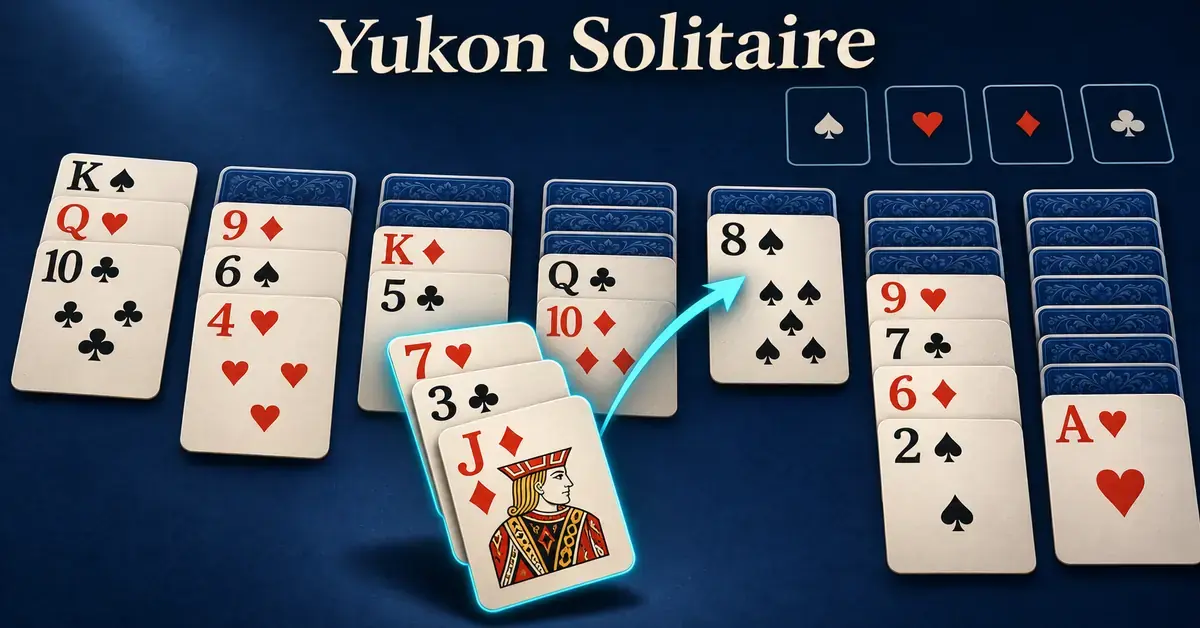
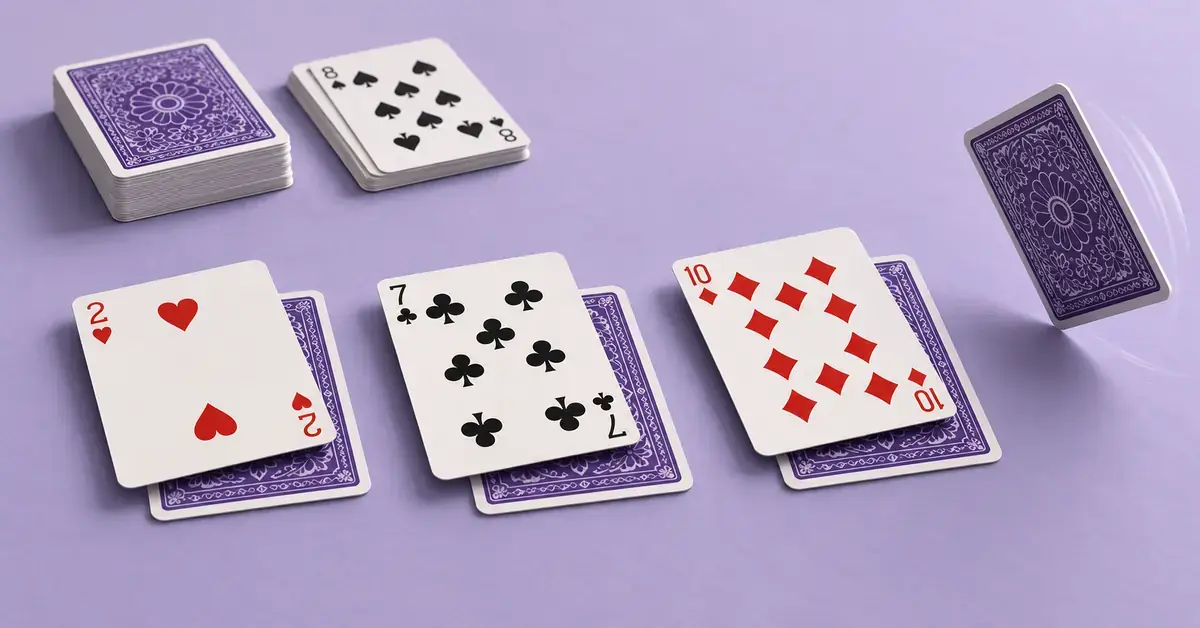
Shuffle the two decks together thoroughly, then deal 54 cards face down into ten columns, known collectively as the tableau (the main playing area):
- The first four columns each receive six cards.
- The remaining six columns each receive five cards.
- Turn the top card of every column face up; all the cards beneath stay face down.

That accounts for 54 cards (4 × 6 + 6 × 5). The 50 cards left over form the stock — a reserve pile you deal from later. Because the layout is wide, a large table or clear floor space helps if you are playing with physical cards. Digital versions handle the deal for you and simply present the ten columns ready to play.
The one, two and four-suit versions
Spider’s difficulty is set before the deal by choosing how many suits are used. All three versions still use 104 cards; only the mix of suits changes. In Microsoft’s long-running edition these appear as Beginner, Intermediate and Advanced.
Difficulty Comparison
| Version | Suits in play | Group moves | Best for |
|---|---|---|---|
| One suit | 104 cards of a single suit (usually Spades) | Any descending run can be moved as a block | Learning the game |
| Two suits | 52 cards each of two suits (e.g. Spades and Hearts) | Only same-suit runs move together | Intermediate players |
| Four suits | Two full decks, all four suits | Runs must match suit exactly to move together | Experienced players seeking the full challenge |
Why the four-suit game is the hardest
In the one-suit game, suit never matters, so any descending run can be picked up and moved as a block — it is the easiest way to learn the flow of the game. As you add suits, a new restriction bites: you may only pick up and move several cards at once when they are all the same suit and in order. In the four-suit version you are constantly forced to leave mixed-suit cards stacked on top of one another, which blocks the runs underneath and makes the board far harder to untangle. For deeper tactical advice beyond the rules, see our dedicated Spider Solitaire strategy guide.
How cards move
Movement in Spider follows two simple rules, one for single cards and one for groups:
- Single cards: any face-up card can be placed on a card that is exactly one rank higher, regardless of suit. A 7 can go on any 8, a Jack on any Queen, and so on. Suit is ignored for single-card moves.
- Groups of cards: several cards can be moved together only when they already form a descending run of the same suit. Such a same-suit run is called a “natural” sequence — for example the 8, 7 and 6 of Hearts moved as one unit.
- Empty columns: when a column is completely emptied, any single card, or any valid same-suit run, may be moved into the space.
Turning over a face-down card is the heart of the game. Each face-up card you clear away from the top of a pile reveals the hidden card beneath it, giving you new options. Much of your effort goes into freeing and flipping those buried cards.
Dealing from the stock
When you run out of useful moves, you deal a new row from the stock: one face-up card is added to the bottom of every column at once. There are 50 cards in the stock, so you can deal exactly five times during a game.
One rule catches out new players: you cannot deal while any column is empty. Every one of the ten columns must hold at least one card first. The stock deal is a double-edged tool — it brings in cards you need, but it also drops a fresh, often unhelpful card onto each of your tidy runs, burying them. Experienced players uncover as many hidden cards and tidy as many runs as they can before dealing again.
Core tactics for beginners
Knowing the rules is enough to play, but a few habits make a huge difference to how often you win, especially in the harder versions:
- Chase face-down cards. Prefer moves that reveal a hidden card over moves that just tidy face-up cards. Progress comes from exposing what is buried.
- Empty a column early. An empty column is the most valuable space on the board; it acts as a work area where you can temporarily park cards while you reorganise. Clearing the column with the fewest hidden cards first is the quickest route to one.
- Keep sequences in one suit. Wherever you have a choice, build in a single suit so the run can later be moved as a block and eventually completed.
- Save empty columns for Kings or completions. A King cannot be placed on any higher card, so an empty column is often the only home for it. Try not to fill the space with something you will soon want to move again.
Common mistakes to avoid
Most lost games trace back to a handful of avoidable errors:
- Dealing from the stock too early, before the board is organised, which buries unfinished runs.
- Making “convenience” moves that feel productive but reveal no new cards.
- Filling an empty column with a low or mixed card instead of keeping it as a work space.
- Ignoring suit when it matters, so that runs can never be lifted as a block in the two and four-suit games.
Who Spider Solitaire suits
Spider rewards patience and forward planning more than luck, which makes it a good fit for players who enjoy a slower, puzzle-like challenge and do not mind a game that can run for many minutes. Beginners can start comfortably with the one-suit version and work up. If you prefer a shorter or differently structured solo game, you might enjoy FreeCell, where every card is visible from the start, or Pyramid Solitaire, which is built around matching pairs. You can browse the full range in our guide to solitaire card games.
Sources
Frequently asked questions (FAQ)
How many decks and cards does Spider Solitaire use?
Spider Solitaire uses two standard 52-card decks shuffled together, for a total of 104 cards. This is true of all three difficulty settings; only the number of suits in play changes.
Can you move a group of cards of different suits together?
No. Several cards can be moved as a single block only when they form a descending run that is all one suit. A single card, by contrast, can always be placed on any card one rank higher regardless of suit.
What happens when you complete a King-to-Ace sequence?
A full descending run of thirteen same-suit cards, King down to Ace, is removed from the table automatically. There are no foundation piles to build up in Spider; clearing all eight sequences empties the board and wins the game.
Why do you have to fill empty columns before dealing from the stock?
It is a core rule of the game: every one of the ten columns must contain at least one card before you may deal a new row from the stock. This forces you to use empty columns deliberately rather than leaving them open indefinitely.
Is the one-suit version easier than the four-suit version?
Yes, considerably. In the one-suit game any descending run can be moved as a block because suit is ignored. The four-suit game only lets you move same-suit runs together, so mixed suits constantly block the cards beneath them, making it much harder to win.