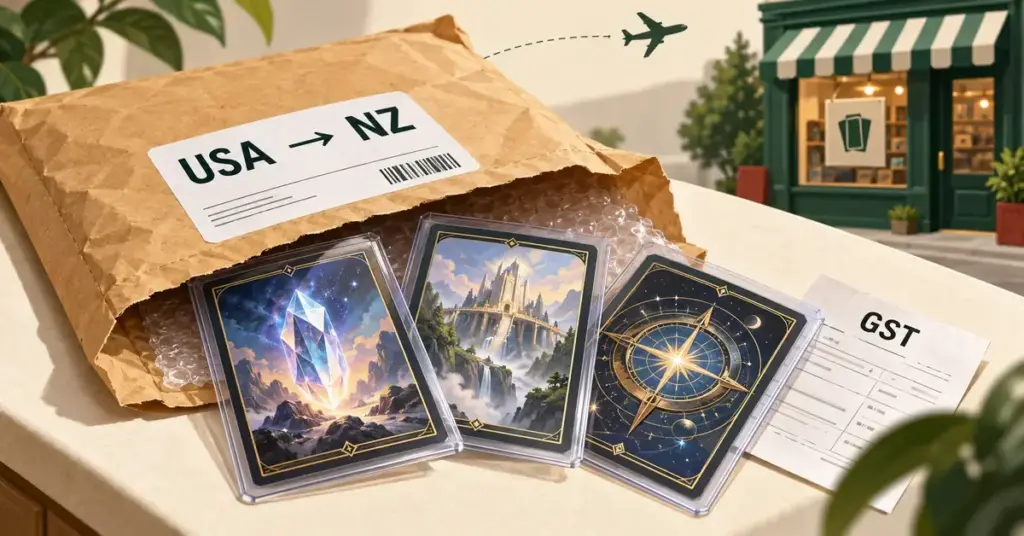

For card collectors and competitive players in New Zealand, TCGplayer is often the first name that comes up when hunting for a specific single, a sealed booster box or a hard-to-find promo. It is the largest online marketplace for trading card games (TCGs — games played with specially designed collectible cards, such as Magic: The Gathering or Pokémon) in the world, but it was built around the United States market. That means using it from Aotearoa takes a little planning. This guide explains what TCGplayer is, who owns it, whether it ships to New Zealand, how GST and customs apply to your orders, what the real landed cost looks like once the exchange rate is added, and which trusted local stores can often do the same job without the wait.
Key Points
- TCGplayer is the world’s largest TCG marketplace and is owned by eBay (acquired 2022); the business is now based in Louisville, Kentucky.
- TCGplayer Direct ships internationally only to Canada, the UK and Japan — not New Zealand — so most Kiwi buyers use a freight forwarder.
- Prices are in US dollars; budget for the exchange rate plus a 2–3% bank fee.
- Imports with a customs value of NZ$1,000 or less have 15% GST charged at checkout and no border fees; above that, GST and duty are collected at the border.
- For common cards and sealed product, trusted New Zealand stores are often cheaper and faster once shipping and fees are counted.
What TCGplayer is and who owns it
TCGplayer is an online marketplace, not a single shop. It brings together thousands of independent hobby stores and individual sellers onto one website, so a search for one card returns dozens of listings at different prices and conditions. Its best-known feature is the Market Price — an average based on recent completed sales on the platform, widely treated as a reliable benchmark for what a card is actually worth. Buyers and traders around the world, including in New Zealand, use it as a reference even when they buy elsewhere.
The platform launched in 2008 and was acquired by eBay in 2022 in a deal worth up to about US$295 million. In 2025 eBay relocated the business and closed its long-time Syracuse, New York headquarters, consolidating operations in Louisville, Kentucky. For shoppers this changes little day to day, but it is worth knowing that the company now sits inside the eBay ecosystem. TCGplayer is a primary market for Magic: The Gathering, Pokémon cards and the fast-growing One Piece Card Game, among many others.
Quick Facts
| Service | TCGplayer (online TCG marketplace) |
| Owner | eBay Inc. (acquired 2022) |
| Official website | tcgplayer.com |
| Headquarters | Louisville, Kentucky, USA (relocated from Syracuse, NY in 2025) |
| Launched | 2008 |
| Currency | US dollars (USD) |
| Ships directly to NZ? | No — NZ buyers use freight forwarding |
| Payment | PayPal, Apple Pay, store credit (card options vary by country) |
TCGplayer Direct vs marketplace sellers
There are two ways to buy. TCGplayer Direct items are stored, condition-checked and shipped by TCGplayer itself, and multiple Direct items are combined into a single package. Marketplace orders ship straight from each individual seller, so condition and packaging are the seller’s responsibility and each seller sends a separate parcel. Direct also carries the TCGplayer Safeguard buyer protection; marketplace orders rely on the seller’s own policies and the platform’s dispute process.
| Feature | TCGplayer Direct | Marketplace sellers |
|---|---|---|
| Who ships it | TCGplayer fulfilment centre | Each individual store or seller |
| Condition check | Verified by TCGplayer staff | Set by the seller |
| Consolidation | Direct items combined into one parcel | One parcel per seller |
| International shipping | Canada, UK and Japan only | Varies seller by seller |
Does TCGplayer ship to New Zealand?
This is the question that catches most Kiwis out. TCGplayer Direct does now offer official international shipping, but only to Canada, the United Kingdom and Japan — New Zealand is not on the Direct list. On the marketplace side, whether a seller posts to New Zealand is decided individually, and many choose not to because of the paperwork and the risk of lost mail. When you browse from a New Zealand address you will often see “this seller does not ship to your country” on a large share of listings.
Because of this, the practical route for most New Zealand buyers is a freight forwarder: a service that gives you a US delivery address, receives your orders, and then forwards them on to you. TCGplayer openly supports this and points overseas shoppers toward package-forwarding partners such as Buy & Ship and MyUS through its own global-shopping pages.
Freight forwarding: the usual route to New Zealand

A forwarder gives you a US street address (often in a sales-tax-free state such as Oregon) where sellers send your cards. The forwarder then ships everything on to your NZ door. The main advantages and catches:
- Consolidation: you can hold several orders at the warehouse and combine them into one international parcel, which usually cuts the per-card shipping cost sharply versus posting each order separately.
- No US sales tax: shipping to a tax-free state avoids the US state sales tax you would otherwise pay.
- Tracking: a good forwarder gives end-to-end tracking, which plain domestic US shipping often loses once a parcel leaves the country.
- The protection gap: a seller’s responsibility and TCGplayer Safeguard generally end once the parcel is marked delivered to the US address. If a card is lost or damaged between the forwarder and New Zealand, you deal with the forwarder, not the TCGplayer seller.
GST, customs and the NZ$1,000 threshold
New Zealand’s import rules are relatively friendly for hobby-sized orders. Since 1 December 2019, overseas suppliers that sell more than NZ$60,000 of goods a year to New Zealand must charge 15% GST at the checkout on low-value consignments — those with a customs value of NZ$1,000 or less. For those orders, GST is collected at the point of sale and there are generally no further duties or border entry fees on arrival. For consignments over NZ$1,000, GST and any applicable duty are instead collected at the border, and you may need a Customs Client Code (a free importer number from the New Zealand Customs Service).
| Order value (customs value, NZD) | GST | Duty & border fees | What you do |
|---|---|---|---|
| NZ$1,000 or less | 15%, charged at checkout by the supplier | Usually none | Nothing — delivered as normal |
| Over NZ$1,000 | 15%, collected at the border | Duty may apply, plus entry fees | Apply for a Customs Client Code |
Note that the NZ$1,000 line is based on the customs value of the goods, so transport and insurance are not counted when deciding which side of the threshold you fall on. Rules can change, so confirm current detail with the New Zealand Customs Service before a big purchase.
Orders over NZ$1,000
If you are buying a case of booster boxes or a high-value chase card, it is often simpler to split orders so each consignment stays under the threshold, or to budget an extra margin for the customs invoice that will follow the parcel. Keep the seller’s receipt: Customs may ask you to document the declared value of expensive singles.
The real cost: exchange rates and hidden fees

TCGplayer prices are listed in US dollars, and the gap between USD and NZD is where Kiwi buyers most often under-budget. Through 2026 the New Zealand dollar has traded well below the US dollar (around US$0.58 to the NZ dollar), so roughly every US$100 becomes about NZ$165–$175 before fees. On top of the exchange rate, watch for:
- Bank and card fees: most NZ banks and cards add a foreign-transaction fee of about 2–3% and build a margin into the exchange rate. A multi-currency card or low-fee digital account can save money over a year of collecting.
- Shipping type: cheap “plain white envelope” post has no tracking and a higher chance of going missing internationally; tracked shipping costs more but is far safer for anything valuable.
- Price swings: as a live marketplace, prices move quickly during spoiler season for new sets and when a card spikes in competitive play.
- Grading ambition: “Near Mint” on TCGplayer still allows minor flaws, so a raw card bought to send for professional grading may not reach the top gem-mint grade — read seller photos and notes carefully.
A worked example. A booster box listed at US$110 is about NZ$190 at today’s rate. Add roughly US$40 for international forwarding and 15% GST and the landed cost can approach NZ$265. If a trusted local store sells the same box for NZ$230, buying locally clearly wins once you count everything.
Card condition grades on TCGplayer
Because marketplace listings are rarely photographed one at a time, TCGplayer sorts every raw card into five standard grades under its Card Conditioning Guide. Knowing them before you buy avoids disappointment when the parcel arrives, and the same five tiers apply whether you are chasing a Yu-Gi-Oh! staple or a vintage single.
| Grade | Code | What to expect |
|---|---|---|
| Near Mint | NM | The top grade sold here: little or no wear, perhaps a tiny edge nick or faint scratch, but no major flaws. |
| Lightly Played | LP | Minor border or corner wear and light scuffs, with no structural damage. |
| Moderately Played | MP | Noticeable wear, scratches and possibly light whitening or a small crease; still sound once sleeved. |
| Heavily Played | HP | Heavy wear, whitening or creasing while the card stays recognisable and able to be authenticated. |
| Damaged | DMG | Structural problems such as tears, deep creases, water damage or writing; may be illegal for sanctioned play. |
Two things catch New Zealand buyers out. First, the marketplace does not sell Mint or Gem Mint cards — those top grades belong to professionally graded slabs rather than raw singles, and a manufacturing fault such as a bad miscut can drop an otherwise Near Mint card straight to Damaged. Second, grading is a seller’s judgement call and standards vary a little, so for anything you plan to keep, resell or send away for grading, favour sellers with strong feedback and read the condition notes closely. If you want to track what a card is worth as its grade changes, a dedicated tool like PriceCharting complements TCGplayer’s market data, and for the most expensive cards the sums shift again — see our guide to buying high-value singles.
Trusted New Zealand alternatives to TCGplayer
For common singles, sealed product and pre-orders, New Zealand now has a strong network of specialist stores that price in NZD, ship domestically within days and handle returns locally. The table below lists established NZ retailers you can buy from directly; always check live stock and current pricing on each site.
| Store | Based in | Main games | Notes |
|---|---|---|---|
| Card Merchant | Auckland (plus branches) | Pokémon, Magic, Yu-Gi-Oh! | Dedicated singles search across games |
| Turtle Island | Auckland | Pokémon, Magic, One Piece, Dragon Ball | Large singles range, tracked NZ-wide shipping |
| Card Masters | New Zealand | Pokémon, Dragon Ball, Yu-Gi-Oh! | Broad singles and sealed catalogue |
| TCG Collector | Christchurch | Pokémon, Magic | Operating since 2019; free shipping over set thresholds |
| Card Bard | Christchurch | Pokémon, Magic | Tracked NZ Post delivery |
| Calico Keep | Kāpiti Coast | Magic, Pokémon, Lorcana | Specialist Magic store with in-person play |
Why buying locally often wins
Shopping with a New Zealand store keeps money in the local hobby, supports the venues that run weekly tournaments and prereleases, and skips the two-to-four week wait of standard international post. Returns are far easier when a card’s condition is not as described, and you avoid currency fees entirely. The usual exception is scarcity: when a card spikes and local stock sells out, importing through TCGplayer and a forwarder can briefly be the cheaper or only option. For player-to-player deals, local marketplaces such as Trade Me and community Facebook groups are also active.
New Zealand’s home-grown TCG: Flesh and Blood
No discussion of the NZ card scene is complete without Flesh and Blood. Designed by Legend Story Studios, an independent company based in Auckland, it launched in October 2019 with its first set, Welcome to Rathe, and has since grown into a global competitive game with a World Tour circuit. Because the publisher is local, New Zealand players are effectively at the source: supply is often more stable here, and the local secondary market on community groups is very active. TCGplayer remains a major market for Flesh and Blood singles in the US, but Kiwis frequently find better availability at home.
Can you sell on TCGplayer from New Zealand?
Technically it is possible, but it is rarely worthwhile for individuals without a US presence, because the platform is geared around US-based sellers and domestic fulfilment. The practical hurdles:
- Postage out of NZ: a tracked bubble mailer to the US costs roughly NZ$25–$35, which wipes out any profit on low-value cards.
- Fees: TCGplayer takes a percentage of the total sale, shipping included.
- Payout delays: international sellers can wait longer for funds to clear into an NZ bank account.
- Returns risk: if a US buyer disputes condition, paying for a return back to New Zealand is almost always a net loss.
For most Kiwis, selling through local Facebook buy/sell/trade groups, Trade Me, or by trading cards in to a local game store for store credit (often with a bonus of 20–30% over cash) is simpler and more profitable.
Common mistakes to avoid
- Forgetting the exchange rate: always convert the USD total and add bank fees before deciding a price is cheap.
- Ignoring the protection gap: remember that buyer protection may stop at the US forwarder, not your door.
- Skimping on tracking: untracked post on anything valuable is a false economy.
- Buying sealed boxes to import: heavy, bulky and prone to crush damage in transit — usually better bought locally.
- Trusting a condition grade blind: read the photos and description, especially if you plan to grade the card later.
Sources
- New Zealand Customs Service — GST rules for low-value imported goods
- New Zealand Customs Service
- TCGplayer Help Center — International Shipping Overview
- TCGplayer — Global Shopping (Buy & Ship / forwarding)
- Flesh and Blood — Legend Story Studios (official site)
- TCGplayer Help Center — Card Conditioning Overview
Frequently Asked Questions
Does TCGplayer ship directly to New Zealand?
Not through TCGplayer Direct, which only ships internationally to Canada, the UK and Japan. Some individual marketplace sellers post to New Zealand, but many do not, so most Kiwi buyers use a freight-forwarding service with a US address.
Will I have to pay GST or customs duty on my cards?
If the consignment’s customs value is NZ$1,000 or less, 15% GST is normally charged at checkout and there is nothing more to pay on arrival. Above NZ$1,000, GST and any duty are collected at the border and you may need a free Customs Client Code.
What is the TCGplayer Market Price?
It is an average price based on recent completed sales on the platform. It is widely used as a benchmark for a card’s real-world value, even by collectors who buy and sell elsewhere.
Is using a freight forwarder safe?
It is a common and legitimate route, and TCGplayer itself points overseas buyers to forwarding partners. The main caveat is that buyer protection usually only covers delivery to the US warehouse, so any loss on the leg to New Zealand is handled by the forwarder.
Is it cheaper to buy locally or on TCGplayer?
For common singles, sealed product and pre-orders, a New Zealand store is often cheaper once shipping, currency fees and GST are counted — and far faster. TCGplayer tends to win only for rare cards that are out of stock locally.
What currency are TCGplayer prices in?
All TCGplayer prices and payments are in US dollars (USD). From New Zealand, the amount you actually pay depends on the day’s USD/NZD exchange rate plus any foreign-transaction fee your bank or card adds, so convert the total before deciding whether a listing is cheap.
Where is TCGplayer located?
TCGplayer is a United States company owned by eBay. In 2025 it closed its long-time Syracuse, New York base and consolidated operations at an authentication and fulfilment centre in Louisville, Kentucky.