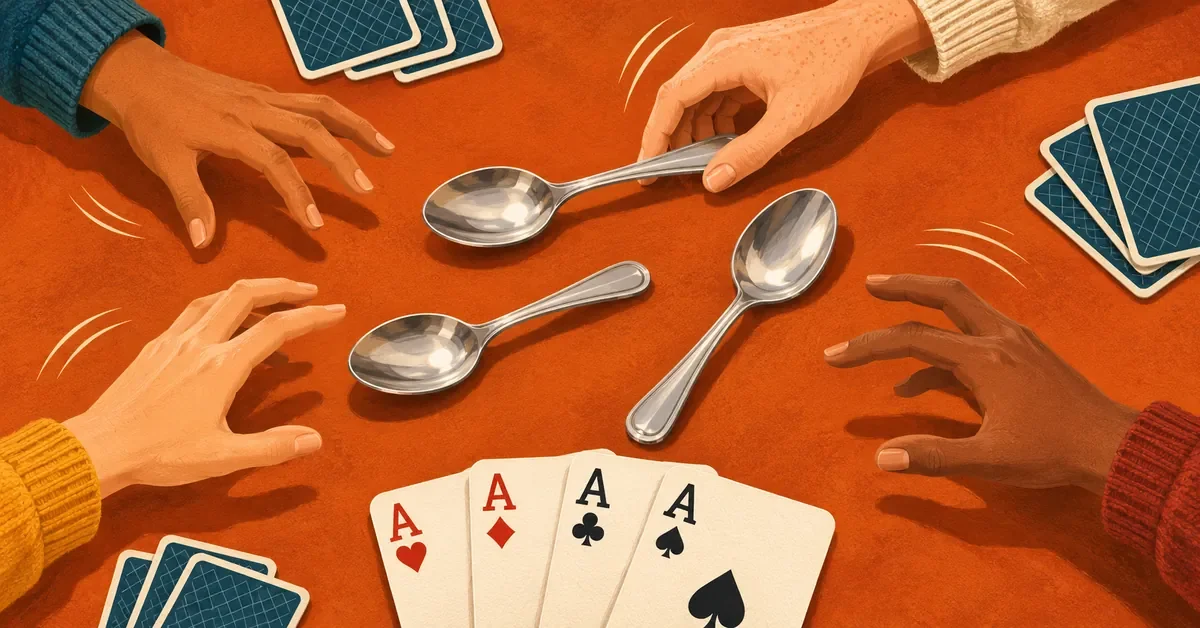
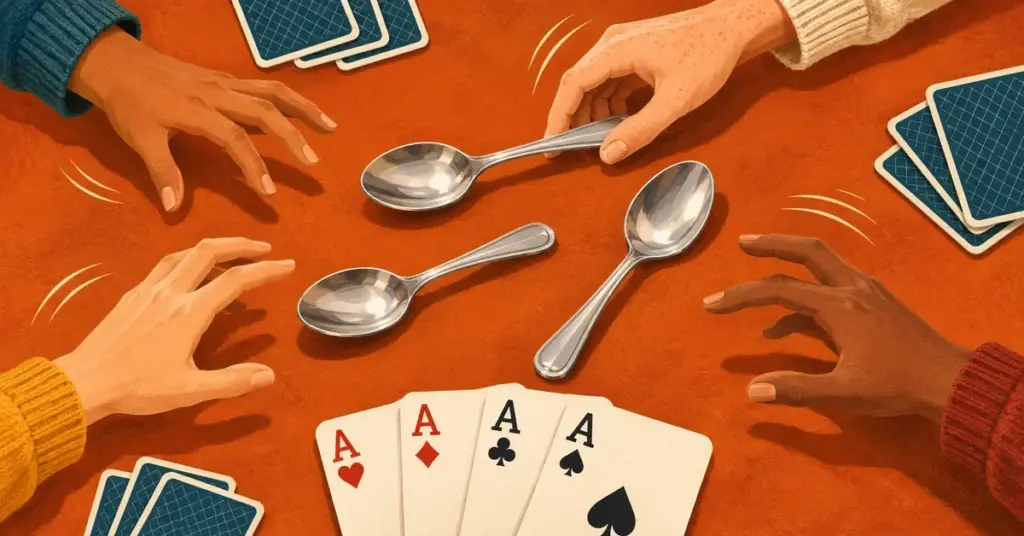
Spoons is a fast, noisy card game that turns a standard deck and a handful of spoons into a scramble the whole table can join. The rules are simple enough for a child’s first card game, yet chaotic enough to keep teenagers and adults laughing around a Kiwi kitchen table, a bach deck or a family Christmas. On your turn you pass cards quickly to collect four of a kind, and the moment someone does, everyone races to grab a spoon from the centre. There is always one fewer spoon than there are players, so somebody always misses out.
What you need to play Spoons
Spoons needs very little, which is part of its charm. You can set up a round in under a minute with things most households already have.
- Players: three or more. It plays well with four to about eight; up to about thirteen can play with a single deck, and you can add a second deck for bigger crowds.
- Cards: one standard 52-card deck with the jokers removed. For large groups, shuffle two decks together so there are always enough cards moving around the table.
- Spoons: one fewer spoon than the number of players. For six players you use five spoons; for eight players you use seven. They do not have to be spoons, but spoons are easy to grab and traditional.
Set the spoons in a small cluster in the centre of the table so no one sits closer to them than anyone else. If you want more mayhem, some families place them just out of reach so everyone has to lunge. Spoons sits comfortably alongside other no-fuss card games for kids and travels well because the kit is so small.
Quick Facts
| Players | 3 or more (best with 4–8; up to about 13 on one deck, more with a second) |
|---|---|
| Equipment | One 52-card deck (jokers removed) plus spoons |
| Spoons needed | One fewer than the number of players |
| Age | Around 4+ with help; no reading or maths required |
| Round length | Rough guide (no official length): under a minute per round; about 10–20 minutes for a full game |
| Objective | Collect four of a kind, then grab a spoon before everyone else |
| Skills | Observation, reaction speed, a little card-matching |
Setting up a round
Choose a dealer for the first round. Rounds are quick, so you can simply pass the deal to the left each time, or let the previous round’s loser deal the next one.
- Shuffle the full 52-card deck.
- Deal four cards to each player, one at a time.
- Place the rest of the deck face down beside the dealer as the draw pile.
- Arrange the spoons in the centre, within equal reach of everyone.
Each player looks at their four cards but keeps them hidden. The aim from here is to end up holding four cards of the same rank, for example four sevens, four Queens or four Aces.
How to play Spoons
The heart of Spoons is a continuous, fast pass of cards around the table. The rule that keeps it moving is simple: you may only ever hold four cards at a time, and you look at just one new card at a time.
Passing the cards
The dealer starts by taking the top card of the draw pile. That briefly gives them five cards, so they keep one and pass a single card face down to the player on their left. From there everyone plays at once: as a card arrives from your right, you pick it up, decide whether to keep it, and pass one card face down to your left. Cards flow around the circle as fast as players can manage, and a discard pile builds up in front of the last player. There are no strict turns, so the pace is set by the table.
If the draw pile runs out before anyone has four of a kind, pause, shuffle the discard pile into a fresh draw pile, and keep going. Because there is no bidding or set turn order, Spoons feels very different from shedding games such as the one in our Last Card rules guide, where the goal is to be first to get rid of every card in your hand.
Grabbing a spoon
As soon as a player collects four of a kind, they take a spoon from the centre. This can be a sneaky, quiet grab or a loud, obvious one, depending on your style. The instant one spoon is taken, it is a free-for-all: every other player tries to snatch a spoon too. Since there is always one fewer spoon than players, one person is always left with nothing. That player loses the round.
Watching your opponents matters as much as watching your own hand. A subtle grab can catch the whole table napping, which is why many players keep one eye on the spoons at all times.
Scoring and elimination
The player who fails to grab a spoon takes a penalty letter. Over successive rounds those letters spell a word, and once you complete the word you are out.
- The first time you miss a spoon you get an S, then a P, then O, O and N.
- Spell the full word and you are eliminated for the rest of the game, a bit like the basketball game H-O-R-S-E.
- When a player drops out, remove one spoon so there is still exactly one fewer spoon than remaining players.
- The last player left in the game wins.
Some rulesets spell the shorter word SPOON (five letters) and others use SPOONS (six letters); agree on which before you start. The length of the word sets how many rounds a player can survive, so a shorter word such as PIG makes for a faster game while a longer one draws it out.
House rules and variations
Spoons is endlessly house-ruleable, which is why it suits a crowd of mixed ages. Decide on any of these before you deal.
- False-grab penalty: if someone grabs a spoon when no one has four of a kind, that player loses the round and takes a letter. This tames nervous, trigger-happy grabbers.
- Quiet version (Pig): in the variant known as Pig, no spoons are used; instead, the player with four of a kind quietly touches their nose and everyone else follows once they notice. The last player to touch their nose loses the round. It rewards sharp observation over fast hands.
- Spoons out of reach: place the spoons across the room so everyone has to run. Great for burning off energy at a school camp or a Boxing Day gathering.
- Big groups: for more than about ten players, add a second deck or split into two tables and have the winners play off.
If you enjoy quick, loud games like this, they fit naturally on a shelf of party games for a crowd.
Tips and common mistakes
Spoons rewards attention as much as speed. A few habits make a real difference:
- Keep the cards moving. Holding on to decide slowly jams the player on your left and makes you an easy target when the grab happens.
- Watch the centre, not just your hand. Many rounds are lost because a player is still sorting cards when the spoons vanish.
- Do not over-commit to one rank. If three Kings are not coming, be ready to switch to whatever pairs up fastest.
- Grab first, celebrate later. If you get four of a kind, secure your spoon before anyone can react.
- Agree the rules first. Settle the penalty word and whether false grabs are punished before the first deal to avoid mid-game arguments.
Spoons works best as one of several quick games in an evening. It pairs well with other easy classics such as Go Fish rules and Uno rules, and because it needs at least three players, keep a couple of card games for two players on hand for when the group thins out.
Sources
Frequently asked questions
Can you play Spoons without spoons?
Yes. Any small, grabbable objects work as long as there is one fewer than the number of players: bottle caps, coasters, pegs or even balled-up socks. Spoons are just the traditional, easy-to-snatch choice.
What happens if you grab a spoon by mistake?
Under the common false-grab rule, a player who takes a spoon when no one actually has four of a kind loses that round and picks up a letter. Not every group plays this way, so agree on it before you start.
Is Spoons suitable for young children?
It is one of the most beginner-friendly card games around and is often played with children from about four upwards with a bit of adult help. The only skill needed is matching four cards of the same rank and grabbing quickly.
How long does a game of Spoons take?
There is no official length. As a rough guide from our own games, a single round is usually over in well under a minute, and a full game to one winner tends to run somewhere around ten to twenty minutes, depending on how many players there are and how long the penalty word is.
Is Spoons the same as Pig or Donkey?
They are close relatives in the same passing-game family. In Pig, players collect four of a kind the same way, but instead of grabbing a spoon they quietly touch their nose, and the last player to do so loses. Donkey is usually played for the longer six-letter word (D-O-N-K-E-Y) rather than a shorter one, and in some versions players claim a token much like a spoon. Spoons simply swaps the nose signal for a physical grab, which adds to the chaos.