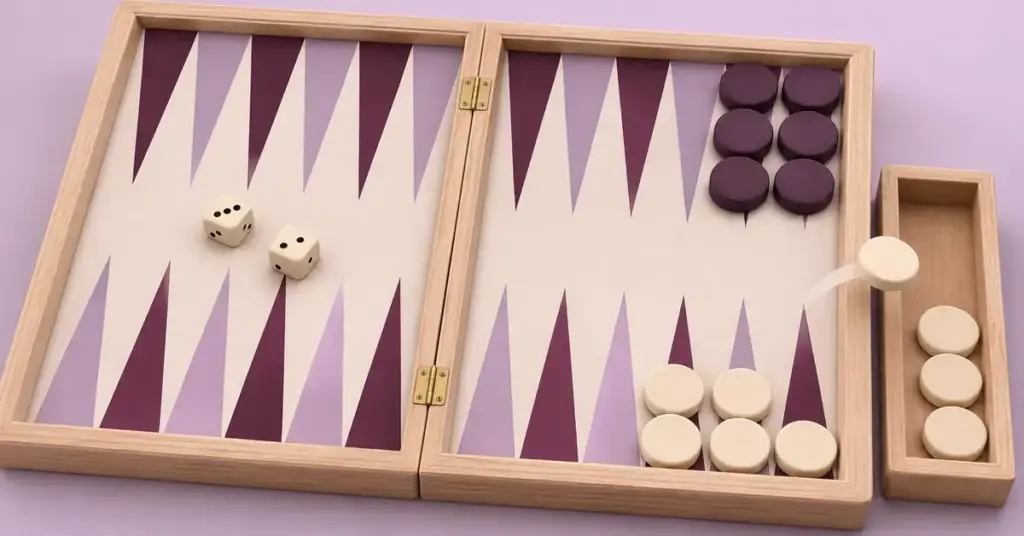
Backgammon is one of the world’s oldest board games and still one of the best two-player games to have on the shelf at a bach or around the kitchen table. It mixes luck and skill in equal measure: you roll two dice, race your fifteen checkers around the board and off the other side, and try to slow your opponent down along the way. The rules below walk you through everything from setting up the board to bearing off the final checker, so you can start a game within a few minutes of opening the box.
Key Points
- Two players race 15 checkers each around a 24-point board and off the other side; first to bear all theirs off wins.
- Roll two dice each turn; each die is a separate move, and doubles are played four times.
- Land only on open points — a point with two or more enemy checkers is blocked.
- Land on a lone enemy checker (a blot) to hit it and send it to the bar; a checker on the bar must re-enter before you move anything else.
- Bear off only once all 15 of your checkers are in your home board.
Quick Facts
| Players | 2 |
|---|---|
| Equipment | Backgammon board, 30 checkers (15 each), 2 dice per player, doubling cube (optional) |
| Game length | Usually fairly quick, but it varies |
| Objective | Move all 15 checkers home and bear them off first |
| Skill vs luck | A balance of dice luck and tactical decisions |
What you need and the aim of the game
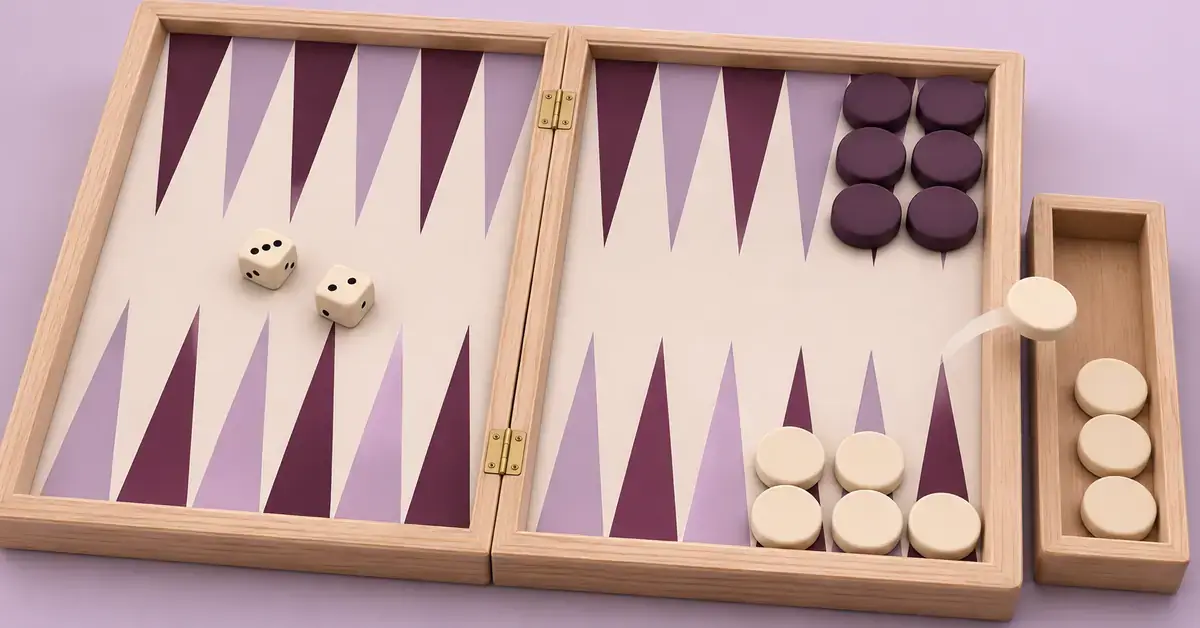
Backgammon is played by two people on a board of 24 narrow triangles called points. The points alternate in colour and are grouped into four quadrants of six: your home board and outer board, and your opponent’s home board and outer board. A raised ridge down the centre, called the bar, separates the home boards from the outer boards.
Each player has 15 checkers (also called counters or men) in their own colour — traditionally one dark set and one light set. You also need two dice per player, a dice cup if you have one, and the small numbered doubling cube used for keeping score.
The aim is simple: move all 15 of your checkers around the board into your own home board, then bear them off (remove them from the board). The first player to bear off all fifteen checkers wins. The two players move in opposite directions, so your checkers and theirs are racing past each other — which is where the tactics come in.
Setting up the board
Each player counts the points from their own home board outward, so a point is a different number for each player. The standard starting position gives every player the same mirrored layout. Place your checkers like this:
- Two checkers on your 24-point (the point farthest away, in your opponent’s home board).
- Five checkers on your 13-point (in your outer board).
- Three checkers on your 8-point (in your outer board, next to the bar).
- Five checkers on your 6-point (in your home board).
That adds up to 15 checkers each. If you are unsure you have it right, check that both sides look identical when the board is turned around.
Starting play: who goes first
To decide who starts, each player rolls a single die. Whoever rolls the higher number goes first — and that player does not roll again. Instead, they play the two numbers just rolled (their own die and the opponent’s) as their opening move. If both players roll the same number, you both roll again until the numbers are different. Because ties are always re-rolled, the first player can never open with doubles.
After the opening move, players take turns, and on every turn you roll both of your dice together.
Moving your checkers
Each number on the dice is a separate move. If you roll a 5 and a 3, you may move one checker five points and a different checker three points, or move a single checker eight points in total — but only if the intermediate point (either three or five away) is also open. Checkers always move forward, toward your home board and lower-numbered points.
A checker may only land on an open point. A point is open unless it holds two or more of your opponent’s checkers. So you can land on an empty point, a point with your own checkers, or a point holding just one enemy checker. A point held by two or more opposing checkers is “made” or blocked, and you cannot land there.
Doubles are worth four moves. If you roll matching numbers — say two 4s — you play that number four times. You can move one checker four times, four checkers once each, or any combination you like, as long as every single step is legal.
You must use both numbers if there is any legal way to do so (or all four numbers of a double). The key rules to remember are:
- If you can play only one of the two numbers, you must play that one.
- If you could play either number but not both, you must play the larger one.
- If neither number can be played, you forfeit your turn.
- With doubles, if you cannot play all four, play as many as you legally can.
Hitting, blots and the bar
A lone checker sitting on a point is called a blot, and it is vulnerable. If an opposing checker lands on your blot, the blot is hit and sent to the bar in the centre of the board. Being hit is a real setback, because that checker must travel all the way around again.
Whenever you have one or more checkers on the bar, your first job is to re-enter them before you can move anything else. You re-enter in your opponent’s home board, on the point that matches a number you roll. For example, a roll of 4 lets you enter on the opponent’s 4-point, provided that point is not blocked by two or more of their checkers.
- If neither rolled number matches an open point, you cannot enter and you lose your turn.
- If you can enter some but not all of your checkers, enter as many as you can and forfeit the rest of the turn.
- Once all your checkers are off the bar, you may use any unused numbers to move normally.
Blocking your opponent is a big part of the game. If you can build a wall of made points in front of their checkers — a “prime” — you can trap them for several turns.
Bearing off
Once all 15 of your checkers have reached your home board, you may begin bearing off — removing them from the board. You bear a checker off by rolling the number of the point it sits on: a roll of 6 removes a checker from your 6-point, a roll of 3 removes one from your 3-point, and so on.
Two situations need care:
- No checker on that point: if you roll a number but have no checker on that point, you must make a legal move with a checker on a higher point instead.
- The overshoot rule: if you roll a number higher than your highest occupied point, you must bear a checker off from that highest point. For example, if your back checkers are on the 4-point and you roll a 6, you bear one off the 4-point.
You are never forced to bear off if you can make another legal move instead — sometimes it is safer to keep a checker back. Watch out, though: if one of your checkers is hit while you are bearing off, it goes to the bar and you must bring it all the way back into your home board before you can bear off again. The first player to get all fifteen checkers off the board wins the game.
Keeping score: gammons, backgammons and the doubling cube
A casual game is often just played to a single win. In match or club play, the margin matters and is counted in points:
- Single game (1 point): the loser has borne off at least one checker.
- Gammon (2 points): the loser has not borne off a single checker.
- Backgammon (3 points): the loser has borne off none and still has a checker on the bar or stuck in the winner’s home board.
The small cube marked 2, 4, 8, 16, 32 and 64 is the doubling cube. It tracks the stake of the current game. At the start of your turn, before you roll, you may offer to double the stake. Your opponent either refuses — and concedes the game at its current value — or accepts, takes ownership of the cube, and becomes the only player who can offer the next double. The cube multiplies the points above, so a gammon with the cube on 2 is worth four points. Backgammon has long been played for money using this cube, so if any stakes are involved, keep them friendly and within your means.
Simple strategy and common mistakes
You do not need deep theory to improve quickly. A few habits make a real difference:
- Make points, don’t scatter. Landing two checkers together builds a made point and avoids leaving blots. The 5-point in your home board is especially valuable.
- Keep an anchor. Holding a made point in your opponent’s home board gives you a safe landing spot if you get hit later.
- Count the race. Add up the total number of points all your checkers must travel to get home — the “pip count.” If you are clearly ahead in the race, play safe and run; if behind, play a blocking game and wait for a hit.
- Don’t over-stack. Piling many checkers on one point wastes them. Spread out to control more points.
- Mind your blots near the enemy. Leaving a lone checker where your opponent can reach it with a single die is the most common beginner error.
Popular variations
Once the standard game feels comfortable, there are plenty of twists to try:
- Acey-Deucey: an American variant in which all checkers start off the board and are entered in the opponent’s home board; rolling a 1 and 2 (“acey-deucey”) lets you then name and play any double you like, and roll again.
- Dutch Backgammon: all checkers start off the board and must be entered first, and you cannot hit an opponent’s blot until you have brought at least one of your own checkers into your home board.
- Nackgammon: each player starts with two extra back checkers, a setup that makes for longer, more positional games.
Backgammon also plays very well on phones and computers, where the app rolls the dice and enforces the rules — a handy way to practise before your next game night. If you are building a games cupboard, it sits nicely alongside other classics; you will find more ideas in our guide to board games in New Zealand, including dice-driven favourites like the Trouble board game and the strategy staple Sequence. If you often play with just two, our round-up of card games for two players suits the same quiet evenings, and for a lighter card option on the same shelf the Last Card rules are always a crowd-pleaser.
Sources
Frequently Asked Questions
Is backgammon difficult to learn?
No. The basic moves — roll two dice, move your checkers forward, and race them home — can be picked up in a single game, which is why children and first-timers manage it easily. The depth comes from decisions like when to hit, when to block and how to use the doubling cube, and those you learn simply by playing more.
Why was backgammon banned in the past?
Its history is tied to gambling, and that is why it was restricted at various times. The Roman ancestor of the game fuelled a gambling craze and was declared illegal under the Republic, and in England it was reportedly banned for a period until the reign of Elizabeth I. The game itself is perfectly legal today; only wagering on it is regulated, as with any game played for money.
Do you need the doubling cube to play?
No. The doubling cube only changes the stakes and scoring; it has no effect on how checkers move. Beginners and families often leave it out entirely and simply play each game to a single win, adding the cube later once the core rules feel natural.
How long does a game of backgammon take?
A single game is usually fairly quick — often over in a short sitting — though it varies a lot with the players and how often checkers get hit. Many people play a short match — first to five or seven points — which strings several games together and makes the doubling cube more interesting.