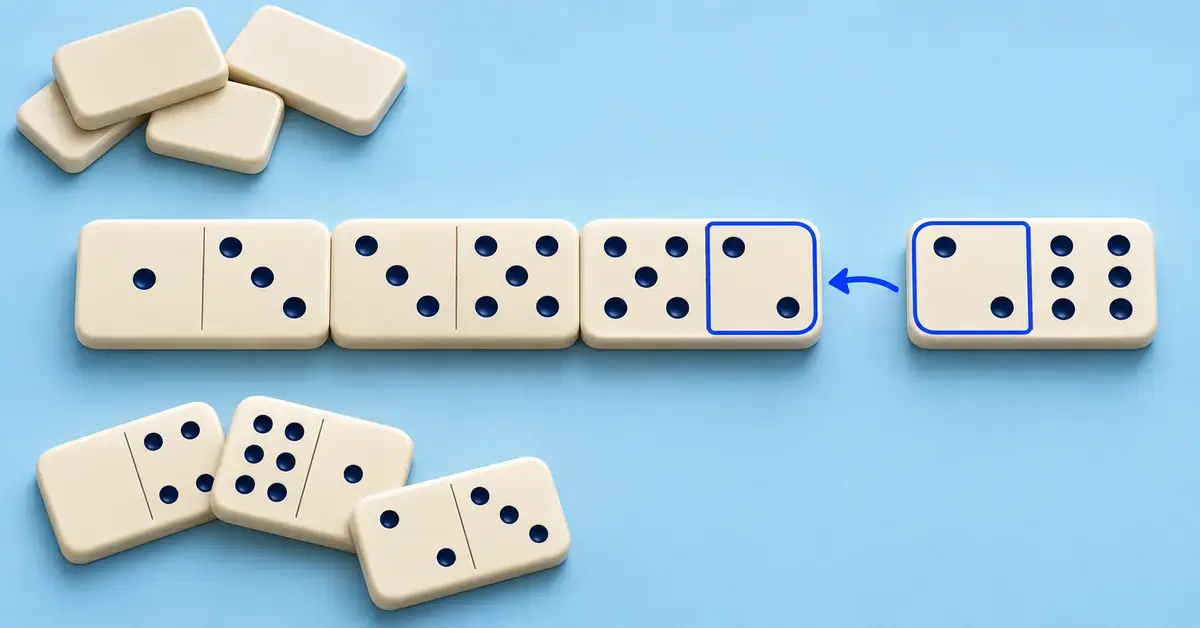
Dominoes is played with a 28-tile double-six set: on your turn you match the pips on one end of a tile to an open end of the line already on the table. The first player to empty their hand wins the round — or, if the game blocks and nobody can make a legal move, the player left with the fewest pips in hand wins.
Quick Facts
| Players | 2–4 (more with a larger set) |
|---|---|
| Equipment | One double-six set (28 tiles) |
| Suggested age | About 6 and up |
| Round length | Roughly 10–20 minutes |
| Game type | Tile-matching |
| Skills used | Matching, counting, light tactics |
What you need to play
Most dominoes games use a standard double-six set of 28 tiles. Each tile — sometimes called a bone or a stone — is a small rectangle split into two square ends. Every end shows between 0 and 6 spots, which players call pips. The set has exactly one tile for every possible pairing, from the double-blank (0-0) up to the double-six (6-6). A tile with the same number on both ends, such as 4-4, is a double.
Larger sets exist for bigger groups: a double-nine set has 55 tiles and a double-twelve set has 91. You only need the larger ones for games like Mexican Train, so a single double-six set is plenty to get started. If you enjoy tile games generally, a mahjong set scratches a similar itch with a different ruleset.
Setting up the game
Dominoes suits 2 to 4 players with one double-six set. Here is the standard setup for the basic game:
- Shuffle. Turn all the tiles face down on the table and swirl them around with both hands. This shuffled pool is called the boneyard (or stock).
- Draw your hand. In the basic block game, two players take 7 tiles each, while three or four players take 5 each. Leave the rest face down in the boneyard.
- Stand your tiles up. Line them on edge in front of you so only you can see the pips.
- Decide who leads. A common method is for each player to draw one tile and the highest total goes first. Many families simply agree that whoever holds the highest double leads with it.
How a turn works
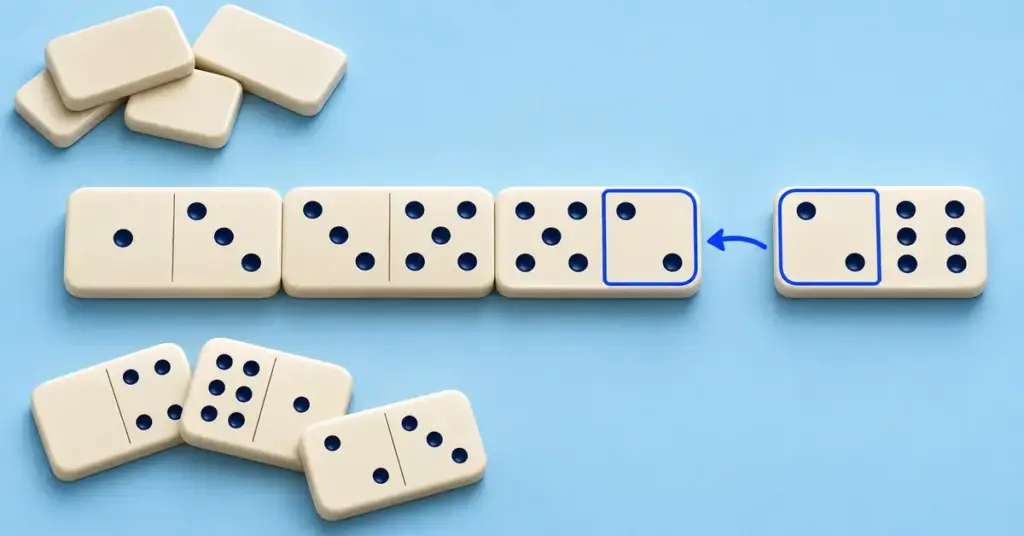
The first player places any tile in the centre to start a single line, usually called the layout. After that, play passes to the left and each player adds one tile per turn by matching a number to one of the two open ends of the line.
- A 5 can only join another 5, a blank joins a blank, and so on. The two numbers that touch must be the same.
- Doubles are usually laid crossways (at a right angle) to the line. In the basic game they are just another tile; in some variants the first double becomes a spinner you can build off in extra directions.
- The line can bend and snake around the table to fit the space — only the numbers at the two far ends are “live” and open for play.
- If you cannot match either end, what happens depends on the version you are playing (see below).
A round ends the moment one player lays their final tile and calls “domino!”, or when the game blocks — nobody can add a tile to either end.
Block game or draw game?
There are two base versions of basic dominoes, and most house styles are a tweak of one of them. The difference is simply what you do when you are stuck.
- Block game: there is no drawing. If you cannot play, you pass and wait for your next turn. It is the quickest version and the easiest to teach.
- Draw game: if you cannot play, you take tiles from the boneyard one at a time until you can — but the last two tiles are always left untouched. You only pass once the boneyard is down to those two tiles and you still cannot go.
Variant Comparison
| Variant | Set | Players & tiles | How you score | Good for |
|---|---|---|---|---|
| Block game | Double-six (28) | 2 take 7; 3–4 take 5 | Pips left in the losers’ hands | Quick, simple family rounds |
| Draw game | Double-six (28) | 2 take 7; 3 take 7; 4 take 6 | As block, but draw when stuck | Casual two-player games |
| All Fives (Muggins) | Double-six (28) | 2 take 9; 3 take 7; 4 take 5 | Open ends totalling a multiple of five | Players who want more maths |
| Mexican Train | Double-twelve (91) | Up to 4 take 15 each | Fewest pips over 13 rounds | Bigger groups and parties |
How to score dominoes
Scoring is where dominoes becomes a proper game rather than just a tile-matching puzzle. The same counting idea runs through almost every version.
- Going out. The first player to get rid of every tile in their hand wins the round. A player who goes out has zero pips left.
- Counting the pips. Everyone else adds up the spots on the tiles still in their hand. The winner — the lowest total — scores the combined pips of the other players, minus their own remaining pips.
- A blocked round. If nobody can play and the game jams, each player counts the pips in hand. The lowest total wins and scores the others’ leftover pips. If two players tie for the lowest, no one scores that round.
Games are played to an agreed target. A common convention is 100 points for a two-player or partnership game and 61 points for three or four players, which conveniently lets you keep score on a cribbage board. Keeping a running tally matters just as much here as it does in trick-taking games like 500, where a single hand can swing the result.
Popular dominoes variants
Once the basic game feels easy, these are the variants worth learning next.
All Fives (Muggins)
All Fives, sometimes also called Muggins, is a scoring game that many American players regard as the standard form of dominoes. You deal more tiles — 9 each for two players, 7 each for three and 5 each for four — and score during play, not just at the end.
- After you place a tile, add up the numbers showing at the open ends of the layout. If that total is a multiple of five (5, 10, 15 and so on), you immediately score that many points.
- A double counts both of its ends, so a 6-6 at the end of the line is worth 12 toward the total. The first double played becomes a spinner and counts on both ends until tiles are built against it.
- Many players divide every score by five to keep the numbers small — 15 pips on the ends becomes 3 points — and play to 61 on a cribbage board.
When the round ends, the winner also collects the pips left in the opponents’ hands, rounded to the nearest multiple of five.
Mexican Train
Mexican Train is the crowd-pleaser for bigger groups and uses a larger double-twelve set of 91 tiles. The highest double (12-12) is placed in the centre of the table to start, and each player builds their own “train” of matching tiles running out from it.
- Up to four players draw 15 tiles each; five or six players take 12 each; seven or eight take 10 each. The rest form the boneyard.
- A shared Mexican train sits in the middle and is open to everyone to add to.
- If you cannot play, you draw one tile. Still stuck? You pass and place a marker on your own train, which lets any player build on it until you come back and play there yourself.
- A full game runs 13 rounds, starting from the 12-12 and working down to the double-blank. You want the fewest pips: the lowest total across all rounds wins.
Other versions you may meet include straight Draw and Block partnership games, plus regional favourites, but All Fives and Mexican Train cover most of what you will see around a New Zealand table.
Common mistakes to avoid
- Hoarding high doubles. Hold the 6-6 too long and you can be caught with a fistful of pips if the game blocks — play heavy doubles while you still have a matching end.
- Ignoring what opponents cannot play. When someone passes, note the number they were missing; starving that end is one of the best ways to block the table in your favour.
- Dumping your flexible tiles first. Tiles that match several numbers are your escape routes — offload the awkward single-match tiles early and keep the versatile ones for when the ends tighten up.
If your group enjoys first-to-empty-your-hand games, the rules for Last Card follow the same shedding idea with a standard pack of cards.
Where dominoes came from
Tile games were recorded in China as far back as around 1120 CE, though those early Chinese tiles differ from the ones we use today. The familiar Western double-six set first appeared in 18th-century Italy — likely in Venice and Naples — before spreading through France and on to Britain. Today domino games are played all over the world, though they remain most popular in Latin America.
Simple to learn and genuinely sociable, dominoes remains one of the best two-player games around, and a gentle introduction for tamariki alongside other card games for kids.
Sources
Frequently Asked Questions
Can you play dominoes with just two people?
Yes — two-player dominoes is one of the most common ways to play. In the basic block or draw game each player takes seven tiles; in All Fives you each take nine. Two-handed games tend to be more tactical because you can track roughly what your opponent is missing.
Do the blank tiles count for anything?
They do. A blank end simply counts as zero: it matches other blanks during play and is worth no pips when you tally hands at the end of a round. Because a blank scores nothing, blanks and low tiles are handy ones to be left holding if the game blocks.
Is dominoes more about luck or skill?
Both. The tiles you draw are down to luck, but deciding which end to play, when to offload heavy doubles and how to block your opponents is pure skill. Over several rounds the more thoughtful player usually comes out ahead.
Which variant is best for younger children?
The basic block game is the easiest starting point: there is no drawing, no running score, and matching numbers helps younger players practise counting. Once they are comfortable, All Fives adds a bit of friendly arithmetic.
What version of dominoes do black people play?
In many African American and Caribbean communities the favourite is partnership block dominoes: four players in two teams of two, matching ends on a single line and racing to empty their hands, usually played to 100 or more points. Lively scoring games such as All Fives (also known as Five-Up) are popular too. The rules are the same tile-matching basics covered above, played competitively two-against-two.