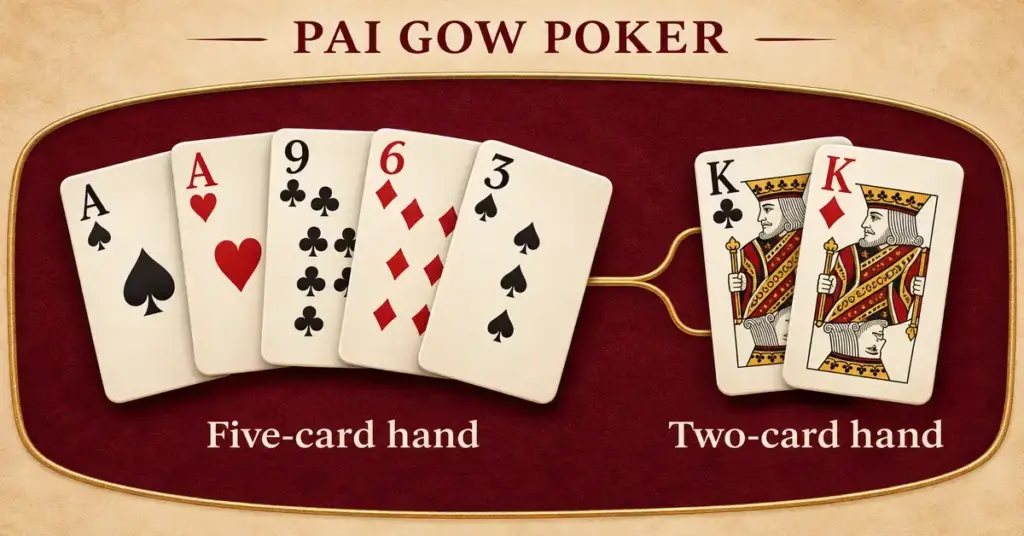
Pai Gow Poker is a slow, sociable casino card game where you play against the dealer rather than the other people at the table. You are dealt seven cards and split them into two poker hands — a five-card hand and a two-card hand — and both of your hands need to beat the dealer to win the bet. It is easy to pick up, and because a round is a push whenever you win one of your hands but lose the other, many rounds end in neither a win nor a loss — it is the kind of game you can stretch over a relaxed evening. This guide walks through the full rules, how to set your hands, the “House Way” the dealer follows, and how winners are paid.
Quick facts
| Players | 1 to 6, each against the dealer |
|---|---|
| Deck | 52 cards plus one joker (53 total) |
| Game type | Casino banking card game |
| You build | One five-card hand and one two-card hand |
| Aim | Beat both of the dealer’s hands |
| Skill level | Easy to learn; slow-paced |
What is Pai Gow Poker?
Pai Gow Poker is an American casino game that borrows its two-hand structure from the ancient Chinese game of pai gow, which is played with tiles rather than cards. In the poker version you use a normal pack of playing cards plus a joker, and you build two poker hands out of seven cards. It is a banking game, which means every player is trying to beat one hand — the dealer’s — instead of competing with each other.
Because the pace is gentle and so many rounds end in a push, it is often listed among the friendlier casino table games for newcomers. If you have ever watched a game like how to play baccarat, the idea of backing your hand against the house will already feel familiar.
What you need to play
- A 53-card pack: a standard 52-card deck plus one joker.
- The joker: it is not fully wild. It may only be used as an ace, or to complete a straight, a flush or a straight flush.
- Players: up to six people can sit at one table, each playing against the dealer, who also acts as the banker.
One point that trips up beginners: “pai gow” on its own usually means the tile game played with 32 Chinese dominoes, which has its own ranking of pairs. Pai Gow Poker is the card adaptation covered here, and the two are played very differently.
The aim of the game
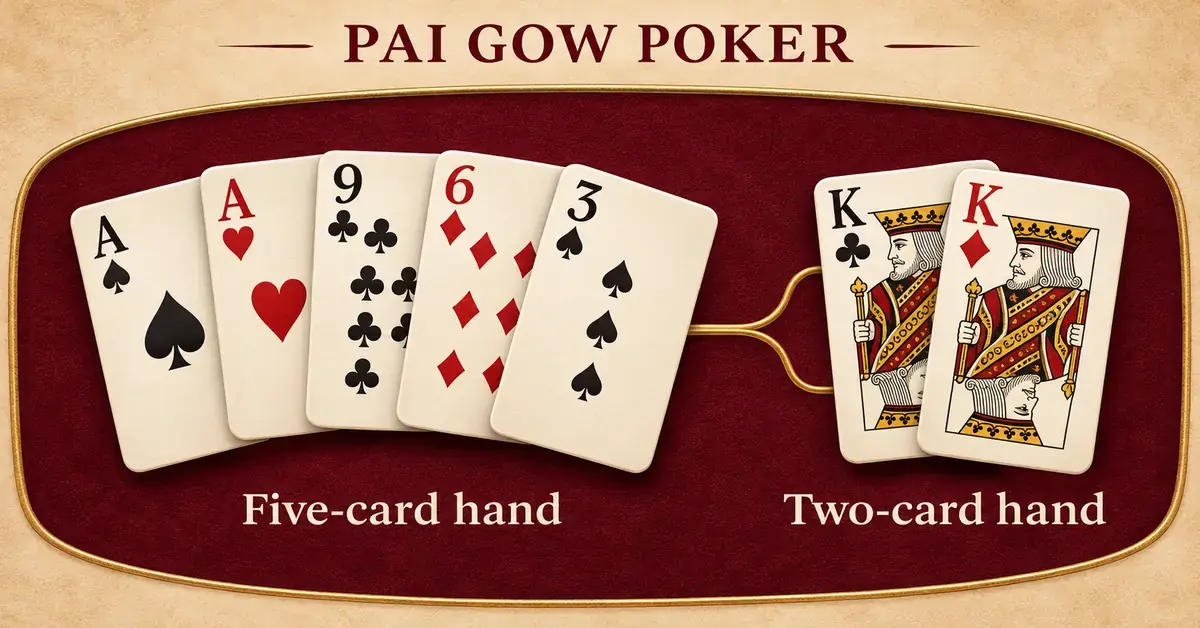
You receive seven cards and arrange them into two separate hands:
- A five-card hand — called the high hand or back hand.
- A two-card hand — called the low hand or front hand.
The golden rule is that your five-card hand must outrank your two-card hand. To win the round, both of your hands have to beat the dealer’s matching hands.
How a round of Pai Gow Poker is played
- Place your bet. You wager before any cards are dealt.
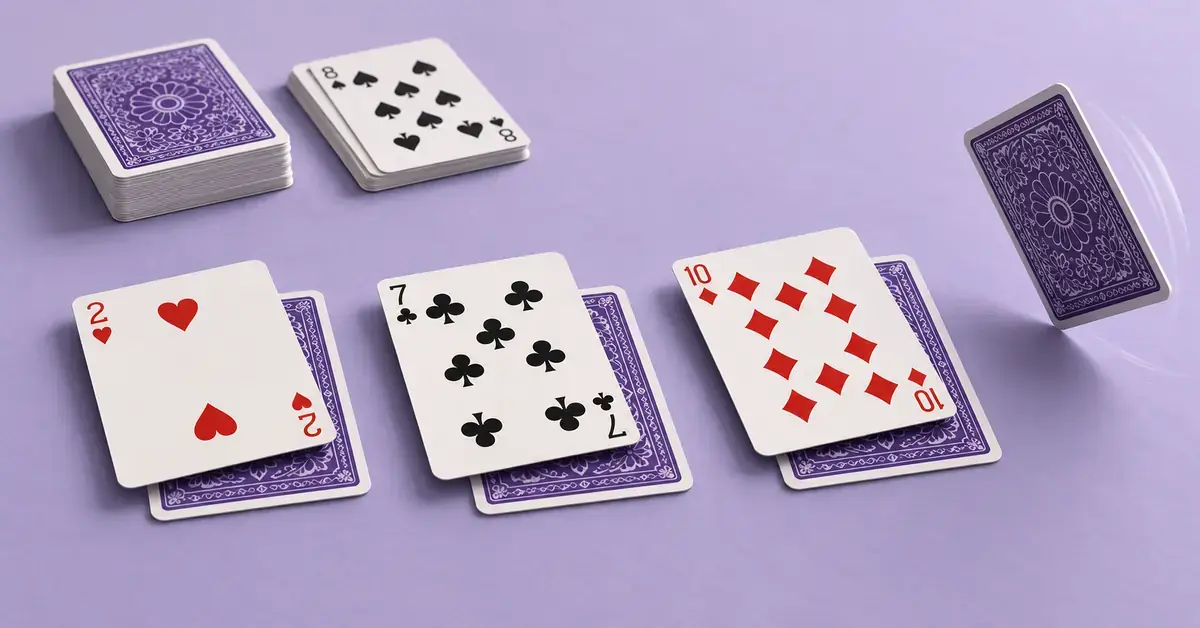
- The deal. Everyone, including the dealer, receives seven cards face down. A dice cup or a random number generator decides which seat gets the first hand, after which cards go round the table one packet at a time.
- Set your hands. You look at your seven cards and split them into a five-card high hand and a two-card low hand, placing each face down in its marked area.
- The dealer sets. Once every player has set, the dealer turns over their seven cards and arranges them following the fixed House Way.
- Compare. Your five-card hand is measured against the dealer’s five-card hand, and your two-card hand against theirs.
- Settle up. Winning, losing and pushing are paid as described below.
Setting your hands: the one rule that matters
Your five-card hand must rank higher than your two-card hand. If it does not — or if you end up with the wrong number of cards in a hand — the hand is “fouled” and automatically loses, no matter how strong the cards are. You are responsible for setting your own cards, so it pays to check this before you let go of them.
The five-card hand uses the usual poker hand rankings. The two-card hand can only ever be a single pair or two unmatched high cards, so a pair of aces is the best possible low hand. A common beginner move is simply to keep your strongest five-card hand together and drop the next two highest cards into the front — but balancing the two hands is where skill comes in.
Hand rankings in Pai Gow Poker
Five-card hands follow standard poker order, from strongest to weakest:
| Hand | Notes |
|---|---|
| Five aces | Four aces plus the joker — the highest hand in the game, beating a royal flush. |
| Royal flush | A-K-Q-J-10, all one suit. |
| Straight flush | Five cards in sequence, one suit. |
| Four of a kind | Four cards of the same rank. |
| Full house | Three of a kind plus a pair. |
| Flush | Five cards of one suit. |
| Straight | Five cards in sequence. |
| Three of a kind | Three cards of the same rank. |
| Two pair | Two separate pairs. |
| One pair | A single pair. |
| High card | No combination; highest card plays. |
Two quirks catch people out. First, five aces outranks everything, including a royal flush. Second, at most tables the straight A-2-3-4-5 (“the wheel”) is treated as the second-highest straight, ranking below A-K-Q-J-10 but above a king-high straight. A few casinos have dropped this unusual rule, so it is worth checking the posted rules before you sit down.
The House Way: how the dealer sets their hand
The dealer never chooses how to split their cards. They follow the House Way, a pre-set method that tells them exactly how to arrange every possible seven-card combination. It must be posted at the table for players to read, and it varies a little from casino to casino. If you are unsure how to set your own cards, you can ask the dealer to set them for you according to the House Way — a marker button is placed in front of you to show this was done.
A typical House Way looks something like this:
- No pair: keep your highest card in the five-card hand and put the next two highest in the two-card hand.
- One pair: keep the pair in the five-card hand; the two highest remaining cards go in front.
- Two pairs: whether to split them depends on how high the pairs are and whether you also hold an ace.
- Three of a kind: keep them together — except three aces, where you play a pair of aces in the back and one ace in front.
- Straights and flushes: usually keep them intact in the five-card hand unless splitting improves your two-card hand.
Following the House Way is a perfectly sound default, and many experienced players use it as their own strategy. The thinking is a little like learning blackjack strategy: a fixed, mathematically-sensible method takes the guesswork out of each decision.
Winning, losing and pushing
After the hands are revealed, there are three outcomes:
- You win when both of your hands beat the dealer’s. Winning bets pay even money (1 to 1), minus a commission of up to 5%.
- You lose when both of your hands are beaten.
- It is a push when you win one hand and lose the other — nobody wins or loses, and your stake is returned.
If one of your hands exactly matches the dealer’s — a “copy” — the dealer wins that hand. That tie-breaker, together with the commission, is where the house gets its advantage. Even so, Pai Gow Poker carries a relatively modest casino house edge compared with many table games, and some venues now offer commission-free (“face up”) versions that change how the edge is applied.
Banking, dragon hands and side bets
In most games the house dealer banks every hand, but players are usually allowed to take a turn as the banker — at a minimum the house must bank at least every other hand. When you bank, you play against the other players and the dealer, and you need enough chips to cover every possible payout.
If a seat is empty, some rooms let a player take the extra “dragon hand” dealt to it, effectively playing two hands at once. Many tables also offer an optional side bet, often called a Fortune Bonus, which pays extra if your seven cards contain a high-ranking combination such as a seven-card straight flush — regardless of how you split your two hands.
Common mistakes to avoid
- Fouling your hand. Always double-check that your five-card hand beats your two-card hand before you commit.
- Forgetting about copies. A tied hand goes to the dealer, so a “close” hand is not as safe as it looks.
- Splitting pairs blindly. Sometimes a pair belongs in front and sometimes in the back; the House Way is a reliable guide.
- Chasing side bets. Bonus wagers are fun but usually carry a much larger house edge than the main game.
- Ignoring the commission. The 5% cut on winning bets is easy to overlook when you work out whether you are ahead.
A short history of Pai Gow Poker
Pai Gow Poker is a surprisingly modern invention. It was created in 1985 by Sam Torosian, owner of the Bell Card Club in California, who adapted a slower Chinese card game into a faster seven-card format split into a five-card and a two-card hand. The game spread quickly through California’s card rooms and reached Las Vegas in 1986, where it has been a fixture ever since. Famously, Torosian was advised that a game based on a standard deck could not be patented, so he never earned royalties from it even as casinos around the world adopted the game.
A note on responsible gambling
Pai Gow Poker is a real-money casino game. The dealer keeps a built-in mathematical advantage through the 5% commission and the rule that tied hands go to the house, and no method of setting your cards removes that edge over time. In New Zealand you must be 20 or older to enter a casino’s gaming area. Only ever stake money you can comfortably afford to lose, and treat any winnings as a bonus rather than income.
If gambling is causing harm for you or someone you know, free and confidential help is available in New Zealand. You can call the Gambling Helpline Aotearoa on 0800 654 655 (text 8006), find support through Safer Gambling Aotearoa, or read more about staying in control in our guide to responsible gambling. This article is general information about the rules, not betting advice.
Sources
- Washington State Gambling Commission — Pai Gow Poker Game Rules
- Pechanga Resort Casino — How to Play Pai Gow Poker and House Way
- Wizard of Odds — Fortune Pai Gow Poker side bet and house edge
- Wizard of Odds — Face Up (commission-free) Pai Gow Poker
- Pagat — Pai Gow (tile game, 32 Chinese dominoes)
- SkyCity Auckland — Age limits (20+ to enter gaming areas)
- Las Vegas Advisor — Pai Gow Poker history
Frequently asked questions
What is the best hand in Pai Gow Poker?
Five aces — four natural aces together with the joker. It is the only hand that beats a royal flush, because the joker can stand in as a fifth ace.
Can my two-card hand be higher than my five-card hand?
No. The five-card hand must always outrank the two-card hand. If it does not, your hand is “fouled” and loses automatically, no matter how good the cards are.
What is the House Way?
It is the fixed set of rules the dealer must follow when splitting their seven cards into two hands. It has to be posted at the table, and you can ask the dealer to set your own cards the same way if you are unsure.
Is Pai Gow Poker the same as pai gow tiles?
No. Traditional pai gow is played with 32 Chinese tiles (dominoes) and has its own system of ranking pairs. Pai Gow Poker is a card game that borrows the two-hand idea but uses a 53-card pack and standard poker rankings.
What happens if my hand ties the dealer’s?
An exact tie on one hand is called a “copy”, and the dealer wins it. That is part of the reason the house keeps an edge even in a game with so many pushes.