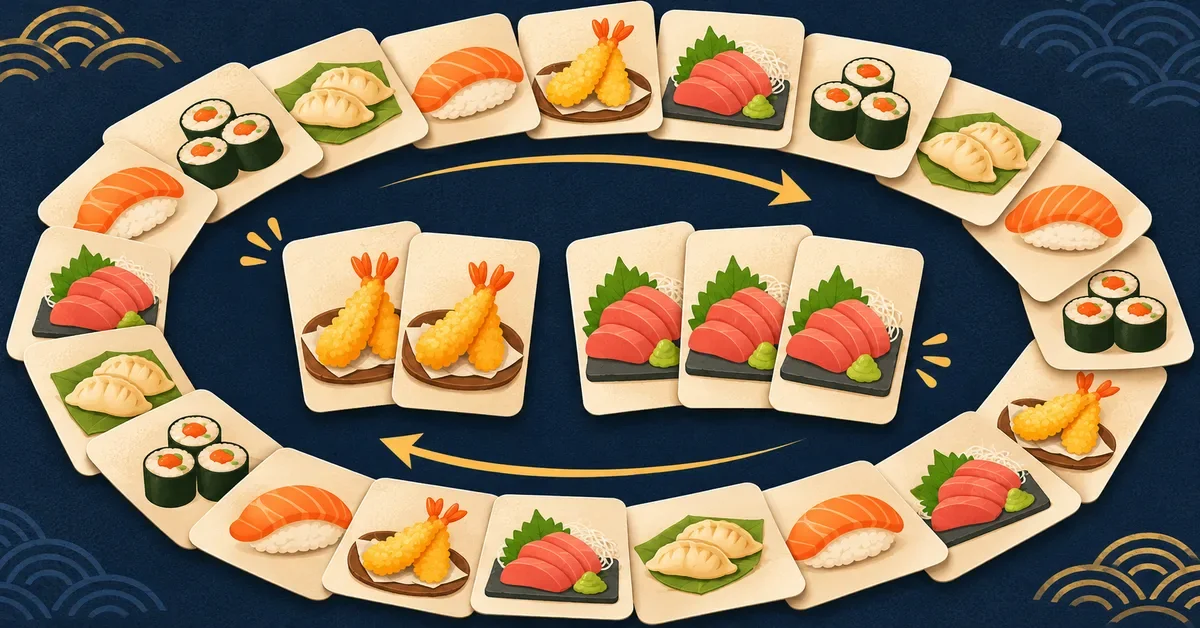
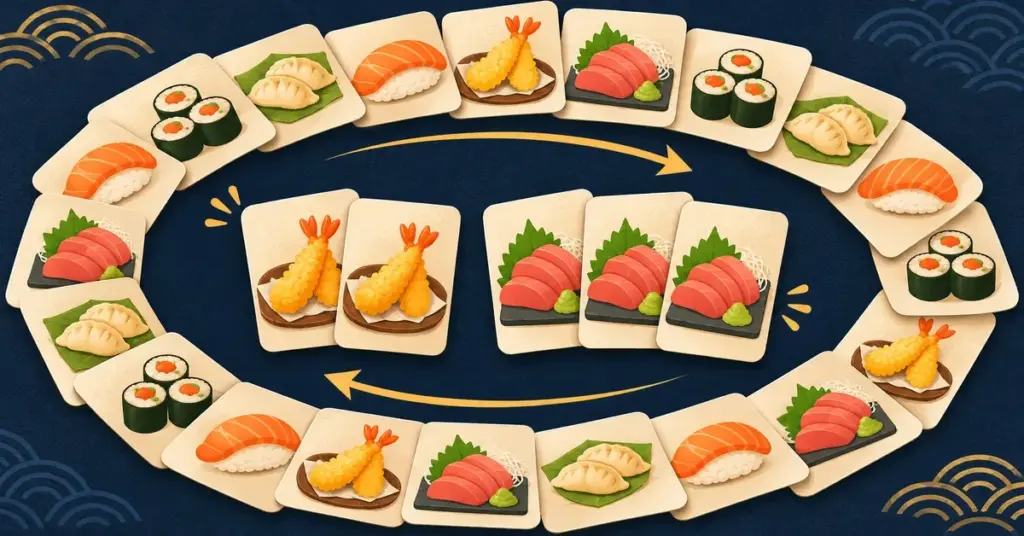
Sushi Go! is a fast, friendly card-drafting game where everyone picks one card from their hand, keeps it, and passes the rest to the player on their left. Over three quick rounds you try to grab the tastiest combination of sushi dishes as they whiz past, then tot up the points. It plays 2 to 5 players, suits ages 8 and up, and a full game takes about 15 minutes, which makes it a natural fit for a Kiwi kitchen table, a bach holiday or a rainy school-holiday afternoon, and it holds its own among quick party games for a crowd.
Quick Facts
| Players | 2–5 |
|---|---|
| Age | 8+ |
| Playing time | About 15 minutes |
| Cards | 108 |
| Rounds | 3 |
| Game type | Card drafting (pick and pass) |
| Designer | Phil Walker-Harding |
| Publisher | Gamewright |
What is in the deck
The game is a single deck of 108 cards, each showing a sushi-related dish. You do not need to sort them before playing, but it helps to know what is in there:
- 14 Tempura
- 14 Sashimi
- 14 Dumpling
- 26 Maki roll cards (6 showing one roll, 12 showing two rolls, 8 showing three rolls)
- 10 Salmon Nigiri, 5 Squid Nigiri and 5 Egg Nigiri
- 10 Pudding
- 6 Wasabi
- 4 Chopsticks
That is everything: no boards, dice or tokens. You only need the cards plus a scrap of paper and a pen to track scores. If you enjoy light, portable games like this, it sits nicely alongside other quick card games for kids and grown-ups that teach themselves in a couple of minutes.
Setting up the game
Shuffle the full deck well, then deal a hand to each player. The number of cards each person gets depends on how many are playing:
- 2 players: deal 10 cards each
- 3 players: deal 9 cards each
- 4 players: deal 8 cards each
- 5 players: deal 7 cards each
Hold your hand so nobody else can see it, and place the rest of the cards face-down as a draw pile in the centre of the table. Pick one person to be the scorekeeper. You are now ready for the first of three rounds.
How a turn works: pick and pass
Sushi Go! uses a mechanic called card drafting, which simply means everyone chooses from a shared pool of cards that keeps moving around the table. Here is the rhythm of a round:
- Everyone secretly chooses one card from their hand and places it face-down in front of them.
- When all players have chosen, everyone flips their card face-up at the same time.
- Pass the rest of your hand face-down to the player on your left.
- Pick up the new, smaller hand you have just been passed and repeat.
Your face-up cards stay in front of you until the end of the round, when they are scored, so it helps to group cards of the same type together as you collect them. The round ends when the final single card is passed along and played; often that last card is useless, but now and then you are stuck handing a rival something valuable. Two special cards change how your turns play out: Wasabi and Chopsticks.
Wasabi: tripling a nigiri
A Wasabi card scores nothing on its own. Instead, the next Nigiri card you take must be placed on top of it, which triples that Nigiri’s value. You can have several Wasabi cards in front of you, but only one Nigiri sits on each. The catch is timing: play Wasabi too late in the round and you may never draft a Nigiri to dip in it.
Chopsticks: taking two cards
Chopsticks let you grab two cards on a later turn instead of one. On a turn after you have played Chopsticks, choose your first card as normal, then call out “Sushi Go!” before everyone reveals, and take a second card from your hand as well. After you reveal, put the Chopsticks card back into your hand so it gets passed on and can be used again by someone else. You may hold several Chopsticks but use only one per turn. It is worth no points, so only keep it if the extra card will pay for the lost drafting slot.
How to score every card
At the end of each round, the scorekeeper totals everyone’s collected cards. Each card type scores in its own way, and knowing the values is most of the game:
| Card | How it scores |
|---|---|
| Maki rolls | Add up the roll icons. Most icons scores 6 points; second most scores 3. Ties are split evenly (round down), and a tie for first place awards no second-place points. |
| Tempura | 5 points for every pair (set of 2). A single Tempura is worth nothing. |
| Sashimi | 10 points for every set of 3. One or two Sashimi score nothing. |
| Dumplings | The more the better: 1, 2, 3, 4 or 5+ Dumplings score 1, 3, 6, 10 or 15 points. |
| Nigiri | Egg 1 point, Salmon 2 points, Squid 3 points. |
| Wasabi | 0 on its own, but triples the Nigiri placed on it (Egg 3, Salmon 6, Squid 9). |
| Chopsticks | 0 points. Its value is the extra card it lets you take. |
| Pudding | Not scored each round; see below. |
You can score multiple sets in a round, so three Tempura pairs are worth 15, and two full Sashimi sets are worth 20, although collecting that many of one type is hard when rivals are hoarding the same cards.
Pudding and the end of the game
Pudding is the one card that does not score within a round. Instead you keep every Pudding you collect in front of you across all three rounds. At the end of each round you announce your score, then discard your other cards face-up beside the draw pile, keeping only Pudding, and deal fresh hands of the same size from the draw pile for the next round.
Once the third round is scored, it is time for dessert. The player with the most Pudding cards gains 6 points, and the player with the fewest (including anyone with none) loses 6 points. Ties split those points evenly, rounding down. In a 2-player game there is no penalty for the fewest Pudding; only the 6-point bonus for the most is awarded. Because Pudding can swing the final score by up to 12 points, it is often worth taking a card you would otherwise skip.
Who wins and tie-breakers
Whoever has the most points after all three rounds and the Pudding scoring is the winner. If two or more players tie on points, the player with the most Pudding cards wins.
Variations and house rules
The rulebook includes two official variants once your group knows the basics:
- Pass Both Ways: change the direction of passing each round. Pass to the left in rounds 1 and 3, and to the right in round 2. This shifts which neighbour you are feeding and makes blocking harder.
- Two-Player Variant: add a third “dummy” hand that alternates between the two players, so there is a little more to read and react to than a straight head-to-head. If you mostly play in pairs, it is worth trying alongside other card games for 2.
Strategy tips for beginners
The rules are simple, but a few habits sharpen your play:
- Count what you can commit to. A lone Sashimi scores zero, so do not start a set you cannot finish.
- Watch the Maki battle. If you cannot realistically take first place (6 points), aim for a cheap second place (3 points) instead of overspending turns.
- Dumplings reward early commitment: the jump from 4 to 5 cards is 5 points, so gather them steadily rather than at the last moment.
- Keep an eye on the player to your right, since you see the hands they pass you, and remember they are passing to you first.
- Think about what you pass, not just what you keep. Handing the player on your left a Squid Nigiri or a third Sashimi can hand them the game, so manage your hand the way you would in Last Card.
Sources
Frequently asked questions
What is the difference between Sushi Go! and Sushi Go Party!?
Both are designed by Phil Walker-Harding and published by Gamewright, and both use the same pick-and-pass drafting. Sushi Go Party! is the larger, expanded edition: it supports up to eight players and lets you build a customisable “menu” from many more card types, so it offers more variety. The original Sushi Go! is smaller, quicker to set up and easier to carry.
Is Sushi Go! suitable for younger children?
The box is rated 8 and up, mainly because of the set-collection scoring. Younger children can usually join in with a little help from an adult who totals their cards, since the turns themselves (pick one, pass the rest) are very simple.
Can you win Sushi Go! without any pudding?
Yes, but it is risky. If you hold zero Pudding you lose 6 points at the end (in games of three or more players), and Pudding is also the tie-breaker. Many winning games are decided by grabbing a dessert card or two along the way.
Do you reshuffle the cards between rounds?
No. After scoring a round you discard your cards face-up beside the draw pile, keep your Pudding, and deal new hands from the same draw pile. The deck is not reshuffled, and whatever is left after the third round is simply set aside.