
Whist is one of the great classic trick-taking card games: four players in two fixed partnerships, a full 52-card deck, and no bidding at all. For more than two centuries it was the thinking player’s card game of choice, and it remains a familiar sight in New Zealand community halls, clubs and rest homes, usually in the sociable “whist drive” format. This guide explains the standard rules, how trumps and scoring work, the strategy that separates casual players from strong ones, and the best-known variations you are likely to meet around a Kiwi card table.
Key points
- Players: four, in two fixed partnerships sitting opposite each other.
- Cards: a standard 52-card pack, Ace high down to 2 low; 13 cards each.
- No bidding: play begins immediately after the deal.
- Trumps: set by the dealer’s last card, turned face up.
- Goal: win the majority of the 13 tricks; only tricks above six score.
- Skills that matter: following suit, counting cards, partnership signals.
A short history of whist
Whist grew out of earlier English games such as Ruff and Trump and became the dominant intellectual card game of the 18th and 19th centuries. Its great attraction is that the entire contest rests on the play of the cards rather than on an auction. The rules of the short-game form were later codified by the Portland Club in London and the Whist Club in New York, and the game spread throughout the British Empire, which is how it reached New Zealand.
In the 1890s a relative called bridge whist began to displace whist in fashionable clubs, and that game evolved into auction bridge and then modern Contract Bridge rules. Because the trick-taking mechanics of the two games are almost identical, whist is still widely recommended as the natural stepping stone for anyone who wants to learn bridge without first tackling a complex bidding system.
What you need and how the deal works
Whist is a partnership game for exactly four players. The two members of each partnership sit opposite one another, so play alternates between the two sides around the table. You need a single standard 52-card pack with no jokers. Within every suit the cards rank from the Ace (high) down through King, Queen, Jack, 10 and so on to the 2 (low).
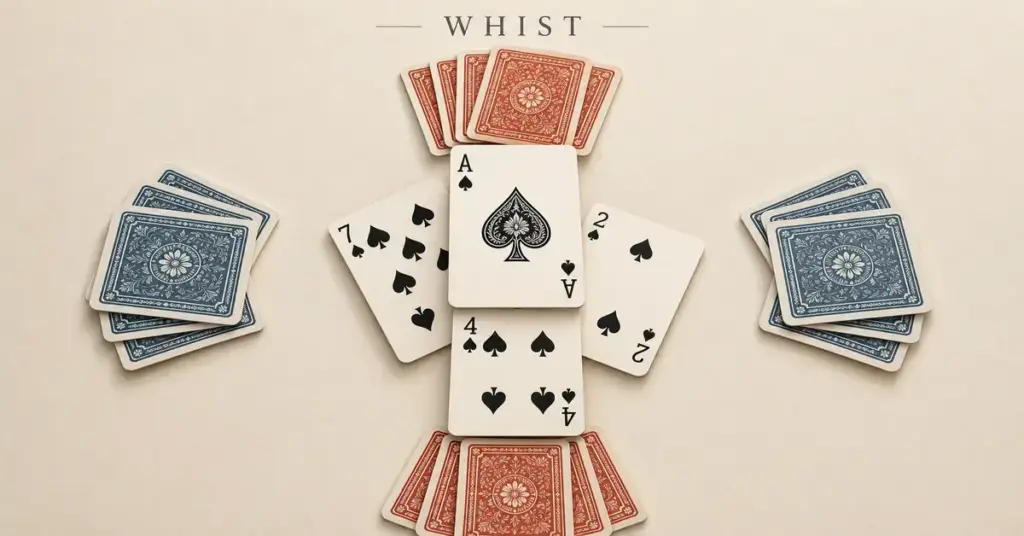
The dealer shuffles, offers a cut, and deals the whole pack one card at a time in a clockwise direction, so each player receives 13 cards. The very last card, which belongs to the dealer, is turned face up on the table. Its suit becomes trumps for that hand. This turned card stays face up until it is the dealer’s turn to play to the first trick, after which it is picked up like any other card. The upcard gives everyone a small piece of public information: one of the dealer’s cards is known, and the trump suit is fixed before a single card is led.
Quick facts
| Type of game | Trick-taking, partnership |
| Players | 4 (two partnerships of 2) |
| Deck | Standard 52 cards, no jokers |
| Card ranking | A (high), K, Q, J, 10 … 2 (low) |
| Cards per player | 13 |
| Direction of play | Clockwise |
| Trump suit | Dealer’s final card, turned face up |
| Objective | Win the most tricks over six |
| Typical game length | 5 points (British) up to 10 (long whist) |
How a hand is played
A hand of whist is a sequence of 13 tricks. A trick is simply one card played by each of the four players in turn. The player to the dealer’s left leads to the first trick by playing any card face up in the middle of the table. Play then continues clockwise.
Following suit and winning tricks
The central rule is that you must follow suit: if you hold any card of the suit that was led, you have to play one. Only when you are void in that suit (hold none of it) may you do something else. In that case you can either play a trump in an attempt to win the trick, or discard a card from another suit if you would rather not or cannot win it.
A trick is won by the highest trump played to it. If no trump is played, it is won by the highest card of the suit that was led — cards of other plain suits cannot win, however high they are. Whoever wins a trick gathers the four cards, sets them aside, and leads to the next trick. Winning a trick therefore does more than score: it hands you control of what is led next, an advantage experienced players value highly.
The revoke
Failing to follow suit when you actually could is called a revoke (or renege), and it is the most serious error in whist. In friendly New Zealand play a revoke noticed before the trick is turned over is simply corrected. Under the traditional laws, once a revoke is established the non-offending side may claim a penalty — historically a choice of transferring three tricks, deducting three points from the offenders, or adding three points to their own score. The revoke penalty is scored before any other points. Because the stakes are high, a partner who notices a player not following suit is allowed to ask, “No clubs, partner?” (or whichever suit was led) as a courtesy check before the trick is completed.
Scoring in whist
Only tricks beyond the first six count towards the score. The first six tricks a partnership wins are called the “book” and are worth nothing; every trick above six is an “odd trick” worth one point. If your side wins nine tricks, for example, you score three points (9 minus 6). The side that takes fewer than seven tricks scores nothing that hand.
Honours
Traditional whist also rewards honours — the Ace, King, Queen and Jack of the trump suit. If the two partners hold all four honours between them they score four points; holding three of the four scores two points. A side that is already within one point of winning (at four points in a five-point game) is not allowed to score honours that deal, and when both sides score on the same hand the odd tricks are always counted first. Many modern and competitive players omit honours altogether so that the result depends purely on skilful trick-taking, so it is worth agreeing before you start whether honours will count.
Game and rubber
In the British short-whist tradition a game is five points, and a match is usually a rubber — the best of three games, with a bonus to the side that wins two games first. American whist traditionally played games to seven points, while the older “long whist” ran to ten. In New Zealand whist drives the scoring is normally simplified: players record the number of odd tricks they win on each deal and add them up across the whole evening, rather than racing to a fixed game total.
Strategy: how to play whist well
Because there is no bidding to reveal information, every clue in whist comes from the cards themselves. Strong play rests on a handful of connected ideas.
The opening lead and establishing a suit
The opening lead is often the most important decision of the hand. A sound, long-standing guideline is to lead from your longest suit. By forcing the other players to follow suit you gradually strip that suit from their hands, after which your remaining low cards in it can become winners once everyone else has run out. This process of turning small cards into trick-winners is called “establishing” a suit, and it is a skill that carries directly across to Spades and other partnership games.
Managing the trump suit

Trumps are the great equaliser: the lowest trump beats the highest card of any other suit. A player with a strong trump holding will often lead trumps repeatedly to “draw” them from the opponents, clearing the way for winners in the side suits. The opposite tactic is to keep trumps back so you can “ruff” — play a trump on a suit you are void in — and steal tricks late in the hand. Knowing which approach a hand calls for is at the heart of good whist, and the same judgement underpins games such as Euchre and 500.
Signals and the blue peter
Talking about your cards is forbidden, so partners communicate through the order in which they play. The best-known convention is the “blue peter,” or call for trumps: by playing an unnecessarily high card and then a lower one in the same suit (a high-low “echo”), you signal to your partner that you would like them to lead a trump at the first opportunity. Reading these quiet signals is what lets two players defend and attack as a coordinated pair rather than as individuals.
Card counting and the endgame
With the whole pack in play, memory is the sharpest weapon at the table. Keep track of which high cards have gone, and note when a player “shows out” of a suit — once someone cannot follow suit you know they hold none of it, and they are likely to trump it next time. Beginners often start by counting only the trump suit, then add the other suits as they improve. By the last few tricks an attentive player can often work out every remaining card, and it is in this endgame that whist matches are usually won or lost. The same memory discipline rewards players of Hearts and Pitch.
Popular variations of whist
Whist has spawned a large family of games. A few you are most likely to encounter are:
- Knockout whist: a light, fast game, often played with children, in which anyone who wins no trick in a hand is eliminated until one winner remains.
- Solo whist: an every-player-for-themselves game with a simple auction; players bid to win 5, 9 or all 13 tricks, or to lose every trick (“misère”).
- Bid whist: a North American partnership game that adds bidding and a face-down “kitty” of cards for the winning bidder, with the winner choosing trumps.
- German whist: a two-player version built around a stock of cards that players draw from as they compete for the better hand.
- Progressive whist (whist drive): the social tournament format described below.
Whist drives in New Zealand

The form most New Zealanders know is the progressive whist drive, a club and fundraising staple. Players are seated at numbered tables; after each short round the winners move up one table and change partners, so you play alongside and against many different people over the course of an evening. To keep things moving, the trump suit is frequently fixed by a set rotation of the suits rather than by turning up the dealer’s card, and scoring is based on the total number of tricks each person wins. The emphasis is firmly on sociability and consistent play rather than on cut-throat competition, which is a large part of why the game has endured here for so long. If you enjoy that club-night atmosphere, the pegging game of cribbage is another perennial New Zealand favourite.
Who whist suits
Whist rewards patience, memory and partnership rather than luck or bluff, so it suits players who enjoy a quiet, methodical contest and the pleasure of working well with a partner. It is easy to learn in a single sitting — the rules fit on a postcard — yet deep enough to repay a lifetime of play. For newcomers it is also the gentlest possible introduction to the wider world of trick-taking games, from bridge to 500. All you need is three friends and a single pack of cards.
Reference sources
Frequently Asked Questions (FAQ)
How many players do you need for whist?
Standard whist is played by exactly four people in two fixed partnerships, with partners sitting opposite each other. Variations such as German whist (two players) and solo whist (four players competing individually) change this, but the classic partnership game always needs four.
How is the trump suit decided in whist?
The dealer deals the whole pack one card at a time, and the final card — the dealer’s own — is turned face up. Its suit is trumps for that hand. The card stays face up on the table until the dealer plays to the first trick. In many whist drives a fixed rotation of the suits is used instead.
How do you score points in whist?
Only tricks beyond six count. The first six tricks a partnership wins are the “book” and score nothing; each trick above six is worth one point. Under the traditional rules a side can also score two points for holding three honours (the top four trump cards) or four points for holding all four, though many players leave honours out.
Do you have to follow suit in whist?
Yes. If you hold a card in the suit that was led, you must play one. Only when you have no card of that suit may you trump or discard. Failing to follow suit when you could is a “revoke” and carries a penalty, so it pays to watch the led suit carefully.
What is the difference between whist and bridge?
Whist has no bidding and no exposed hand: all four players simply play out their cards, and trumps are set by the turned-up card. Bridge adds an auction in which players bid for the contract and choose trumps, and one hand (the dummy) is laid face up. Whist is therefore simpler and is often used to learn the trick-taking skills bridge relies on.