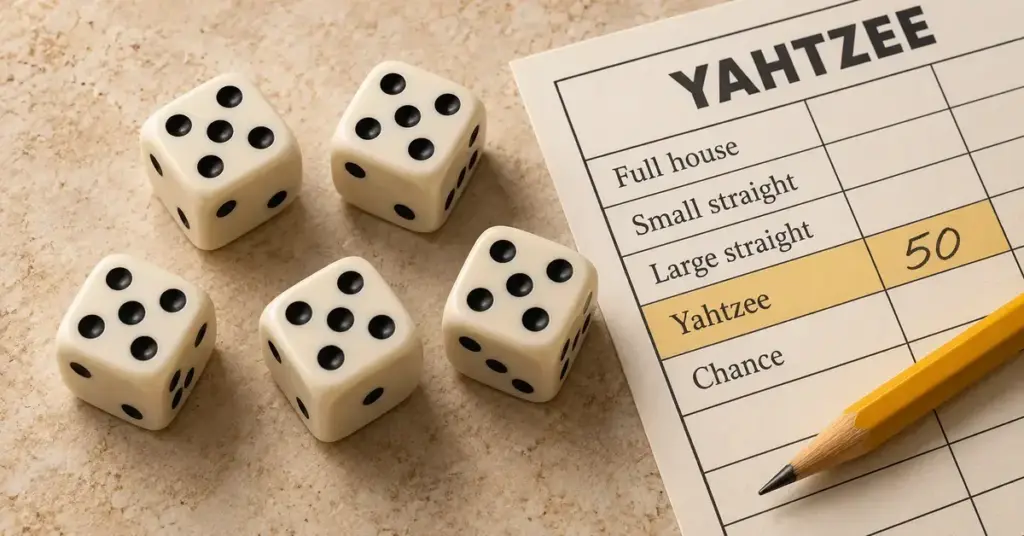

Yahtzee is a classic dice game in which players roll five dice over thirteen rounds, trying to match them to scoring combinations on a shared scorecard. It mixes genuine luck with meaningful decisions: you get up to three rolls each turn and must commit the result to one of thirteen categories before the turn ends. The game is quick to teach, plays well with two or more people, and has been a fixture of family game nights in New Zealand and around the world for decades. This guide explains the rules, the scorecard, how points are counted, and the practical choices that help you post a higher total.
What Yahtzee is
Yahtzee is a category-filling dice game for two or more players (it can also be played solo). Everyone uses the same set of five standard six-sided dice and their own paper scorecard. The aim is simple: score the most points by the time all thirteen categories on your card are filled. Each category can only be used once, so part of the game is deciding where to record a given roll — a good roll in the wrong box can be wasted, and a weak roll sometimes has to be “dumped” as a zero.
Because it needs only dice, a scorecard and a pencil, Yahtzee travels well and a full game usually runs about 20 to 30 minutes. If you enjoy dice games, it sits alongside other press-your-luck favourites such as Farkle, and it is a common pick for a family board game night.
Quick Facts
| Game type | Category-filling dice game |
|---|---|
| Players | 2 or more (also playable solo) |
| Equipment | Five six-sided dice, scorecards, a pencil |
| Rounds | 13 (one per scoring category) |
| Playing time | About 20–30 minutes |
| Recommended age | Around 8 and up |
| Originated | 1954 (“The Yacht Game”); trademarked 1956 |
| Current publisher | Hasbro (formerly Milton Bradley / E.S. Lowe) |
A short history of Yahtzee
According to Hasbro, the game was created in 1954 by a Canadian couple who played it aboard their yacht and called it “The Yacht Game.” Entrepreneur Edwin S. Lowe bought the rights, refined it, and registered Yahtzee as a trademark with the U.S. Patent Office in 1956. Sales were slow at first, so Lowe promoted the game by hosting “Yahtzee parties” where people could learn it firsthand, and word of mouth did the rest.
Lowe’s company sold Yahtzee until 1973, when Milton Bradley bought the E.S. Lowe Company. Milton Bradley later became part of Hasbro, which owns the brand today. The game draws on a long line of earlier dice games such as Poker Dice, Yacht and Generala, and Hasbro has reported selling in the order of 50 million sets a year, making it one of the best-known dice games in the world.
What you need to play
A standard Yahtzee set is inexpensive and contains only a few pieces:
- Five six-sided dice — rolled together each turn.
- A dice cup or shaker (optional) — handy for mixing the dice and keeping rolls fair.
- A scorecard per player — a printed pad with the thirteen categories listed.
- A pencil — for recording scores and totalling up at the end.
No board is required despite Yahtzee often being shelved with board games. If you do not have a pad handy, scorecards are easy to draw by hand or print, and many free apps reproduce the official layout.
How a turn works: the three-roll rule
Play passes clockwise. On your turn you may roll the dice up to three times:
- First roll: roll all five dice.
- Second roll (optional): set aside any dice you want to keep and re-roll the rest.
- Third roll (optional): re-roll any dice again. You can pick up previously kept dice and re-roll them too.
You may stop after the first or second roll if you are happy with the result. At the end of your turn you must enter a score in exactly one empty category — even if that means writing a zero. That forced choice is the heart of the game: once a box is filled it stays filled for the rest of the match.
Key Points
- Players: 2 or more (solo play possible); scales well to large groups.
- Each turn: up to three rolls of five dice, then record one category.
- Goal: fill all 13 categories for the highest total.
- Key bonus: 35 points if the Upper Section reaches 63 or more.
- Top combo: Yahtzee (five of a kind) scores 50, with 100-point bonuses for extras.
- Forced entry: every turn ends with a score or a zero in one box.
The thirteen scoring categories

The scorecard is split into an Upper Section (six number categories) and a Lower Section (seven combination categories). The table below summarises how each one scores.
| Category | Section | How it scores |
|---|---|---|
| Ones to Sixes | Upper | Total of the dice showing that number only |
| Three of a Kind | Lower | Sum of all five dice (needs at least three matching) |
| Four of a Kind | Lower | Sum of all five dice (needs at least four matching) |
| Full House | Lower | 25 points (three of one number and two of another) |
| Small Straight | Lower | 30 points (four consecutive numbers) |
| Large Straight | Lower | 40 points (five consecutive numbers) |
| Yahtzee | Lower | 50 points (five of a kind) |
| Chance | Lower | Sum of all five dice, with no requirements |
Note that Three of a Kind, Four of a Kind and Chance all score the total of all five dice, not just the matching ones. A Four of a Kind in sixes plus a five, for example, is worth 29 points.
The Upper Section and the 35-point bonus
In the Upper Section, each box collects only the dice that show its number. Three fours scores 12 in the Fours box; two sixes scores 12 in the Sixes box, and so on. The important rule is the bonus: if your six Upper Section boxes add up to 63 points or more at the end of the game, you earn a flat 35-point bonus.
A total of 63 works out to an average of three dice of each number across the six boxes. You do not have to hit exactly three of every number — a strong result in the Fives and Sixes can cover a weak Ones or Twos. Because the bonus is guaranteed points that do not depend on rare combinations, many players treat reaching 63 as a central goal and keep a running tally of how far above or below that pace they are.
Lower Section combinations explained
The Lower Section rewards specific patterns rather than raw totals of one number:
- Three of a Kind / Four of a Kind: at least three (or four) dice showing the same number; you score the sum of all five dice.
- Full House: three of one number and two of another, for a fixed 25 points.
- Small Straight: four consecutive numbers (such as 2-3-4-5), for 30 points.
- Large Straight: all five dice in sequence (1-2-3-4-5 or 2-3-4-5-6), for 40 points.
- Chance: any five dice, scored as their total — a useful safety net for an awkward roll.
Straights are the hardest combinations to force in only three rolls, so a common piece of advice is to take a Small Straight when it is on offer rather than gambling the whole turn on completing a Large Straight and risking a zero.
The Yahtzee bonus and the Joker rule
Rolling five of a kind fills the Yahtzee box for 50 points. If you roll a second Yahtzee later in the game after already scoring 50 there, you earn a 100-point bonus for each additional Yahtzee. These bonuses are why exceptional games can reach scores far higher than a typical total.
An extra Yahtzee also triggers the Joker rule. Once your Yahtzee box is filled, a further five-of-a-kind must first be recorded in the matching Upper Section box if that box is still open. If it is already filled, you may use the roll in any open Lower Section category — scoring, for example, a full 40 in Large Straight even though the dice are not actually a straight. Note that if you ever write a zero in the Yahtzee box, you forfeit all future Yahtzee bonuses for that game, so taking that zero early is usually a last resort.
Scoring strategy for beginners

Yahtzee is largely a game of luck, but consistent decisions make a measurable difference over a full card. A few principles help:
- Protect the Upper bonus. Prioritise Fives and Sixes early so you build a cushion toward the 63-point threshold.
- Commit to one goal per turn. After the first roll, pick the most likely outcome and keep dice toward it rather than chasing two combinations at once.
- Keep open-ended dice. Holding 3-4-5 is stronger than holding 3-6, because a run can grow in either direction.
- Use Chance wisely. Save it for a middling roll that fits nowhere else rather than spending it on an early good roll.
- Dump into cheap boxes. When a turn fails, a zero in Ones or Twos usually costs less than wasting a high-value category.
Like the scoring games cribbage and Golf, Yahtzee rewards players who keep a clear eye on the running total and play the percentages instead of hoping for a single lucky roll.
Common mistakes to avoid
- Ignoring the Upper bonus until it is mathematically out of reach — track your pace from the first few turns.
- Zeroing the Yahtzee box too soon, which cancels any chance of the 100-point bonuses.
- Over-chasing a Large Straight when a 30-point Small Straight is already available.
- Leaving only hard categories for the end, which forces risky all-or-nothing final turns. Clear difficult boxes earlier when you can afford a modest score.
- Forgetting the bonus maths — know whether a given roll helps the Upper total or is better spent in the Lower Section.
Variants and related dice games
Several close relatives share Yahtzee’s DNA. Yatzy and Yams are European versions with slightly different categories and bonus thresholds (Yams, for instance, awards its bonus at 60 rather than 63). Generala is a South American ancestor, and Poker Dice uses the same five-dice idea with poker-style hands. Triple Yahtzee, played on a three-column card, is a longer official variant. If you enjoy the roll-and-score format, the dice game Farkle offers a faster, more aggressive press-your-luck experience, and there are plenty of other options among the best family games to try next.
Who Yahtzee suits
Yahtzee works best for families and casual groups who want a short game with simple rules and a bit of tension on every roll. The printed age guidance is around 8 and up, mainly because of the running addition involved, which also makes it a gentle way for younger players to practise mental maths. It scales comfortably from two players to a large table, and because turns are quick there is little downtime. Players who prefer deep, interactive strategy may find it light, but as a reliable, portable crowd-pleaser it has few equals.
Sources
Frequently asked questions
How many dice are used in Yahtzee?
Yahtzee is played with exactly five standard six-sided dice, rolled together on every turn throughout the thirteen rounds.
How do you earn the 35-point Upper Section bonus?
Add up your six Upper Section boxes (Ones through Sixes) at the end of the game. If they total 63 points or more, you receive a one-off 35-point bonus.
Can you roll the dice more than three times in a turn?
No. Each turn allows a maximum of three rolls, though you may choose to stop after the first or second roll if you are happy with the dice.
What happens if you roll a second Yahtzee?
If your Yahtzee box already holds a 50, each additional Yahtzee is worth a 100-point bonus and can act as a Joker, letting you fill another open category. If the box holds a zero, no bonus is awarded.
What is the highest score possible in Yahtzee?
Under standard rules with Yahtzee bonuses and the Joker rule, the theoretical maximum is 1,575 points, which requires a Yahtzee every round and is astronomically unlikely. Most completed games finish well under 400.