
The Idiot card game is a fast, funny shedding game where everyone races to get rid of their cards and nobody wants to be the last one left holding them. It goes by many names around the world — Shithead, Palace, Karma, Shed and Threes among them — and “Idiot” is simply the family-friendly label many New Zealand households use for the loser who gets caught at the end. This guide explains the deal, the turn-by-turn mechanics, the special “power” cards, the nerve-wracking blind endgame, and the strategy that keeps you out of the hot seat.
Key Points
- Also known as: Shithead, Palace, Karma, Shed, Threes.
- Players: 2–5 (best with 3–5); add a second deck for larger groups.
- Cards: one standard 52-card deck.
- Goal: empty all your cards and avoid being the last player left — the “Idiot.”
- Each player gets: 3 face-down, 3 face-up, 3 in hand (played in that order).
- Key rule: play equal to or higher than the top card, or pick up the whole pile.
- Power cards: 2 resets the pile; 10 (or four of a kind) burns it.
What the Idiot card game is
Idiot is a shedding game — a game whose only aim is to empty your cards before everyone else. It is played with a single standard 52-card deck and works best with three to five players, although two can play and larger groups can shuffle two decks together. There is no real winner: players who clear all their cards simply drop out safely, and the one person left with cards at the very end is crowned the “Idiot.” That loser usually takes a light-hearted forfeit, such as dealing the next hand or fetching the next round of drinks.
What makes the game tense is its layered structure. Each player manages three separate stacks of cards that must be played in a fixed order, and the final stack is played completely blind. A player who looks almost certain to escape can be dragged back in by one unlucky flip, which is exactly where the laughter (and the groaning) comes from.
The deal and table layout
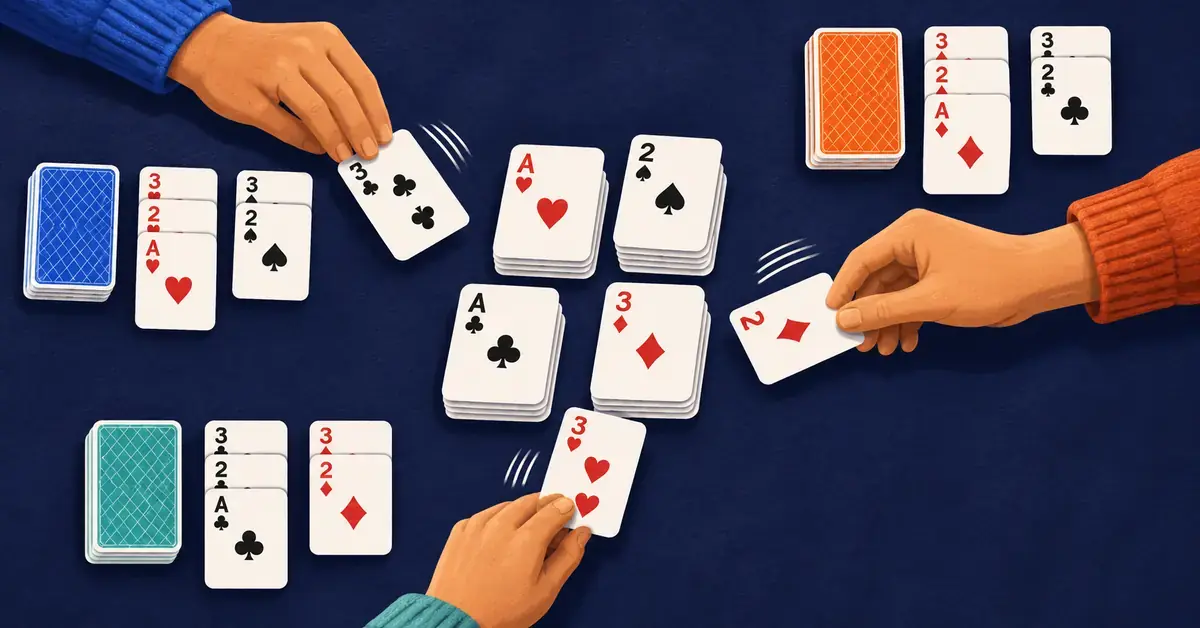
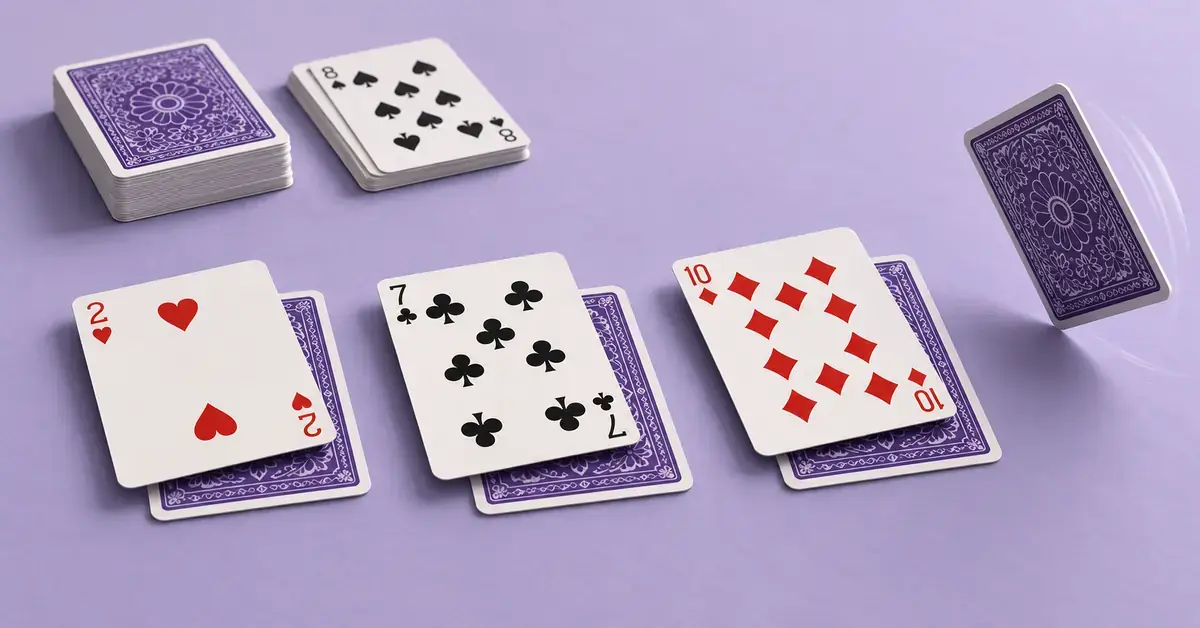
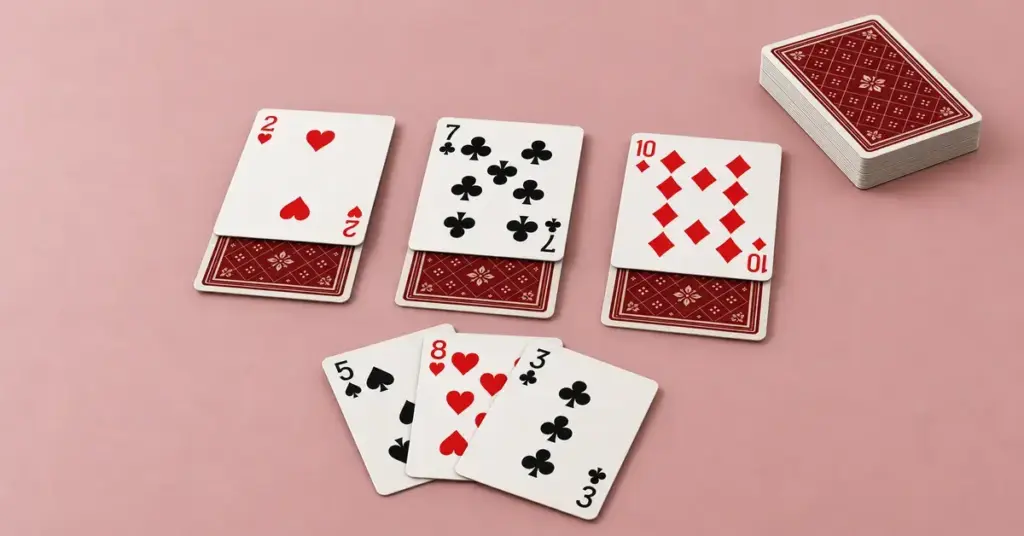
After shuffling, the dealer gives every player nine cards arranged in three parts:
- Three face-down cards in a row in front of each player. Nobody — including the owner — may look at these until the very end.
- Three face-up cards placed on top of the face-down cards, visible to everyone.
- Three hand cards dealt privately to each player.
The rest of the deck becomes a face-down stock (draw) pile in the middle. The face-up cards cannot be played until your hand is empty, and the face-down cards cannot be touched until your face-up cards are gone, so the order is always hand → face-up → face-down.
The swap phase
Before the first card is played, each player may swap any number of their hand cards with their own face-up cards. This is your one chance to plan ahead: move your strongest and most useful cards — Aces, Kings, and the special 2s and 10s — onto the face-up row so you have reliable options when you reach that stage later. Many games are effectively decided here, because weak face-up cards make the endgame far more dangerous.
How a turn works
Play moves clockwise. The player holding the lowest starting card leads — traditionally whoever has a 3 goes first; if nobody has a 3, the first player with a 4 begins, and so on. On your turn you play a card onto the central discard pile that is equal to or higher than the card currently on top.
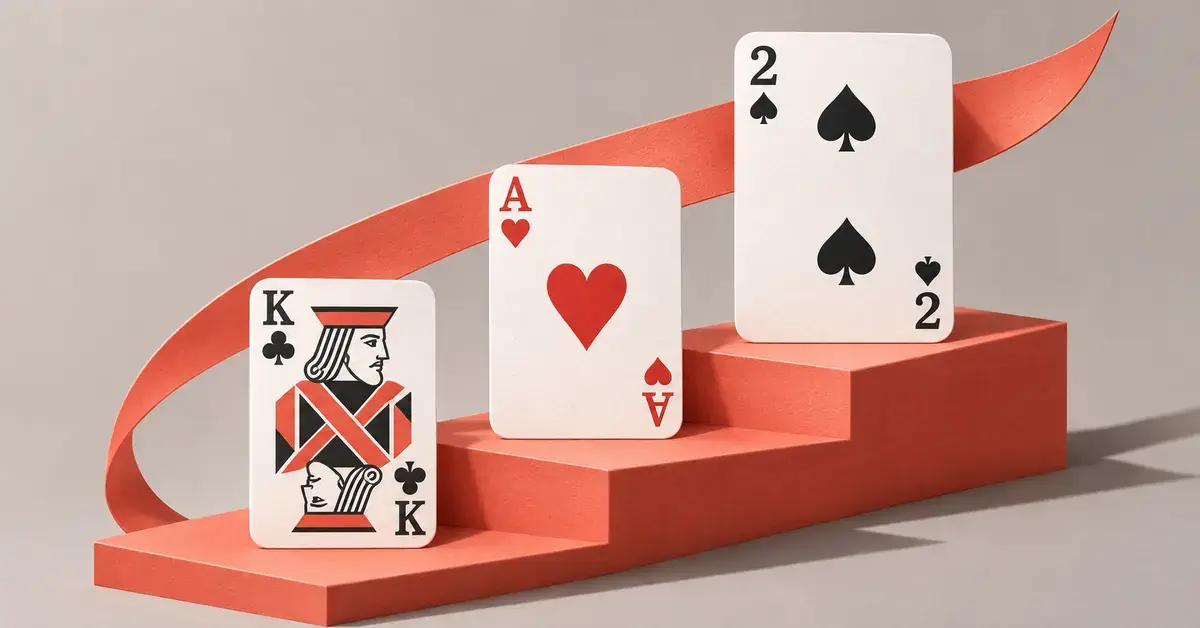
Card ranking runs from 3 (low) up to Ace (high), with the 2 and the 10 acting as special cards that can be played at almost any time. If you hold several cards of the same rank — say three 7s — you may lay them all down together on a single turn to shed faster. After playing, while the stock pile still has cards, you draw back up to a minimum of three cards in hand.
If you cannot (or choose not to) beat the top card, you must pick up the entire discard pile into your hand. This is the core punishment of the game: one blocked turn can turn a tidy three-card hand into a fistful of a dozen or more.
The power cards: 2 and 10
Two ranks break the normal “equal or higher” rule and give you control over the pile:
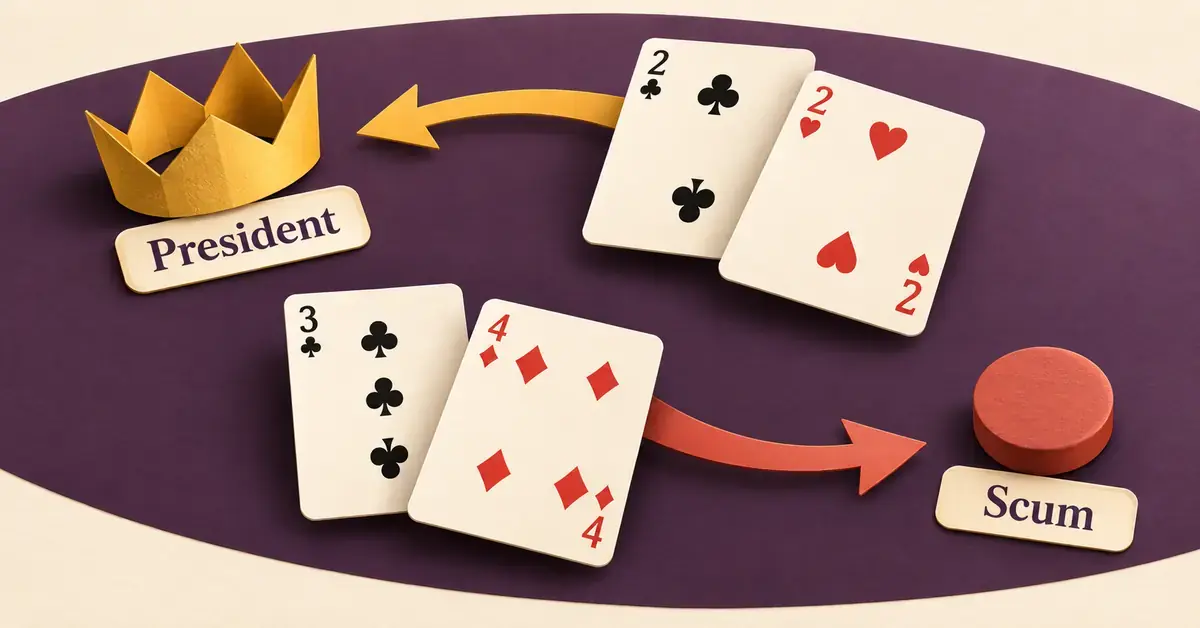
- The 2 — reset. A 2 can be played on top of any card and resets the pile, so the next player may lay down anything they like. It is your escape hatch when the pile climbs too high.
- The 10 — burn. A 10 can also be played on anything. It “burns” the whole discard pile out of the game for good, and the player who played it immediately goes again onto an empty pile.
Because these cards are so valuable late in the game, experienced players often sacrifice a strong card early and hold a 2 or 10 in reserve — ideally sitting in the face-up row — to guarantee a clean exit.
The four-of-a-kind burn
There is a second way to burn the pile that is easy to forget. If four cards of the same rank end up on top of the pile — whether one player lays all four at once, or several players add to the same rank in consecutive turns — the pile is immediately burned and removed, exactly as if a 10 had been played. The player who completed the four-of-a-kind then takes another turn. This is a handy way to clear a monster pile before someone is forced to scoop it up.
Special Card Effects
| Card | Effect | Status |
|---|---|---|
| 2 | Reset — play on anything; next player may lay any card. | Standard |
| 10 | Burn — play on anything; removes the whole pile from the game; same player goes again. | Standard |
| Four of a kind | Burns the pile like a 10; the player who completes it goes again. | Standard |
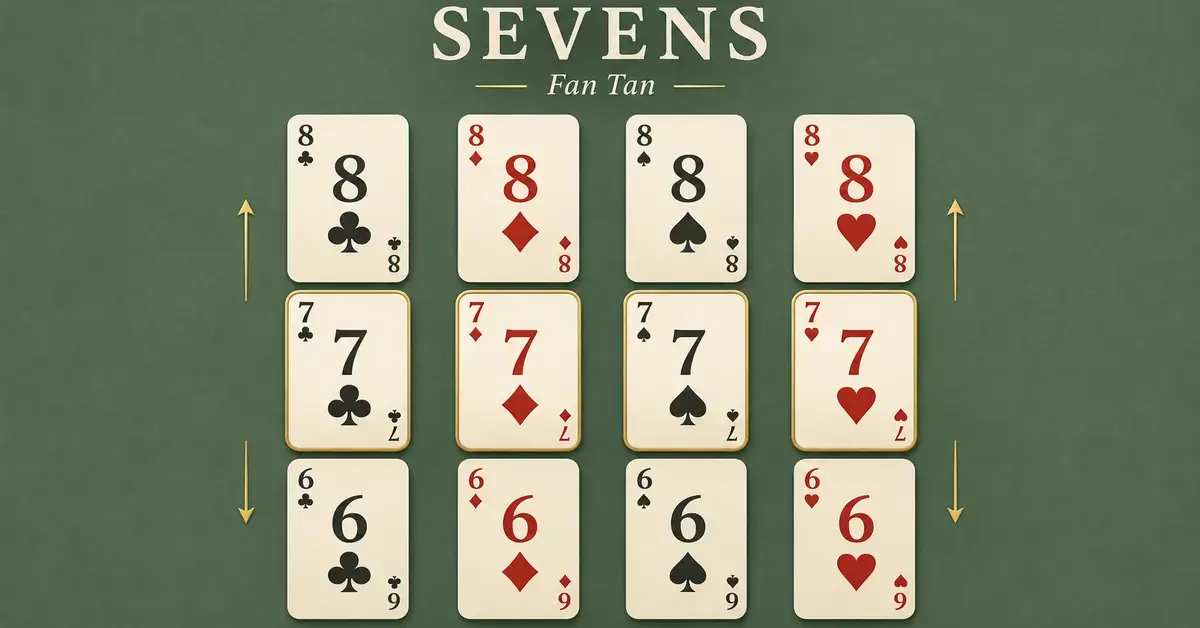
| 7 | Next player must play a 7 or lower (special cards still allowed). | Optional / house rule |
| 8 | Next player misses their turn. | Optional / house rule |
| 9 | Used by some groups instead of the 8 as the skip card. | Optional / house rule |
| 3 | Transparent — next player treats the card beneath it as the top card. | Optional / house rule |
The endgame: face-up, then blind

Once the stock pile is exhausted, hands are no longer refilled and the game enters its tense final stretch. When your hand is finally empty, you begin playing from your three visible face-up cards, one per turn, still following the “equal or higher” rule. If a face-up card cannot beat the pile, you pick up the pile as usual and must clear your hand again before returning to the table cards.
When the face-up cards are gone, you play your three face-down cards — and this is where nerve meets luck. You flip one card blind, without choosing. If it happens to beat the pile, you are a step closer to safety. If it is too low, you pick up the whole pile plus that card and have to work through the new hand before trying another face-down flip. Successfully playing your final face-down card means you are out and safe. The last player still stuck with cards is the Idiot.
Common variations and house rules
Idiot has countless regional and household variants, so the golden rule is to agree on the “magic” cards before you deal. The 2-resets and 10-burns rules are near-universal, but these optional extras appear in many groups:
- 7 — play under: after a 7, the next player must play a card of 7 or lower (special cards still allowed).
- 8 — skip: the next player misses their turn.
- 3 — transparent: a 3 is “see-through,” so the next player treats the card beneath it as the top card.
- 9 — miss-a-go: some groups use the 9 instead of the 8 as the skip card.
None of these are compulsory. For straightforward competitive play, the standard version with just the 2 and the 10 as special cards is the cleanest and most widely understood. If you enjoy trick-taking and bluffing instead, you might compare the tempo of Idiot with a social favourite like the Cheat card game.
Beginner strategy and common mistakes
Idiot rewards patience far more than aggression. A few habits separate the survivors from the Idiot:
- Stock up your face-up row. During the swap, load your visible cards with Aces, Kings and at least one 2 or 10. Weak face-up cards are the single biggest cause of last-place finishes.
- Dump low cards while you can draw. Early on, shed your 3s, 4s and 5s while the stock pile still refills your hand. Saving them for later just leaves you unable to beat a rising pile.
- Hold a reset for emergencies. Keep a 2 back so you are never completely stuck and forced to swallow a huge pile.
- Watch the pile height. If the discard pile has grown large, a well-timed 10 or four-of-a-kind burn can rescue you — or deny an opponent an easy escape.
- Keep the pile tidy. Always make sure everyone can see the current top card so there are no disputes about what has to be beaten.
The most common beginner error is treating power cards as ordinary high cards and burning them too soon, then arriving at the blind face-down stage with nothing left to control the pile.
Who the game suits
Idiot is ideal for relaxed social settings — family nights, flat gatherings or a pub table — because the rules are simple enough to teach in a couple of minutes but the swings keep everyone laughing. It scales nicely from two players up to a noisy group of five or six with a second deck. If you like the quick, luck-driven energy of Idiot, you may also enjoy the simplicity of the War card game, the reflex challenge of Snap, or the chaotic card-shedding of Uno Flip. For a wider round-up of options to play at home, see our guide to the best family card games in New Zealand.
Sources
Frequently asked questions
What happens if you cannot beat the discard pile?
You must pick up the entire discard pile and add it to your hand. You then keep playing on later turns until you can clear those cards again, so a single blocked turn can set you back a long way.
What do the 2 and 10 cards do?
The 2 can be played on anything and resets the pile so the next player may lay down any card. The 10 can also be played on anything and “burns” the whole pile out of the game, after which the same player takes another turn on an empty pile.
Can you look at your face-down cards before you play them?
No. The three face-down cards stay secret from everyone until you have cleared your hand and your face-up cards and are forced to flip them one at a time, completely blind.
How many cards does each player get?
Each player is dealt nine cards in total: three face-down, three face-up placed on top of them, and three held in the hand. The rest of the deck forms the central stock pile used for drawing.
Why is the game called Idiot?
There is no single winner — players simply drop out as they empty their cards. The one person left holding cards at the end is playfully named the “Idiot” and usually takes a small forfeit, such as dealing the next round.