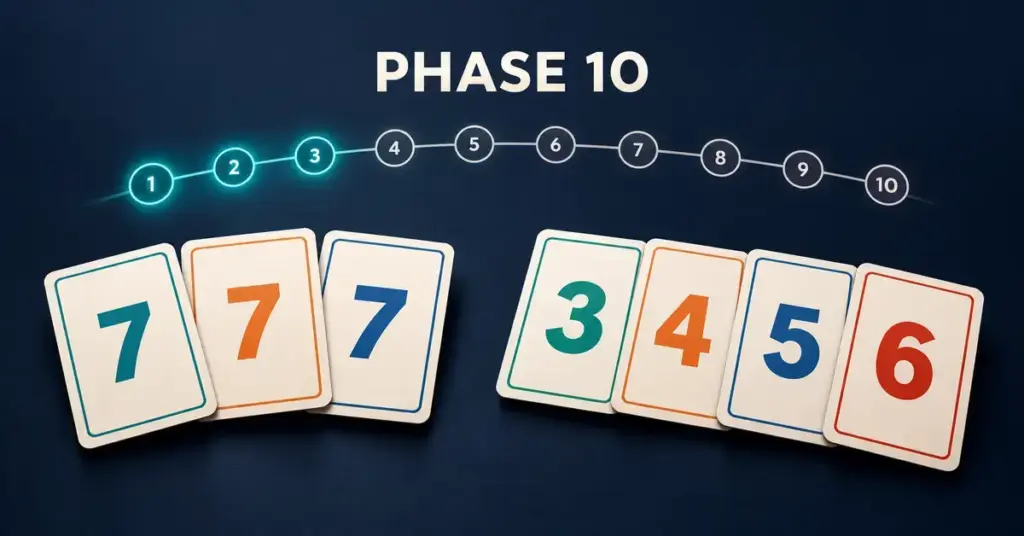
Phase 10 is a rummy-style card game in which the goal is not simply to empty your hand but to complete ten set challenges — called phases — in a fixed order before anyone else. Each phase is a specific combination of cards, such as sets of matching numbers, runs of consecutive numbers or groups of a single colour. Because you only move to the next phase once you have laid the current one, players often sit on different phases at the same time, which keeps every hand competitive. This guide explains the deck, the full list of phases, how a turn works, how scoring decides the winner, and the tactics that help in a typical New Zealand game night.
Quick Facts
| Game | Phase 10 |
| Designer | Kenneth Johnson (1982) |
| Current publisher | Mattel (since December 2010; previously Fundex) |
| Type | Rummy-style card game (based on contract rummy) |
| Players | 2 to 6 |
| Deck | 108 cards: 96 number cards, 8 Wild, 4 Skip |
| Cards dealt | 10 to each player per hand |
| Typical length | About 30 to 90 minutes |
| Aim | Be first to complete all 10 phases in order |
What Phase 10 is and where it came from
Phase 10 was created by Kenneth Johnson in 1982 and is based on a variant of rummy known as contract rummy, where players must complete a set ‘contract’ of melds each round. It was published for decades by Fundex Games and became that company’s best-selling product, reportedly selling more than 62 million units. In December 2010 Fundex sold the rights to Mattel, which has published the game ever since, so modern copies carry the Mattel brand. The name refers directly to the game’s structure: there are ten phases to clear, and the race to reach the final one gives the game both its title and its tension.
The appeal is its blend of luck and planning. Like traditional Rummy, you collect cards into sets and runs, but the fixed sequence of ten phases turns a single deal into a longer campaign. A full game is a marathon rather than a sprint, which makes it a good fit for family evenings and relaxed group play.
The cards and setting up a game
Phase 10 uses its own dedicated deck of 108 cards, not a standard 52-card pack. Knowing exactly what is in the deck helps you judge how likely you are to draw what you need.
- 96 number cards — the numbers 1 to 12, in four colours (red, blue, green and yellow), with two of each number in each colour.
- 8 Wild cards — each can stand in for any number or any colour.
- 4 Skip cards — each forces a chosen opponent to miss their next turn.
The game is designed for two to six players. The dealer shuffles and deals ten cards face down to each player. The rest of the deck becomes the draw (stock) pile in the middle, and the top card is turned over to start the discard pile beside it. It helps to keep the printed phase reference cards visible so everyone can check the requirement for their current phase.
The very first upturned card can occasionally be a special card, and the rules cover both cases. If the starting discard is a Skip card, the first player to the dealer’s left simply loses that opening turn. If it is a Wild, the first player is allowed to pick it up straight away. These small details rarely change a game but are worth agreeing on so the opening is never disputed.
What each player is trying to do
The overall aim is to be the first player to complete all ten phases, in order, across successive hands. You can only attempt one phase per hand, and you can only lay it down once you hold every card it requires. If you complete your phase, you advance to the next one in the following hand; if you fail, you attempt the same phase again next hand. Completing Phase 10 before your rivals wins the game.
The ten phases in order
Every phase must be built from the cards in your hand and laid on the table in a single turn. Phases must be done in sequence — you cannot skip ahead to an easier one later in the list, and cards laid for one phase cannot be re-used for a different phase. The official requirements are as follows.
| Phase | Requirement |
|---|---|
| Phase 1 | 2 sets of 3 |
| Phase 2 | 1 set of 3 + 1 run of 4 |
| Phase 3 | 1 set of 4 + 1 run of 4 |
| Phase 4 | 1 run of 7 |
| Phase 5 | 1 run of 8 |
| Phase 6 | 1 run of 9 |
| Phase 7 | 2 sets of 4 |
| Phase 8 | 7 cards of one colour |
| Phase 9 | 1 set of 5 + 1 set of 2 |
| Phase 10 | 1 set of 5 + 1 set of 3 |
Sets, runs and colours explained
Three building blocks appear throughout the list, and every term is worth learning before you start:
- Set — two or more cards that share the same number, regardless of colour (for example three 7s).
- Run — cards in consecutive numerical order, such as 4-5-6-7; colours do not matter in a run.
- Colour group — cards that are all the same colour, regardless of their numbers; this only matters for Phase 8.
If you have played set-and-run games such as Canasta or Five Crowns, these combinations will feel familiar, though Phase 10’s fixed order of requirements is what sets it apart.
How a turn plays out
Play passes clockwise, and each turn follows the same simple rhythm. First you draw one card, either the unseen top card of the draw pile or the visible top card of the discard pile. Next, if you are holding every card your current phase needs, you may lay that phase on the table. Finally you must discard one card to end your turn, which also feeds the discard pile that opponents can draw from. You never have to lay down a phase the moment you can — some players hold on briefly to add extra cards — but you can only lay your phase once per hand.
The draw choice is more tactical than it first appears. Taking the face-down stock card keeps your plans hidden but is a gamble on what you receive. Taking the visible discard tells opponents exactly what you are collecting, yet it guarantees a card you know you need. Skilled players also read the discard: picking up a 6 when you are clearly short of a run of 7 can be a signal that invites rivals to withhold the cards you still want.
Wild cards and Skip cards
The two special cards shape much of the tactics. A Wild can represent any number or colour needed to complete a phase, and you may use more than one Wild in a single phase — but a laid phase must contain at least one natural (non-Wild) card. Once a Wild is placed in a phase, it is locked in as the card it represents for the rest of that hand and cannot be moved.
A Skip card is played by discarding it, at which point you choose an opponent who then loses their next turn. A Skip cannot be picked up from the discard pile, cannot be used as part of any phase, and only one Skip can be used against a given player in a single round (one trip around the table). Timing a Skip against the player closest to going out can buy you the turn you need, a little like holding back a UNO action card for the right moment.
Hitting and going out
Once you have laid your own phase, you enter the part of the hand where you try to empty your hand completely. This is done through hitting — adding spare cards to any phase already on the table, whether it is yours or an opponent’s. For example, if someone has laid a set of 4s, you can add your own 4 to it. You cannot hit until your own phase is down. The hand ends the instant any player plays their final card and ‘goes out’; every other player is then stuck scoring the cards still in their hand.
Hitting is also where flexible cards pay off. If the cards you have left after laying your phase are Wilds or common numbers, you will usually find somewhere to place them and go out quickly. If they are awkward, isolated cards, you may be stranded while the round races to a close around you — another reason to plan your hand with the end of the round in mind, not just the phase in front of you.
Scoring and winning
Scores are tallied at the end of every hand, and in Phase 10 a low score is good — you want as few points as possible. The player who goes out scores nothing for that hand. Everyone else counts the cards left in their hand using the values below. Cards already laid on the table do not count against you.
| Card type | Points each |
|---|---|
| Numbers 1 to 9 | 5 points |
| Numbers 10 to 12 | 10 points |
| Skip card | 15 points |
| Wild card | 25 points |
Winning the game and breaking ties
The game is won by the first player to complete Phase 10 at the end of a hand. If two or more players finish Phase 10 in the same hand, the one with the lowest total score across the whole game wins. If those players are also tied on points, they replay Phase 10 as a decider and the first to go out takes the win. Because of this, keeping your running total low throughout the game matters as much as racing ahead — a hand where you are caught holding a Wild and a couple of high cards can cost you a tie-breaker later.
Key Points
- Complete the ten phases in order — only one phase can be laid per hand.
- Each turn: draw one card, optionally lay your phase, then discard one card.
- A Wild stands in for any number or colour, but a phase needs at least one natural card; Wilds are worth 25 points if caught in hand.
- A Skip makes a chosen opponent miss a turn and cannot be taken from the discard pile.
- Lowest score wins a tie, so keep your running total low as well as advancing phases.
Strategy tips for Phase 10
The game rewards patience and observation rather than pure speed. A few habits tend to separate consistent players from the rest:
- Finish the phase first. Completing your phase is the priority; going out is a bonus. A common mistake is chasing an early ‘out’ and failing to lay the phase at all, which leaves you repeating it next hand.
- Keep a flexible hand. Holding cards that could form more than one combination protects you against a poor draw pile, especially for the long runs in Phases 4 to 6.
- Dump dangerous cards early. High-value 10s, 11s, 12s and Wilds become a liability if an opponent looks ready to go out, so discard the ones you cannot use before someone ends the hand.
- Watch which phase opponents are on. If a rival needs a particular colour for Phase 8, think twice before discarding it; starving them of useful cards slows their progress.
- Save Skips for the leader. A Skip aimed at whoever is closest to going out can be worth far more than using it on the player to your left out of habit.
Common house rules and variations
Many households play it with their own tweaks, and that is fine as long as everyone agrees on the rules before the first deal. The table below shows a few popular variations alongside the official rule they replace.
| Area | Official rule | Common house variation |
|---|---|---|
| Phase order | Phases 1 to 10 must be completed in sequence | Phases may be attempted in any order (‘all advance’ style) |
| Advancing | You repeat a phase if you fail to lay it | Everyone advances each hand for exactly ten hands |
| Skip targeting | One Skip may be used against each player per round | No skipping the same player twice in a row |
| Game length | Game ends when a player completes Phase 10 | A minimum points threshold must also be reached |
Dedicated editions such as Phase 10 Dice and Phase 10 Masters exist too, and the core game sits comfortably alongside other Mattel sequence games like Skip-Bo in a family game cupboard. Whichever version you choose, consistency is what keeps the game fair.
Who Phase 10 suits
The game works best for players who enjoy a mix of hand management and social play over a longer sitting. It is simple enough for children who can already handle a set-and-run game, yet the fixed phases and scoring give adults plenty to think about, which makes it a reliable pick for mixed-age tables and a solid addition to any Gin Rummy or rummy fan’s collection. A single game can run from 30 minutes to well over an hour depending on how many hands are needed.
Sources
Frequently asked questions
How many cards are in a Phase 10 deck?
A Phase 10 deck has 108 cards: 96 number cards (the numbers 1 to 12 in four colours, with two of each number per colour), plus 8 Wild cards and 4 Skip cards.
What happens if you complete a phase but do not go out?
You still advance to the next phase in the following hand. You only count the points of the cards left in your hand for that round, which counts towards your running total.
Can you use more than one Wild card in a single phase?
Yes. You may use several Wild cards to help complete a phase, provided the laid phase also contains at least one natural, non-Wild card.
Can you hit on another player’s phase before laying your own?
No. You cannot add cards to any phase on the table until you have successfully laid down your own current phase first.
What happens if the draw pile runs out?
The discard pile is reshuffled to form a fresh draw pile and play continues, so a round can be finished even if the stock is used up.