
If you have searched for a tga box while looking into card grading, you have almost certainly landed on TAG — short for Technical Authentication & Grading. “TGA” is simply a common transposition of the brand, and in the trading-card world it points to two related things: the rigid, see-through deck box that TAG ships graded cards in, and the submission kit that holds that box. This guide explains what the box actually is, how TAG grades cards, how its digital reports work, and — importantly for anyone in Aotearoa — how realistic it is to use the service from New Zealand.
What a “TGA Box” Actually Is
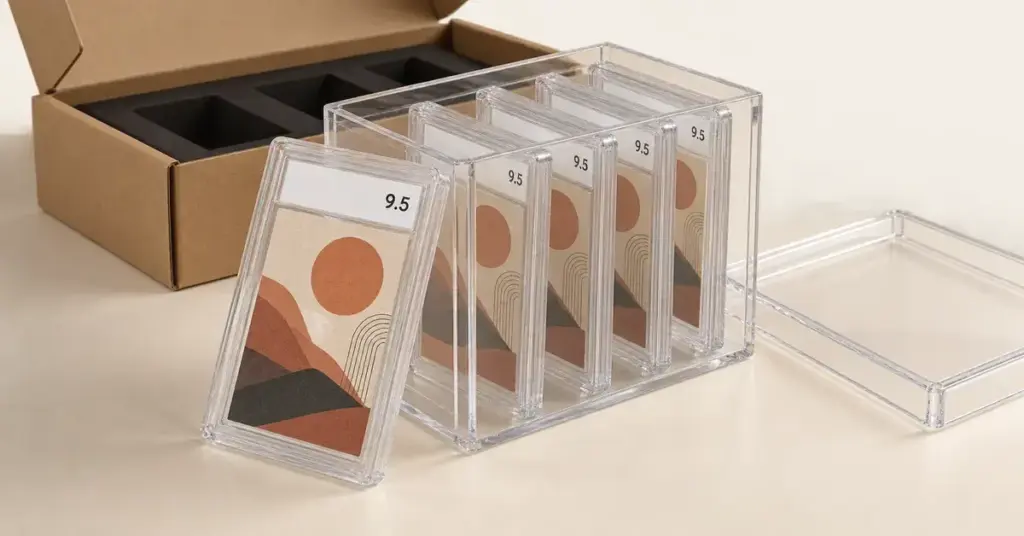
There is no separate product officially called a “TGA box.” The term almost always refers to the TAG deck box: a rigid, polycarbonate case used to hold graded card slabs during transit and storage. TAG is a technology-focused grading company, and the box is part of its packaging rather than a stand-alone item you buy on its own.
When TAG grades a card, it seals the card in a tamper-evident slab and laser-inscribes the grade and certification details directly into the plastic rather than using a paper label. Several of these slabs can sit inside the rigid deck box, which is designed to stack. So when collectors talk about a “TGA box,” they usually mean one of three things: the deck box itself, the full submission kit it comes in, or simply the slab a graded card arrives in.
If you are new to the whole idea of sealing and ranking cards, it is worth reading a plain-language overview of how card grading works before deciding whether any of this is right for your collection.
How TAG Grading Works
TAG uses an automated, machine-learning imaging system rather than relying solely on a grader’s eye. Its software photographs each card, analyses it for defects, and records what the company calls a digital fingerprint — a detailed image record unique to that copy. The company describes its approach as machine learning rather than “AI,” and independent, published accuracy studies comparing it with human grading are still limited, so treat strong marketing claims with the usual caution.
Every card is scored on a 1,000-point scale, from 100 at the bottom to 1000 at the top. That score is then converted into the familiar 1–10 grade, including half grades such as 8.5 or 9.5. Centering is reported as a ratio — for example 55/45 or 65/35 — which is more precise than a simple pass/fail.
TAG offers its service in tiers, which have been structured roughly as follows (names and prices change, so confirm current details on TAG’s own site):
- TAG V – verifies that a card is authentic, without assigning a numerical grade.
- TAG X – assigns the standard 1–10 grade and includes the digital report.
- TAG S – adds the full 1,000-point score and a ranking for the card.
The TAG Grade Scale
The table below shows representative point bands and labels. Half grades fall between the whole-number bands shown here.
| Grade | Point range | Label |
|---|---|---|
| 10 | 990–1000 | Pristine |
| 10 | 950–989 | Gem Mint |
| 9 | 900–949 | Mint |
| 8 | 800–849 | NM-MT |
| 7 | 700–749 | Near Mint |
| 5 | 500–549 | Excellent |
| 3 | 300–349 | Very Good |
| 1 | 100–149 | Poor |
Key Points
- “TGA box” is almost always a misspelling of TAG (Technical Authentication & Grading); the box is TAG’s rigid polycarbonate deck case.
- TAG grades using machine-learning imaging and scores cards 100–1000, shown as a 1–10 grade with half grades.
- Each graded card gets a scannable DIG report with photos, metrics and a summary of grade-affecting defects (DINGS).
- Direct submissions and kits are US/Canada only; New Zealand is not a listed region, so expect to use an overseas affiliate or international mail.
- TAG grades English and Japanese cards only, so check eligibility and total cost before shipping valuable cards offshore.
Inside a TAG Submission Kit
Where TAG offers a submission kit, the rigid box is bundled with the other supplies needed to send cards in safely. Based on TAG’s own descriptions, a kit typically includes:
- Polycarbonate TAG deck box – the rigid case that holds your cards.
- TAG shields – semi-rigid holders that protect raw cards before grading.
- Easy-pull sleeves – soft sleeves designed so cards can be removed without edge damage.
- Rigid, lockable SafeCase – a secure outer case for transport.
- Mailer box and instructions – step-by-step guidance for packing and sending.
- Prepaid return label and transit insurance – TAG has advertised cover of up to US$1,000 in transit on domestic kits.
The practical takeaway is that the “box” is only one piece of a packaging system built to keep cards immobile and protected while they travel to and from the grading facility.
Quick Facts
| Company | Technical Authentication & Grading (TAG) |
| Official website | taggrading.com |
| What “TGA box” means | Rigid polycarbonate TAG deck box / submission kit |
| Grading method | Machine-learning imaging with digital fingerprint |
| Grade scale | 100–1000 points, shown as a 1–10 grade (half grades) |
| Service tiers | TAG V (authentication), TAG X (grade + DIG), TAG S (adds 1000-pt score & ranking) |
| Accepted card languages | English and Japanese only |
| Direct availability | United States and Canada; elsewhere via authorised affiliates |
| New Zealand | Not a listed direct region (October 2026) — check TAG for current partners |
The DIG Report and DINGS
A defining feature of TAG’s service is its digital report. Scanning the QR code on a slab opens the DIG report — short for Digital Imaging & Grading — which includes high-resolution images, a breakdown of the score, centering metrics, and a summary of any defects.
Those grade-affecting flaws are labelled DINGS, which TAG defines as “Defects Identified with Notable Grade Significance.” In plain terms, DINGS are the specific issues — a soft corner, edge whitening, a surface scratch — that cost the card points. The DIG report is generally tied to the TAG X and TAG S tiers, and because it is accessible by anyone scanning the slab, a prospective buyer can review exactly why a card received the grade it did before paying for it.
This kind of transparency is useful on the secondary market. If you are buying or selling, pairing a grade with recorded sales data from a tool like PriceCharting for tracking card values gives a clearer picture than a grade alone.
Using TAG From New Zealand: What Is Realistic
This is the most important section for Kiwi collectors, because the marketing around TAG can give a misleading impression. As of October 2026, direct submissions and submission kits through TAG’s own website are limited to the United States and Canada. New Zealand is not listed as a directly supported country.
Outside North America, TAG directs customers to authorised affiliate partners rather than accepting cards mailed directly to its facility. Australia is served through an authorised affiliate, but no New Zealand-based partner was listed at the time of writing. TAG also warns that cards mailed in from unsupported regions can run into customs problems, and it has stated that orders arriving with requests for TAG to pay duties or taxes may be rejected and returned.
Two further limits matter for New Zealand collectors:
- Card language: TAG has stated it grades cards in English and Japanese only, so many European-language cards are not eligible.
- Shipping cost and risk: sending high-value cards offshore means international courier fees, insured postage, customs paperwork and a long round trip — costs that can outweigh the benefit on all but the most valuable cards.
If you are in New Zealand and set on TAG specifically, the realistic routes are to use the Australian affiliate channel, to grade cards while you are travelling in a supported country, or to arrange submission through a dealer who batches cards. For most collectors, it is worth weighing whether an established grader with clearer international access is a better fit — something covered in a wider guide to TCG collecting and grading in New Zealand.
TAG Compared With Other Grading Options
TAG is one of several services a New Zealand collector might consider. The comparison below focuses on stable, factual differences rather than turnaround times, which change frequently and should be checked on each company’s own site.
| Service | Grading method | Grade scale | Digital report | NZ access |
|---|---|---|---|---|
| TAG | Machine-learning imaging | 1–10 (100–1000 pts) | Yes, DIG with photos | No direct; affiliates/overseas mail |
| PSA | Human graders | 1–10 with half grades | Scan/images on some tiers | International submissions accepted |
| Beckett (BGS) | Human graders | 1–10 plus subgrades | Limited | International submissions accepted |
| CGC Cards | Human graders | 1–10 with half grades | Images on some tiers | International submissions accepted |
| SGC | Human graders | 1–10 with half grades | Images | Mainly sports; international accepted |
None of these is objectively “best.” Human grading has a long track record and broad buyer recognition, while TAG’s appeal is the detailed digital record. The right choice depends on the card, its value, and how easily you can submit from where you live.
Storing and Protecting Cards Before You Grade

Whether or not you ever send a card away, good storage is the part most within your control — and it is where a rigid deck box genuinely earns its place. Before grading, the goal is simply to stop a card’s condition from slipping.
- Sleeve first: a soft penny sleeve, then a semi-rigid holder or toploader, protects corners and edges from handling.
- Keep cards flat and supported: loose cards sliding in a bin pick up scuffs; a snug box prevents movement.
- Mind the climate: New Zealand homes can be humid, so store cards away from damp, direct sun and large temperature swings, which cause warping and surface damage.
- Handle by the edges: fingerprints and oils show up clearly under grading-level imaging.
Supplies are easy to find locally through hobby shops and marketplaces such as Trade Me. For high-value cards — the kind most worth grading in the first place — it is worth reading about buying and owning high-value trading-card singles and the specifics of grading Pokémon trading cards in NZ before you spend on grading fees and international postage.
TGA Box Health & Fitness: A Name Not to Confuse
If your search for “TGA box” turned up a gym, that is a separate business entirely. TGA Box Health & Fitness is a boxing and fitness venue in Tauranga (the “TGA” there is the common airport-code shorthand for the city). It has no connection to card grading or to Technical Authentication & Grading. Collectors sometimes use “TGA” loosely as shorthand for TAG, which is how the two names end up in the same search results.
Sources
Frequently Asked Questions
Is a “TGA box” a real product?
Not as a separate item. “TGA” is a common misspelling of TAG (Technical Authentication & Grading). The “box” people mean is the rigid polycarbonate deck box TAG ships graded cards in, or the submission kit that contains it.
Can I use TAG grading from New Zealand?
Not directly. As of October 2026, TAG’s direct submissions and kits are limited to the United States and Canada, with other regions served through authorised affiliates. No New Zealand partner was listed, so a Kiwi collector would need to use an overseas affiliate or arrange international submission, weighing the shipping and customs costs involved.
How does TAG’s grading scale work?
TAG scores each card from 100 to 1000 and converts that into the standard 1–10 grade, including half grades. A 10 covers roughly 950–1000 points, with 990–1000 labelled Pristine and the band below it Gem Mint.
What are the DIG report and DINGS?
The DIG report (Digital Imaging & Grading) is accessed by scanning the slab’s QR code and shows images, metrics and a defect summary. DINGS are “Defects Identified with Notable Grade Significance” — the specific flaws that lowered the card’s grade.
Is TAG better than PSA, Beckett or CGC?
There is no single best grader. TAG’s strength is a detailed digital record produced by machine-learning imaging, while PSA, Beckett and CGC use human graders and have broad buyer recognition. The best option depends on the card’s value and how easily you can submit from New Zealand.