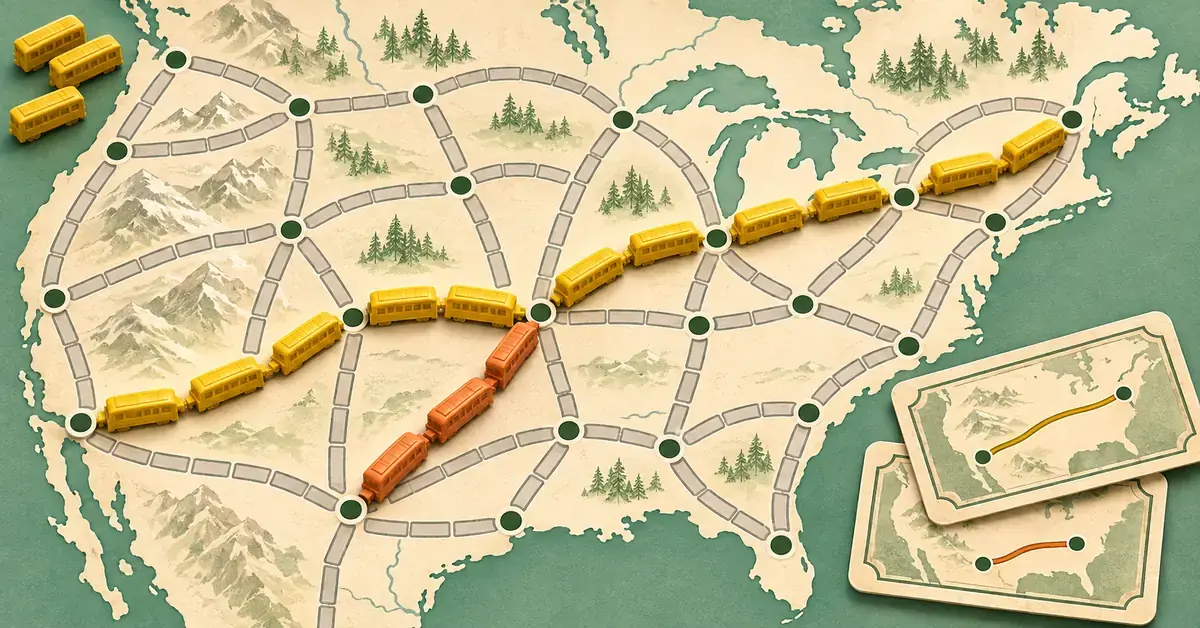
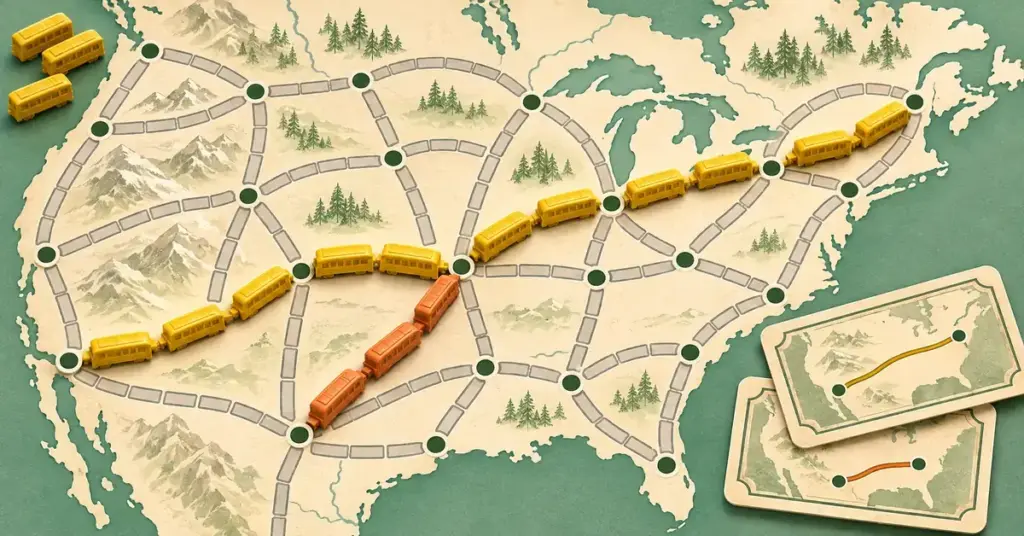
Ticket to Ride is a railway-building board game in which 2 to 5 players race to claim train routes across a map of North America, link the cities printed on their secret destination tickets, and finish with the most points. It is one of the easiest strategy games to teach – a whole turn is just one of three simple choices – which is why it turns up so often around a Kiwi kitchen table, at a bach over summer, or on a rainy school-holiday afternoon. This guide covers the official setup, every rule you need for a first game, how scoring works, and a few beginner tactics to get you started.
Quick Facts
| Players | 2-5 |
|---|---|
| Recommended age | 8+ |
| Playing time | 30-60 minutes |
| Designer | Alan R. Moon |
| Publisher | Days of Wonder |
| Trains per player | 45 |
| Map (base game) | North America |
| What you need | Everything is in the box – no dice or paper |
What Ticket to Ride is about
Designed by Alan R. Moon and first published by Days of Wonder in 2004, Ticket to Ride is a railway-themed strategy game for 2 to 5 players. The version most people own is the original game set in North America; later editions use the same core rules on different maps.
The object is simple: score the highest total. You earn points three ways – by claiming routes between neighbouring cities, by completing the destination tickets you are holding, and by building the single longest continuous line of track. The catch is that every destination ticket you fail to complete costs you points, so the game is a balance between grabbing routes and making sure your tickets actually connect.
What comes in the box
The standard North America base game includes:
- 1 board showing the North American rail network and a scoring track around the edge
- Plastic train carriages in 5 colours, 45 per player (a few spares are included, but start each game with exactly 45)
- 110 train cards – 12 each in 8 colours (purple, red, orange, yellow, green, blue, white, black) plus 14 multi-coloured locomotive wild cards
- Destination ticket cards (30 in older printings, 33 in the current edition), each naming two cities and a point value
- 1 Longest Path bonus card
- 5 wooden scoring markers, one per player colour
You never need anything beyond the box – no dice, no pen and paper. If you are weighing up which tabletop game to bring home, it sits alongside picks like the Sequence board game and the tile-laying Azul board game as a gentle gateway into strategy games.
Setting up the game
- Place the board in the centre of the table.
- Each player takes a set of 45 trains in one colour and the matching scoring marker, placing the marker on the 0 space of the scoring track.
- Shuffle the train cards and deal 4 to each player as a starting hand.
- Put the rest of the train deck beside the board and turn the top 5 cards face up in a row. If 3 or more of those 5 are locomotives, discard all five and turn up five new ones.
- Place the Longest Path bonus card face up near the board.
- Shuffle the destination tickets and deal them out. In the current edition each player is dealt 4 tickets and must keep at least 2; in earlier printings you were dealt 3 and kept at least 2. Either way, look at them secretly, choose which to keep, and return the rest to the bottom of the deck.
The most experienced traveller (or anyone you like) goes first, and play passes clockwise. Keep your destination tickets hidden until the final scoring.
Your three options on a turn
On your turn you must do one – and only one – of the following three actions. You cannot mix them, and you cannot skip your turn.
1. Draw train cards
Take 2 train cards. Each can come from the 5 face-up cards or be drawn blind from the top of the deck. After you take a face-up card, immediately replace it with the next card from the deck.
Locomotives are wild and can stand in for any colour when you claim a route. They come with one restriction: if you take a face-up locomotive, it must be the only card you draw that turn – you do not get a second card. A locomotive drawn blind from the deck, however, counts as a normal single card, so you still draw two. (If 3 of the 5 face-up cards are ever locomotives, all five are discarded and replaced.) There is no hand limit; you may hold as many cards as you like.
2. Claim a route
A route is the band of coloured spaces between two neighbouring cities. To claim one, play a set of train cards matching the route’s colour and length – for example, three blue cards for a three-space blue route. Grey routes can be claimed with a set of any single colour. Place one of your trains on each space and move your scoring marker up the track according to the length of the route:
Route scoring
| Route length (spaces) | Points scored |
|---|---|
| 1 | 1 |
| 2 | 2 |
| 3 | 4 |
| 4 | 7 |
| 5 | 10 |
| 6 | 15 |
You may claim any open route, whether or not it touches your other track, but only one route per turn. Some cities are joined by double-routes (two parallel lines); one player cannot own both. In 2- and 3-player games only one line of each double-route may be used – once a player claims one, the second is closed to everyone.
3. Draw destination tickets
Instead of drawing train cards or claiming a route, you can draw 3 new destination tickets from the top of the deck. You must keep at least 1, but may keep 2 or all 3. Return the rest to the bottom of the deck. Remember that every ticket you keep is a promise: complete it for the points, or lose that many at the end.
How the game ends
The end is triggered the moment any player’s supply of trains drops to 2, 1, or 0 at the end of their turn. From there, each player – including the one who triggered it – takes exactly one final turn, and then the game stops. This gives everyone a fair chance to squeeze in a last route or complete a ticket, so keep an eye on your opponents’ remaining trains.
Final scoring and the longest route bonus
Most route points are already on the scoring track from play. To finish the game, work through the scores in order:
- Confirm the route points each player banked during the game.
- Players reveal their destination tickets. Add the value of every ticket you completed – meaning an unbroken path of your own trains links the two named cities – and subtract the value of every ticket you did not.
- Award a 10-point bonus to the player with the longest continuous path of track. Only a single unbroken line of one colour counts; it may loop and revisit cities, but a given train can be counted once. If players tie, they all score the bonus.
The highest total wins. If scores are tied, the player who completed the most destination tickets takes it; if still level, the holder of the Longest Path card wins, and otherwise the tied players share victory.
Beginner strategy
The rules are easy, but a few habits help newcomers hold their own:
- Build around your tickets first. Look for tickets whose paths overlap, so a single stretch of track counts towards two or three of them at once.
- Favour longer routes. The scoring table rewards length – a 6-space route is worth 15 points, far more than six separate 1-space routes. Longer routes also build towards the 10-point longest-path bonus.
- Grab contested routes early. If only one sensible line links two of your cities, claim it before an opponent blocks it, especially on the busy east-coast section of the map.
- Keep a train buffer. Running yourself down to your last couple of trains ends the game – handy if you are ahead, risky if you still have tickets to finish.
- Watch which colours opponents hoard. A rival stockpiling cards is usually lining up a long route; you may be able to take the space first.
Common mistakes to avoid
- Drawing extra destination tickets late in the game and then running out of trains to complete them – each unfinished ticket is a straight loss.
- Trying to take a face-up locomotive and a second card on the same turn. A face-up locomotive always ends your draw.
- Forgetting the double-route rule in 2- and 3-player games, where only one of each pair of parallel lines can ever be used.
- Hoarding cards for a dream route while opponents quietly complete tickets and trigger the endgame.
Other versions and maps
Beyond the original North America game, Ticket to Ride: Europe is played on a map of Europe, while Ticket to Ride: First Journey is a simplified version aimed at younger children. Other stand-alone maps and expansions use the same core turn structure on different regions, so learning the base game carries over.
Finding Ticket to Ride in New Zealand
Ticket to Ride is a mainstream title, so it is worth looking for it at dedicated hobby game shops and larger toy retailers, as well as comparing the budget options in our guide to Kmart board games. If you are building a shelf for mixed-age play, our wider guide to choosing board games in New Zealand and our round-up of card games for kids both pair well with it. For a faster, card-only option on the same family-games night, the compact Monopoly Deal is an easy companion.
Sources
Frequently asked questions (FAQ)
How many cards do you draw on a turn in Ticket to Ride?
If you use your turn to draw train cards, you take 2 – from the face-up row, the deck, or a mix. A face-up locomotive is the exception: taking one ends your draw for that turn. If instead you draw destination tickets, you take 3 and keep at least 1.
How do you win Ticket to Ride?
You win by scoring the most points. Points come from claiming routes, completing your destination tickets, and holding the single longest continuous path (a 10-point bonus). Incomplete tickets subtract points, so completing the tickets you keep is as important as laying track.
When does the game end?
The game ends once any player finishes a turn with only 2, 1, or 0 trains left. Every player then takes one more turn, and the game stops for final scoring.
Is Ticket to Ride good for kids?
Yes. The base game is recommended for ages 8 and up and is a popular family choice because a turn is just one simple action. For younger children, Ticket to Ride: First Journey simplifies the rules further.
How many players can play Ticket to Ride?
The base game is for 2 to 5 players. In 2- and 3-player games, only one line of each double-route can be claimed.