Scattergories is a fast, social word game in which players race a timer to come up with answers that fit a set of categories and all begin with the same randomly chosen letter. First published by Milton Bradley in 1988 and now sold by Hasbro, it is a regular feature of family game nights, holiday gatherings and classroom activities across New Zealand. This guide to Scattergories rules explains how the game works, how scoring and the challenge vote operate, which strategies actually help, what the main editions offer, and how to find a copy locally. Every term is explained on first use, so it works whether you have never played or you want to tighten up your house rules.
Quick Facts
| Original publisher | Milton Bradley (1988); now published by Hasbro |
| Players | 2–6 (teams for larger groups) |
| Recommended age | 12 and up |
| Round length | About 3 minutes per round |
| Categories per list | 12 |
| Letters on the die | 20 of 26 (omits Q, U, V, X, Y, Z) |
| Typical contents | 20-sided letter die, sand timer, folders, answer pads, category cards |
| Typical NZ price | Around NZ$25–NZ$35, depending on retailer and edition |
How Scattergories Works
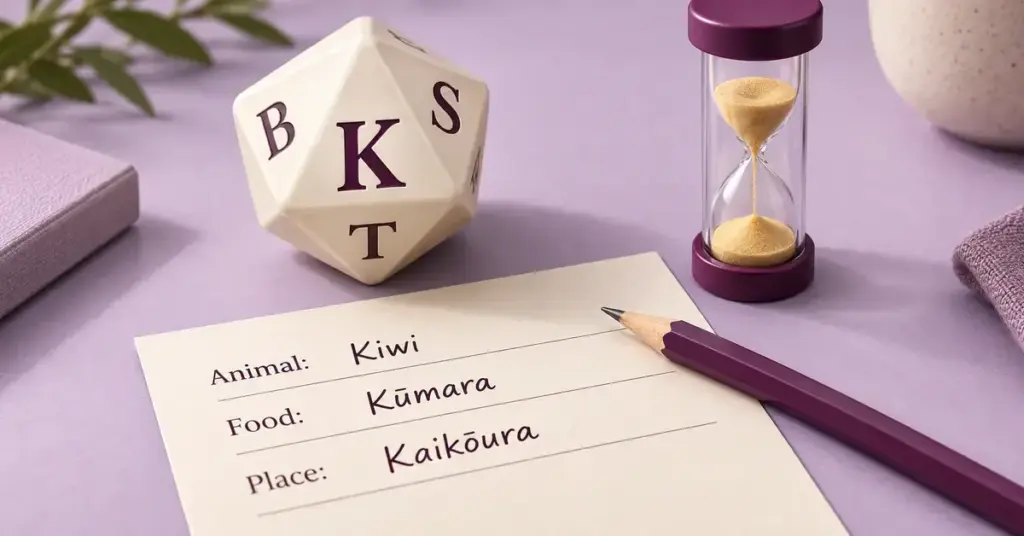
A round of Scattergories is built around three things: a letter, a list of categories and a timer. One player rolls a 20-sided letter die, which selects the starting letter for the whole round. Everyone then has the length of the timer to write one answer for each category on the current list, with every answer starting with that letter.
The standard die carries 20 of the 26 letters of the alphabet. The letters Q, U, V, X, Y and Z are left off because they make answers too hard to find. The classic set uses a three-minute sand timer, and each printed list contains 12 categories such as “Boys’ names,” “Things that are cold” or “TV shows.”
The twist that gives the game its character is uniqueness. An answer only scores if no one else at the table wrote the same thing for that category. If two or more players put down the same word, nobody scores for it. That single rule is why rushing to the obvious answer is often a mistake, and why creative, less predictable choices win games.
- The roll: A 20-sided letter die sets one starting letter for all 12 categories in the round.
- The timer: A standard round runs three minutes; groups often shorten or lengthen it to suit the players.
- Uniqueness: You only score for an answer that no other player has also written.
- The article rule: For titles, leading words such as “A,” “An” and “The” are ignored, so the next word must start with the chosen letter.
Scoring and the Two-Word Bonus

Scoring is simple: each accepted, unique answer is worth one point, and the player with the most points at the end wins. Many sets and groups also use an optional bonus for answers made of two or more words that all start with the chosen letter, awarding a point for each qualifying word. For the letter P, an answer like “Peter Pan” would earn two points under that rule. Because this bonus is treated as optional in the rules and as a house rule by many players, it is worth agreeing on it before you start.
Strategy: How to Score More Points
Winning consistently is less about a huge vocabulary and more about avoiding the answers everyone else will reach for. If the letter is A and the category is “Fruit,” most players write “Apple,” which usually cancels out. Choosing “Apricot” instead keeps the point. The table below sums up the techniques that reliably help.
| Technique | How it works | Example |
|---|---|---|
| Go less obvious | Skip the first word that comes to mind, since others will pick it too. | “Apricot” instead of “Apple” for Fruit (A) |
| Use two-word answers | Where the bonus applies, use answers whose words both start with the letter. | “Sea Salt” for Things in a kitchen (S) |
| Reach for proper nouns | Specific names often satisfy broad categories. | “Wellington” for a Place (W) |
| Defend borderline answers | Be ready to justify a creative answer if it is challenged. | “Carpet” for Things that are soft (C) |
| Always write something | A questionable answer can score; a blank line never does. | Fill every category before time runs out |
The Challenge Vote
When the timer stops, players read their answers aloud. Any player can challenge an answer they think does not fit the category, and the group votes on whether it counts. This is where much of the fun lives, from arguing whether a “jandal” belongs under “Things you wear” to debating what truly counts as “sticky.” Because the vote is subjective, it helps to settle in advance how strict the table will be, and some groups appoint a moderator to keep rounds moving.
Common Mistakes New Players Make
Most lost points come from a handful of avoidable habits. New players tend to write the first word that pops into their head, which is also the word everyone else writes, so it cancels out. They also spend too long perfecting one clever answer and leave other categories blank, when a plausible answer in every box scores far better. Finally, it is easy to forget the chosen letter mid-round and drift onto the wrong one, so it helps to write the letter large at the top of your sheet as a reminder.
Key Points
- Roll the 20-sided die to set one letter for all 12 categories in the round.
- You only score for answers no other player wrote — uniqueness beats speed.
- An optional bonus rewards multi-word answers whose words all start with the letter.
- Agree on the challenge rules and the two-word bonus before you start.
- Local, custom category lists keep the game fresh for repeat game nights.
Editions and Variants
Several versions of Scattergories have appeared over the years, each changing the core formula in a different way. Knowing the differences helps you pick the right one for your group, whether you want the full tabletop experience or something quick for a trip.
| Edition | What is different | Suits |
|---|---|---|
| Classic | 12 categories, one rolled letter, three-minute timer. | Groups and traditional play |
| Scattergories Categories | A keyword is spelled down the page and you find a word per letter. | One-on-one games and logic fans |
| The Card Game | A fast deck-based version where players call out answers; no writing. | Travel and quick rounds |
| Junior | Simpler categories and gentler scoring. | Younger children |
If you enjoy the writing-and-scoring format, it sits comfortably alongside other household favourites such as Yahtzee and the wider world of party games that reward quick thinking in a group.
Where to Buy Scattergories in New Zealand

Scattergories is widely available in New Zealand through major retailers and online stores. Kmart New Zealand lists the classic word game, and it is commonly stocked by general toy and game sellers including Mighty Ape and The Warehouse. As a guide, recent New Zealand listings have sat around NZ$25 to NZ$35 depending on the retailer and edition, so it is worth comparing a couple of stores before buying.
- Chain and online retailers: Kmart NZ and Mighty Ape typically carry the current Hasbro edition new.
- Second-hand and spare parts: Older or sealed vintage sets, replacement dice and spare score pads often turn up on Trade Me.
- Specialty stores: Dedicated game shops sometimes stock variants such as Scattergories Categories or the card game.
If you are weighing up what else to put on the shelf, our overview of board games in New Zealand covers how to choose titles for different group sizes and ages.
House Rules and Category Ideas for Kiwi Game Nights
Part of the game’s longevity is how easily it bends to a group. Beyond the printed lists, many New Zealand players build their own category sheets with local references, which keeps rounds fresh and gives everyone a fair chance. The table below shows how a standard theme can be given a local twist.
| Theme | Common categories | Local twist |
|---|---|---|
| Nature | Animals, Trees, Flowers | Native birds, NZ beaches |
| Pop culture | TV shows, Movies, Bands | NZ musicians, local presenters |
| Everyday | Things in a kitchen, Clothing | Items in a bach, dairy snacks |
| Abstract | Things that are sticky, Fears | Excuses for being late |
Common house rules include narrowing a broad category (for example, “Birds that cannot fly” instead of “Animals”), agreeing whether the two-word bonus applies, and deciding how strict the challenge vote will be. Younger players are sometimes given partial credit for a right category even when the letter is wrong, which keeps the game welcoming. For mixed-age tables, our guide to card games for kids has more ideas for keeping younger players involved.
Digital and Solo Ways to Play
You do not need the box to play. Free online list generators produce endless category sheets, which is handy when you want fresh lists or have lost your folders. Mobile apps let you play with friends remotely and handle the timing and scoring automatically. For solo play, Hasbro has also released Scattergories word-search puzzle books that combine the category idea with a hidden-word format. These options are useful for practice, but they do not change the core skill the game rewards: thinking of answers other people will not.
The same category-and-timer idea also works well as a quick warm-up or icebreaker. Asking a group to name three things starting with a given letter is a low-pressure way to get everyone talking, which is part of why the format turns up in classrooms and team activities as well as at the kitchen table.
A Short History of Scattergories
Milton Bradley launched Scattergories in 1988, and it quickly became a fixture of the category-game genre. The brand briefly jumped to television as an NBC daytime game show hosted by Dick Clark, which aired in 1993 and paired contestants with a panel of celebrities. The board game outlasted the show and is now published by Hasbro, which continues to sell the classic edition alongside spin-offs. Its appeal has stayed consistent: the rules take a minute to learn, and a grandparent and a teenager can compete on roughly even terms.
Sources
Frequently Asked Questions (FAQ)
How many people can play Scattergories?
The game is designed for two to six players. Larger groups can split into teams so everyone takes part.
Which letters are not on the die?
The standard 20-sided letter die leaves off Q, U, V, X, Y and Z because answers starting with those letters are considered too difficult.
What happens if two players write the same answer?
Neither player scores for that category. Only answers that no one else wrote down earn a point, which is why unusual answers are valuable.
How long is each round?
A standard round lasts three minutes using the included timer, though groups often shorten or lengthen it to match the players.
Does an answer starting with “The” or “A” count?
Leading articles such as “A,” “An” and “The” are ignored, so the following word must start with the chosen letter for the answer to count.