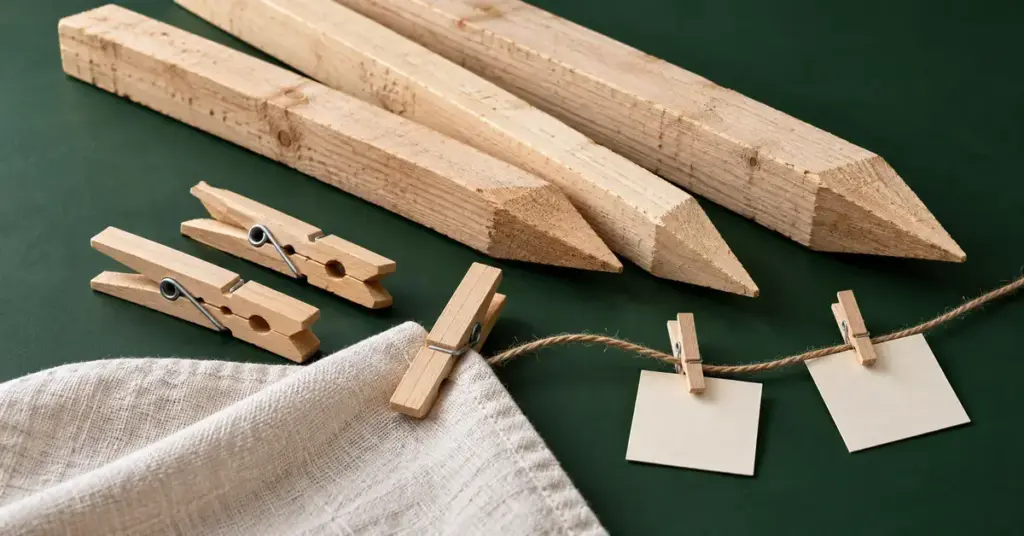

In New Zealand, the phrase “wooden pegs” covers three very different products that happen to share a name. Around the home it means the classic spring clothes peg and the small craft pegs used for photos and decorations. On a building site it means the pointed timber stakes used for concrete boxing and landscaping. And on a film set it means the humble wooden clothes peg pressed into service as a heat-proof clip. This guide explains each type, the timber and treatment behind them, how to look after them and where to buy them locally.
Three different products, one name
Because the search term “wooden pegs” is used so loosely, it helps to separate the categories before shopping. A packet of laundry pegs from the supermarket has almost nothing in common with a pallet of pointed boxing stakes from a timber merchant, yet both are sold under the same words. Knowing which product you actually need — and the timber and treatment that suit the job — saves money and avoids disappointment, such as buying untreated stakes that rot in the ground within a season.
Quick Facts
| Everyday meaning | Spring clothes pegs and small craft pegs for the home |
| Trade meaning | Pointed timber stakes for concrete boxing and landscaping |
| Common timber | Radiata pine for stakes; historically tawa for early NZ-made clothes pegs |
| Ground-contact treatment | H4 under the New Zealand standard NZS 3640 |
| Typical builders’ peg sizes | 32–50 mm square, 300–1200 mm long |
| Indicative price | Craft and clothes pegs from a few dollars a pack; builders’ pegs about NZ$1.60–$3.30 each |
| Where to buy | Supermarkets and craft stores; Bunnings and Mitre 10 for timber pegs |
Wooden pegs for the home and laundry
In the domestic setting, wooden pegs are a familiar part of the Kiwi backyard. Traditional one-piece “dolly” pegs have largely given way to the spring-hinged design for everyday washing, though they survive in heritage crafts and for sealing food bags. Many households still prefer wood on the line because it stands up to strong ultraviolet (UV) light — the part of sunlight that makes plastic brittle — far better than cheap plastic, which tends to snap after a summer or two. Smaller decorative pegs are also popular indoors for hanging photos, displaying children’s artwork or clipping open bags shut.
Common household peg types
| Peg type | Design | Typical use |
|---|---|---|
| Spring peg | Two wooden jaws joined by a steel coil spring | Everyday and heavy laundry such as towels and jeans |
| Dolly peg | One piece of wood, slit at the base, knob on top | Delicate items, heritage crafts and peg dolls |
| Mini peg | Small-scale spring peg | Photo displays, gift wrapping and decorations |
| Shaker peg | Round-headed turned dowel | Wall-mounted coat and hat rails |
Caring for wooden laundry pegs

Wood is a natural material, so it can stain fabric or grow mould if it is left wet for long periods. A little routine care keeps pegs usable for years and stops the metal spring rusting, which is a real issue in coastal and humid parts of the country.
- Store them dry: keep pegs in a covered peg bag or basket and bring them inside between washes to prevent mould and grey weathering.
- Clean when marked: wipe pegs with a mild white-vinegar solution if they start to look grey or discoloured.
- Do not soak them: leaving wooden pegs in water swells the timber and loosens or rusts the spring.
- Mind the spring: a light wipe of oil on the coil helps prevent corrosion near the sea.
- Replace tannin-stained pegs: old pegs that have darkened can transfer marks to white washing, so retire them to the craft box.
Timber pegs for building and landscaping
For larger projects, “wooden pegs” means substantial timber stakes that mark out ground or hold formwork in place. In New Zealand these are almost always made from radiata pine, the fast-growing plantation softwood that dominates the local timber trade. In construction, “boxing pegs” brace the timber boards (the boxing) that contain wet concrete while a path, slab or driveway is poured. In landscaping, longer stakes define garden edges, hold edging boards and set out retaining walls and decks.
Common timber peg sizes in New Zealand
Builders’ pegs are sold pointed at one end so they drive into firm ground. Sizes are given as width by thickness by length in millimetres. The examples below reflect products stocked by major New Zealand retailers.
| Size (mm) | Treatment | Typical use |
|---|---|---|
| 32 x 42 x 300 | H4 treated radiata | Light garden edging and set-out marking |
| 45 x 45 x 450 | Untreated radiata | Concrete boxing for paths and slabs |
| 45 x 45 x 600 | H4 treated radiata | Landscaping and retaining-wall set-out |
| 50 x 50 x 900–1200 | Untreated radiata | Tall profile and boxing pegs for bigger pours |
Treated or untreated: which to choose
New Zealand rates timber durability with hazard classes under the standard NZS 3640, written as H1 to H6. The key number for pegs is H4, the class for timber in contact with the ground or fresh water, where decay fungi and insects are a serious risk. The practical rule is simple:
- Untreated radiata is fine for concrete boxing, because the pegs are only in the ground for days and are then pulled out.
- H4-treated radiata is the right choice for anything that stays in the soil — edging stakes, boundary set-out and retaining work — so it does not rot.
- For vegetable gardens, some people prefer untreated timber and simply accept that it will need replacing, or line the soil side to keep it away from treated wood.
Key Points
- “Wooden pegs” in NZ can mean laundry pegs, craft pegs, timber stakes or film-set C47s — check which you need.
- Radiata pine is the standard timber for stakes; choose H4-treated for anything left in the ground.
- Untreated pegs are fine for temporary concrete boxing but rot if left in soil.
- Wood resists UV and heat better than plastic, which turns brittle in strong New Zealand sun.
- Store laundry pegs dry to stop staining, mould and rusting springs.
C47s: wooden pegs on the film set
A surprising use of the ordinary wooden clothes peg is on film and television sets, where crews call it a “C47”. Gaffers and lighting technicians use them to clip coloured gels and diffusion sheets onto the barn doors (the hinged metal flaps) of hot studio lamps. Wood is chosen because it is a poor conductor of heat and electricity: it does not melt like plastic, and it stays cool enough to handle near tungsten lights that would make metal clips dangerous.
- Heat resistant: safe to use on lamps hot enough to soften a plastic clip.
- Non-conductive: suited to work around powerful lighting rigs.
- Handy: also used to bundle cables, mark positions and hold paperwork.
- Nicknames: crews who clip rows of them to a tool belt sometimes call them “bullets”.
The origin of the name “C47” is genuinely unknown. Competing stories trace it to a wartime transport aircraft, an old studio storage bin, a catalogue number, and a tale that crews dressed up the word “clothes peg” to get the cost approved on a budget. Industry sources agree that none of these has ever been confirmed.
Craft, classroom and game projects
For the creative household, wooden pegs are a cheap and versatile craft material because they take paint and glue well. They turn up constantly in school projects and rainy-day activities, from peg dolls and Christmas ornaments to simple learning games. A classic example is a spelling or counting game where letters or numbers are written on pegs and clipped onto a card — an idea that sits comfortably alongside the sort of hands-on kids’ card games families reach for on a wet afternoon.
Pegs also have a quiet role in tabletop gaming. The small movable pegs in a cribbage scoring board are a close cousin of the household peg, and if you enjoy that kind of game it is worth reading up on how a cribbage peg board works and the related pin and peg boards used for scoring. More broadly, peg crafts are a gentle entry point to the wider world of board games in New Zealand, where simple components create a lot of fun.
- Peg dolls: a vintage craft that turns dolly pegs into little figures with fabric and pens.
- Ornaments: mini pegs decorated with fabric, paint or glitter for seasonal displays.
- Plant markers: larger pegs labelled to identify seedlings in the garden.
- Herb drying: clipping bunches of herbs to a string to air-dry in the kitchen.
A short history of the wooden peg

The one-piece dolly peg — a split length of wood with a rounded knob — is the oldest common design. In Britain these were often made and sold door to door by Romany (Gypsy) travellers, who worked springy hedgerow woods such as willow and hazel and bound the top with a thin band of tin to stop the wood splitting. Settlers brought pegs like these to New Zealand, and the spring-hinged design gradually took over for everyday use.
New Zealand has made its own pegs, too. As far back as 1932 a Hamilton factory was producing clothes pegs from tawa, a native timber, to reduce reliance on imported pegs. The well-known Sunshine brand came much later and is a different story: the New Zealand company Sunshine Plastics began making plastic pegs in 1983, and today’s Sunshine pegs are moulded plastic rather than wood. In other words, the familiar supermarket peg brand is not a heritage wooden product, and claims of a 1960s wooden “Sunshine” peg should be treated with caution.
Wood, plastic or stainless steel?
Laundry pegs now come in three main materials, each with trade-offs. Plastic is cheapest but the least durable outdoors; marine-grade stainless steel lasts almost indefinitely but costs more and lacks the rustic look; wood sits in the middle, balancing price, grip and sustainability.
| Material | UV durability | Sustainability | Typical cost |
|---|---|---|---|
| Wood | Good — does not go brittle | Renewable and biodegradable | Low to moderate |
| Plastic | Poor — becomes brittle in sun | Low — petroleum-based | Low |
| Stainless steel | Very high | Recyclable | Highest |
For most Kiwi backyards, wooden pegs offer a sensible middle ground, while stainless steel appeals to anyone who wants to buy once and never again.
Where to buy wooden pegs in New Zealand
Where you shop depends on whether you need a packet for the washing line or a bulk order of timber stakes.
- Home and craft pegs: supermarkets, variety and discount stores, and craft retailers carry clothes pegs and small decorative pegs, usually from a few dollars a pack.
- Builders’ and landscaping pegs: hardware and trade stores such as Bunnings and Mitre 10 stock pointed radiata pegs in both untreated and H4-treated grades; as a rough guide, individual builders’ pegs run from about NZ$1.60 for a short 300 mm peg to around NZ$3.30 for a 600 mm one.
- Bulk and trade orders: timber merchants and building suppliers can quote on pallet quantities and custom lengths for larger civil and construction jobs.
Because longer timber pegs are awkward to post, many retailers list them as in-store or click-and-collect only, so it is worth checking stock at your local branch before travelling.
Sources
- Mitre 10 – Kiwipegs H4 builders’ pegs (sizes and prices)
- Bunnings New Zealand – untreated radiata boxing pegs
- NZ Farm Forestry Association – timber treatment hazard classes (H1–H6)
- Videomaker – what a C47 is and how it is used on set
- Kiwi North (Whangarei Museum) – Laundry Day: NZ pegs and Sunshine Plastics
- Object Lessons – Victorian dolly clothes pegs
Frequently Asked Questions
What are C47s in the film industry?
A C47 is simply a standard wooden spring clothes peg used on set. Lighting crews use it to clip gels and diffusion onto hot lamps because wood does not melt or conduct heat and electricity the way plastic and metal do.
Do wooden pegs stain white clothes?
They can if they are left wet on the line for long periods, as the timber may grow mould or release tannins that mark fabric. Storing them dry in a peg bag between uses prevents most staining.
What is the difference between H4-treated and untreated pegs?
H4-treated radiata is designed to survive in contact with soil and moisture without rotting, so it suits landscaping and set-out work. Untreated pegs are cheaper and fine for temporary jobs such as concrete boxing, but they decay quickly if left in the ground.
Are Sunshine pegs made of wood in New Zealand?
No. The Sunshine brand is made by Sunshine Plastics, which began producing plastic pegs in New Zealand in 1983. Today’s Sunshine pegs are moulded plastic, not timber, so they are not a wooden heritage product.
Can I use mini wooden pegs for laundry?
Not really. Mini pegs are decorative and lack the spring tension to hold wet washing on a line in the wind. Use full-size spring pegs for laundry and keep the mini pegs for photos, gifts and crafts.