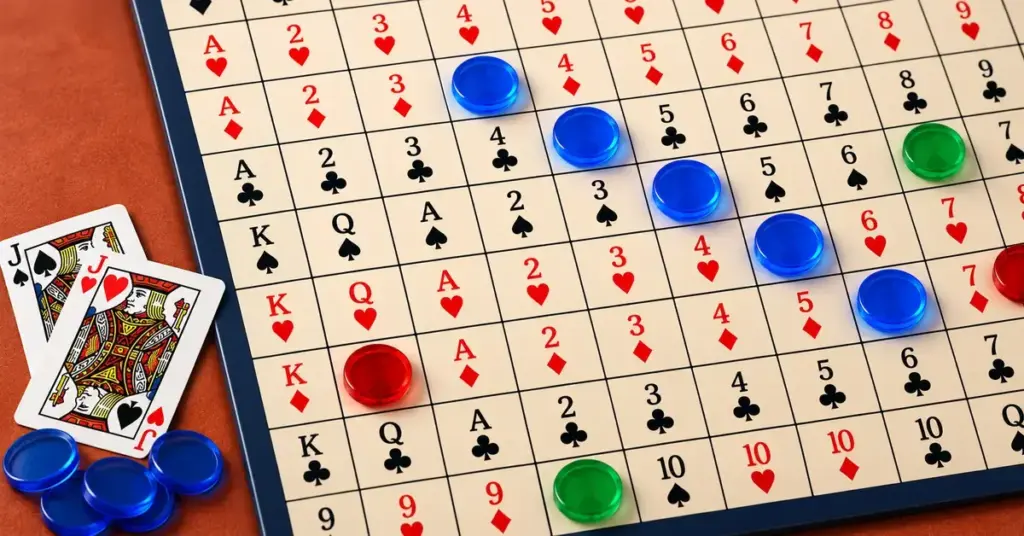
Sequence is a hybrid board-and-card game in which players or teams race to be the first to line up five of their marker chips in an unbroken row on a 10×10 grid printed with playing cards. It first reached shop shelves in 1982 and has since become a regular fixture on New Zealand family game nights, because it blends the luck of the shuffle with genuine tactical choices about where to place a chip and when to block an opponent. This Sequence game NZ guide walks through the components, the rules of a single turn, how the two different Jacks work, the main editions sold in New Zealand, where to buy the game, and the strategies that separate a casual player from a consistent winner.
Quick Facts
| Designer | Douglas Reuter |
| First published | 1982 |
| Current publisher | Goliath Game Company (acquired rights by 2018) |
| Players | 2–12 (in equal teams) |
| Recommended age | 7+ (3–6 for Sequence for Kids) |
| Playing time | About 10–30 minutes |
| In the box | Folding board, two decks (104 cards), 135 chips |
| Typical NZ price | From about $24 (standard edition) |
What Sequence is and what comes in the box
Sequence sits somewhere between a card game and a board game. Instead of a deck alone deciding play, the cards tell you where you are allowed to act on a fixed board. The standard game includes one folding board, two complete decks of standard playing cards (104 cards in total, with the Jokers removed and set aside) and 135 plastic marker chips. The chips come in three colours — 50 blue, 50 green and 35 red — and the red set is only used when three teams play.
The board shows a 10×10 grid. Each of the four corners is a free "wild" space, which leaves 96 squares printed with cards. Because the two decks contain 48 non-Jack cards each, every ordinary card appears on the board exactly twice. The Jacks are the only cards that are not printed anywhere on the board, which is what makes them special. If you enjoy games that reward planning as much as they reward a good draw, Sequence fits neatly alongside other family board games in New Zealand.
How a single turn works
A turn in Sequence is short and always follows the same three steps. Getting the order right matters, because skipping a step carries a penalty.
- Play a card. Choose a card from your hand and place it face up on a discard pile.
- Place a chip. Put one of your marker chips on either of the two board squares that match the card you just played.
- Draw a card. Take a new card from the draw pile so your hand returns to its starting size.
The catch is the draw. If you forget to pick up a replacement card and the next player takes their turn, you lose the right to that card for good and must finish the game with a smaller hand. This is often called the "loss of card" rule, and because a smaller hand means fewer options every single turn, it is one of the most costly mistakes a beginner can make.
Players, teams and how many cards you hold
Sequence works with anywhere from two to twelve people, as long as the group divides evenly into equal teams. That means you cannot play a balanced game with exactly five, seven or eleven players. Two or three people can play as individuals; larger groups split into two or three teams, with teammates seated so that turns alternate around the table. The number of cards each person is dealt shrinks as the group grows, which keeps the board from filling up too quickly.
Cards dealt by group size
| Players | Setup | Cards dealt each |
|---|---|---|
| 2 players | Individual or 2 teams | 7 |
| 3 players | Individual or 3 teams | 6 |
| 4 players | 2 teams | 6 |
| 6 players | 2 or 3 teams | 5 |
| 8–9 players | 2 or 3 teams | 4 |
| 10–12 players | 2 or 3 teams | 3 |
In team play there is one firm social rule: no coaching or "table talk." Teammates may not hint at which card to play or where to block, so strong teams win by reading the board rather than by whispering.
Key Points
- The aim is to line up five of your chips in a row — horizontal, vertical or diagonal.
- Two players or teams need two sequences; three players or teams need one.
- Each turn is three steps: play a card, place a chip, draw a card — in that order.
- Two-eyed Jacks place a chip anywhere; one-eyed Jacks remove an opponent’s chip.
- The four corners are free for everyone, so corner lines need only four of your chips.
- No coaching or table talk is allowed between teammates.
The two kinds of Jacks
There are eight Jacks across the two decks, and because they do not appear on the board they act as special cards rather than placement cards. Learning to tell them apart — and holding them for the right moment — is the single biggest skill in Sequence. The difference is shown in the artwork: look at how many eyes are drawn on the Jack’s face.
- Two-eyed Jacks (the Jacks of diamonds and clubs) are wild. They let you place a chip on any open square anywhere on the board.
- One-eyed Jacks (the Jacks of spades and hearts) are "anti-wild." They let you remove a single chip belonging to an opponent, as long as that chip is not already part of a completed sequence.
There are four of each type. Because they are scarce, spending a Jack early to gain a small advantage often leaves you defenceless in the tense final moves, when one well-timed removal or placement decides the game.
Jack reference
| Jack type | Cards | What it does | Limitation |
|---|---|---|---|
| Two-eyed Jack | Diamonds, clubs | Place a chip on any empty square | Cannot be used on an occupied square |
| One-eyed Jack | Spades, hearts | Remove one opponent chip | Cannot remove a chip in a finished sequence |
Winning lines, corners and dead cards
A "sequence" is five of your chips in a continuous straight line — horizontal, vertical or diagonal. How many you need depends on the setup:
- Two players or two teams: be first to make two sequences.
- Three players or three teams: be first to make one sequence.
Two sequences may share a single chip, so in a two-player game nine chips in a clever arrangement can count as two lines. Two board features change the maths in your favour:
- The four corners are free spaces that count as everyone’s chip. A line that uses a corner needs only four of your own chips rather than five.
- Dead cards. If both board squares for a card in your hand are already covered, that card is "dead." At the start of your turn you may announce it, discard it and draw a replacement so a useless card does not clog your hand.
Strategy: board control and common mistakes
Sequence rewards patience and board awareness. The best players think about what their opponents are building as much as their own lines. A few reliable principles:
- Use the centre early. Central squares can extend in the most directions, giving you several possible lines from one chip.
- Build toward corners. Because a corner counts as a free chip, a line anchored to one is both faster to finish and harder to block.
- Do not commit a Jack too soon. Hold two-eyed Jacks to bridge a gap and one-eyed Jacks to break up an opponent’s row of three or four.
- Block as a priority. Stopping an opponent who is one chip from a sequence is often worth more than advancing your own.
- Keep two paths open. Setting up two possible lines at once forces opponents to choose which to block, and usually leaves the other free.
If you enjoy this kind of planning, our wider guide to board game strategy covers the thinking that carries across many tabletop titles. The mistakes below cost beginners the most games.
Common mistakes and how to avoid them
| Mistake | Consequence | Fix |
|---|---|---|
| Forgetting to draw | Permanently smaller hand | Make drawing the automatic last step of every turn |
| Wasting Jacks early | No defence in the end game | Save them for game-winning placements or critical blocks |
| Ignoring the corners | Lines are slower to finish | Favour cards that build toward the four free corners |
| Tunnel vision on your own lines | Opponents sneak a win | Scan the whole board for anyone with four in a row |
Editions of Sequence sold in New Zealand
Several versions are stocked in New Zealand to suit different ages and group sizes. The standard game (often labelled Sequence Classic by its publisher) is the one most families buy, and it is frequently sold in a sturdy tin. Younger children have their own version that swaps playing cards for pictures and drops the Jacks entirely. For the very youngest players, kids’ card games and the dedicated Sequence for Kids set are a gentler starting point.
- Standard / Classic: the folding board, two decks and 135 chips; recommended for ages 7 and up.
- Sequence Deluxe: a larger board and heavier components aimed at bigger groups.
- Sequence for Kids: a double-sided board with animal and shape cards, no Jacks, for roughly ages 3–6.
- Jumbo Sequence: an oversized board that is easier to see across a crowded table.
- Travel Sequence: a compact format designed to keep pieces in place on the move.
NZ edition comparison
| Edition | Recommended age | Best for | Notable feature |
|---|---|---|---|
| Standard / Classic | 7+ | Most families | Often sold in a storage tin |
| Deluxe | 7+ | Larger groups | Bigger board, sturdier parts |
| For Kids | 3–6 | Pre-readers | Animal cards, no Jacks |
| Jumbo | All ages | Parties, group play | Oversized, highly visible board |
| Travel | 7+ | Trips and holidays | Compact, pieces stay put |
Where to buy Sequence in New Zealand

Sequence is easy to find in New Zealand through department stores, dedicated game shops and online retailers. Prices move with sales and edition, so the figures below are indicative rather than fixed; always check the current listing before buying. Out-of-print or oversized versions turn up second-hand on Trade Me, which is also a good place to compare new and used prices from local sellers.
Indicative NZ pricing (2026)
| Retailer | Edition | Indicative price (NZD) | Notes |
|---|---|---|---|
| Kmart NZ | Standard | around $29 | In-store and Click & Collect |
| Price-comparison listings | Standard | from about $24 | Lowest advertised NZ price; stock varies |
| Online game retailers | Standard / Deluxe | roughly $40–$55 | Wider edition range, nationwide delivery |
| Trade Me | New and used | varies | Auctions and Buy Now, including rare editions |
Playing Sequence online versus the physical board
Digital versions and web-based clones of the game exist and can be handy for solo practice, since software enforces the rules automatically and removes setup time. They are useful for learning the rhythm of the three-step turn and getting a feel for when a card has gone dead. That said, most of the game’s appeal is social — the table talk, the groans when a one-eyed Jack wrecks a plan, the team coordination done purely by reading the board. For that reason, clubs and school game sessions almost always use the physical set, and many New Zealand families treat digital play as practice between in-person nights.
A short history of Sequence
Sequence was created by American game designer and former Minnesota state legislator Douglas Reuter, who said the idea came to him in a dream in the mid-1970s. He originally called it "Sequence Five" and spent several years refining the rules. Reuter granted the company Jax Ltd an exclusive licence in June 1981, and the game went on sale in 1982. It has sold widely ever since and weathered a number of imitators. In 2017 the Goliath Game Company bought Jax, and by 2018 it had acquired the full rights, making Goliath the current owner of the game. If you are new to the hobby and want a broader starting point, our overview of another family board game, Trouble, shows how a few simple rules can carry a whole evening.
Sources
Frequently Asked Questions (FAQ)
How many people can play Sequence?
Anywhere from 2 to 12, as long as the group divides evenly into equal teams. That allows 2, 3, 4, 6, 8, 9, 10 or 12 players, but not 5, 7 or 11. Two or three people can also play as individuals.
What is the difference between a one-eyed and a two-eyed Jack?
A two-eyed Jack (diamonds or clubs) is wild and lets you place a chip on any empty square. A one-eyed Jack (spades or hearts) is anti-wild and lets you remove one opponent’s chip, as long as it is not part of a completed sequence.
What happens if I forget to draw a card?
If the next player takes their turn before you draw a replacement, you lose that draw permanently and must carry on with a smaller hand. Make drawing the automatic final step of every turn.
Why are the corner spaces special?
The four corners are free spaces that count as a chip for every player. A sequence that uses a corner therefore needs only four of your own chips instead of five, which makes corner lines quicker to complete and harder to block.
Who invented Sequence and who makes it now?
It was designed by Douglas Reuter, originally as "Sequence Five," and licensed to Jax Ltd in 1981 before launching in 1982. The Goliath Game Company acquired Jax and the full rights by 2018 and publishes the game today.