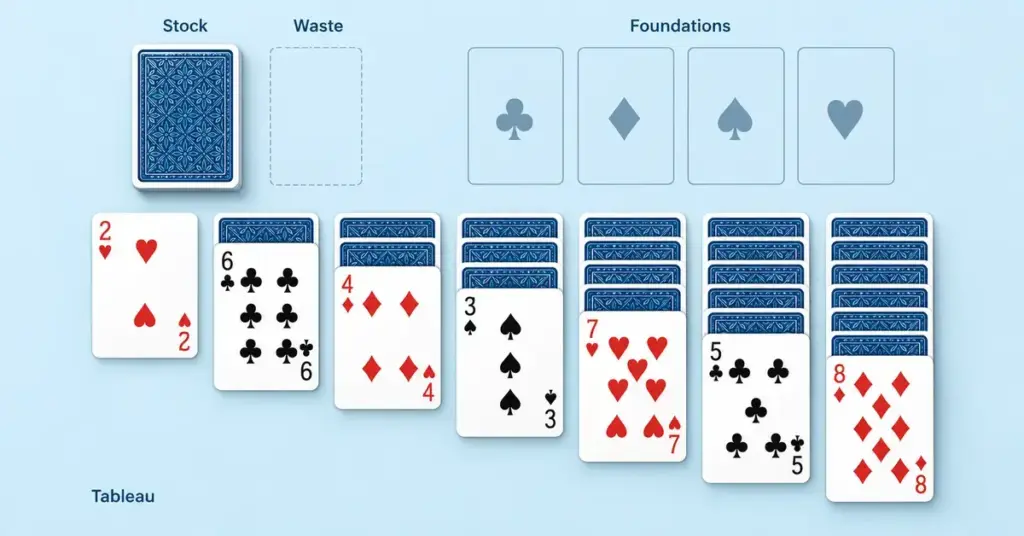
Klondike is the solitaire game most people picture when they hear the word “solitaire” at all — the single-player card game bundled with Windows for decades. One player uses a standard 52-card deck, dealing cards into a seven-column layout and trying to sort the whole deck into four tidy, suit-ordered piles. This guide explains the setup, the full rules, the Draw 1 and Draw 3 modes, your realistic chances of winning, and the mistakes that trip up most beginners. It focuses on how the game actually works; if you want deeper tactical play, see the dedicated Klondike strategy guide linked below.
Quick Facts
| Players | 1 (single-player) |
|---|---|
| Deck | Standard 52 cards, no jokers |
| Also known as | Solitaire, Patience, Canfield (historical US name) |
| Layout | 7 tableau columns, 4 foundations, stock and waste |
| Objective | Build all four suits up from Ace to King on the foundations |
| Common modes | Draw 1 (easier), Draw 3 (harder) |
| Typical length | Around 5–15 minutes per deal |
| Difficulty | Easy to learn; many deals are not winnable |
What Klondike solitaire is
Klondike is a “patience” game, the British term for solitaire card games played alone. The goal is to move all 52 cards onto four foundation piles, one per suit, each built in order from Ace up to King. You do this by rearranging cards across a tableau of seven columns and drawing extra cards from a face-down stock.
The name’s exact origin is uncertain. It is popularly linked to the 1890s Klondike Gold Rush in Canada’s Yukon, though card historians note there is no firm evidence for that story. In the United States the same game was long known as Canfield, after the gambler Richard Canfield, while in Britain it is simply one of many “patience” games. The reason almost everyone now calls it “Solitaire” is Microsoft: an intern named Wes Cherry wrote a version that shipped with Windows 3.0 in 1990, and that single game turned Klondike into one of the most-played card games in history.
Klondike belongs to a wide family of solitaire games that share the same deck and vocabulary but differ in layout and difficulty. If you enjoy the broader world of single-player card games, the overview of solitaire games is a useful starting point, and the complete guide to card game families and history puts patience games in context.
Setting up the game
You need one shuffled 52-card deck and a flat surface such as a table. Deal the tableau from left to right across seven columns:
- Column 1 gets 1 card, column 2 gets 2 cards, and so on up to column 7, which gets 7 cards — 28 cards in total.
- Only the top (last-dealt) card of each column is turned face up; every card beneath it stays face down.
- The remaining 24 cards form the stock, placed face down to one side.

Four empty spaces above the tableau are reserved for the foundations. The area where you turn stock cards face up is called the waste (or talon). Once the layout is clear, you are ready to play. The four zones you will work with are:
- Foundations: four piles built up by suit, from Ace to King. Completing all four wins the game.
- Tableau: the seven working columns, built down in alternating colours.
- Stock: the face-down reserve you draw from when the tableau offers no moves.
- Waste: the face-up pile next to the stock; only its top card is in play.
How to play: the core rules
Play alternates freely between moving cards around the tableau, sending cards up to the foundations, and drawing from the stock. There is no turn limit — you simply keep making legal moves until you either clear the deck or run out of options.
Building the tableau
Within the seven columns you build sequences downward in rank and in alternating colours. A red card must sit on a black card of the next rank up, and vice versa. For example, a red 7 (hearts or diamonds) can go onto a black 8 (spades or clubs), but not onto a red 8 or a black 9. You may move a single face-up card or an entire ordered run of face-up cards together, as long as the run lands on a card one rank higher and of the opposite colour.
Whenever you move the last face-up card off a column, flip the face-down card now on top so it becomes available. Uncovering these hidden cards is the whole point of tableau play — it is how you gain access to the cards you need. An empty column can only be filled by a King (or a run headed by a King), so a cleared column is valuable but also easy to waste.
Building the foundations
Each foundation starts with an Ace and is built up in suit order: Ace, 2, 3, and so on to King. There are four foundations, one for each suit (hearts, diamonds, spades, clubs). You can send a card to its foundation from the top of a tableau column or from the waste. Clearing all four foundations — every card from Ace to King in all four suits — is how you win.
It is tempting to rush every eligible card up to the foundations, but that can backfire: low cards are often needed in the tableau to receive other cards. Moving both red 2s up early, for instance, removes the only spots a black Ace could never use but that a 2 of the right colour could support beneath. Build the foundations steadily rather than greedily.
Using the stock and waste
When the tableau has no useful move, draw from the stock. Cards drawn from the stock land face up on the waste pile, and only the top waste card can be played — onto a foundation or a tableau column. When the stock runs out, you turn the waste back over to form a fresh stock and go through it again. Some scored or “Vegas” rule sets limit how many times you may recycle the stock; casual play usually allows unlimited passes.
Draw 1 versus Draw 3
Klondike is almost always played in one of two stock modes, and the choice changes the difficulty dramatically:
- Draw 1 (turn one): you flip one stock card at a time, so every card in the stock eventually reaches the top of the waste and can be played. This is the easier, more forgiving mode.
- Draw 3 (turn three): you flip three cards at once and may only play the top one of the three. Lower cards in each group of three become reachable only on later passes through the stock, so you have to plan which cards you cycle to and when.
The deck is identical in both modes, so the theoretical ceiling of winnable deals is similar. The practical difference is access: Draw 3 hides cards behind others and forces careful counting, which is why it feels much harder and is a favourite of experienced players.
Can every Klondike game be won?
No. Because the deck is shuffled at random, some deals are simply impossible to complete no matter how well you play — the order of the face-down cards locks you out. Exactly how many deals are winnable is a famously hard maths problem; the statistician Persi Diaconis has called the inability to calculate the odds precisely an embarrassment for the field.
The clearest estimate comes from “thoughtful” Klondike, a version where every card’s position is known in advance. Under those conditions, researchers estimate that roughly 80% of deals (around 82% for Draw 3) can be solved. In normal play, where cards are hidden, real win rates are much lower and vary widely with skill and draw mode — published figures range from the low tens of percent for Draw 1 down to around 10% or less for Draw 3. Treat any single percentage you see online with caution; most are rough, unverified estimates rather than official statistics.
Common beginner mistakes
- Emptying a column with no King ready. A cleared column you cannot refill is wasted space. Wait until a King is available before you finish clearing it.
- Rushing cards to the foundations. Low cards are often more useful in the tableau. Promote them only when you are sure they are not needed below.
- Ignoring the biggest piles. Columns with the most face-down cards are the biggest obstacles; prioritise moves that reveal cards there.
- Drawing from the stock too soon. Exhaust your tableau and waste options first, so you do not bury useful cards under fresh draws.
For a full walkthrough of planning several moves ahead, reading the board and improving your win rate, see our in-depth Klondike solitaire strategy guide.
How Klondike compares to other solitaire games
Klondike is the best-known patience game, but it is far from the only one. The games below use the same 52-card deck (TriPeaks and some others vary) yet feel completely different, so trying a few is the quickest way to find the style you enjoy.
Solitaire Game Comparison
| Game | Deck | Core idea | Relative difficulty |
|---|---|---|---|
| Klondike | 52 cards | Build foundations up by suit; tableau down in alternating colours | Moderate; luck-dependent |
| FreeCell | 52 cards | All cards dealt face up, with four free cells as temporary storage | Skill-based; almost all deals winnable |
| Spider | Two 52-card decks | Build same-suit runs King to Ace, then remove them | Hard (especially four-suit) |
| Pyramid | 52 cards | Remove pairs of cards that add up to 13 | Easy to moderate |
| TriPeaks | 52 cards | Clear three peaks by playing cards one rank above or below | Easy; fast-paced |
If Klondike’s reliance on the shuffle frustrates you, FreeCell is a good next step because nearly every deal is solvable with skill; if you prefer matching and clearing to sequence-building, Pyramid and TriPeaks are gentler, faster games.
Sources
Frequently asked questions (FAQ)
What is the goal of Klondike solitaire?
To move all 52 cards onto the four foundation piles, each built up by suit from Ace to King. Completing all four foundations wins the game.
How many cards are dealt into the tableau at the start?
Twenty-eight cards are dealt across seven columns, from one card in the first column up to seven in the last, with only the top card of each column face up. The remaining 24 cards form the stock.
What is the difference between Draw 1 and Draw 3?
In Draw 1 you turn over one stock card at a time, so every card becomes playable. In Draw 3 you turn three at once and may play only the top one, which makes the game noticeably harder.
Can any card be placed in an empty tableau column?
No. Only a King, or an ordered run of cards headed by a King, can be moved into an empty column.
Is every Klondike deal winnable?
No. Random shuffling means some deals cannot be completed whatever you do. Even with perfect play and full card knowledge, only around 80% of deals are solvable, and real win rates are lower.